
iPhone Screen Replacement Wholesale: Best Options for Repair Businesses

Searching for iPhone screen replacement wholesale options returns hundreds of suppliers, thousands of SKUs, and no clear answer to the actual question: which screens should your repair business buy?
The challenge isn't finding wholesale iPhone replacement screens — it's choosing the right combination of models, grades, and suppliers that matches your specific business. A mall kiosk doing quick repairs needs different screens than a premium shop offering same-day service on flagship iPhones. A solo technician starting out has different sourcing needs than a 3-location operation doing 40 repairs a day.
This guide cuts through the catalog noise and gives you specific recommendations based on your business type, customer base, and growth stage — so you buy the right iPhone screen replacements from the start, not after expensive trial-and-error.
Sourcing Replacement Screens in Bulk?
Incell / Hard OLED / Soft OLED grades — wholesale pricing, grade comparison on request.
Get Wholesale QuoteThe iPhone Screen Replacement Landscape in 2026
Before choosing specific products, understand what's available in the iPhone screen replacement wholesale market right now.
Four Replacement Tiers
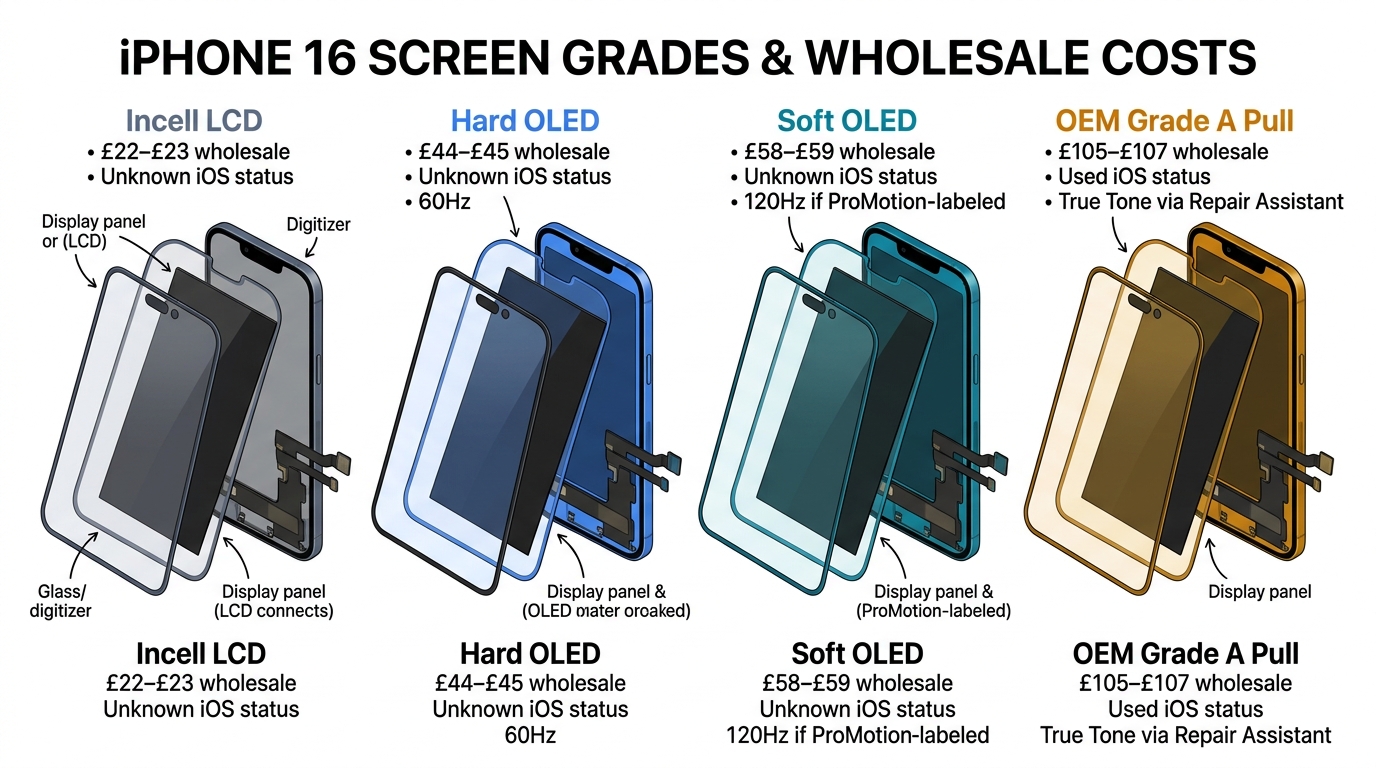
Every wholesale iPhone screen replacement falls into one of these tiers:
| Tier | Technology | Best For | Wholesale Price Range (iPhone 15) | Customer Perception |
|---|---|---|---|---|
| Budget | Incell LCD | Price-sensitive repairs, older models | $18–$22 | "It works, but I can tell it's different" |
| Mid-Range | Hard OLED | Standard repairs, best value | $28–$35 | "Looks good, close to original" |
| Premium | Soft OLED | Quality-focused repairs, Pro models | $42–$55 | "Can't tell the difference" |
| Original | OEM Refurbished | Customers requesting genuine parts | $55–$75 | "Same as Apple Store quality" |
The key insight most buyers miss: these tiers aren't just quality levels — they're different products for different customer segments. A shop that stocks only one tier is like a restaurant with one item on the menu. You'll satisfy some customers and lose the rest.
For detailed technical comparisons between these tiers, see our OLED vs Incell comparison guide.
What Models to Prioritize
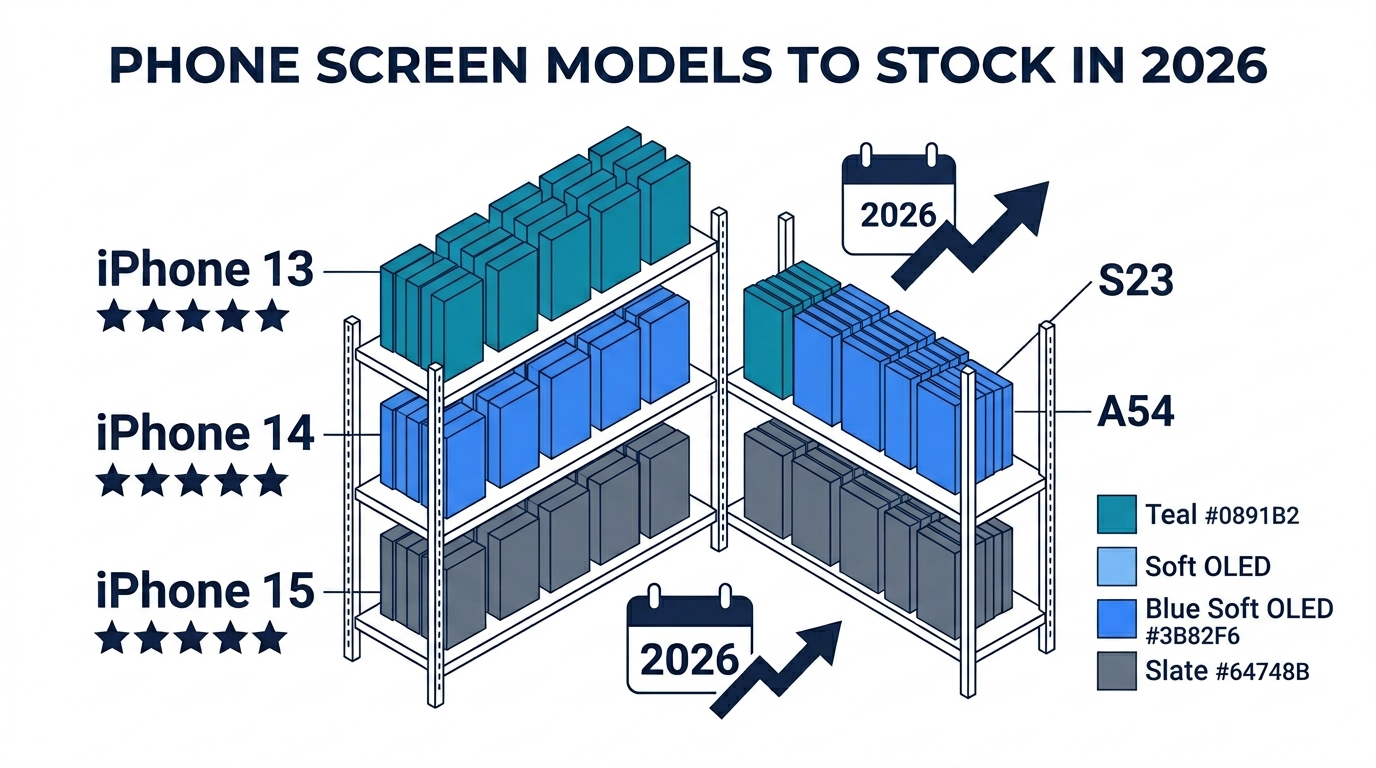
Your iPhone screen replacement wholesale budget should concentrate on models in their peak repair window — typically 12–30 months after launch. In Q2 2026:
- Peak demand: iPhone 15, iPhone 14 (warranties expiring, heavy usage)
- Strong demand: iPhone 15 Pro, iPhone 14 Pro (Pro users repair more, upgrade less)
- Declining: iPhone 13 (entering year 3, budget segment only)
- Emerging: iPhone 16 (still new, stock conservatively)
For the complete model-by-model breakdown with monthly order quantities, see our 2026 repair shop stocking guide.
Best iPhone Screen Replacement Options by Business Type
Your business model determines which wholesale options make sense. Here are specific recommendations for the three most common repair business types.
Type 1: Quick-Service Shop (Mall Kiosk, Walk-In Counter)
Profile: High foot traffic, price-conscious customers, 15–30 minute repair promise, 8–15 repairs per day.
Best wholesale iPhone screen replacement strategy:
| Model | Primary Grade | Secondary Grade | Why |
|---|---|---|---|
| iPhone 15 | Hard OLED | Incell (budget option) | Highest volume model. Hard OLED satisfies 80% of customers. |
| iPhone 14 | Hard OLED | Incell | Still strong demand. Same two-tier approach. |
| iPhone 13 | Incell only | — | Budget model. Customers choosing to repair a 3-year phone are price-sensitive. |
| iPhone 15 Pro | Soft OLED | Hard OLED | Pro customers expect quality. Soft OLED prevents complaints. |
| iPhone 14 Pro | Soft OLED | Hard OLED | Same logic as iPhone 15 Pro. |
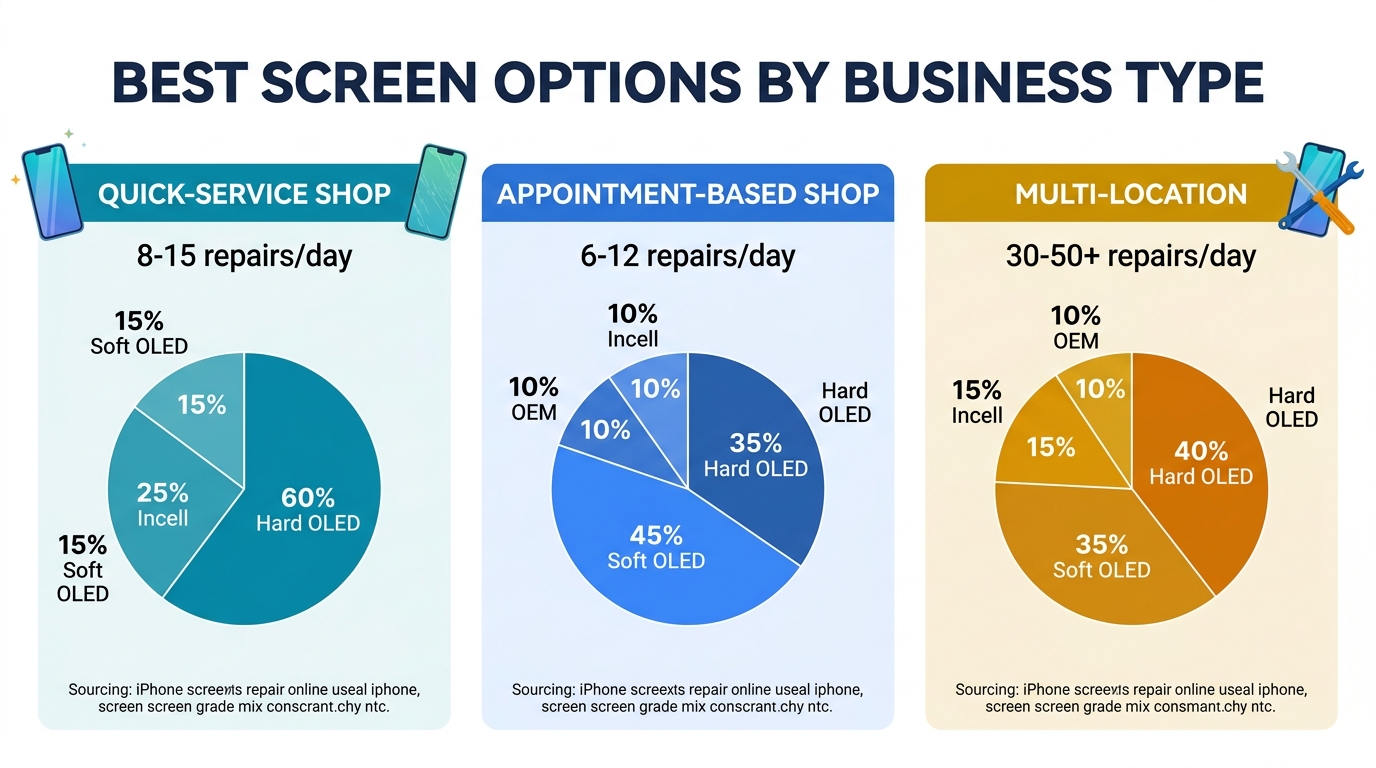
Grade split recommendation: 60% Hard OLED, 25% Incell, 15% Soft OLED
Sourcing approach: Domestic distributor as primary (next-day restocking matters when you can't afford stockouts), China direct for planned monthly bulk orders on your top 3 models. The speed premium you pay to a domestic supplier is worth it when an empty display case means lost walk-in customers.
Type 2: Appointment-Based Repair Shop (Standalone Location)
Profile: Scheduled repairs, relationship-driven customers, 45–90 minute service window, 6–12 repairs per day, higher average ticket.
Best wholesale iPhone screen replacement strategy:
| Model | Primary Grade | Premium Upsell | Why |
|---|---|---|---|
| iPhone 15 | Soft OLED | OEM Refurbished | Your customers value quality over speed. Lead with Soft OLED, upsell OEM. |
| iPhone 14 | Hard OLED | Soft OLED | Mid-tier default with premium option. |
| iPhone 15 Pro / Pro Max | Soft OLED | OEM Refurbished | Pro owners spending $1,000+ on a phone expect the best repair. |
| iPhone 14 Pro | Soft OLED | — | Solid demand, one grade is sufficient. |
| iPhone 13 | Hard OLED | — | Budget repairs still come in. Hard OLED keeps quality acceptable. |
Grade split recommendation: 45% Soft OLED, 35% Hard OLED, 10% OEM Refurbished, 10% Incell
Sourcing approach: China direct for 70% of volume (your appointment model gives you the planning time to work with international lead times). Domestic distributor for 20% emergency restocks. Specialized OEM refurbishment supplier for the 10% premium tier. For China sourcing logistics, see our guide on paying a China phone parts supplier.
Type 3: Multi-Location / High-Volume Operation
Profile: 3+ locations, centralized purchasing, 30–50+ total daily repairs, technician teams, established brand.
Best wholesale iPhone screen replacement strategy:
At this scale, your iPhone screen replacement wholesale strategy needs three levels:
-
Core inventory (China direct, 70% of budget): Top 5 models × 2 grades each = 10 SKUs. Monthly orders of 300–500+ screens. This is where your margin advantage lives — at 300+ units/month, China direct pricing saves $3,000–$6,000/month versus domestic-only sourcing.
-
Fast restock (domestic distributor, 20% of budget): Same top 5 models, one grade each. Weekly orders to cover gaps between monthly China shipments. Accept the 20–30% price premium for speed.
-
Premium tier (OEM specialist, 10% of budget): iPhone 15 and 15 Pro OEM Refurbished only. Low volume, high margin. These are your $180–$220 repairs that boost average ticket across all locations.
Grade split recommendation: 40% Hard OLED, 35% Soft OLED, 15% Incell, 10% OEM Refurbished
Centralized purchasing tip: One person negotiates with suppliers and places orders. Each location tracks its own usage data and submits reorder requests weekly. This prevents Location A from hoarding iPhone 15 screens while Location B runs out.
For supplier evaluation at this scale, use our 6-point supplier scoring framework.
Building Your iPhone Screen Replacement Menu
The most profitable repair businesses don't just stock screens — they build a structured repair menu that guides customers toward higher-value options. Here's how to design yours.
The Three-Tier Repair Menu
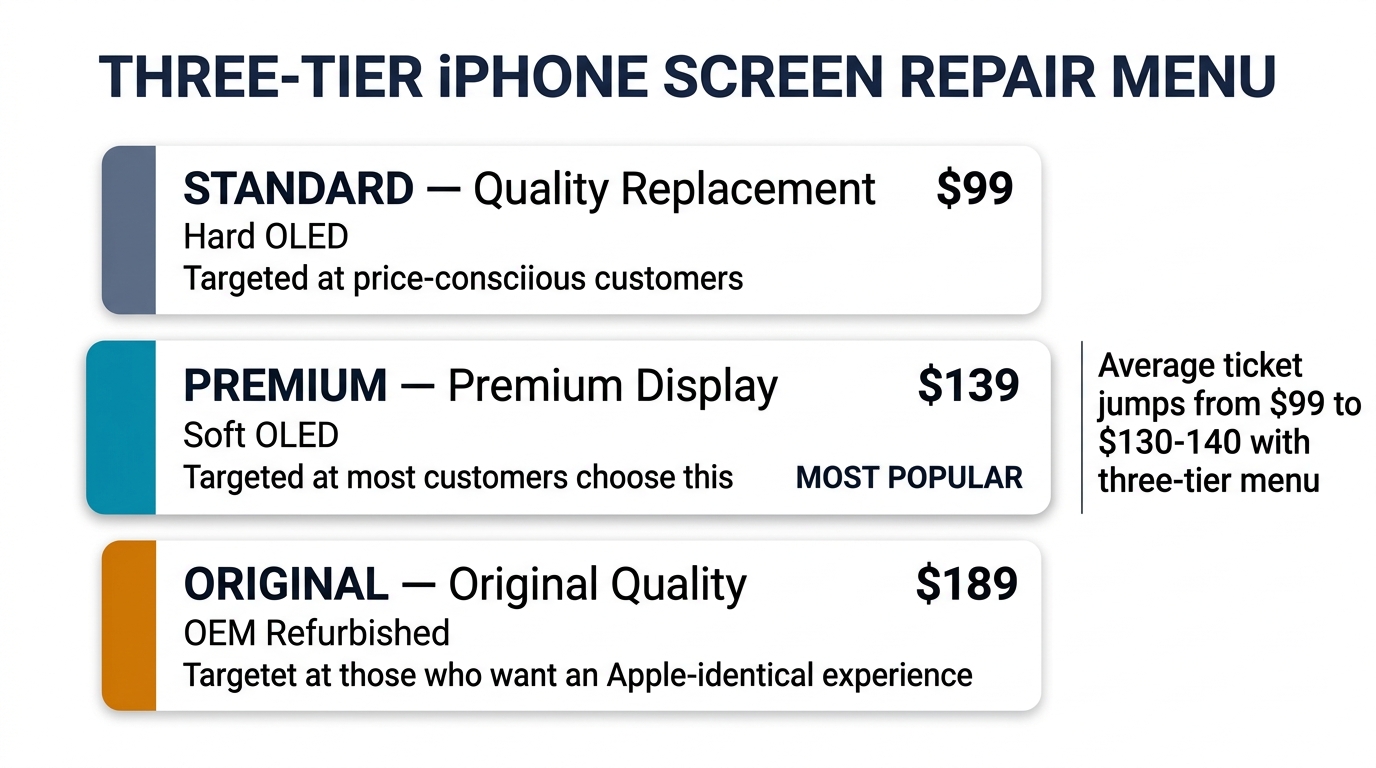
Present customers with three options for every iPhone screen replacement. This is the same pricing psychology restaurants and SaaS companies use — and it works because it shifts the decision from "should I repair?" to "which repair level?"
| Tier | What You Call It | What It Is | Example Price (iPhone 15) | Target Customer |
|---|---|---|---|---|
| Standard | "Quality Replacement" | Hard OLED screen | $99 | Price-conscious, just wants it fixed |
| Premium | "Premium Display" | Soft OLED screen | $139 | Wants quality, willing to pay more |
| Original | "Original Quality" | OEM Refurbished | $189 | Wants identical-to-Apple experience |
Why three tiers work: Research consistently shows that when given three options, most customers choose the middle one. Your Premium tier becomes the default, not the upsell. This naturally pushes your average repair ticket higher without aggressive selling.
What to say at the counter: "We have three options for your iPhone 15 screen. Standard is $99 — it's a quality screen, works perfectly. Premium is $139 — uses the same OLED technology as the original, most customers can't tell the difference. And Original Quality is $189 — that's an actual refurbished Apple display panel. Which works best for you?"
Most customers pick Premium. Some pick Original. Few pick Standard. Your average ticket goes from $99 (if you only offered one option) to $130–$140 with the three-tier menu.
Pricing Your Tiers for Maximum Profit
The gap between tiers matters more than the absolute price. Follow this pricing structure:
- Standard to Premium gap: $30–$50 (large enough to signal quality difference, small enough that Premium feels like an easy upgrade)
- Premium to Original gap: $40–$60 (larger gap signals genuine premium, but Original is still positioned as reasonable compared to Apple Store pricing at $279+)
For complete repair pricing strategies including competitive analysis, see our phone screen repair pricing guide.
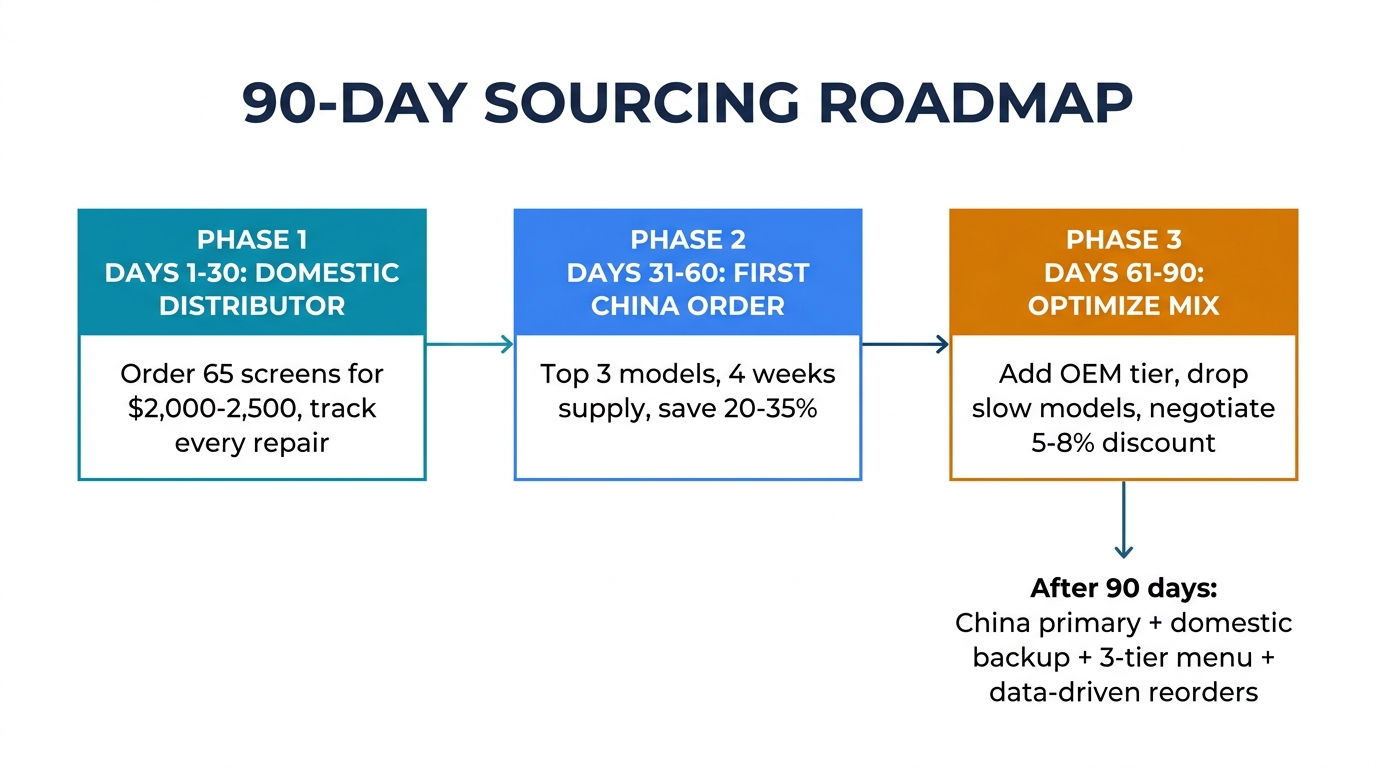
Your First 90 Days: iPhone Screen Replacement Wholesale Sourcing Roadmap
Whether you're opening a new repair shop or switching from retail-priced parts to wholesale, here's a structured plan to get your sourcing optimized within 90 days.
Days 1–30: Start with a Domestic Distributor
Why: You need screens now, not in 2–3 weeks. A domestic distributor ships in 1–3 days.
What to order:
- 20 units iPhone 15 Hard OLED
- 20 units iPhone 14 Hard OLED
- 10 units iPhone 15 Pro Soft OLED
- 10 units iPhone 13 Incell
- 5 units iPhone 14 Pro Soft OLED
Total: ~65 screens, ~$2,000–$2,500
What to track: Log every repair — model, grade used, repair charge, customer reaction, any callbacks. This data drives every decision in the next 60 days.
Days 31–60: Place Your First China Direct Order
Why: You now have 30 days of repair data showing exactly which models and grades move fastest.
What to order: Your top 3 models by installation volume, 4 weeks of supply per model, from a China-based supplier. Use the 4-week rolling reorder formula to calculate exact quantities.
Expected savings: 20–35% per unit versus your domestic distributor pricing. On a $2,000 order, that's $400–$700 saved — money that goes straight to your bottom line.
Keep your domestic distributor active for emergency restocks and models you don't order in bulk from China.
Days 61–90: Optimize Your Mix
By day 60, you know:
- Which models sell fastest (adjust quantities)
- Which grades customers prefer (adjust tier mix)
- Whether your three-tier menu is working (check average ticket)
- Whether your China direct supplier's quality matches samples (if not, try a second supplier)
What to optimize:
- Add OEM Refurbished screens for your top 2 models if customers ask about "original" options
- Drop any model where you installed fewer than 5 screens in 30 days — order on-demand instead
- Negotiate better pricing with your China supplier based on your first 2 months of order history. Showing consistent monthly volume is the fastest way to unlock 5–8% discounts
After 90 days, you should have: a primary China supplier for planned inventory, a domestic backup for urgent restocks, a three-tier repair menu generating $120–$140 average tickets, and data-driven reorder quantities. For ongoing inventory management, review our wholesale iPhone screens buyer checklist quarterly.
5 Mistakes That Cost Repair Businesses Money on iPhone Screen Replacement Wholesale
Mistake 1: Buying the Cheapest Screens Available
A $12 Incell screen from an unknown supplier saves you $6 per unit versus a $18 Incell from a tested supplier. On 100 screens, that's $600 saved. But if the cheap screens have a 6% defect rate instead of 3%, you're spending $720 extra on replacements and re-repairs — plus losing customers who don't come back after a bad experience. Always calculate total cost per successful repair, not just unit price.
Mistake 2: Stocking Only One Grade
Single-grade shops leave money on the table. If you only stock Hard OLED and a customer wants premium quality, you either lose the repair or underdeliver on their expectations. Stocking two grades per model (Hard OLED + Soft OLED for current models) adds 4–6 SKUs but can increase your average repair ticket by $20–$40.
Mistake 3: Ordering Based on Supplier Promotions Instead of Demand
"iPhone 12 screens are 40% off this month!" Great — except your iPhone 12 repair volume has been declining for 6 months. Supplier promotions clear their slow-moving stock, not yours. Only buy what your repair data says you'll install within 4–6 weeks, regardless of discounts. For a deep dive on avoiding overstock, see our inventory management guide.
Mistake 4: Ignoring IC Chip Specifications
Two iPhone 15 Hard OLED screens can look identical and have completely different IC chips. A screen with BOE IC supports True Tone transfer and shows fewer iOS compatibility warnings. A screen with generic IC may lose True Tone and trigger part-pairing notifications. Always confirm the IC chip with your supplier — "Hard OLED" is not a complete specification. See our wholesale iPhone screens grades and pricing guide for IC chip details by model.
Mistake 5: No Quality Verification Process
Skipping incoming QC means you discover defective screens during installation — wasting 15–30 minutes of technician time per failed screen, plus the customer's patience. A 60-second per-screen check (power on, touch test, dead pixel scan) catches 80% of defects before they reach the repair bench. For a complete QC workflow, see our incoming QC guide.
Frequently Asked Questions
What's the best iPhone screen replacement grade for wholesale buyers?
Hard OLED is the best starting point for most repair businesses. It offers the strongest balance of cost ($28–$35 wholesale for iPhone 15), customer satisfaction (OLED display quality is noticeably better than Incell), and defect rates (2–3%, lower than Incell's 3–4%). Once you have consistent volume, add Soft OLED as a premium tier and Incell as a budget option — but Hard OLED should be your default grade for standard repairs.
How much does iPhone screen replacement cost wholesale versus retail?
Wholesale pricing is 40–70% below retail parts pricing. An iPhone 15 Hard OLED screen costs $28–$35 wholesale (depending on supplier and volume) versus $80–$120 if purchased as a single retail unit. The savings scale with volume — at 50+ units per order, most wholesale suppliers offer an additional 3–8% discount. This margin difference is what makes the repair business viable at competitive repair pricing.
Should I buy iPhone screen replacements from China or a US distributor?
Both, in sequence. Start with a US distributor for immediate inventory needs (1–3 day shipping, easy returns). Once you have 30+ days of repair data showing which models sell, place your first China direct order for those specific models. China pricing is 20–40% lower than US distributors. The hybrid approach gives you speed when you need it and savings on planned inventory. For detailed channel comparison with profit numbers, see our wholesale phone screens sourcing channel guide.
How many iPhone screen replacements should I order for my first wholesale purchase?
For a new repair shop, start with 60–80 screens across your top 5 models. Allocate roughly: 25% iPhone 15, 25% iPhone 14, 15% iPhone 15 Pro, 15% iPhone 13, 10% iPhone 14 Pro, 10% buffer for other models. This supports 3–4 weeks of repairs for a shop doing 5–8 daily. Total investment: $2,000–$2,800. Don't over-order your first time — your repair data from month one will tell you exactly what to buy more of in month two.
Is OEM Refurbished iPhone screen replacement worth the premium at wholesale?
For select models and as an upsell option, yes. OEM Refurbished screens for iPhone 15 cost $55–$75 wholesale and support repair pricing of $180–$220. That's $110–$150 profit per repair — higher absolute profit than any aftermarket grade. But stock them for your top 2 models only (iPhone 15 and 15 Pro), and position them as the premium tier in a three-option repair menu. Supply is inconsistent and per-unit cost is high, so OEM Refurbished works as an upsell, not a default.
Choose the Right iPhone Screen Replacements for Your Business
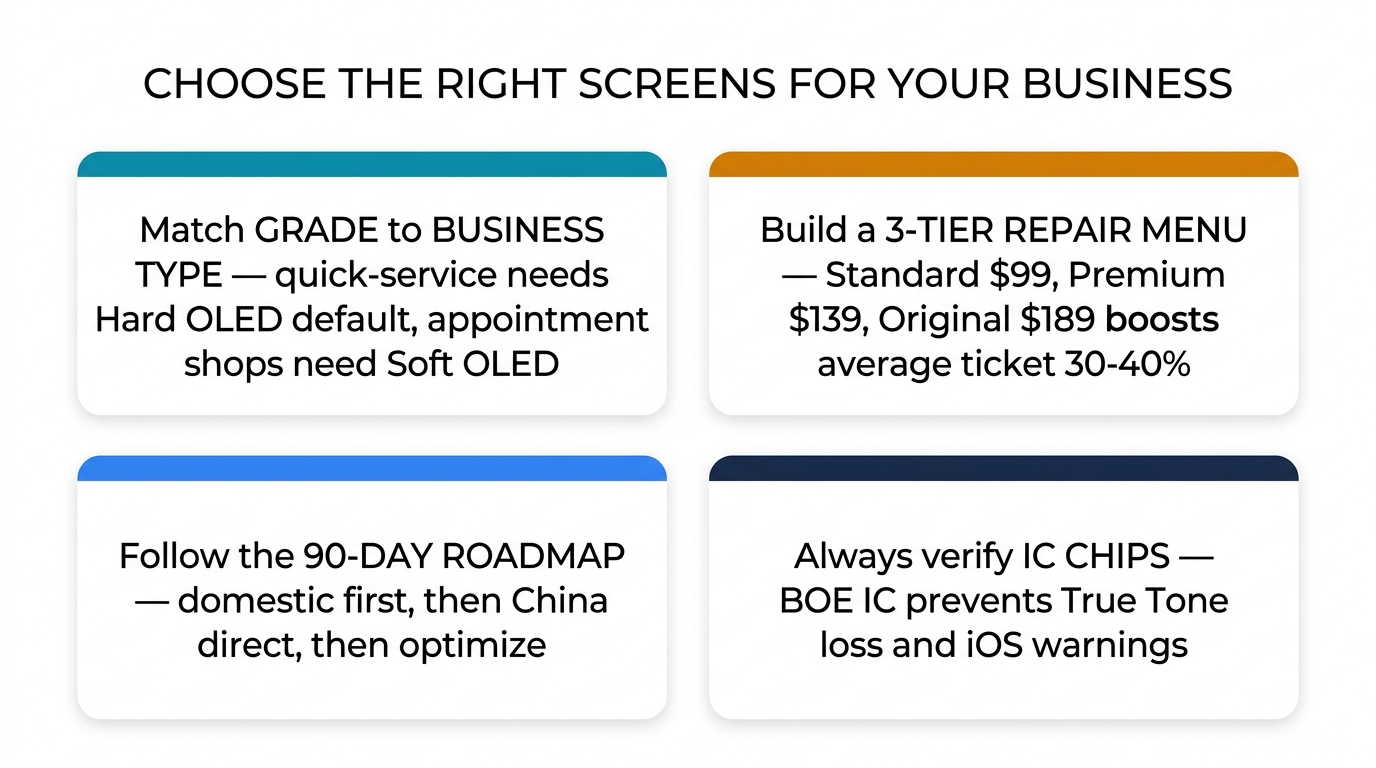
The best iPhone screen replacement wholesale strategy isn't the one with the lowest per-unit cost — it's the one that matches your business type, customer expectations, and growth stage. Quick-service shops need speed and two-tier simplicity. Appointment-based shops need quality and three-tier upsell potential. Multi-location operations need centralized sourcing with scale pricing.
Start with the recommendations for your business type, build your three-tier repair menu, and follow the 90-day roadmap to optimize your sourcing. The difference between a well-structured wholesale strategy and a random one is $2,000–$5,000 per month in additional profit — real money that compounds as your repair business grows.
Ready to source iPhone screen replacements at wholesale pricing? Tell us your business type, daily repair volume, and top models. We'll recommend the exact grades, quantities, and pricing for your situation — with samples to verify quality before you commit to bulk orders.
Request Wholesale Pricing — include your model list and daily volume for a customized quote within 24 hours.
Related reading: