
iPhone Screens Wholesale: Soft OLED vs Hard OLED vs Incell for Bulk Buyers

Ordering iPhone screens wholesale means choosing between three aftermarket grades — and the right answer changes depending on which iPhone model you're buying for. A Soft OLED that makes perfect sense for iPhone 15 Pro might be overkill for iPhone 12. An Incell that works fine on iPhone 11 will generate complaints on iPhone 14 Pro Max.
Most comparison guides explain what each technology is. This one tells you which grade to order for which model, how each grade performs after iOS updates, and where the supply chain is stable versus unreliable in 2026. If you're placing a bulk order this month, this is the comparison that matters.
Sourcing Replacement Screens in Bulk?
Incell / Hard OLED / Soft OLED grades — wholesale pricing, grade comparison on request.
Get Wholesale QuoteThe Three Grades: What Bulk Buyers Actually Need to Know
You've seen the basic definitions before. Here's what matters specifically when buying iphone screens wholesale in volume — the specs that affect your return rate, your repair workflow, and your reorder frequency.
Soft OLED
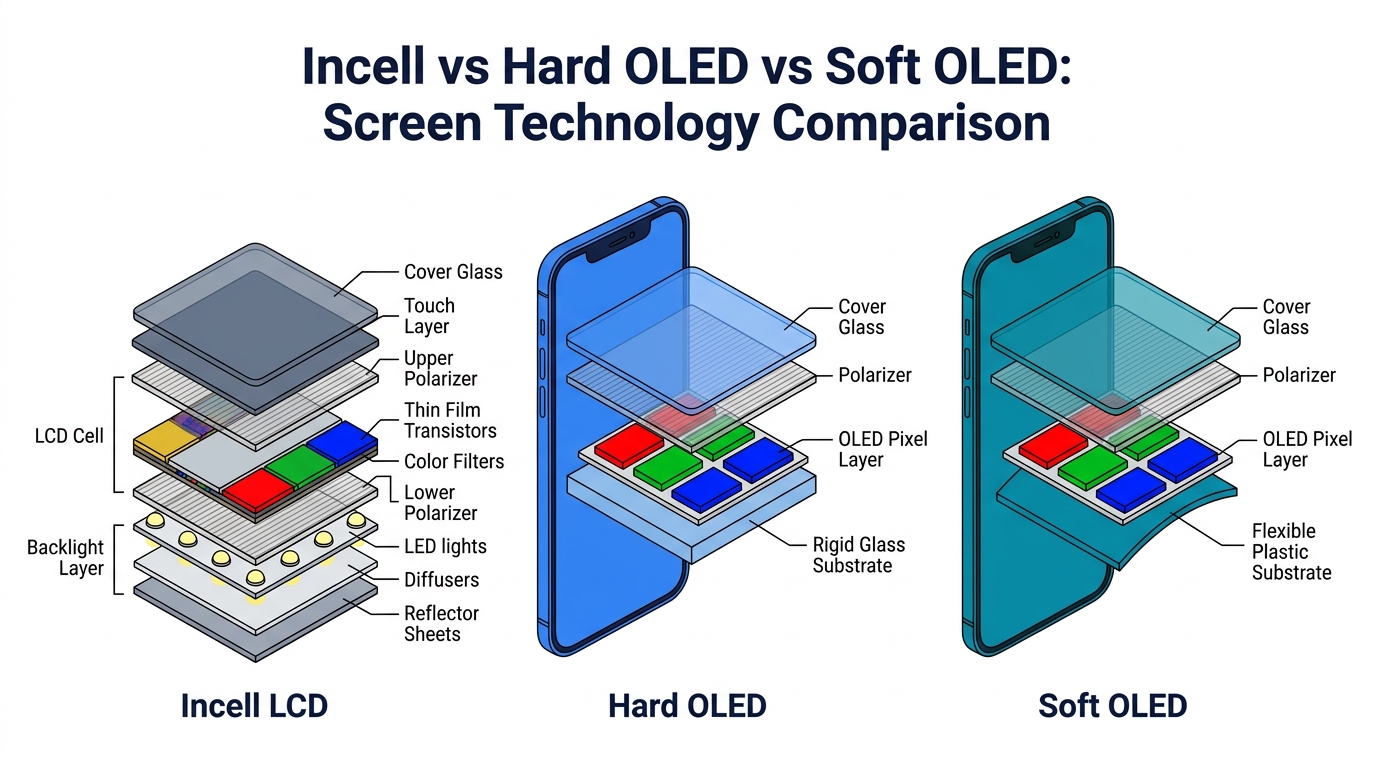
Soft OLED uses a flexible organic panel on a plastic substrate — the same technology Apple uses in original iPhone displays. The panel bends slightly, which allows thinner screen assemblies and better edge-to-edge fit.
What bulk buyers care about:
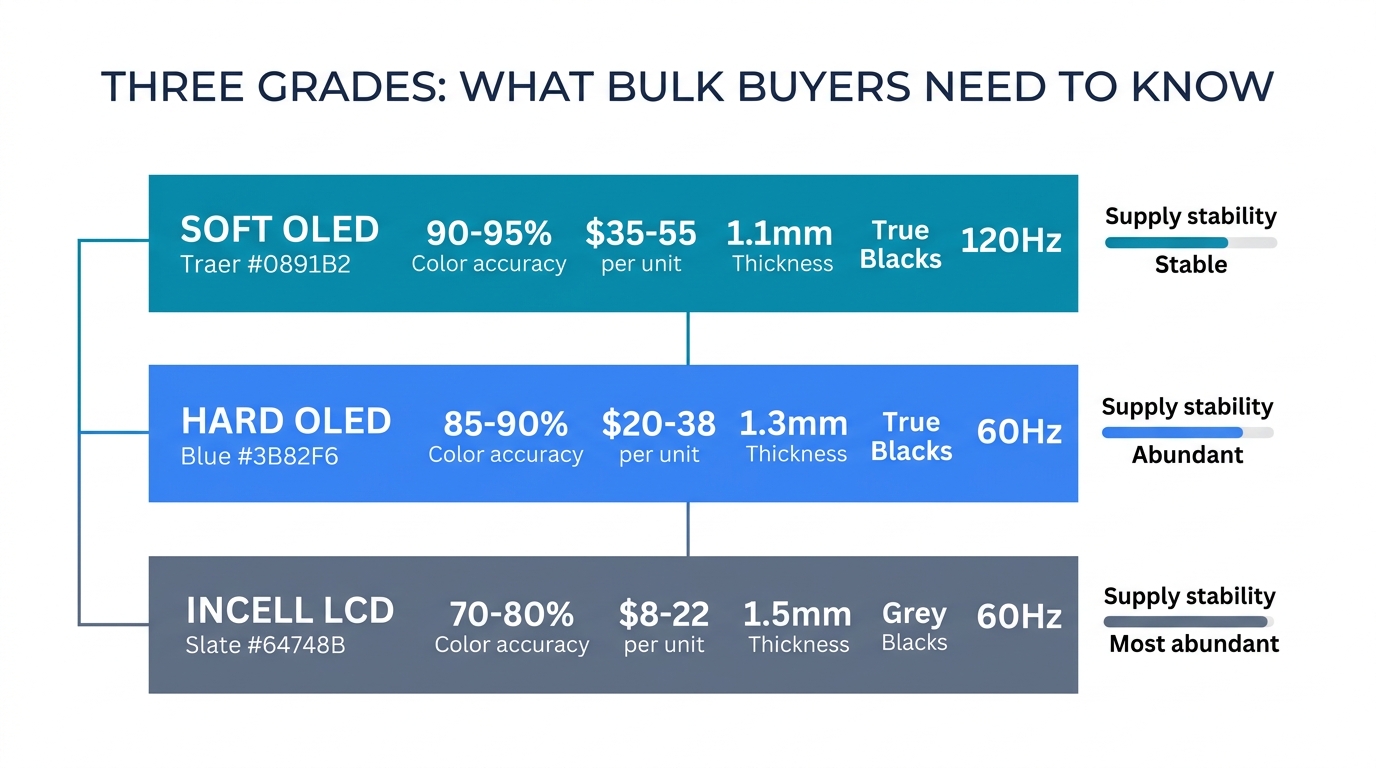
- Closest to original quality — 90–95% color accuracy, true blacks, smooth 120Hz support on Pro models
- Thinnest assembly (~1.1mm) — installs flush without frame modifications
- Best iOS compatibility — fewer touch and display issues after updates
- Highest unit cost — $35–$55 depending on model (FOB Shenzhen)
- Supply stability: Consistent from tier-1 manufacturers. Lead time 5–10 days for standard models
Hard OLED
Hard OLED uses a rigid glass substrate instead of flexible plastic. The OLED light-emitting layer is the same technology, but the rigid backing makes the assembly thicker and slightly less color-accurate.
What bulk buyers care about:
- Good quality at mid-range price — 85–90% color accuracy, true blacks, adequate brightness
- Slightly thicker (~1.3mm) — fits most frames but may require adhesive adjustment on some models
- Good iOS compatibility — occasional touch sensitivity issues on iPhone 14 Pro and newer after major updates
- Unit cost — $20–$38 depending on model
- Supply stability: Abundant supply, multiple manufacturers. Rarely out of stock for any model
Incell LCD
Incell integrates the touch sensor directly into the LCD panel — no separate touch layer. This isn't OLED at all. It's an LCD replacement for phones that originally shipped with OLED screens.
What bulk buyers care about:
- Lowest cost option — $8–$22 depending on model
- Visible quality difference — 70–80% color accuracy, grey blacks instead of true black, lower brightness
- Thickest assembly (~1.5mm) — may not sit perfectly flush on all models
- Variable iOS compatibility — most affected by iOS updates, especially touch responsiveness
- Supply stability: Most abundant. Multiple manufacturers at every price tier. Never out of stock
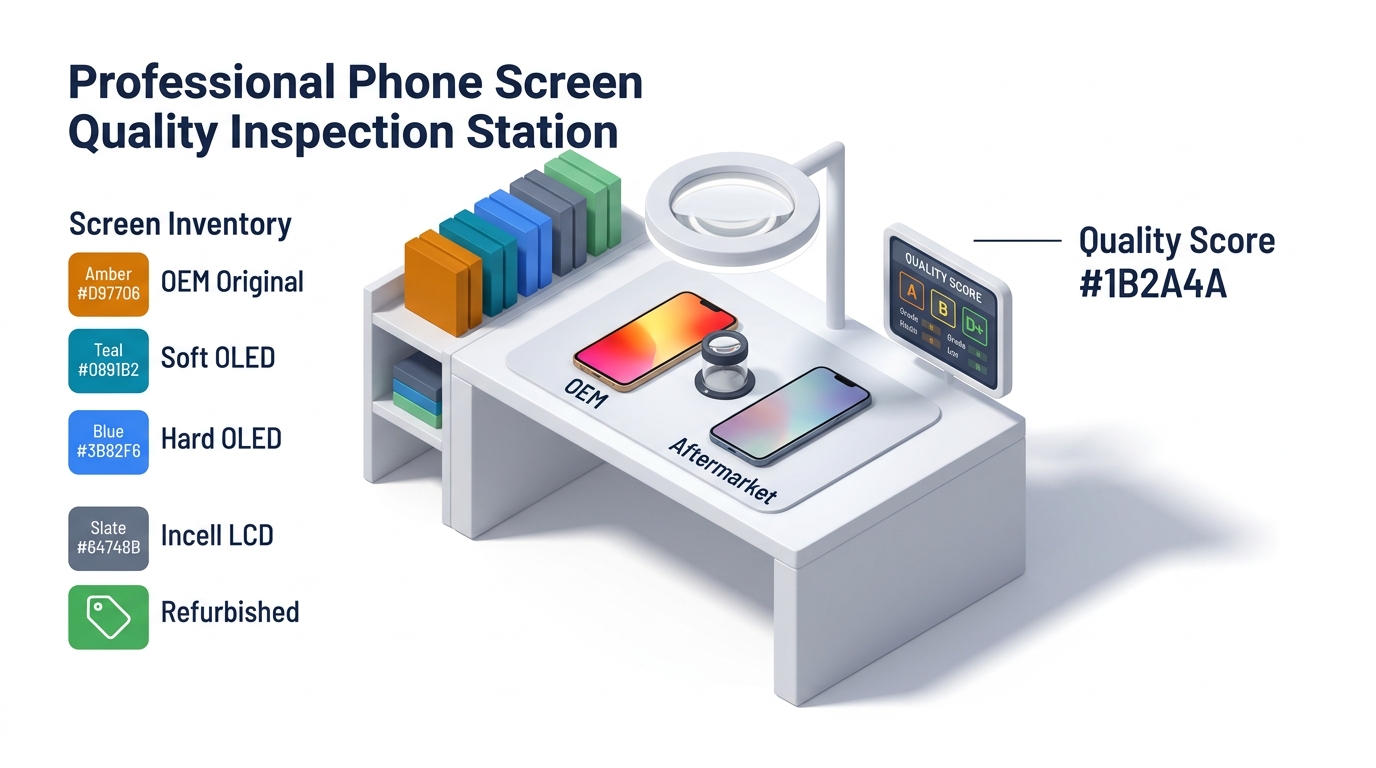
For a full breakdown of how these grades compare to OEM and refurbished options, see our OEM vs aftermarket phone screens guide.
Model-by-Model Grade Recommendations for iPhone Screens Wholesale
This is the table most buyers are actually looking for. Instead of a generic "Soft OLED is best," here's which grade delivers the best value for each iPhone generation when buying wholesale.
Current High-Demand Models (2026)
| iPhone Model | Recommended Grade | Why | Avoid |
|---|---|---|---|
| iPhone 16 Pro / Pro Max | Soft OLED | ProMotion 120Hz requires flexible panel. Hard OLED can't match refresh rate smoothness | Incell — 60Hz cap is immediately noticeable |
| iPhone 16 / 16 Plus | Hard OLED or Soft OLED | Standard 60Hz display. Hard OLED performs well here | Incell — still early in model lifecycle, customers expect quality |
| iPhone 15 Pro / Pro Max | Soft OLED | Same 120Hz rationale as 16 Pro. Price has normalized | Incell — ProMotion mismatch is obvious |
| iPhone 15 / 15 Plus | Hard OLED | Best value. Customers accept good-quality OLED at mid-range repair price | — |
| iPhone 14 Pro / Pro Max | Soft OLED preferred, Hard OLED acceptable | ProMotion display, but model is aging — more price-conscious customers | — |
| iPhone 14 / 14 Plus | Hard OLED | Standard model, maturing price. Hard OLED is the profit sweet spot | — |
Older Models Still in Repair Demand
| iPhone Model | Recommended Grade | Why | Notes |
|---|---|---|---|
| iPhone 13 / 13 mini | Hard OLED or Incell | Customer base is increasingly budget-conscious. Incell works for price-driven repairs | Offer both: Incell for budget, Hard OLED for quality |
| iPhone 13 Pro / Pro Max | Hard OLED | ProMotion model but aging — Soft OLED margin is harder to justify | Soft OLED still fine if your shop charges premium |
| iPhone 12 / 12 mini | Incell or Hard OLED | Three-year-old model. Most repairs are budget jobs | Hard OLED only if you charge $80+ for this repair |
| iPhone 12 Pro / Pro Max | Hard OLED | OLED original — Incell quality gap is too wide for Pro customers | — |
| iPhone 11 / XR | Incell (LCD original) | These are LCD phones originally. Incell is the natural match | N/A — no OLED option needed |
| iPhone X / XS / 11 Pro | Incell or Hard OLED | Aging models with declining volume. Stock lean | Don't overstock — demand drops quarterly |
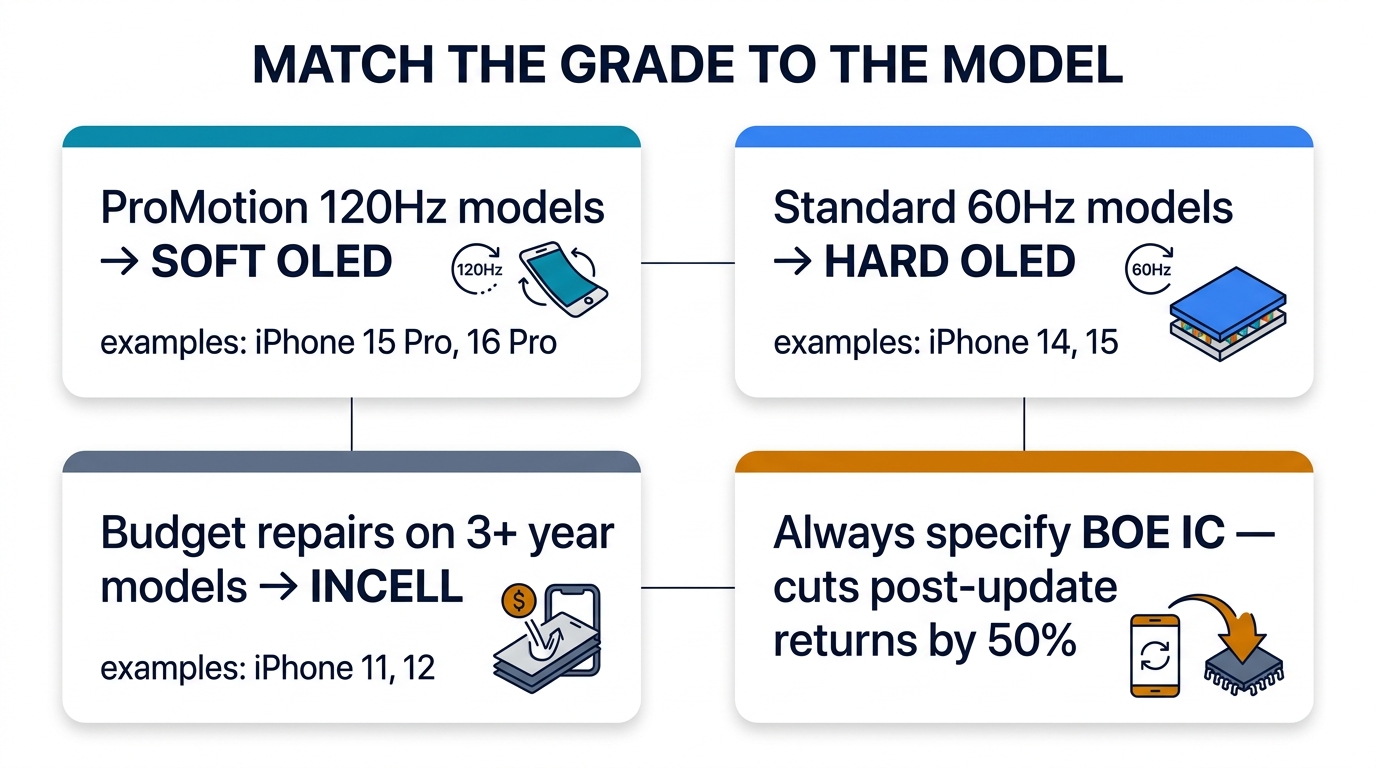
Key pattern: ProMotion (120Hz) models should always get Soft OLED. Standard 60Hz models work well with Hard OLED. Models 3+ years old can take Incell unless the customer pays premium.
Exception: iPhone 13 mini and iPhone 12 mini have lower repair volume but higher per-unit value because screens are harder to source. For mini models, Hard OLED is usually the safest bet — enough demand to justify stocking, but not enough to warrant carrying both grades.
The iOS Compatibility Factor: Which Grade Survives Updates
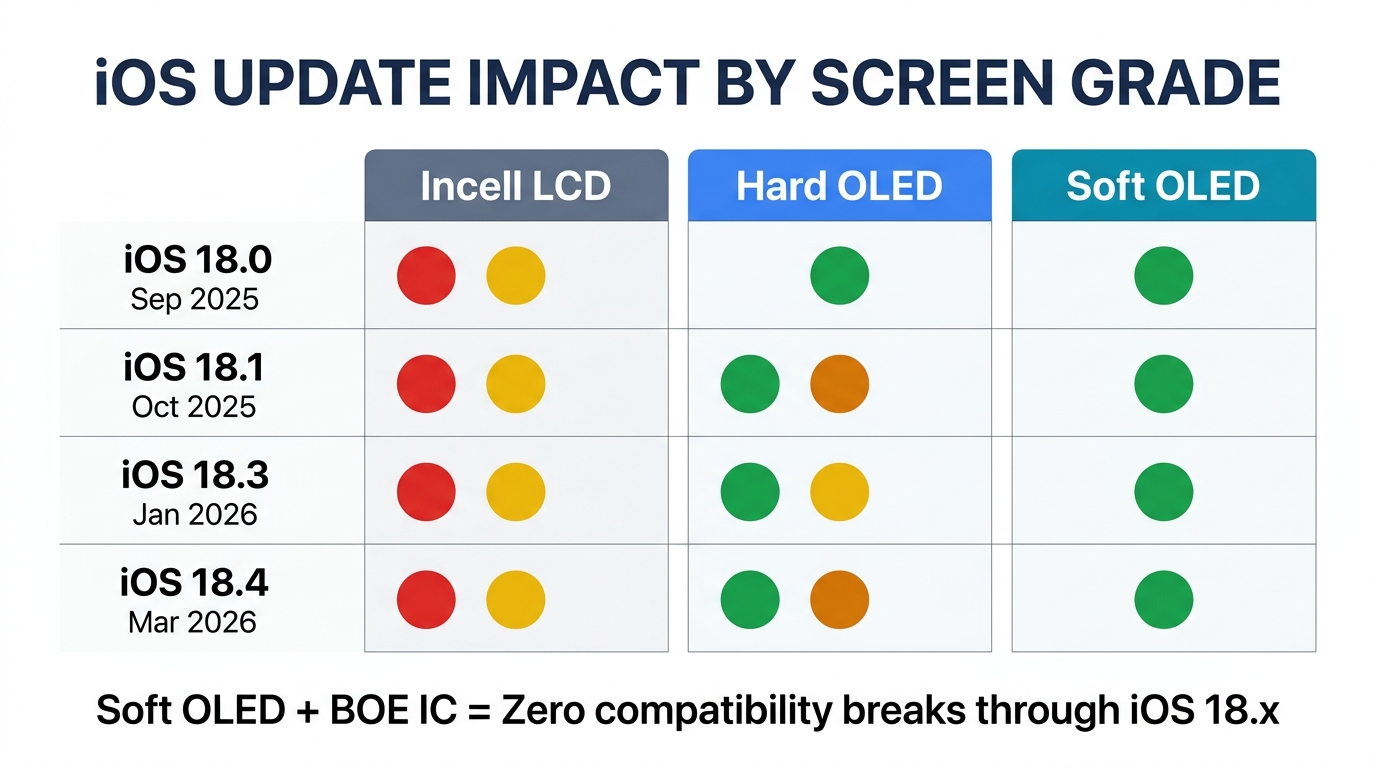
This is the comparison no competitor article covers — and it's the one that determines your return rate after every iOS release.
Apple's iOS updates occasionally break aftermarket screen compatibility. The severity varies by grade and IC chip combination. Here's the track record based on reported issues from the repair community through early 2026:
iOS Update Impact by Grade
| iOS Update | Incell Impact | Hard OLED Impact | Soft OLED Impact |
|---|---|---|---|
| iOS 18.0 (Sep 2025) | Touch lag on iPhone 14+ with generic IC | Minor brightness calibration shift on some models | No significant issues |
| iOS 18.1 (Oct 2025) | Fixed most 18.0 touch issues | No new issues | No issues |
| iOS 18.3 (Jan 2026) | True Tone display warning added for unregistered ICs | Occasional auto-brightness malfunction | No significant issues |
| iOS 18.4 (Mar 2026) | Pending — monitor | Pending | Pending |
What this means for wholesale orders:
-
Soft OLED has the best update survival rate. Flexible OLED panels with BOE IC chips have had zero significant compatibility breaks through iOS 18.x. This is because Soft OLED more closely replicates original display signal protocols.
-
Hard OLED is generally stable but occasionally hits minor calibration issues. These usually self-resolve or get patched in the next iOS point release. Not a deal-breaker for most buyers.
-
Incell is the most vulnerable. LCD technology on an OLED-native phone creates more signal translation, which gives Apple's software more opportunities to detect and flag the non-original display. Generic IC chips make this worse.
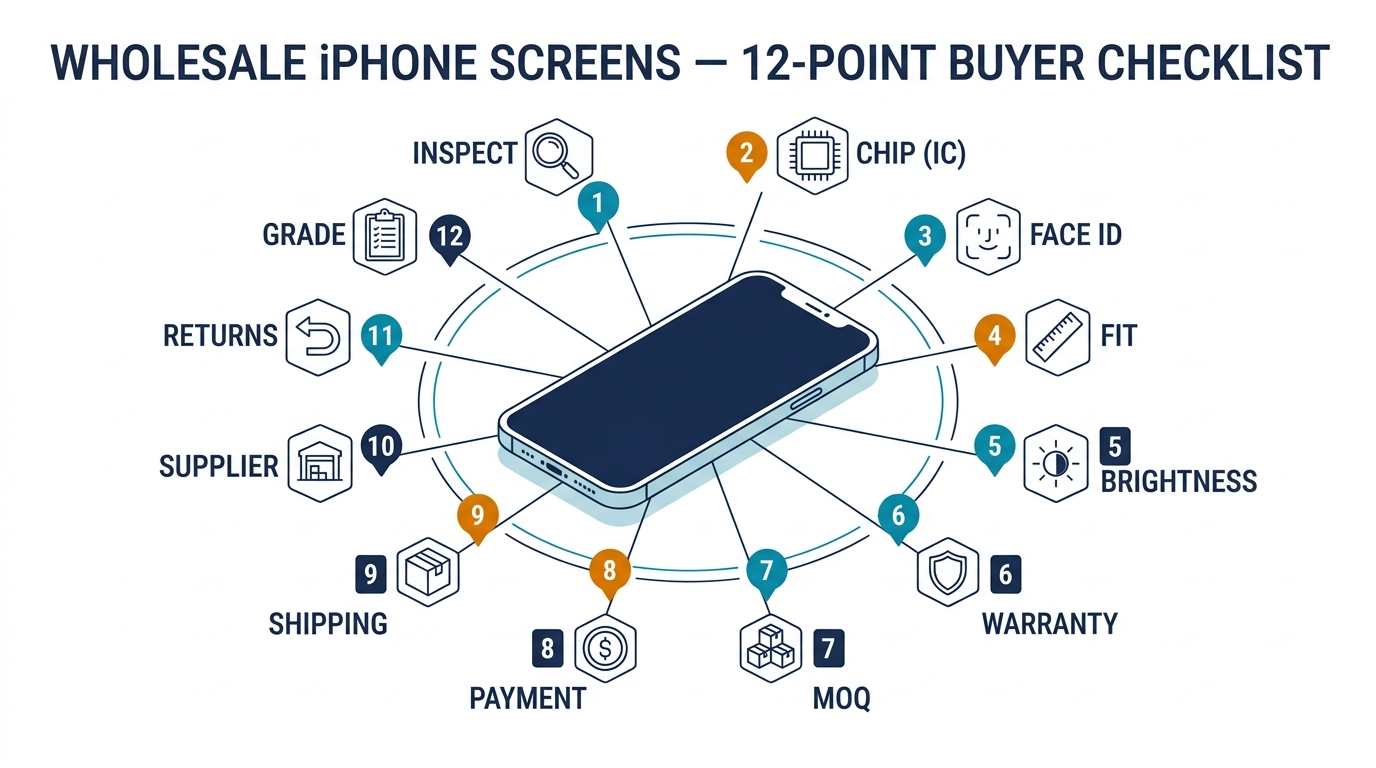
Practical advice: If you stock Incell for iPhone 12 and newer, always specify BOE IC — the $2–3 premium per unit cuts your post-update return rate roughly in half. For detailed IC chip specifications, see our wholesale iPhone screens buyer checklist.
Not sure which IC chip your current supplier uses? Send us your supplier's quote and model list — we'll help you identify the IC specs and flag potential compatibility risks. Get a free quote comparison.
Supply Chain Realities: What's Available and What's Backordered
Grades aren't just about quality — they're about whether you can actually get them when you need them. Supply availability varies significantly by grade and model in 2026.
Supply Stability by Grade
| Grade | Supply Status (Q1 2026) | Typical Lead Time | Risk Factor |
|---|---|---|---|
| Soft OLED | Stable for iPhone 13–15. Tight for iPhone 16 Pro Max | 5–10 days (standard), 15–20 days (iPhone 16 PM) | New model availability |
| Hard OLED | Abundant across all models | 3–7 days | Lowest risk |
| Incell | Abundant, multiple price tiers | 3–5 days | Almost zero risk |
Current Supply Bottlenecks (March 2026)
- iPhone 16 Pro Max Soft OLED: Demand exceeds production capacity. Only 2–3 tier-1 manufacturers have reliable output. Expect 15–20% premium over standard pricing and longer lead times.
- iPhone 15 Pro Soft OLED: Fully normalized. Multiple suppliers, competitive pricing. Best value in the Soft OLED category right now.
- iPhone 12 Hard OLED: Some suppliers are reducing production as demand declines. Order in advance if you still need consistent supply.
Stocking tip: For models where Soft OLED supply is tight (iPhone 16 Pro Max), consider stocking a small buffer of Hard OLED as backup. A customer waiting 2 weeks for a Soft OLED screen is a customer who might go elsewhere. Having Hard OLED in stock keeps the repair same-day and the revenue in your shop.
Price Trend by Grade (Q1 2026 vs Q4 2025)
Grade pricing shifts as supply and demand rebalance each quarter. Here's the recent movement:
| Grade | iPhone 15 Q4 2025 | iPhone 15 Q1 2026 | Change | Trend |
|---|---|---|---|---|
| Soft OLED | $42–$50 | $38–$48 | -8% | Normalizing as more suppliers enter |
| Hard OLED | $30–$36 | $28–$34 | -6% | Stable decline, mature supply |
| Incell | $16–$20 | $14–$18 | -10% | Fastest price erosion |
The pattern repeats across model generations: Incell drops fastest as a model ages, followed by Hard OLED, then Soft OLED. For ordering strategy and how to time your bulk purchases around these cycles, see our wholesale iPhone screens pricing guide.
The Hidden Technical Traps in Wholesale iPhone Screen Orders
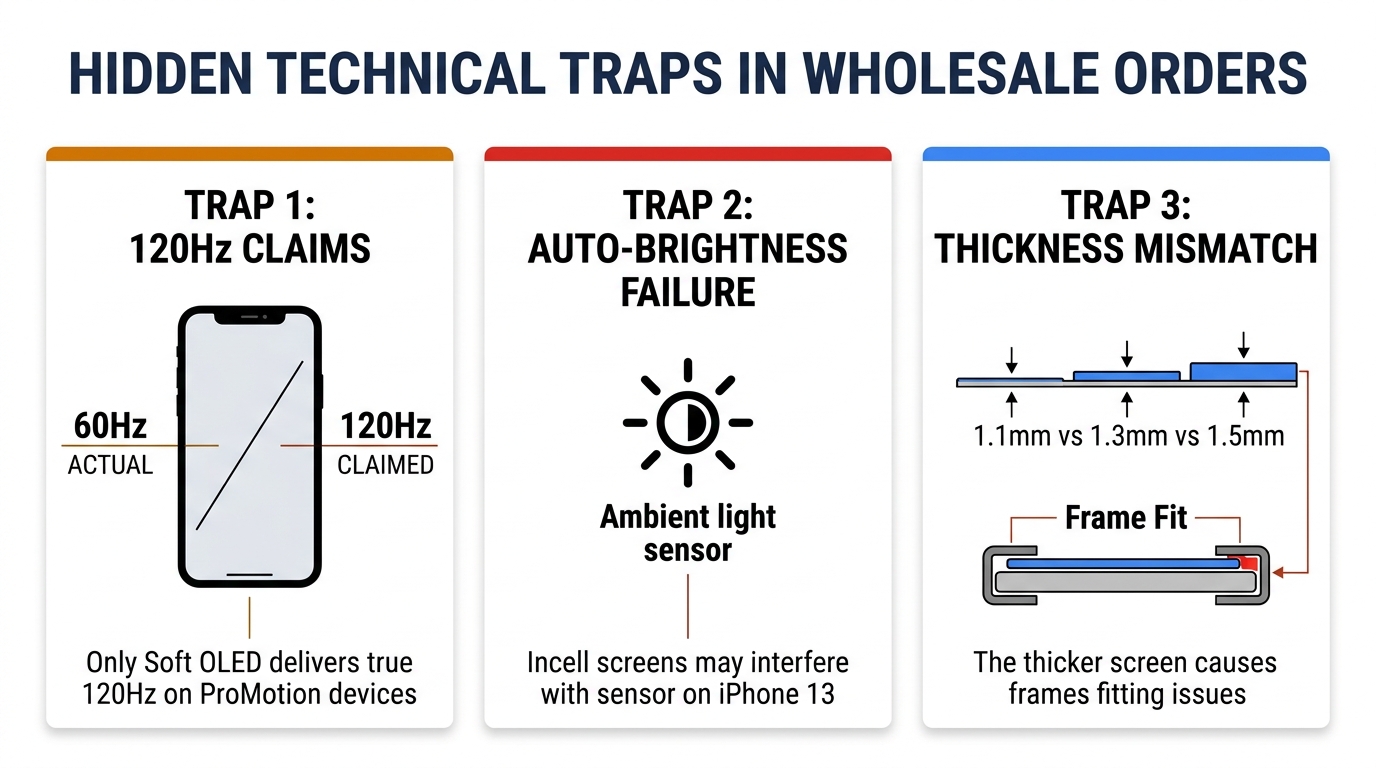
Beyond grade selection, there are three technical details that catch bulk buyers off guard. Each one can turn a profitable order into a loss.
Trap 1: 120Hz Compatibility Claims
Some Hard OLED and Incell screens are marketed as "120Hz compatible" for ProMotion iPhone models (14 Pro, 15 Pro, 16 Pro). In practice, most aftermarket Hard OLED screens cap at 60Hz regardless of the claim. Only Soft OLED consistently delivers true 120Hz on ProMotion devices.
How to verify: Ask the supplier to demonstrate 120Hz on a ProMotion model. You can verify it in iOS Settings > Accessibility > Motion > Limit Frame Rate — toggle this on and off. If the screen doesn't feel any different between settings, it's running at 60Hz.
Trap 2: Auto-Brightness Failure
Aftermarket screens can lose auto-brightness functionality depending on the ambient light sensor connection and IC chip. This is model-specific:
- iPhone 14 and newer: Auto-brightness works reliably across all three grades if the original ambient light sensor flex is transferred correctly
- iPhone 13: Some Incell screens interfere with the sensor — confirm with your supplier
- iPhone 12: Generally no issues across any grade
Auto-brightness failure isn't catastrophic, but it generates customer complaints. Set expectations with your repair team on which model/grade combinations need manual brightness adjustment after installation.
Trap 3: Weight and Thickness Differences
This seems minor until you install 20 screens in a day. Incell assemblies are measurably thicker and heavier than Soft OLED:
| Grade | Typical Assembly Thickness | Weight per Screen |
|---|---|---|
| Soft OLED | ~1.1mm | ~28g |
| Hard OLED | ~1.3mm | ~32g |
| Incell | ~1.5mm | ~36g |
The 0.4mm difference between Soft OLED and Incell affects frame fit. On iPhone 14 Pro and newer, Incell screens occasionally don't seat flush with the housing, creating a slight lip around the edge. This isn't a functional problem, but premium customers notice — and it makes your repair look less professional.
Frequently Asked Questions
Should I use Soft OLED or Hard OLED for iPhone 15?
For iPhone 15 standard (non-Pro), Hard OLED offers the best value. The screen is 60Hz, so you don't need Soft OLED's refresh rate advantage. Hard OLED at $28–$36 delivers 85–90% of original quality. For iPhone 15 Pro/Pro Max with 120Hz ProMotion, Soft OLED is worth the premium — Hard OLED can't match the refresh rate smoothness.
Can I use Incell screens on iPhone 14?
Yes, but with caveats. Incell works functionally on iPhone 14, but the quality gap is visible — grey blacks instead of true black, lower brightness, and some customers report a "washed out" look. It's a viable option for budget repairs under $70, but set customer expectations clearly. For repairs over $80, Hard OLED is a better match.
Do all Soft OLED screens support True Tone?
Most Soft OLED screens from tier-1 manufacturers support True Tone IC transfer, but not all. Screens with BOE IC chips have the highest True Tone compatibility rate. Always confirm with your supplier whether the specific batch supports True Tone transfer before ordering. Losing True Tone generates customer complaints, especially on newer models where users actively notice the difference.
How often do iOS updates break aftermarket iPhone screens?
Major iOS releases (18.0, 19.0) carry the highest risk — roughly 1 in 3 major releases causes some compatibility issue, usually limited to Incell screens with generic IC chips. Point releases (18.1, 18.2) occasionally fix these issues. Soft OLED with BOE IC has the best track record, with zero significant breaks through iOS 18.x. Budget for a 1–2% increase in returns during the first month after major iOS releases.
Is it worth buying the cheapest Incell screens for wholesale?
Only if you're certain about the IC chip and testing level. The cheapest Incell screens ($8–$12) often use generic ICs with minimal testing, pushing defect rates to 5–6%. Mid-tier Incell ($14–$18) with BOE or Tianma IC and 100% testing typically runs 2–3% defects. On a 200-unit order, that's the difference between 10–12 defective screens and 4–6. The $800 savings on cheap screens gets eaten by $900 in rework costs. For grade comparison economics, see our wholesale iPhone screens grades and pricing guide.
Match the Grade to the Model, Not the Other Way Around
The iPhone screens wholesale decision isn't "which grade is best" — it's "which grade is best for this specific model and this specific customer." Soft OLED for ProMotion devices. Hard OLED for standard 60Hz models with quality-conscious customers. Incell for budget repairs on older models.
Stock two grades per model maximum. Verify IC chip specs on every order. Check iOS compatibility before committing to a new supplier's screens. And keep a buffer of Hard OLED for models where Soft OLED supply is tight.
Ready to order iPhone screens wholesale with clear grade specs per model? Tell us your model list and we'll recommend the optimal grade for each — with samples to verify before you commit to volume.
Request a Wholesale Quote — include your top models and monthly volume for grade-specific pricing within 24 hours.
Related reading: