
iPhone 16 Screen Replacement: Parts Guide, Grades, and What Repair Shops Should Stock
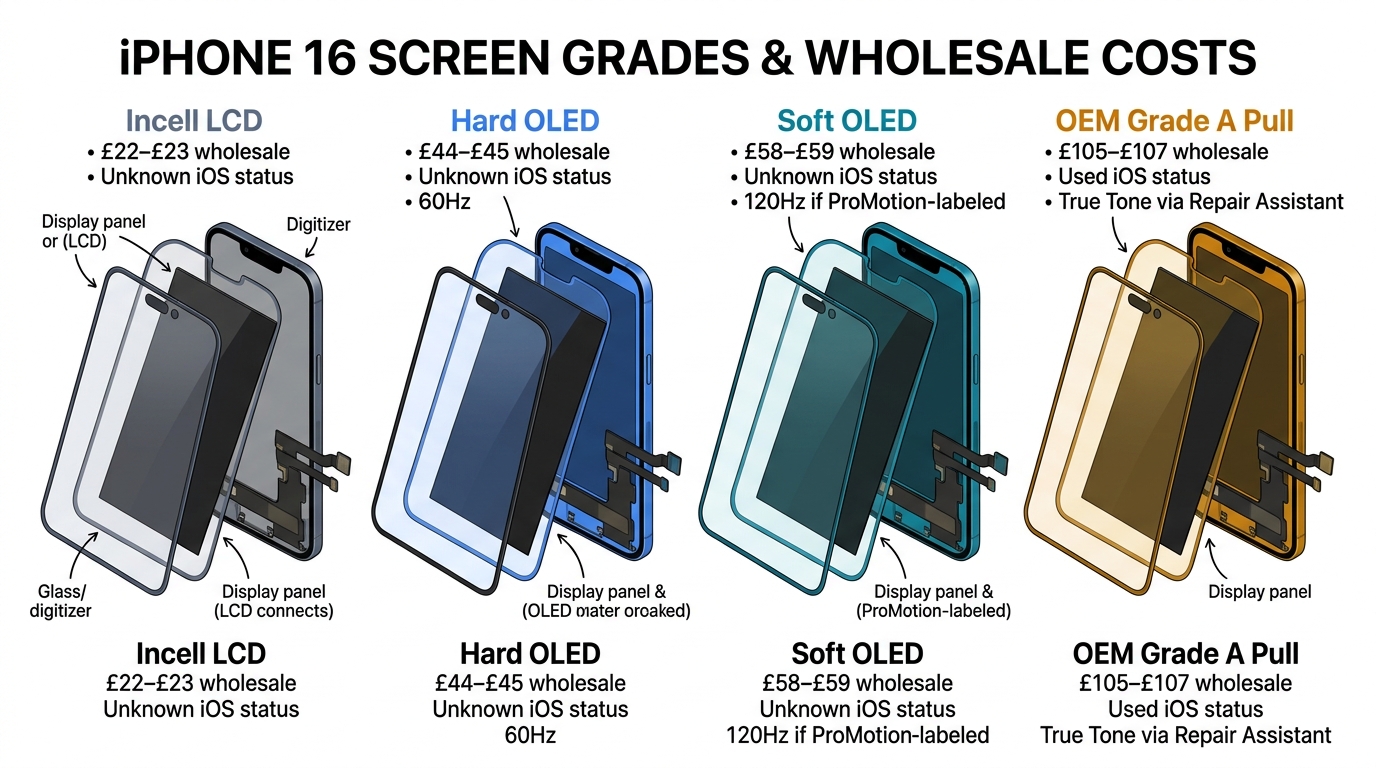
Two things changed with the iPhone 16 that affect what you stock and how you quote. First, iOS 18 introduced a three-tier parts verification system — Genuine, Used, or Unknown — that changes what customers see after a screen swap, and the implications differ from the iPhone 15. Second, the iPhone 16's new Camera Control button is serialised and tracked in the phone's Parts and Service History, which affects customer conversations about service records.
This guide covers the grade options with wholesale costs, what iOS 18 now shows customers, what the Camera Control button means for your repair workflow, and stocking recommendations by model.
Sourcing Replacement Screens in Bulk?
Incell / Hard OLED / Soft OLED grades — wholesale pricing, grade comparison on request.
Get Wholesale QuoteWhy iPhone 16 Repairs Are Different from iPhone 15
Three things changed between iPhone 15 and iPhone 16 that affect screen replacement work:
Repairability is at 7/10 (iFixit). The iPhone 16 maintains the same 7/10 score that iFixit assigned to the iPhone 15 series in late 2024 — primarily because iOS 18's Repair Assistant now works properly for genuine and genuine-used parts, allowing technicians to complete pairing without an Apple Store visit. Both iPhone 16 and 15 models can be opened from front or back.
Camera Control button is serialised. The iPhone 16's new Camera Control button — the capacitive button on the right side — has its own IC chip. When Apple's service system detects it, the button is now logged as an "enclosure" component in the phone's Parts and Service History. This doesn't directly affect screen replacement procedure, but it means the phone now tracks one more original component. Shops should be aware of this in the context of customer conversations about service history.
iOS 18 changed the "Unknown Part" warning. It's now a three-tier system: Genuine, Used, or Unknown. Each has different implications for customer experience and functionality, which we cover in detail below.
iPhone 16 Display Specs: Four Models, Two Repair Tracks
| Model | Screen size | Technology | Refresh rate | Always-On |
|---|---|---|---|---|
| iPhone 16 | 6.1" | Soft OLED (Super Retina XDR) | 60Hz fixed | No |
| iPhone 16 Plus | 6.7" | Soft OLED (Super Retina XDR) | 60Hz fixed | No |
| iPhone 16 Pro | 6.3" | LTPO Soft OLED (Super Retina XDR) | 1–120Hz ProMotion | Yes |
| iPhone 16 Pro Max | 6.9" | LTPO Soft OLED (Super Retina XDR) | 1–120Hz ProMotion | Yes |
Sources: MacRumors display specifications, 9to5Mac iPhone 16 Pro vs 15 Pro comparison.
The 60Hz vs ProMotion split is the same as on the iPhone 15 series. Standard and Plus models are fixed 60Hz — no ProMotion, no Always-On Display. Pro and Pro Max are LTPO with adaptive 1–120Hz refresh.
New across all four models: second-generation Ceramic Shield glass (Apple claims 50% tougher than first-generation Ceramic Shield, and 2x tougher than any other smartphone glass) and a 1-nit minimum brightness that applies even to the standard models. Neither change significantly affects the screen replacement procedure, but Ceramic Shield does mean the front glass is harder to crack — which over time will affect the volume of jobs coming in.
All four models are OLED. There is no LCD option from Apple on the iPhone 16 series.
Screen Grades: What's Available and What It Costs
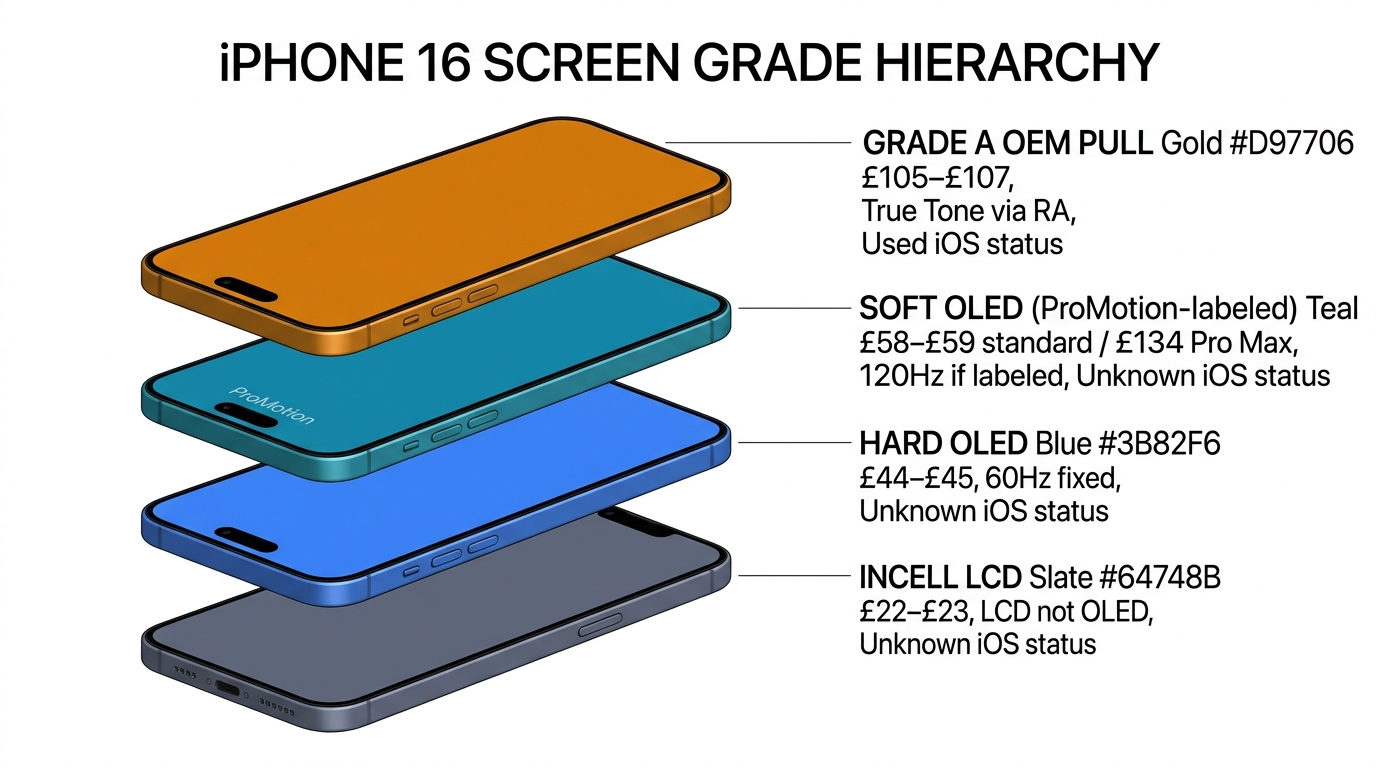
The aftermarket for iPhone 16 screens follows the same grade structure as older models, with prices higher than iPhone 15 due to the newer panels:
| Grade | Technology | Wholesale (USD) | Wholesale (approx GBP) | True Tone | 120Hz (Pro) |
|---|---|---|---|---|---|
| TFT / Budget LCD | LCD | $19–$20 | £15–£16 | ❌ | ❌ |
| Incell LCD | LCD | $28–$29 | £22–£23 | ❌ | ❌ |
| Hard OLED | Rigid OLED | $55–$56 | £44–£45 | ❌ | ❌ (60Hz only) |
| Soft OLED | Flexible OLED | $73–$74 | £58–£59 | Partial (with IC/flex) | ✅ If labeled 120Hz/ProMotion (Pro); 60Hz otherwise |
| Pulled Grade A (OEM, with sensor flex) | Original Apple panel | $131–$133 | £105–£107 | ✅ ("Used" status) | ✅ With flex (Pro) |
| Genuine OEM (Apple SSR) | Original Apple panel | $279–$379 | £223–£303 | ✅ Native | ✅ (Pro) |
Wholesale pricing from iphonelcd.net at 100+ unit quantities, China-direct, ex-freight and tax, for base iPhone 16 unless noted. Pro model Soft OLED wholesale runs higher — MobileSentrix lists iPhone 16 Pro Max Soft OLED XO7 at $167.95 (~£134) for 120Hz-compatible panels. Exchange rate used: $1 = £0.80.
A note on TFT for iPhone 16: These panels are not recommended. The iPhone 16 is OLED-native hardware and a TFT LCD will deliver noticeably inferior colour reproduction, brightness, and contrast. The callback and complaint risk exceeds any margin benefit. Incell is viable for price-sensitive customers; TFT is not worth stocking.
Soft OLED for Pro models: Ensure any Soft OLED you source for the iPhone 16 Pro or Pro Max is explicitly labelled as 120Hz-compatible or ProMotion-compatible by the supplier. Not all Soft OLED panels deliver adaptive refresh. Brands like XO7 (MobileSentrix, eSourceParts) are explicitly spec'd for ProMotion compatibility. Generic Soft OLED without confirmed 120Hz/ProMotion labelling will cap at 60Hz on a Pro model — functional, but not what Pro customers expect.
The iOS 18 "Unknown Part" System: What Your Customers Will See
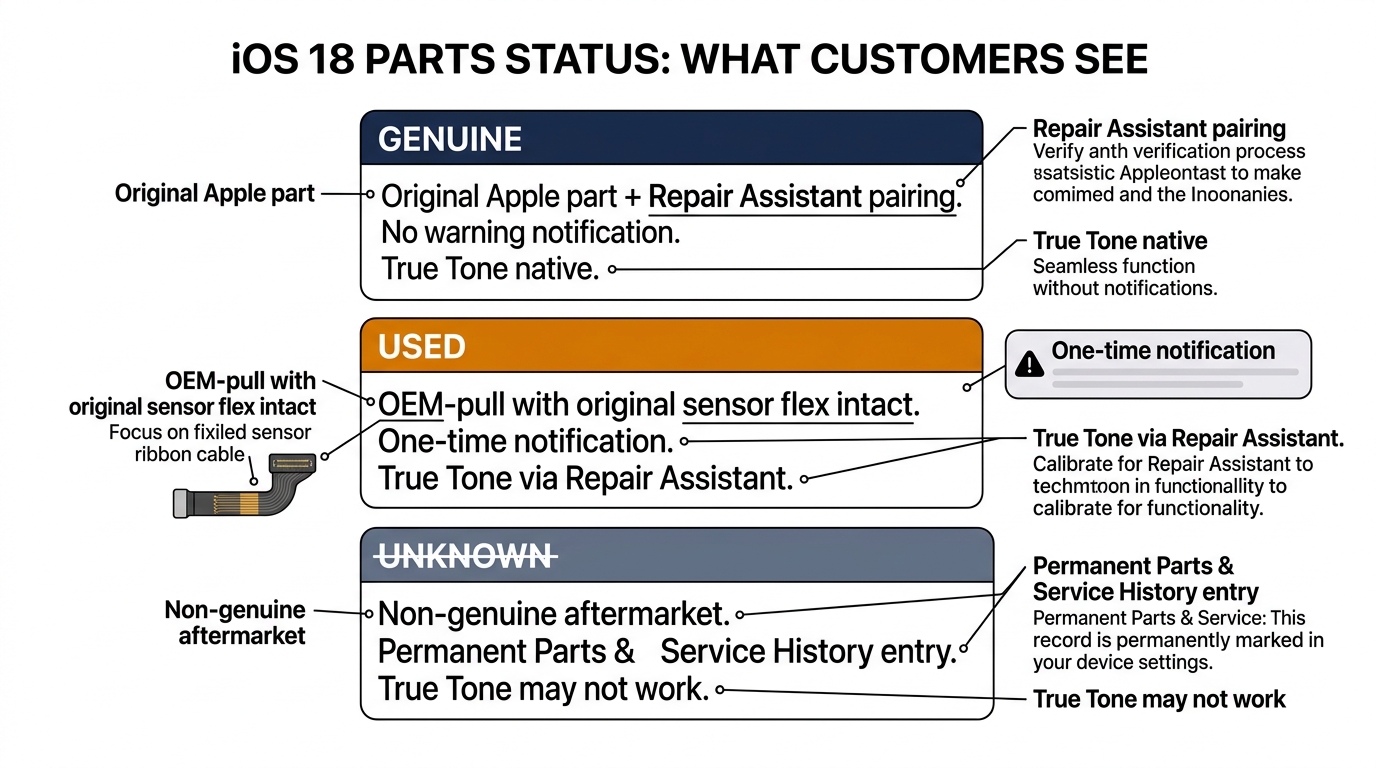
This changed significantly with iOS 18. There are now three distinct messages a customer can see after a screen replacement:
"Genuine" — The display is an original Apple part and has been properly paired to the device via Repair Assistant. True Tone and Auto-brightness work natively. No warning notification shown. This requires either an Apple Store repair, an Apple Authorised Service Provider using Apple parts, or a genuine OEM part run through Repair Assistant.
"Used" — The display is a genuine Apple part pulled from another iPhone (OEM-pull with sensor flex cable intact). iOS recognises it as authentic hardware but notes it was previously installed elsewhere. True Tone can be restored via Repair Assistant. A one-time notification appears. For repair shops, this is the best achievable status with pulled screens.
"Unknown" / "Unable to verify" — The display is non-genuine, failed verification, or hasn't been paired. Shows as a permanent entry in Settings → General → About → Parts and Service History. A notification appears once after restart and once after five days. True Tone and Auto-brightness may not work correctly or may be lost. Face ID continues to function on iPhone 16, but the service history record remains permanently.
Source: Apple Parts and Service History, iOS 18 display status guide.
The practical difference between iPhone 16 and earlier models: On the iPhone 15, IC transfer could eliminate the Unknown Part warning and restore True Tone. On the iPhone 16, non-genuine screens cannot clear the Unknown Part status via Repair Assistant — the firmware change in iOS 18 is definitive. Per Apple's documented baseline, the paths to Genuine or Used status are: (1) Apple OEM part + Repair Assistant, or (2) Grade A pulled panel with original sensor flex cable intact. Outcomes are calibration- and part-dependent.
Brief customers before the repair. A customer who receives their phone back and sees "Unknown Part" in Settings without warning will call you. The explanation is straightforward — it's a firmware decision by Apple, not a repair error — but it's a much easier conversation before the repair than after.
Wholesale Costs and What UK Shops Charge
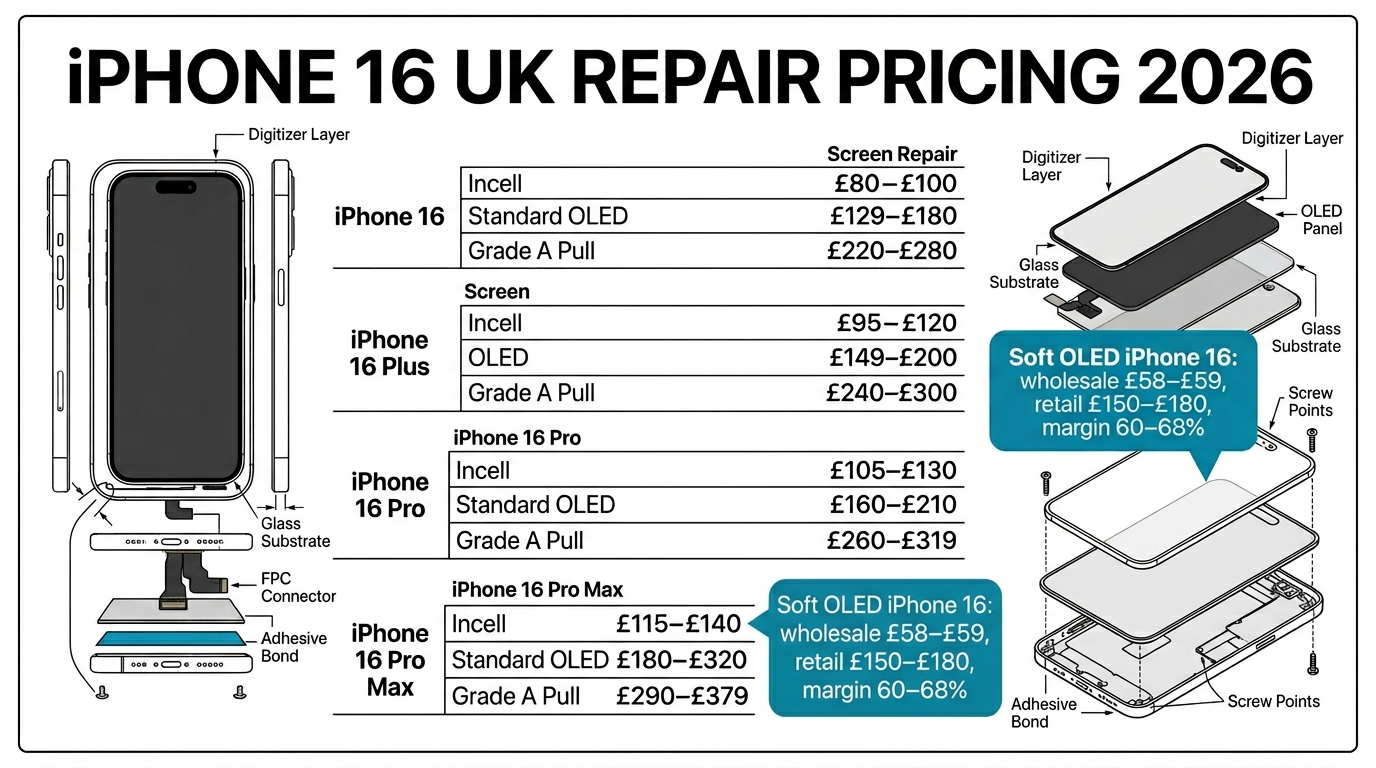
Based on UK repair shop pricing listed publicly as of 2026:
| Model | Incell | Standard OLED | Grade A pull (OEM) | Genuine Apple part |
|---|---|---|---|---|
| iPhone 16 | £80–£100 | £129–£180 | £220–£280 | Contact Apple / AASP |
| iPhone 16 Plus | £95–£120 | £149–£200 | £240–£300 | Contact Apple / AASP |
| iPhone 16 Pro | £105–£130 | £160–£210 | £260–£319 | Contact Apple / AASP |
| iPhone 16 Pro Max | £115–£140 | £180–£320 | £290–£379 | Contact Apple / AASP |
Sources: iSmash (£129 iPhone 16 standard), iDoctor UK (£159.99 Plus), imFixed (£180 standard / £190 Pro / £320+ Pro Max). Apple Store out-of-warranty pricing is not publicly listed for UK — Apple uses an inspection-based quote system; ranges vary by region.
Gross margin on a standard Soft OLED repair (iPhone 16):
- Wholesale: £58–£59
- Retail charged: £150–£180
- Gross margin: £91–£122 (60–68%)
For Pro Max with XO7 Soft OLED:
- Wholesale: ~£134
- Retail charged: £200–£320
- Gross margin: £66–£186 (33–58%)
For Grade A pulled OEM (iPhone 16):
- Wholesale: ~£105–£107 (Sparlay UK pricing)
- Retail charged: £220–£280
- Gross margin: £113–£175 (51–63%)
Note: Genuine Apple service-pack parts (SSR) wholesale at £223–£303 — margin structure is entirely different and only available to AASPs.
Note on Pro Max pricing: In early 2026, repair professionals flagged that iPhone 16 Pro Max aftermarket screen prices aren't dropping as expected — US tariffs on Chinese goods are contributing to price stickiness in the supply chain. Factor this into your Pro Max pricing if you're setting rates now.
UK Wholesale Suppliers for iPhone 16 Screens
For UK repair shops, the sourcing options with confirmed iPhone 16 stock:
ReplaceBase — UK-stocked B2B supplier. iTC BASE Incell range: £38.80 (iPhone 16) to £74.40 (16 Pro Max) ex-VAT. 12-month warranty, free delivery over £100. Strong choice for shops wanting UK-held inventory with no customs delay.
Sparlay — UK-based dismantlers offering genuine Grade A pulled screens for iPhone 16 Pro (£275) and Plus (£265). These include the original sensor flex cable, enabling "Used" iOS status.
Screen Doctor — UK supplier, iPhone 16 Pro Refurbished OLED at £249.99 with lifetime warranty. Note: Refurbished (OEM panel with new glass but sensor flex removed) typically shows "Unknown" in iOS.
For volume orders, China-based suppliers like iphonelcd.net offer the lowest per-unit price on Incell, Hard OLED, and Soft OLED grades. MobileSentrix (US) offers the broadest grade range including XO7 for Pro-compatible Soft OLED.
Camera Control Button: What Shops Need to Know
The Camera Control button on the iPhone 16's right edge is a capacitive button with its own IC chip. Apple's Repair Assistant now tracks it as a separate serialised component ("enclosure" in the Parts and Service History).
For standard screen replacement, this has no direct procedural impact. The button doesn't need to be removed or replaced as part of a front display swap.
Two things worth knowing:
Replacement triggers service history. If a customer replaces their iPhone 16 back housing or has repair work involving the right side assembly, the Camera Control IC becomes flagged. This won't affect your screen replacement, but it will affect how customers read their service history.
Touch responsiveness near the right edge. In the iPhone 16 launch period, users reported that touching near the Camera Control button caused the screen to stop responding momentarily. Apple's iOS 18.0.1 addressed related touch issues, but the right-edge area remains worth testing. If a customer reports post-repair touch problems in that zone, it may be a pre-existing issue rather than a repair fault. Test this area before and after the screen swap to establish a baseline you can show the customer if needed.
What to Stock: Grade Recommendations by Model
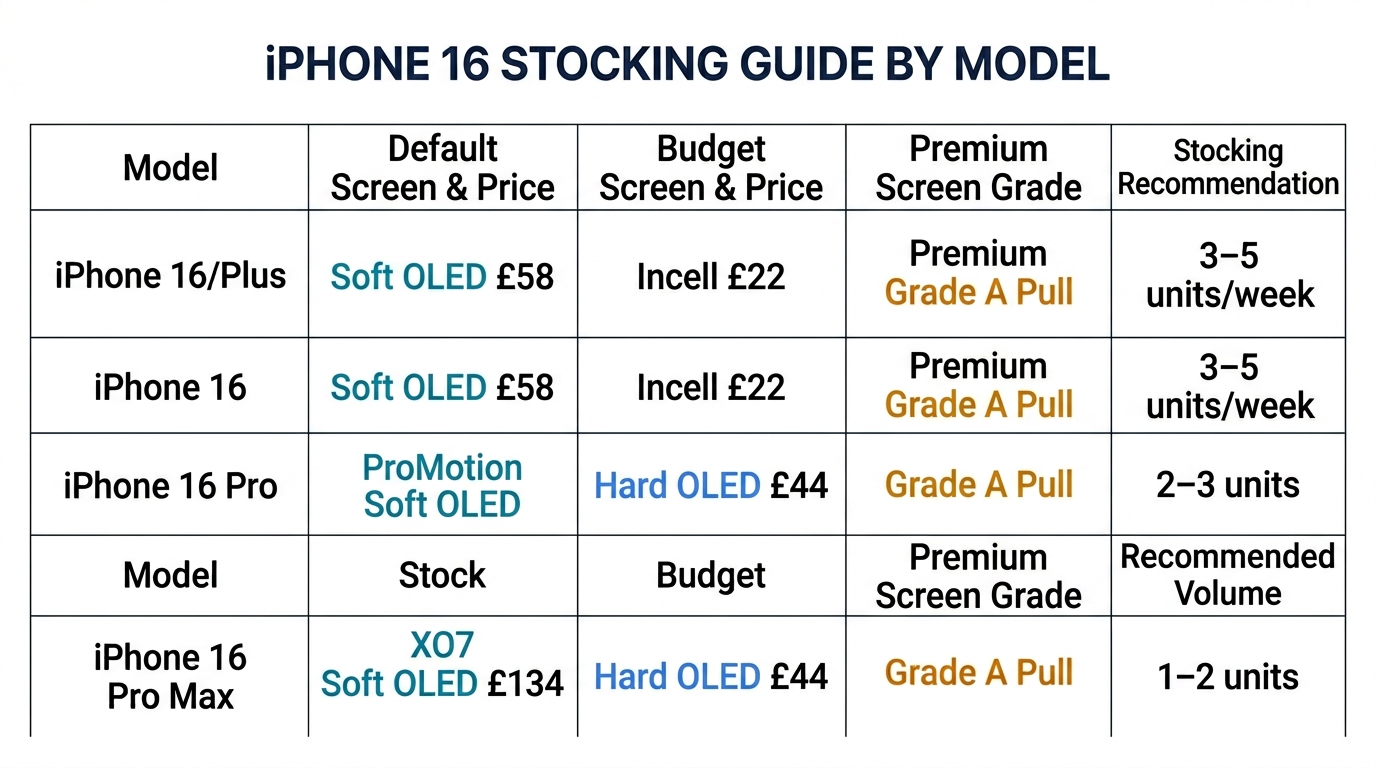
iPhone 16 and 16 Plus (60Hz standard OLED):
- Default stock: Soft OLED ($73, ~£58 wholesale). Quality is close to OEM for 60Hz use; customer complaints are low from reputable suppliers.
- Budget option: Incell LCD ($28, ~£22) for customers who explicitly want the cheapest repair and understand the trade-offs (no OLED quality, Unknown Part notification, no True Tone).
- Don't stock TFT: the quality gap is too visible on a device that's 60Hz OLED from the factory.
iPhone 16 Pro and Pro Max (120Hz ProMotion):
- Default stock: XO7 or equivalent Soft OLED explicitly spec'd as 120Hz/ProMotion-compatible (£134 for Pro Max). Verify the supplier spec sheet states ProMotion compatibility — not just "Soft OLED."
- Grade A pulled (with sensor flex): if volume justifies it, keep 1–2 units per week for Pro/Pro Max. These achieve "Used" iOS status — the best achievable outcome without Apple service parts. Source from UK dismantlers with brightness and pixel integrity testing.
- Hard OLED: functional for Pro models, but caps at 60Hz. Price accordingly and disclose the refresh rate limitation upfront.
Minimum stocking guidance:
- iPhone 16 / Plus: 3–5 Soft OLED units per model per week at medium volume shops
- iPhone 16 Pro / Pro Max: 2–3 LTPO Soft OLED per model; 1 Grade A pull for premium customers
Need wholesale pricing for iPhone 16 screens by grade with LTPO labelling confirmed? Request a quote →
Frequently Asked Questions
Does the iPhone 16 show a warning after a screen replacement? Yes, for non-genuine parts. iOS 18 shows "Unknown Part" if a non-Apple screen is installed — this appears in Settings → General → About → Parts and Service History permanently. A notification also shows once after restart and once after five days. For Grade A pulled OEM screens with the original sensor flex cable intact, iOS shows "Used" instead of Unknown, which is better — True Tone can be restored via Repair Assistant.
Can aftermarket screens support 120Hz ProMotion on the iPhone 16 Pro? Only with LTPO-architecture Soft OLED from a supplier who explicitly labels the panel as ProMotion-compatible. Hard OLED screens and standard Soft OLED without LTPO will cap at 60Hz. Look for "XO7," "LTPO," or explicit "120Hz ProMotion" labelling in the spec sheet.
How does the iPhone 16 screen replacement procedure compare to the iPhone 15 for shops? The front glass removal procedure is similar — heat, pentalobe screws, same basic disassembly sequence. The key difference for shops is parts pairing: iOS 18's Repair Assistant now works properly for genuine and genuine-used parts, meaning you can complete pairing without sending the customer to Apple. For non-genuine screens, the Unknown Part entry in service history is permanent — more visible to customers than on the 15. Factor that into your quoting conversation.
What's the Camera Control button and does it affect screen replacement? The Camera Control is a new capacitive button on the right side with its own serialised IC chip. It doesn't need to be removed during a standard front screen replacement. Be aware of the palm rejection dead zone issue near the button — a known iOS 18 quirk that some customers may report post-repair, even though it's unrelated to the screen swap itself.
Why are iPhone 16 Pro Max screens more expensive than iPhone 15 Pro Max screens? Two factors: the panels are newer (supply has had less time to reach volume pricing), and US tariffs on Chinese goods in 2025–2026 are keeping Pro Max aftermarket prices elevated compared to historical patterns. Expect prices to compress through 2026 as supply matures.
Related: iPhone 15 Screen Replacement: Grades, IC Transfer, and ProMotion · Incell vs Hard OLED vs Soft OLED: Which Screen to Order by Model · iPhone Unknown Part Warning and IC Transfer Guide