
Wholesale Phone Screens: How to Choose the Right Supplier for Bulk Orders
Choosing a supplier for wholesale phone screens is different from choosing a supplier for batteries, cases, or flex cables. Screens are the highest-value, highest-risk part in your inventory. A bad batch of batteries costs you $200. A bad batch of screens costs you $2,000 — plus the customer complaints, warranty claims, and reputation damage.
General supplier advice tells you to "check reviews and verify certifications." That's not enough for screen sourcing. You need to evaluate a supplier's ability to deliver consistent grade accuracy, track iOS compatibility, handle mixed-model orders, and maintain quality across batches — not just the first sample pack they send you.
This guide gives you a screen-specific supplier evaluation framework, the red flags that predict problems, and the negotiation tactics that experienced bulk buyers use.
Sourcing Replacement Screens in Bulk?
Incell / Hard OLED / Soft OLED grades — wholesale pricing, grade comparison on request.
Get Wholesale QuoteThe 6-Point Supplier Scoring Framework for Wholesale Phone Screens

General supplier checklists cover basics like business license, communication speed, and payment terms. Those matter — and we cover them in our guide to choosing a phone parts supplier. This section focuses on the six criteria specific to wholesale phone screen suppliers that general guides miss.
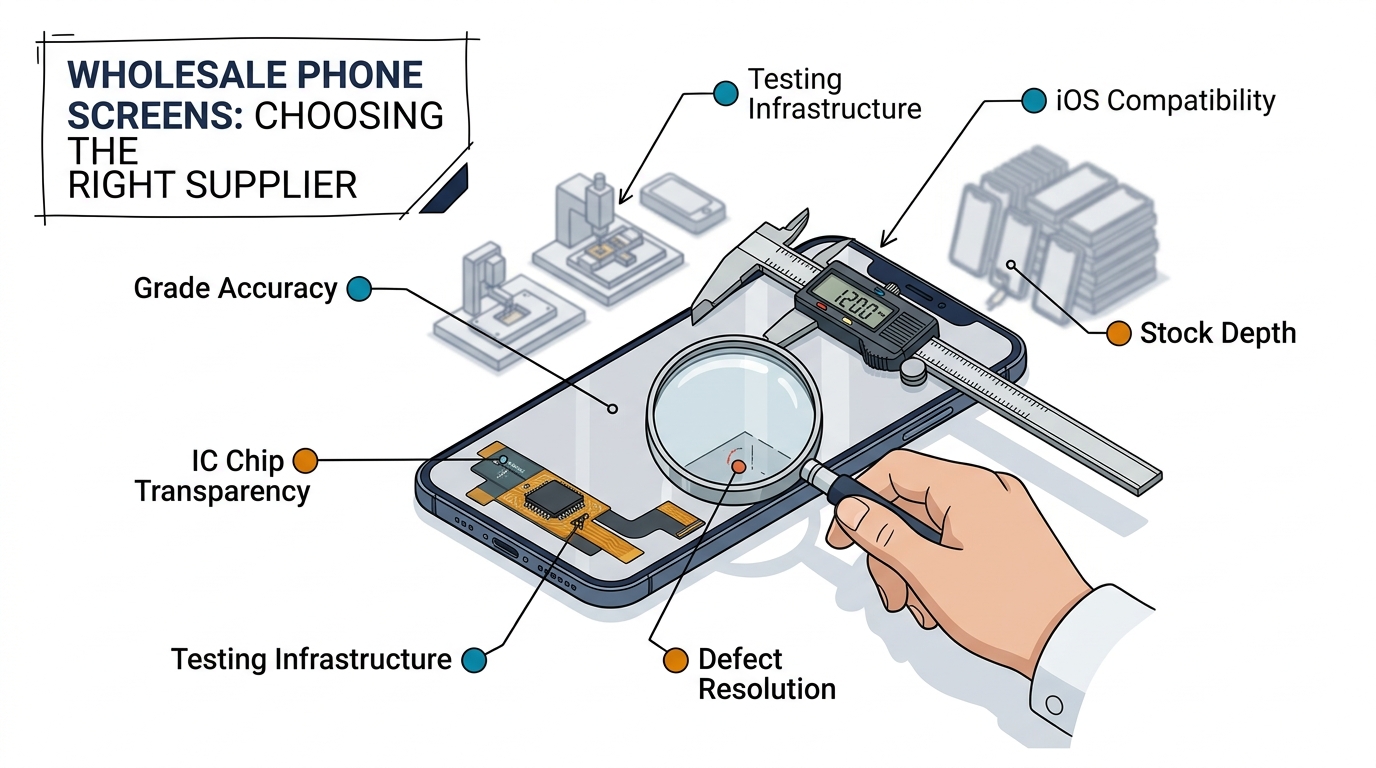
1. Grade Accuracy and Consistency
What to evaluate: Does the supplier deliver exactly the grade they quote? A supplier calling their screen "Soft OLED" should deliver actual Soft OLED — not a Hard OLED relabeled with a Soft OLED price tag.
How to test: Order 5 units of the same model and grade from the supplier. Then order 5 more, two weeks later. Compare the two batches:
- Same brightness level? (Measure with a lux meter app or compare side-by-side)
- Same color temperature? (Display a white screen — warm vs cool tint is immediately visible)
- Same thickness? (Calipers: Soft OLED should be ~1.1mm, Hard OLED ~1.3mm, Incell ~1.5mm)
If batch 2 is noticeably different from batch 1, the supplier has inconsistent sourcing — they're buying from multiple factories without controlling quality.
Score: 0 = inconsistent across batches, 1 = minor variations, 2 = consistent quality across batches
2. IC Chip Transparency
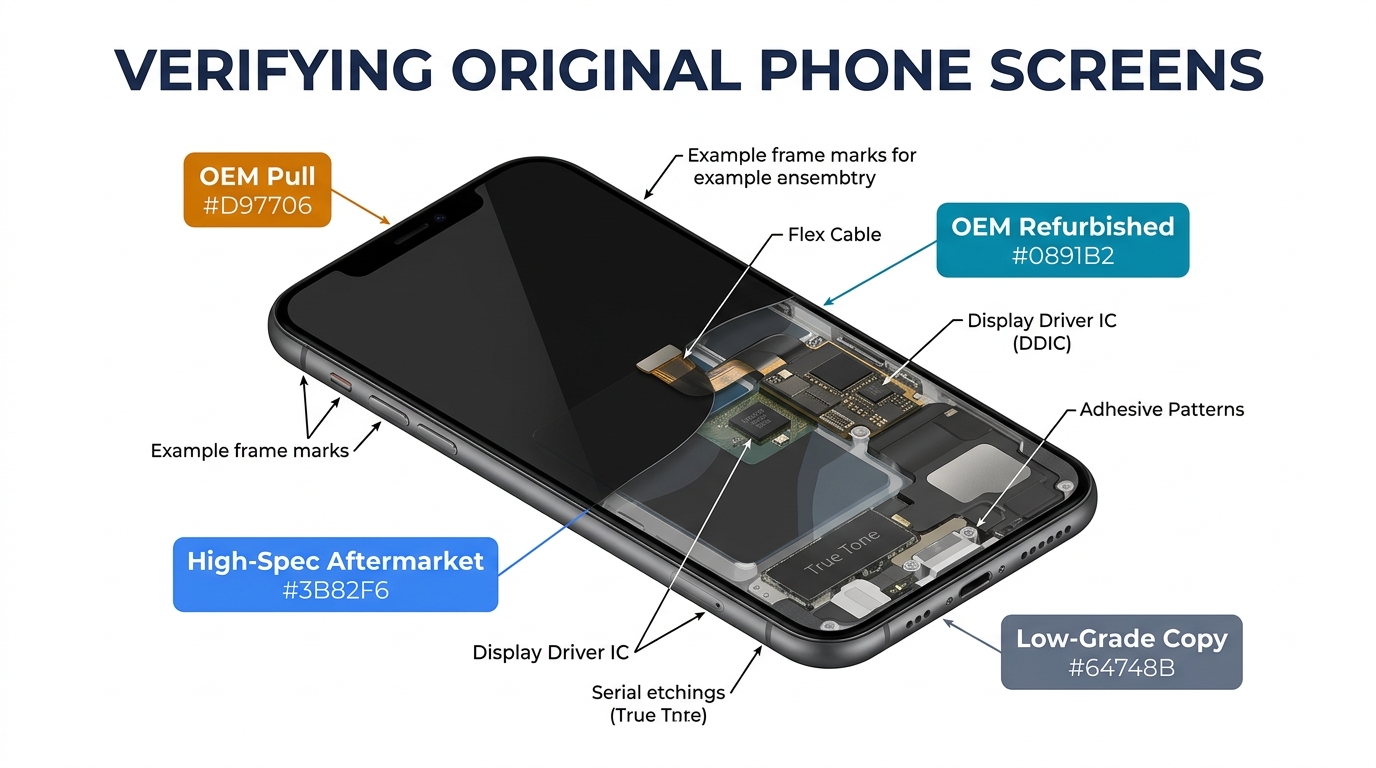
What to evaluate: Does the supplier clearly state which IC chip is in each screen? Can they specify BOE, Tianma, or generic for every model?
Why this matters for screens specifically: IC chip determines True Tone compatibility, iOS update resilience, and touch responsiveness. A supplier who can't tell you the IC chip either doesn't know (bad) or doesn't want to tell you (worse).
How to test: Ask: "What IC chip is in your iPhone 15 Hard OLED?" A reliable supplier answers immediately with a specific brand. A problematic supplier says "standard IC" or "high quality IC" — which means nothing.
Score: 0 = can't specify IC, 1 = specifies brand but not model, 2 = specifies exact IC chip for every SKU
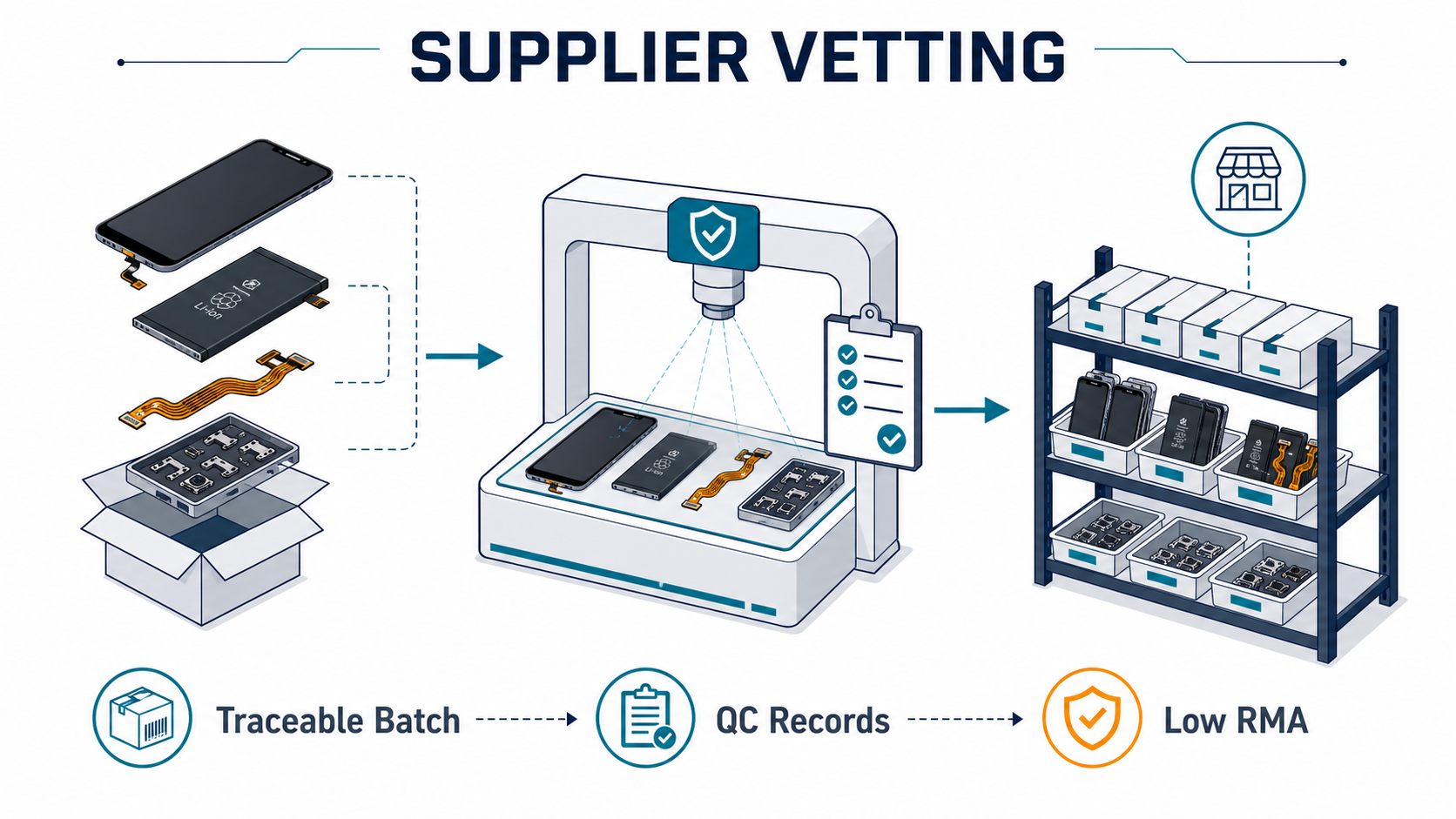
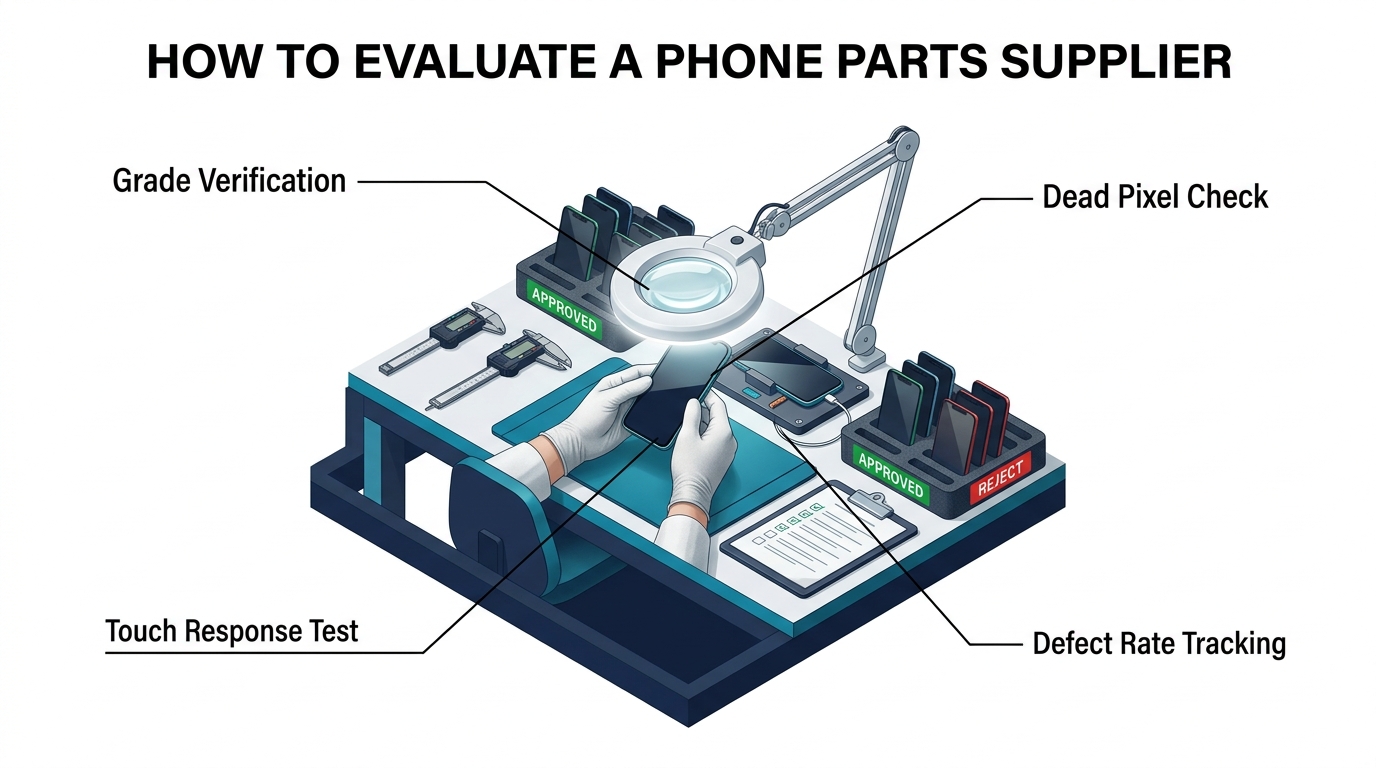
3. Testing Infrastructure
What to evaluate: How does the supplier test screens before shipping?
The testing level directly determines your incoming defect rate:
| Testing Level | What It Means | Expected Defect Rate | Supplier Investment Required |
|---|---|---|---|
| Factory QC only | Relies on the manufacturer's outgoing inspection | 4–6% | Minimal — no independent testing |
| Batch sampling | Supplier tests 10–20% of each batch | 3–4% | Moderate — has test equipment |
| 100% jig-tested | Every screen tested on a display jig | 1.5–2.5% | Significant — dedicated QC line |
| 100% device-tested | Every screen installed in a real device and tested | <1.5% | Major — full QC operation |
How to test: Ask for photos or video of their testing process. Better yet, ask to visit their QC facility on video call. Suppliers who invest in 100% testing are proud of it and will show you. Suppliers who don't will deflect.
Score: 0 = factory QC only, 1 = batch sampling, 2 = 100% tested (jig or device)
4. iOS Compatibility Tracking
What to evaluate: Does the supplier monitor iOS updates and notify you of compatibility issues?
This is the criterion that separates professional screen suppliers from generic parts traders. Apple releases 4–6 iOS updates per year. Each one can potentially break aftermarket screen functionality — especially touch, auto-brightness, and True Tone on Incell and Hard OLED screens.
How to test: Ask: "When iOS 18.3 came out in January, did any of your screens have issues? Which models and grades were affected? How did you handle it?"
A good supplier will have a specific answer: "Our iPhone 14 Incell with generic IC had touch lag. We switched to BOE IC within two weeks and offered credit to affected customers." A bad supplier will say: "No problems" — which either means they didn't check or they're not being honest.
Score: 0 = doesn't track, 1 = tracks but doesn't proactively notify, 2 = tracks and sends updates to buyers
5. Model Coverage and Stock Depth
What to evaluate: Can the supplier consistently supply your top 5–8 iPhone models across multiple grades? How deep is their stock for each?
Why this matters: Some suppliers are specialists (strong on iPhone 14–16, weak on older models). Others are generalists (wide model range, inconsistent quality per model). You need to match supplier strength to your repair demand.
How to test: Send your model list with desired grades. Ask for:
- Current stock levels per model
- Lead time for models not in stock
- Historical stock-out frequency ("How often were you out of iPhone 14 Hard OLED in the past 6 months?")
Score: 0 = frequently out of stock on core models, 1 = covers most models with occasional gaps, 2 = consistently stocked on all requested models
6. Defect Resolution Speed
What to evaluate: When you receive defective screens, how fast does the supplier resolve the claim?
How to test: This is best tested with a real claim — which is why your first small order should intentionally include a defect report, even if it's minor. Time the response:
| Resolution Speed | What It Tells You |
|---|---|
| Credit issued within 24 hours | Professional operation with empowered support team |
| Credit within 3–5 business days | Acceptable — claim goes through a review process |
| 7+ days or requires escalation | Supplier treats claims as adversarial, not operational |
| "Send the screens back first" | Avoid — impractical for China-to-US/UK sourcing |
Score: 0 = 7+ days or adversarial, 1 = 3–5 days, 2 = under 48 hours with clear process
Scoring Summary
| Criteria | Score 0 | Score 1 | Score 2 |
|---|---|---|---|
| Grade accuracy | Inconsistent | Minor variation | Consistent |
| IC chip transparency | Can't specify | Brand only | Exact spec per SKU |
| Testing infrastructure | Factory QC only | Batch sampling | 100% tested |
| iOS compatibility | Doesn't track | Tracks passively | Proactive updates |
| Stock depth | Frequent stockouts | Occasional gaps | Consistently stocked |
| Defect resolution | 7+ days | 3–5 days | Under 48 hours |
Interpretation: 10–12 = tier-1 supplier, commit volume. 7–9 = solid backup supplier. Under 7 = too many risks for primary sourcing.
Want help evaluating your current supplier? Send us your model list and current supplier's grade specs — we'll benchmark them against our standards and flag any gaps. Request a supplier comparison.
5 Red Flags That Predict Problems Before They Happen
These warning signs show up during the evaluation phase — before you've committed a large order. Catching them early saves thousands.
Red Flag 1: Grade Bait-and-Switch
The sample looks great. The bulk order doesn't match. This is the most common problem in wholesale phone screens sourcing.
How it works: Supplier sends tier-1 Soft OLED samples. Once you place a 200-unit order, the screens come from a cheaper source. Brightness is lower, color temperature is different, defect rate is higher.
How to catch it: Keep your sample screens. When the bulk order arrives, pull 5 random screens and compare side-by-side with the sample. Measure brightness, check thickness with calipers, test touch responsiveness. If there's a visible gap, escalate immediately before accepting the shipment.
Red Flag 2: "Grade A" Without Specifications
Any supplier using vague letter grades (A, A+, AA, AAA) without backing them up with measurable specs is hiding something. These labels are not industry-standardized — "Grade A" from one factory is "Grade B" from another.
What to demand instead: Specific technology (Incell / Hard OLED / Soft OLED), IC chip brand, brightness rating in nits, and defect tolerance percentage. If the supplier can't provide these, their quality control isn't systematic enough for bulk orders.
Red Flag 3: No Warranty on Incell Screens
Some suppliers offer 6-month warranty on Soft OLED but zero warranty on Incell, claiming "Incell is budget grade, warranty isn't standard." This is a sign they don't trust their own Incell sourcing.
Benchmark: Minimum 3 months warranty on Incell, 6 months on Hard OLED and Soft OLED. Get terms in writing on the proforma invoice. For full warranty negotiation guidance, see our article on phone screen warranty and return policy.
Red Flag 4: Resistance to Mixed-Model Orders
If a supplier insists on 50+ units per model for every SKU, they're optimizing for their own inventory management, not your needs. Most repair shops need 15–30 units per model across 5–8 models.
What flexible suppliers offer: A total quantity minimum (e.g., 100 units total) that you can split across models and grades however you need. This is standard from experienced screen suppliers. Rigidity on per-model MOQ suggests the supplier is a general trader, not a screen specialist.
Red Flag 5: No Response on Weekends or Chinese Holidays
This seems minor until your busiest repair weekend coincides with a supplier issue. Professional screen suppliers serving international clients maintain at least limited weekend coverage and pre-arrange communication protocols around Chinese holidays (Spring Festival, Golden Week, Mid-Autumn).
What to verify: Before your first bulk order, send a non-urgent question on a Saturday. Track response time. Suppliers who disappear for 48+ hours every weekend will disappear for 2+ weeks during Chinese New Year without advance notice.
Negotiation Tactics for Wholesale Phone Screen Orders
Once you've identified a qualified supplier (scoring 10+ on the framework above), here's how to negotiate pricing and terms that improve as your relationship develops.
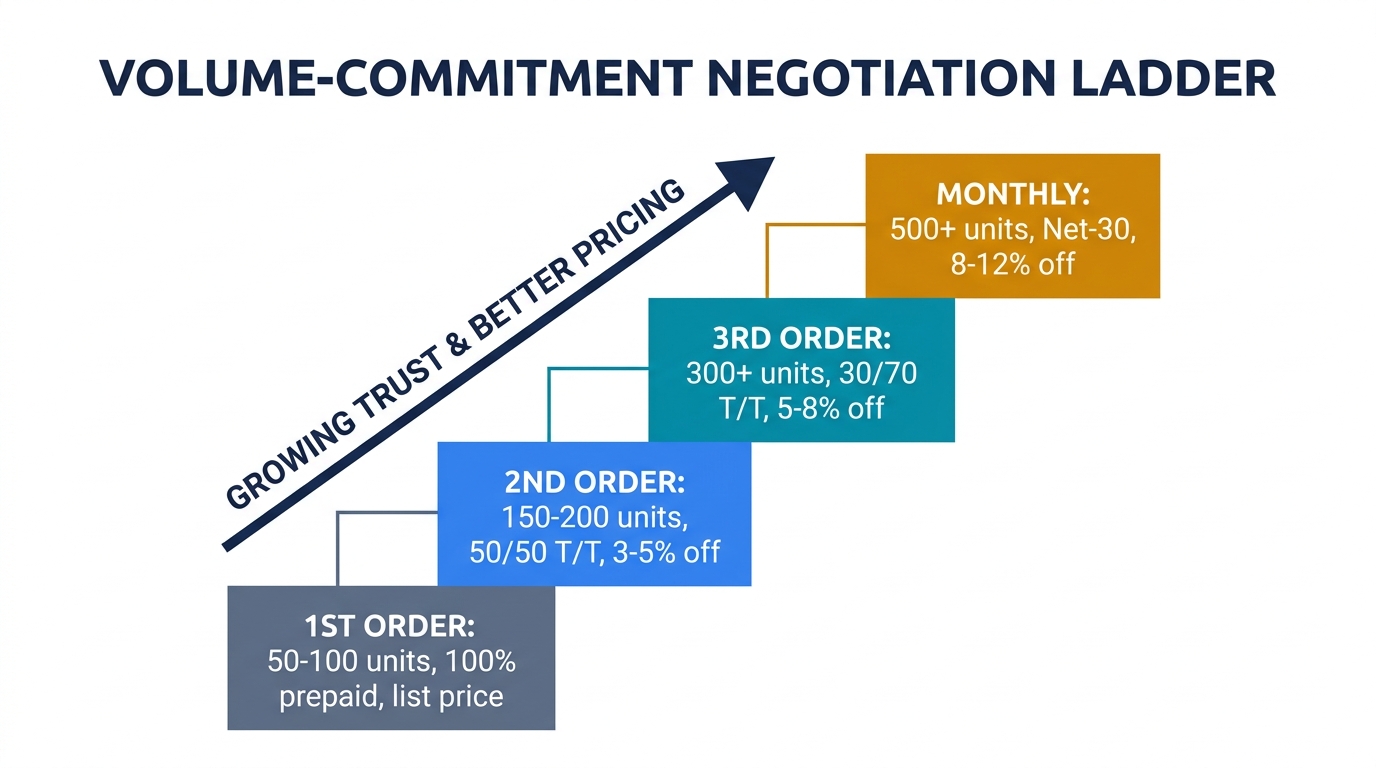
Tactic 1: The Volume-Commitment Ladder
Don't negotiate your best price on order one. Instead, propose a graduated structure:
| Order | Volume | Payment Terms | Expected Discount |
|---|---|---|---|
| 1st (trial) | 50–100 units | 100% prepaid, PayPal | List price |
| 2nd | 150–200 units | 50/50 T/T split | 3–5% off |
| 3rd | 300+ units | 30/70 T/T | 5–8% off |
| Ongoing (monthly) | 500+ units | Net-30 | 8–12% off |
This approach works because it gives the supplier certainty of growing business. They'll offer better pricing on order 2 because they're investing in a recurring customer, not a one-time buyer.
Tactic 2: Grade-Bundle Pricing
Instead of negotiating each grade separately, bundle them: "I'll order 100 Incell + 50 Hard OLED + 30 Soft OLED for the same model mix. What's the bundled price?"
Bundled orders are more profitable for suppliers (larger total order, single shipment) and they'll typically pass 2–4% savings to you. For MOQ optimization strategies, see our wholesale iPhone screens MOQ guide.
Tactic 3: Sample Credit
Always ask: "Will you credit the sample order cost against my first bulk order?" Most professional suppliers say yes — it's standard practice. If they refuse, they don't expect you to order more, which tells you something about their confidence in their product.
China-Based vs Domestic: Where to Source Wholesale Phone Screens
Most wholesale phone screens ultimately come from Shenzhen, China — even when you buy from a domestic US or UK distributor. Understanding the supply chain helps you decide where to buy.
Direct from China (Shenzhen/Huaqiangbei)
- Price advantage: 20–40% lower than domestic distributors
- Model range: Widest selection, including older and niche models
- Lead time: 7–15 days by air express
- Risk: Quality verification is harder remotely. Currency, customs, and communication add complexity
- Best for: Buyers doing 10+ repairs/day who can manage international logistics
For detailed sourcing from China, see our guide on paying a China phone parts supplier and Huaqiangbei vs online sourcing.
Domestic Distributor (US/UK)
- Price: 20–40% higher than direct China sourcing
- Model range: Focuses on top 10–15 models, limited older model stock
- Lead time: 1–3 days
- Risk: Lower — local warranty, local returns, easier communication
- Best for: Shops doing under 10 repairs/day, or shops that need same-week restocking
Hybrid Approach (Most Common for Growing Shops)
Use a domestic distributor for urgent restocking and your top 2–3 fastest-moving models. Use a China-based supplier for bulk monthly orders across all models and grades. This gives you speed for emergencies and cost savings on planned inventory.

Frequently Asked Questions
How many suppliers should I work with for wholesale phone screens?
The right number of screen suppliers for most repair shops is a two-supplier setup: one primary and one backup. The primary handles 70–80% of orders, while the backup covers 20–30%. This structure delivers three benefits: pricing leverage, supply security if one supplier hits stock issues, and quality benchmarking, since you can compare screens from both to keep each honest. In practice, three or more suppliers adds management complexity without much benefit unless you are a large distributor running 1,000+ units monthly. For example, a shop ordering 200 screens a month splits roughly 150 to the primary and 50 to the backup — enough volume to keep both responsive.
What's the first order I should place with a new screen supplier?
The right first order with a new screen supplier is a mixed sample batch, not a bulk commitment. Order 20–50 screens covering your top 3 models in 2 grades each, for a total cost of roughly $500–$1,500. Install them in real customer devices and track quality for 2 weeks: log every defect, customer complaint, touch issue, or display problem. In practice, this small sample investment reveals grade accuracy and batch consistency before you risk $3,000+ on a bulk order. For example, a 40-screen sample returning a 5% defect rate is a clear signal to renegotiate grade or walk away before scaling.
Should I buy wholesale phone screens from Alibaba?
Buying wholesale phone screens from Alibaba is a sourcing option, not a quality guarantee. Alibaba is a discovery platform that connects buyers with suppliers, but it does not verify grade accuracy or defect rates on your behalf. Reliable screen suppliers and unreliable ones both list there, so the platform itself stays neutral. In practice, your own evaluation process — sample orders, defect tracking, written grade definitions, and a 12-month warranty — determines the outcome, not the channel. For example, two suppliers on the same platform can ship the same iPhone model at a 15% quality gap that only a sample order will expose.
How do I handle quality issues with a China-based screen supplier?
Handling quality issues with a China-based screen supplier means documenting everything and acting inside the claim window. First, capture photos of defects, batch numbers, the order reference, and quantities affected. Second, send a clear defect report within the supplier's claim window, typically 7–14 days. Third, expect professional suppliers to resolve claims with credit on the next order, since physical returns to China are impractical for most small-to-mid buyers. In practice, the buyers who recover losses establish the defect-claim process in writing before the first bulk order, not after the first problem. For detailed steps, see our guide on phone screen warranty and return policy.
Is it worth attending trade shows to find phone screen suppliers?
Attending trade shows to find phone screen suppliers is a worthwhile move for buyers placing $5,000+ in monthly orders. The Hong Kong Electronics Fair (spring and autumn), Global Sources Mobile Electronics, and the Canton Fair are where Shenzhen screen manufacturers display their latest panels. At these events buyers physically inspect screens, compare grades side by side, and negotiate face-to-face. In practice, smaller buyers reach about 80% of the same evaluation through video calls and sample orders at a fraction of the cost. For example, a shop ordering $2,000 monthly gains more from a 30-screen sample order than from a $2,500 trade-show trip.
Choose Based on Evidence, Not Promises
Every wholesale phone screen supplier will tell you their quality is excellent. The scoring framework in this article gives you a way to verify that claim with measurable data points — grade consistency, IC chip specs, testing depth, iOS tracking, stock availability, and defect resolution speed.
Run the evaluation on 2–3 suppliers before committing your monthly budget. Score them. Compare. Then commit volume to the one that earns it.
Looking for a wholesale phone screen supplier that scores high on every criterion? Tell us your model list, preferred grades, and monthly volume. We'll send specs, pricing, and samples — so you can score us yourself before committing.
Request a Wholesale Quote — include your top models and desired grades for pricing within 24 hours.
Related reading: