
Paying a China Phone Parts Supplier: Payment Methods, Trade Terms, and How to Reduce Risk
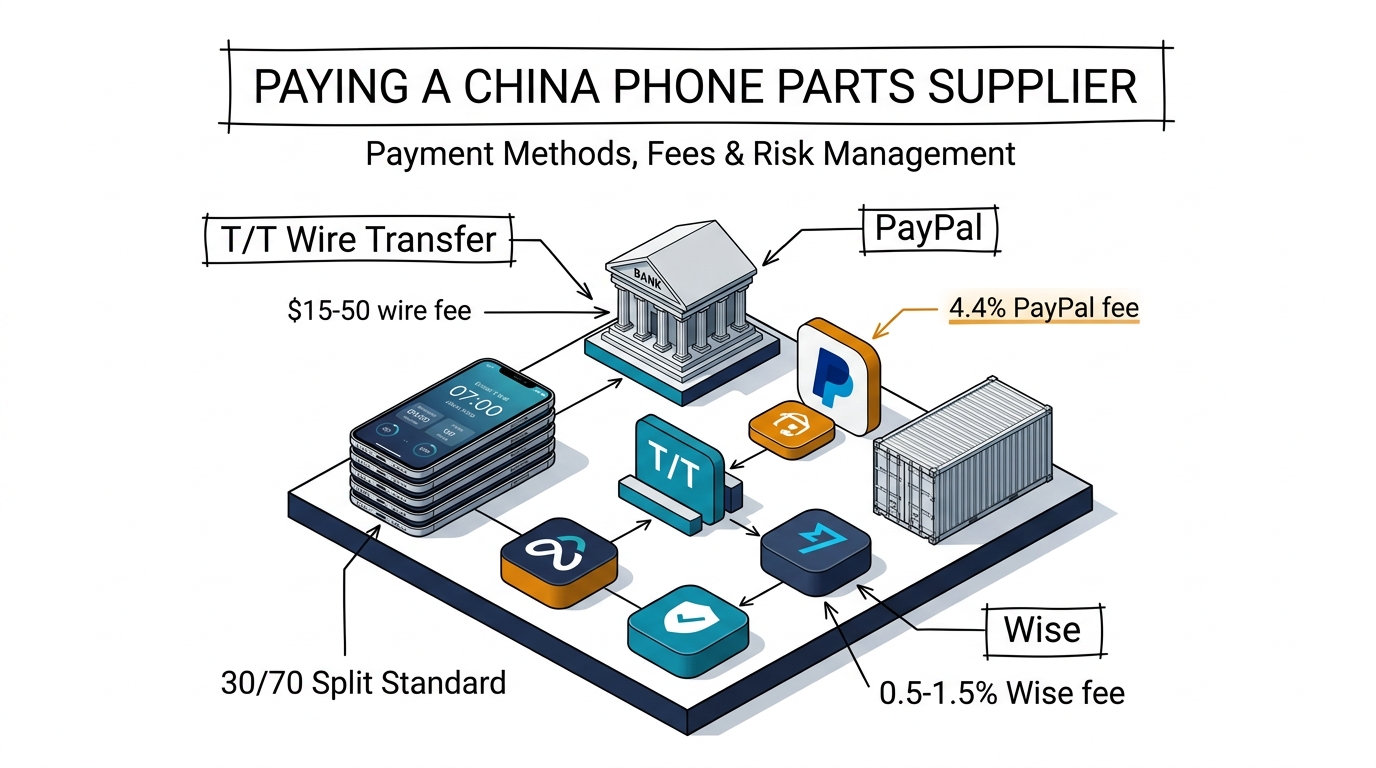
Paying a China phone parts supplier means choosing among three core methods — T/T bank wire, PayPal, and Wise — and structuring the payment as a deposit split rather than one lump sum. For phone parts wholesale orders, the 2026 standard is a 30/70 split: 30% deposit to start production, 70% balance before shipment. PayPal adds a 3–5% surcharge but gives 180-day buyer protection on orders under $1,000; a T/T wire costs $15–50 plus a 1.5–3% FX markup but scales better above $3,000. The right method depends on order size, supplier relationship, and how much protection the buyer needs — not on generic import advice. At PRSPARES in Shenzhen, most repeat buyers settle on T/T with a 30/70 split once a supplier is verified. This guide breaks down each option with real costs and trade-offs, specifically for phone parts orders.
Looking for a Reliable Wholesale Parts Supplier?
Factory-direct from Shenzhen — transparent grades, invoices & 12-month warranty.
Get Wholesale QuoteWhy Payment Method Matters When Buying Phone Parts from China
Payment isn't just logistics. Your choice of payment method directly affects three things:
Your risk exposure. A $3,000 wire transfer to a new supplier carries real risk — if the goods don't arrive or quality is wrong, getting your money back ranges from difficult to impossible. PayPal offers buyer protection, but comes with fees that eat your margin.
Your total landed cost. Payment fees, currency conversion charges, and bank intermediary costs add 1–5% to every order. On a $5,000 screen order, that's $50–$250 in hidden costs. Over 12 months of monthly orders, it compounds significantly.
Your supplier relationship. Chinese suppliers have strong preferences about payment methods. Insisting on a method they don't accept — or one that holds their funds for weeks — can damage the relationship before it starts. Understanding their perspective helps you negotiate terms that work for both sides.
Payment Methods Compared: How to Pay China Phone Parts Suppliers
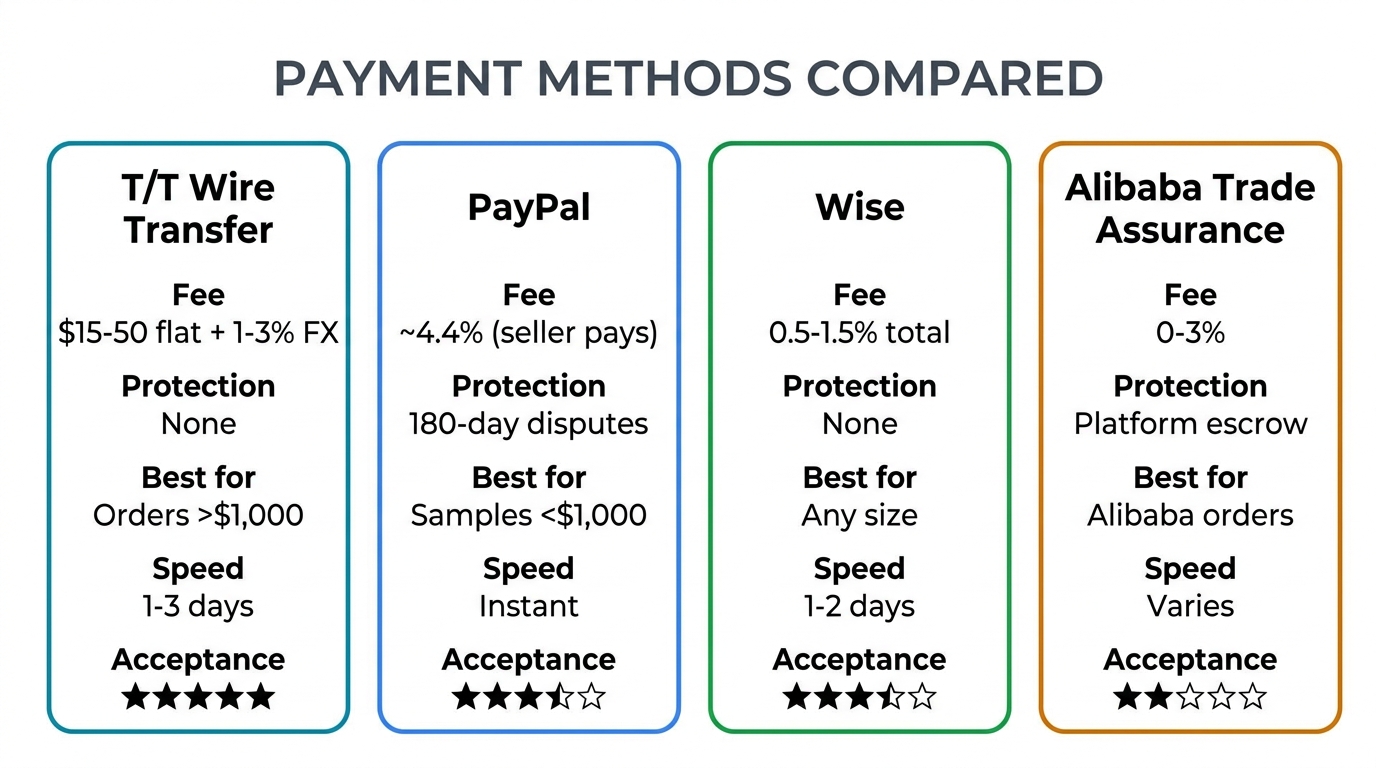
Here's a practical breakdown of the payment methods you'll actually encounter when ordering wholesale phone screens and parts from China:
| Payment Method | Best For | Fees (Buyer Side) | Buyer Protection | Supplier Acceptance | Speed |
|---|---|---|---|---|---|
| T/T (Wire Transfer) | Orders >$1,000 | $15–50 per transfer + 1–3% FX markup | None | Very High | 1–3 business days |
| PayPal | Samples & orders <$1,000 | 0% (supplier absorbs ~4.4%) | Strong (180-day disputes) | Medium | Instant |
| Wise / Wise Business | Orders of any size | 0.5–1.5% total | None | Growing | 1–2 business days |
| Alibaba Trade Assurance | Alibaba-sourced orders | 0–3% depending on method | Strong (platform escrow) | Alibaba sellers only | Varies |
| Western Union | Not recommended | $10–40 + poor FX rate | None | Medium | Minutes to 2 days |
| Letter of Credit (L/C) | Orders >$20,000 | $200–500+ bank fees | Strong (bank-guaranteed) | High for large orders | 5–15 days processing |
T/T (Telegraphic Transfer / Bank Wire)
T/T is the industry standard for B2B phone parts orders. When a Shenzhen supplier says "we accept T/T," they mean an international bank wire transfer to their company's bank account in China.
How it works: You instruct your bank to send USD (or EUR/GBP) to the supplier's Chinese bank account. The bank converts it to CNY on their end. Funds typically arrive within 1–3 business days.
Real costs: Your bank charges a flat fee ($15–50 per transfer, depending on the bank). The bigger hidden cost is the foreign exchange markup — most banks add 1.5–3% above the mid-market exchange rate. On a $3,000 order, that's $45–90 you'll never see itemized.
The risk: Once money leaves your bank, it's gone. There's no chargeback, no dispute mechanism, no platform to complain to. This is why payment splits exist (more on that below).
When to use it: T/T is appropriate for repeat orders with trusted suppliers, or for any order where you're using a 30/70 payment split. It's the cheapest method for orders above $1,000.
PayPal
PayPal is popular for sample orders and small purchases because it offers buyer protection — you can open a dispute within 180 days if goods don't arrive or aren't as described.
Real costs: PayPal charges the receiver approximately 4.4% on international transactions (3.49% + fixed fee + currency conversion). Most Chinese phone parts suppliers pass this cost to you — either as a direct surcharge or by quoting a higher per-unit price for PayPal orders.
The trade-off: On a 50-piece iPhone screen order at $20 each ($1,000 total), the PayPal surcharge is roughly $44. That's more than two additional screens' worth of cost. For sample orders of $100–300, the protection is worth the fee. For $2,000+ orders, the math starts working against you.
Supplier perspective: Many phone parts suppliers dislike PayPal because buyers can open disputes even after receiving goods. Some suppliers have had PayPal accounts frozen due to disputes, locking up their working capital for months. Don't be surprised if a supplier offers a lower price for T/T than for PayPal.
Wise (formerly TransferWise)
Wise has become a strong option for international supplier payments. It uses the real mid-market exchange rate and charges a transparent fee of 0.5–1.5%, significantly lower than traditional bank wire markups.
How it works: You send money through Wise's platform. They convert currency at the real exchange rate and deliver CNY to the supplier's bank account. The supplier receives the payment like a regular domestic transfer.
Real costs: On a $3,000 order, Wise fees typically run $20–45 total — compared to $60–140 through a traditional bank wire when you factor in FX markup.
Limitations: Wise transfers can take 1–2 business days. Some Chinese suppliers aren't familiar with it yet and may initially question whether the money will arrive. Once they receive the first payment, confidence builds quickly.
Alibaba Trade Assurance
If you're sourcing through Alibaba, Trade Assurance acts as an escrow service — Alibaba holds your payment until you confirm the goods meet the agreed specifications.
When it works: Useful for first orders with Alibaba-listed suppliers. Provides a formal dispute resolution mechanism if products don't match the order.
Limitations: Only works for suppliers on Alibaba's platform. Many experienced phone parts suppliers in Shenzhen operate through WhatsApp, WeChat, and direct communication — they may not have Alibaba storefronts or may prefer off-platform transactions for better margins.
Looking for a supplier with flexible payment terms for your first phone parts order? We accept T/T, PayPal, and Wise — and offer a 30/70 split on orders over $1,000. Get a quote with payment details.
Which Payment Method to Use for Phone Parts Orders (by Order Size)
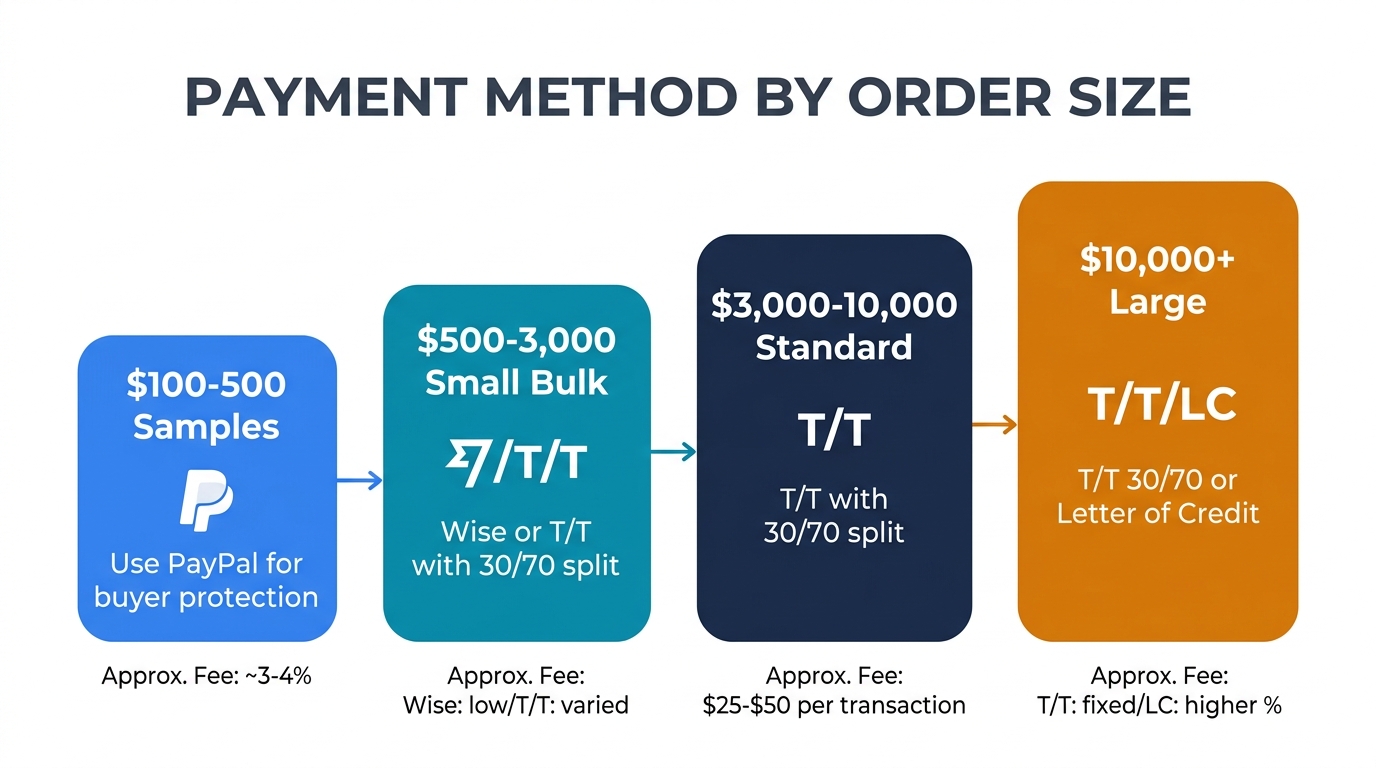
Rather than debating which method is "best" in the abstract, here's what actually makes sense based on typical phone parts order values:
Sample Orders ($100–$500)
Use PayPal. The 4% fee adds $4–20 to your order — a small price for buyer protection when you're testing a new supplier. If the screens arrive dead-on-arrival or don't match the grade, you can dispute it.
Small Bulk Orders ($500–$3,000)
Use Wise or T/T with a 30/70 split. PayPal fees start adding up at this level ($22–$132). A Wise transfer keeps fees under $30 while still offering a traceable payment record. If using T/T, always use a deposit split — never pay 100% upfront to a supplier you haven't ordered from before.
Standard Wholesale Orders ($3,000–$10,000)
Use T/T with a 30/70 split. This is the sweet spot for bank wire — the flat fee becomes negligible relative to order size. Use Wise if your bank's FX markup is particularly high (over 2%). At this order level, you should have already completed at least one successful sample order with this supplier.
Large Orders ($10,000+)
Use T/T with a 30/70 split, or negotiate a Letter of Credit for orders above $20,000. At this volume, even small percentage differences in fees matter. A 1% saving on FX rate for a $15,000 order is $150 — worth negotiating with your bank or using Wise Business.
The 30/70 Payment Split: How It Works and When to Use It
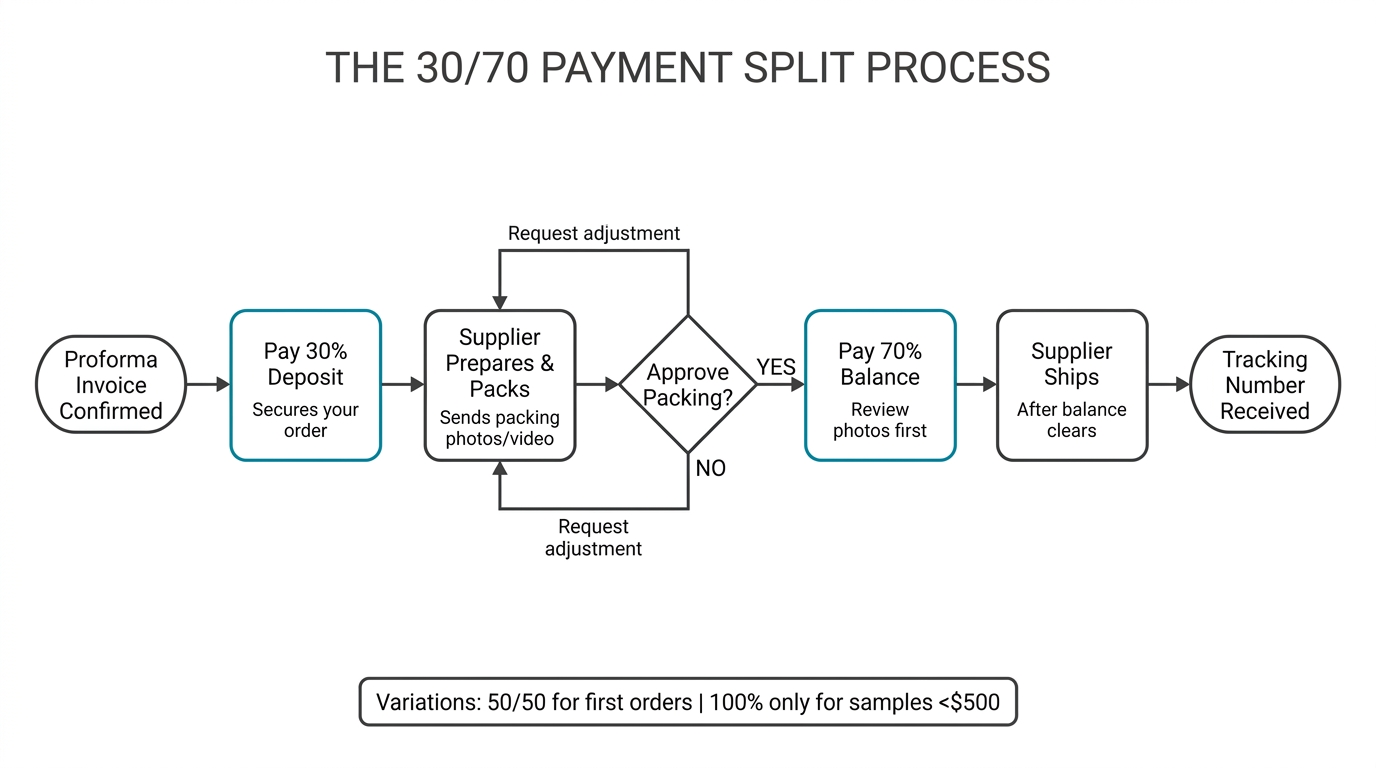
The 30/70 split is the most common payment structure in China's phone parts wholesale trade. Here's the exact process:
- You pay 30% deposit after confirming the proforma invoice. This secures your order and tells the supplier to prepare the goods.
- The supplier prepares and packs your order, then sends you photos or a video showing the packed goods, sometimes with your order number visible on the packages.
- You pay the remaining 70% after reviewing the photos/video and confirming the shipment is ready.
- The supplier ships once the 70% balance clears.
Why it works: You only risk 30% if something goes wrong at the preparation stage. The supplier is motivated to deliver quality because they don't get the remaining 70% until you confirm. It's a trust-building mechanism that protects both parties.
Variations you'll encounter:
- 50/50: Some suppliers request 50% upfront for first orders or for custom/special orders. This is reasonable for initial transactions.
- 100% upfront: Only acceptable for sample orders under $500 or repeat orders with proven suppliers. Never pay 100% upfront on your first large order with a new supplier.
- 0% deposit (net terms): Rare for new relationships. Some established suppliers offer net-30 or net-60 terms to long-standing buyers with a track record of timely payments. You typically need 6–12 months of consistent orders to qualify.
Common Payment Risks When You Pay China Phone Parts Suppliers — and How to Avoid Them
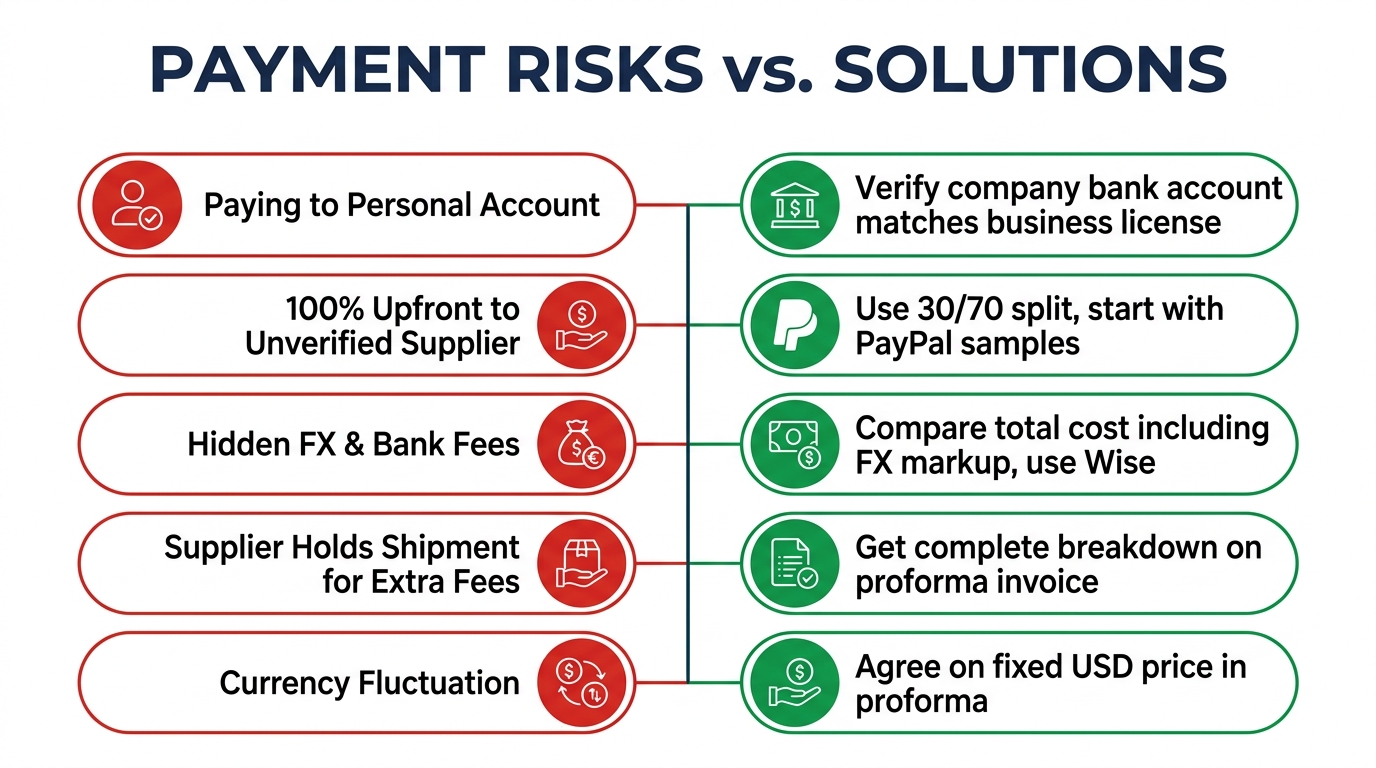
Risk 1: Paying to a Personal Account
The problem: The supplier gives you bank details for a personal account instead of a company account. Personal accounts are harder to verify and offer zero traceability if something goes wrong.
The fix: Always request the company's business bank account. A legitimate Chinese trading company or factory will have a registered business account. The account name should match (or closely match) the company name on their business license. Ask for a copy of their business license if you haven't already — this is standard practice and no serious supplier will refuse.
Risk 2: Wiring the Full Amount to an Unverified Supplier
The problem: You find a supplier offering incredible prices, they push you to pay 100% via T/T immediately, and after payment — radio silence.
The fix: Use the 30/70 split. Verify the supplier before sending any money by checking their business registration, requesting references from other buyers, and starting with a small sample order paid via PayPal. Our guide on choosing a reliable phone parts supplier details the full verification checklist.
Risk 3: Hidden FX and Bank Fees
The problem: Your bank advertises "$25 wire transfer fee" but the real cost is $25 + 2.5% FX markup + possible intermediary bank charges. On a $5,000 order, your "cheap" wire costs you $150+.
The fix: Ask your bank for the total cost including FX markup before initiating the transfer. Compare against Wise or similar platforms. For regular orders, set up a multi-currency account that lets you hold USD and convert to CNY at better rates.
Risk 4: Supplier Holds Shipment After Balance Payment
The problem: You pay the 70% balance, but the supplier delays shipping or claims additional charges (packaging fees, special inspection fees, etc.) that weren't in the original quote.
The fix: Your proforma invoice should list the complete breakdown — unit prices, total quantity, packing charges, shipping method, and total amount. Get written confirmation (email or WeChat message) that the balance payment is the final amount. Any post-payment "extra fees" are a red flag — push back firmly and reference the agreed invoice.
Risk 5: Currency Fluctuation Between Deposit and Balance
The problem: You pay the 30% deposit when USD/CNY is at one rate, and by the time you pay the 70% balance two weeks later, the exchange rate has shifted — your order costs more than expected.
The fix: For most phone parts orders ($1,000–$10,000), the FX fluctuation over 2–3 weeks is minimal — usually under 1%. For larger orders or longer production cycles, agree on a fixed USD price in the proforma invoice so that currency risk sits with the supplier. Most suppliers quote in USD precisely for this reason.
Payment Terms to Negotiate Before Your First Order
Before you send a single dollar, get these terms in writing (email or messaging app is fine — it doesn't need to be a formal contract for typical wholesale orders):
- Payment method and split ratio: "30% T/T deposit, 70% T/T balance before shipment"
- Currency: Most phone parts suppliers quote in USD. Confirm this — paying in CNY can sometimes get you a better price, but adds FX complexity on your end
- What triggers balance payment: "Balance due after buyer reviews packing photos" — not "balance due immediately after deposit"
- Refund policy for defective goods: What happens if the incoming inspection reveals defects above the agreed tolerance? Credit on next order? Partial refund? Replacement shipment?
- Payment deadline: Some suppliers require balance payment within 3–5 days of packing completion, or they reallocate your stock
For context on how MOQ and lead time connect to these payment terms, see our guide on MOQ, sample orders, and lead time.
Frequently Asked Questions
Is PayPal safe for paying a Chinese phone parts supplier?
PayPal is a payment method that offers 180-day buyer protection, which makes it suitable for sample and small phone parts orders under $1,000. The main drawback is cost: China phone parts suppliers typically add a 3–5% surcharge to cover PayPal fees. For example, on a $2,000 order that surcharge adds $60–100. For larger wholesale orders in 2026, a T/T wire with a 30/70 deposit split offers better economics, managing risk through staged payments rather than platform protection.
Should I pay 100% upfront for my first wholesale order?
No. Standard practice in China's phone parts trade is a 30/70 or 50/50 deposit split. Only pay 100% upfront for sample orders under $500 or for repeat orders with a supplier you've already verified through multiple successful transactions. Any supplier insisting on 100% upfront for a large first order is either inexperienced or potentially untrustworthy.
What bank fees should I expect for a T/T wire transfer to China?
A T/T wire transfer to China carries $15–50 in flat bank fees plus a hidden 1.5–3% foreign-exchange markup above the mid-market rate. Intermediary banks may add another $10–25. For example, on a $3,000 phone parts order, total costs typically run $60–140 through a traditional bank in 2026. Using Wise or a similar platform cuts this to $20–45 by charging the real mid-market rate. Always confirm whether your bank or the supplier's bank absorbs intermediary charges before wiring.
Can I use Alibaba Trade Assurance for phone parts orders?
Alibaba Trade Assurance is an escrow service that holds your payment until you confirm the phone parts meet specifications — useful for a first order with an unfamiliar seller. It only works if the supplier sells on Alibaba's platform. In practice, many established phone parts suppliers in Shenzhen and Huaqiangbei trade directly via WhatsApp or WeChat and do not list on Alibaba, so Trade Assurance is not always available. For those direct suppliers, a 30/70 T/T split paid to a verified business bank account gives comparable protection in 2026.
How do I verify a Chinese supplier's bank account is legitimate?
Verifying a Chinese supplier's bank account is a three-step check. First, confirm the bank account name matches the registered company name exactly. Second, request the Chinese business license (营业执照) and verify the registration number and legal representative. Third, cross-check those details against the National Enterprise Credit Information Publicity System (gsxt.gov.cn), a free government database. For example, if a Shenzhen supplier's invoice names one company but the bank account names an individual, your recovery odds drop to near 0% — do not proceed. PRSPARES pays out only to a registered company account so buyers can run this check in 2026.
Send Money with Confidence
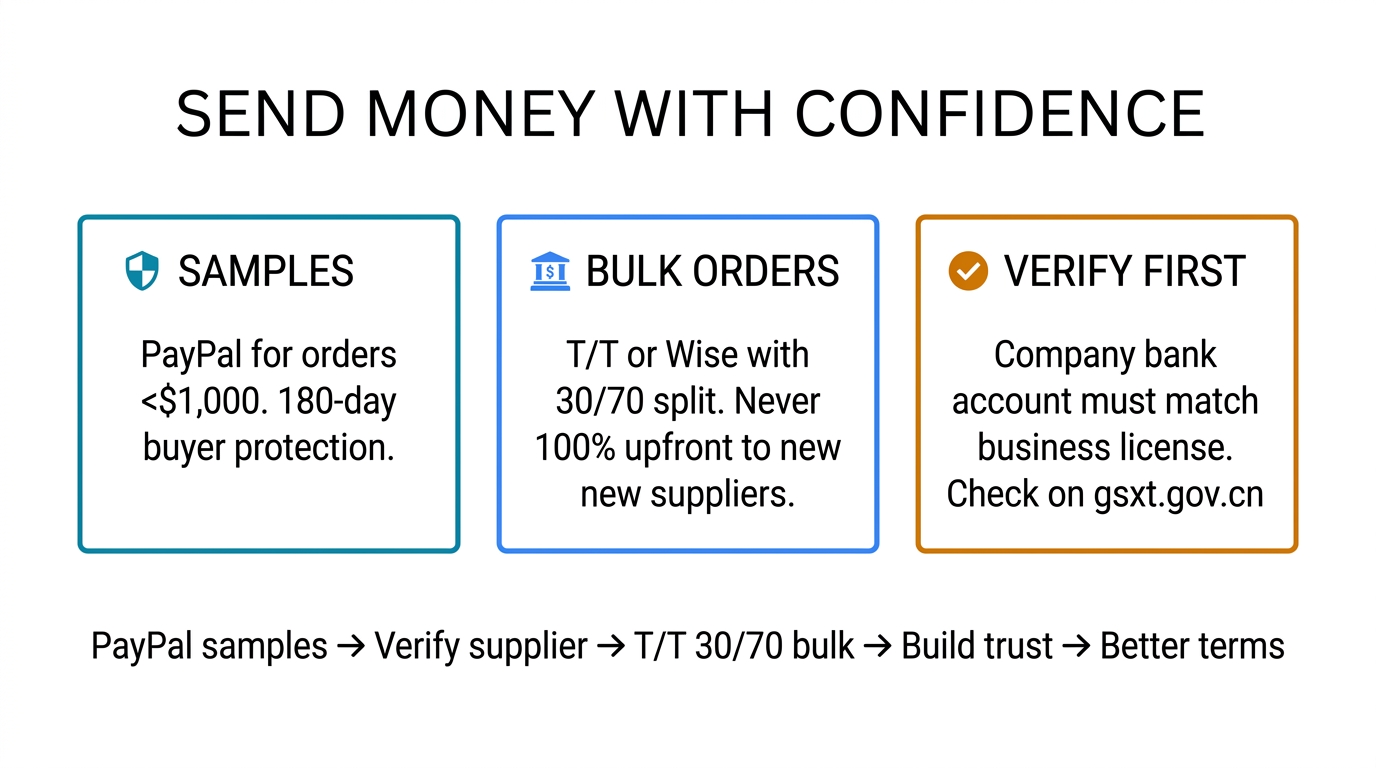
The payment stage is where your supplier relationship either builds trust or falls apart. Start with PayPal for samples, move to T/T or Wise with a 30/70 split for bulk orders, and always verify the supplier's business account before sending money. As your relationship matures and order volumes grow, you'll earn better terms — faster shipping priority, lower deposit ratios, and occasionally net payment terms.
The goal isn't to eliminate all risk — it's to manage it proportionally to each order. A $200 sample order doesn't need the same safeguards as a $10,000 bulk shipment. Match your payment method to the stakes involved.
Ready to place your first order with clear payment terms? Request a wholesale quote — we'll send you a detailed proforma invoice with transparent pricing, payment options, and a 30/70 split structure for your first order.