
Cell Phone Screens Wholesale: What Repair Shops Should Buy in 2026
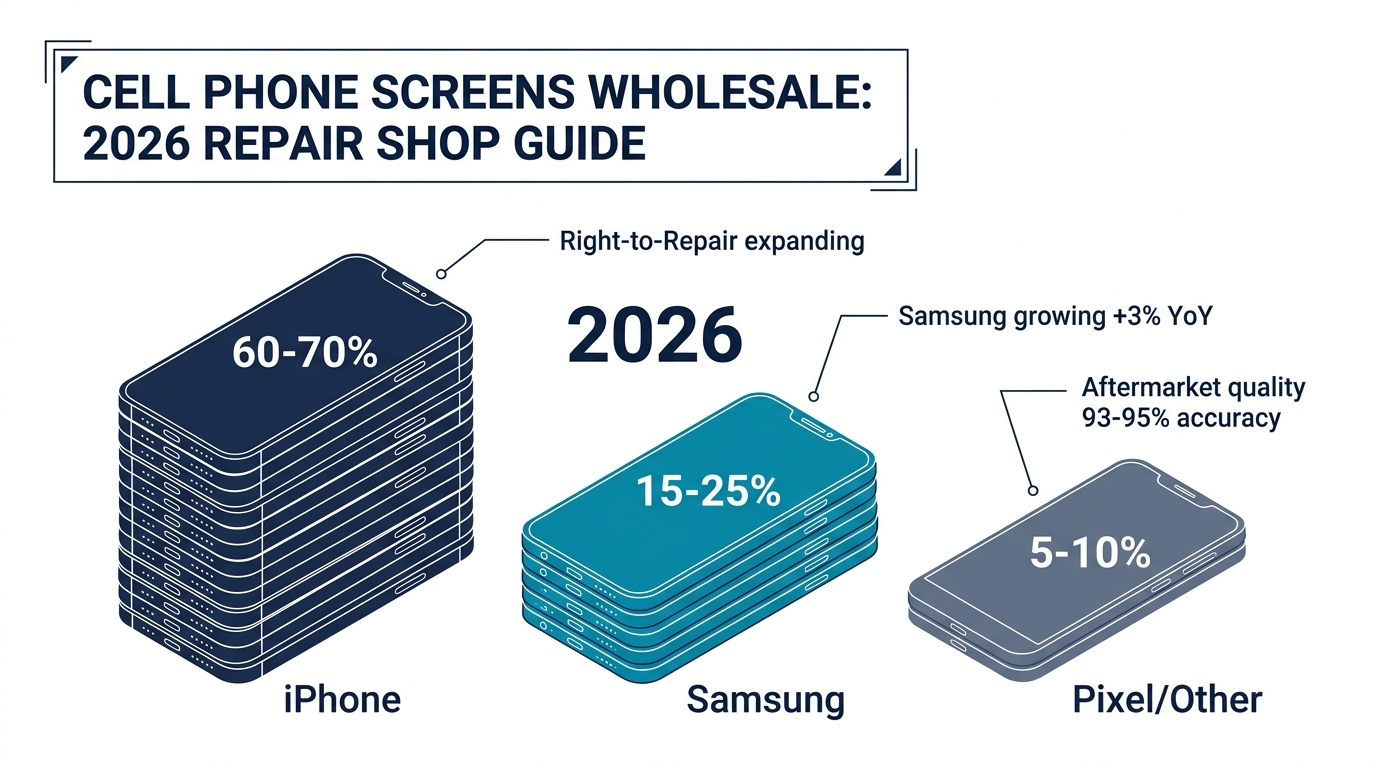
Cell phone screens wholesale in 2026 means stocking the right brand mix at the right grades: roughly 60–70% of the budget on iPhone, 15–25% on Samsung, and 5–10% on Pixel and others. The market has shifted fast. First, right-to-repair laws are expanding parts access. Second, Samsung repair volume is catching up to iPhone. Third, Apple's part-pairing keeps tightening on newer models, and screen prices across all grades have dropped 8–15% as aftermarket supply matures in 2026. For repair shops, these shifts change what to stock, from which brands, at what grades, and from which suppliers. This guide gives a concrete purchasing plan based on where the repair market is now — not where it was in 2024.
Sourcing Replacement Screens in Bulk?
Incell / Hard OLED / Soft OLED grades — wholesale pricing, grade comparison on request.
Get Wholesale QuoteWhat's Changed in the Cell Phone Screen Wholesale Market in 2026
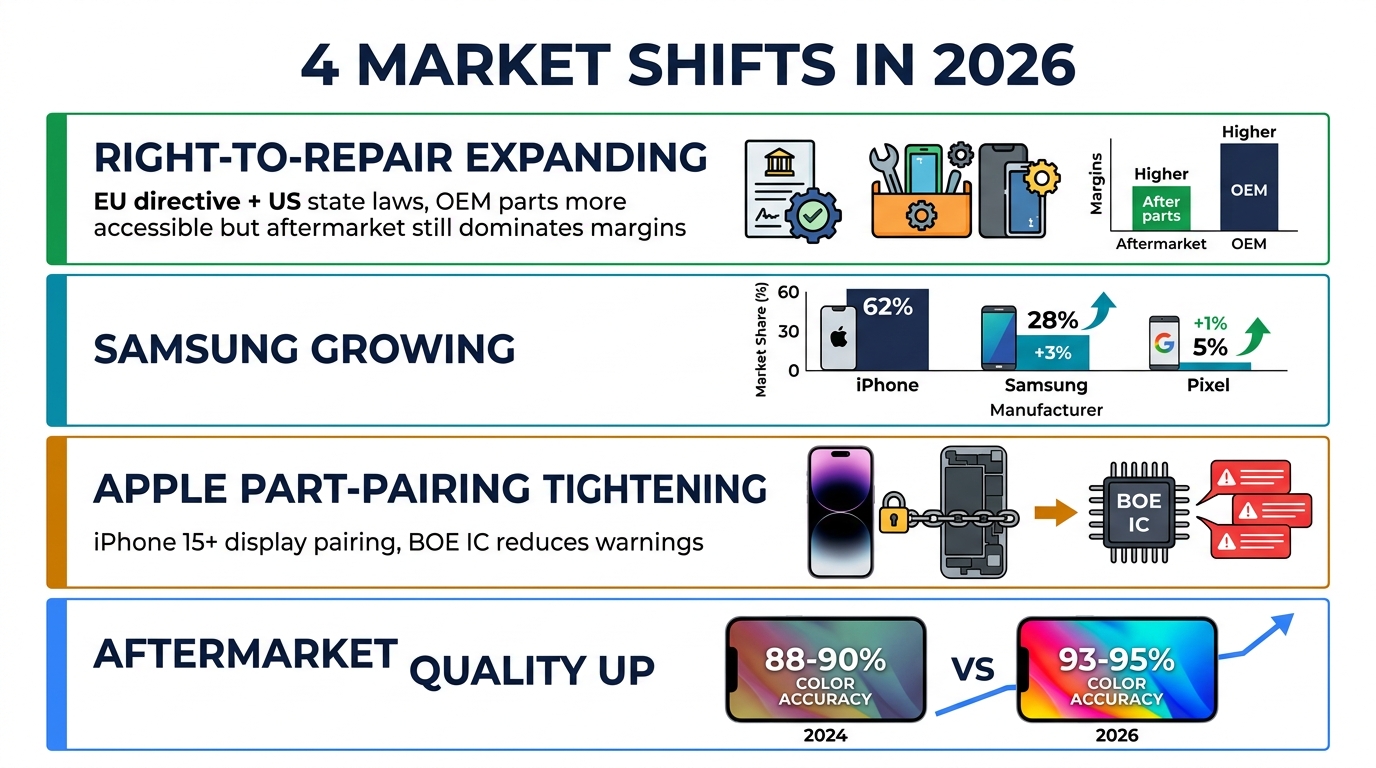
The 2026 cell phone screens wholesale market is a moving target shaped by four shifts that should drive every purchasing decision. First, right-to-repair laws are expanding parts access. Second, Samsung repair volume is growing about 3% year over year. Third, Apple's part-pairing keeps tightening on newer models. Fourth, aftermarket quality has climbed to 93–95% color accuracy. For example, a shop ignoring Samsung now leaves 25–30% of walk-in revenue on the table. The four sections below detail each shift before the model-by-model buying plan.
Shift 1: Right-to-Repair Is Expanding Parts Access
The EU's right-to-repair directive (effective since mid-2025) and expanding US state legislation are pressuring manufacturers to make original parts more accessible. What this means for wholesale buyers:
- Apple Self-Service Repair now covers iPhone 12 through 16, with genuine display assemblies available (though at near-retail pricing)
- Samsung has expanded authorized repair partnerships, making OEM screens more available through independent channels
- Practical impact: OEM Refurbished screens are slightly more available and 5–10% cheaper than a year ago. But aftermarket grades (Soft OLED, Hard OLED, Incell) remain the profit center for most repair shops because OEM pricing still can't compete on margin
Shift 2: Samsung Repair Volume Is Growing
Samsung's US market share has been climbing, and Galaxy screen repairs are following. For shops that are iPhone-only, 2026 is the year to consider adding Samsung:
| Brand | Estimated US Repair Market Share 2025 | 2026 Trend |
|---|---|---|
| iPhone | ~62% | Stable, slight decline |
| Samsung | ~28% | Growing (+3% YoY) |
| Google Pixel | ~5% | Growing (+1% YoY) |
| Other (Motorola, OnePlus) | ~5% | Stable |
The growth in Samsung repair comes from the Galaxy S23 and A54 reaching their 2–3 year peak repair window. If your shop turns away Samsung customers, you're leaving 25–30% of potential revenue to competitors.
Shift 3: Apple Part-Pairing Is Tightening
Starting with iPhone 15, Apple expanded part-pairing to include displays. Replacing the screen with any non-paired part triggers a "Parts and Service History" notification. On iPhone 16, this extends to more components.
What this means for wholesale buyers:
- Aftermarket screens still work perfectly — the notification is cosmetic, not functional
- But customers who see the warning may panic or demand a "genuine" screen
- Your repair staff needs to explain this proactively before installation
- Screens with BOE IC and pre-programmed serial data trigger fewer warnings than generic IC screens
Practical tip: Create a simple one-page handout for customers explaining part-pairing notifications. Something like: "You may see an 'Unable to verify genuine display' message. This is normal for all third-party screen replacements, including those at authorized service providers who don't use Apple's proprietary system. Your screen functions identically to the original." This pre-empts 90% of post-repair calls about the warning.
Shift 4: Aftermarket Screen Quality Has Improved
Aftermarket screen quality in 2026 is a near-OEM proposition. First, soft OLED screens from tier-1 manufacturers now deliver 93–95% color accuracy versus original, up from 88–90% two years ago. Second, hard OLED has improved similarly. For example, a credible "premium" soft OLED tier now passes without customer complaint. This means:
- Customers are less likely to notice aftermarket screens
- Your callback rate on quality complaints should be lower
- Soft OLED is now a credible "premium" tier that most customers accept without complaint
The 2026 Cell Phone Screens Wholesale Priority List
The 2026 cell phone screens wholesale priority list is a budget allocation by repair demand: roughly 60–70% on iPhone, 15–25% on Samsung, and 5–10% on Pixel and others. For example, a shop doing 10 repairs a day should weight the iPhone 15 and 14 as core models. The three priority tiers below rank the specific models, grades, and monthly order quantities to stock in 2026, based on current repair demand and market pricing.
Priority 1: iPhone Screens (60–70% of Your Budget)
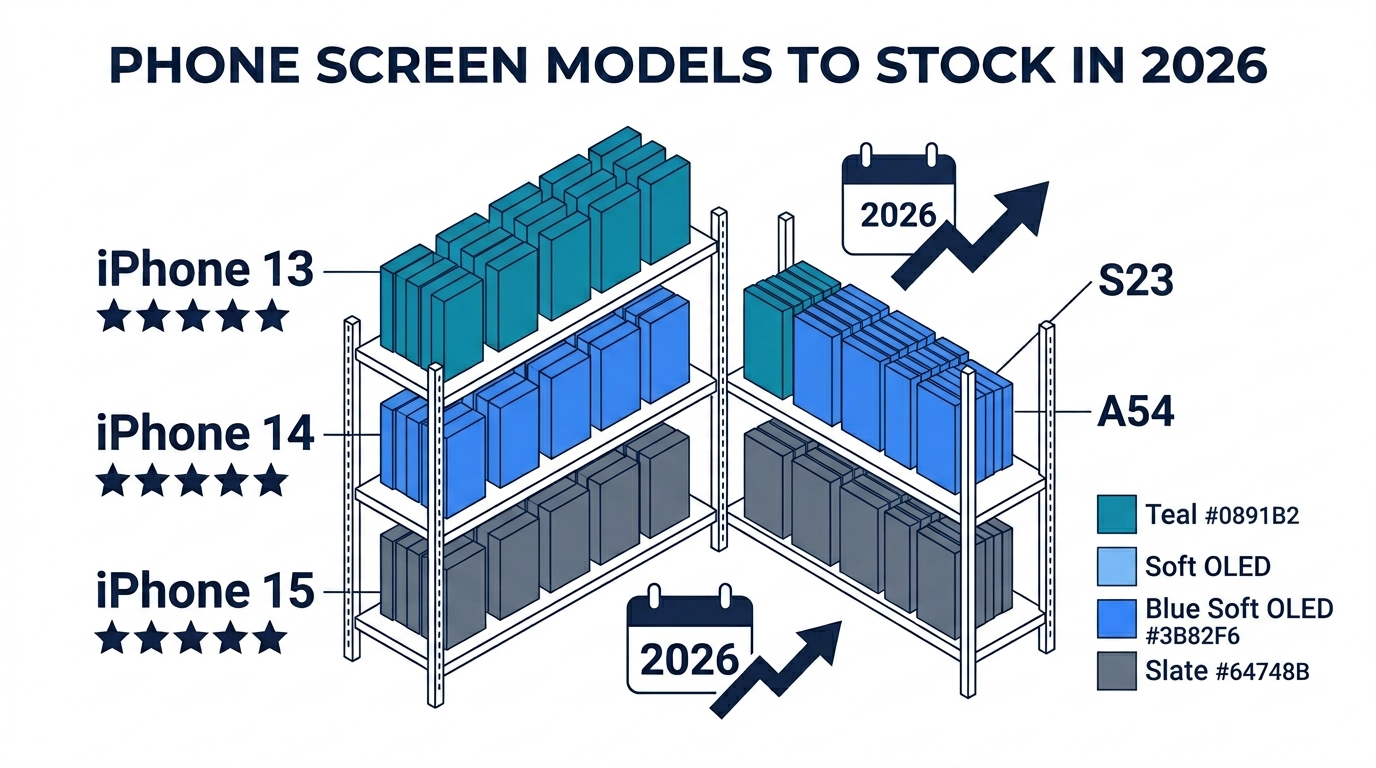
iPhone is the core of screen-repair revenue in 2026, accounting for 60–70% of a typical shop's screen budget. First, the iPhone 15 and 14 together drive the highest current repair volume, at 40–60 units each per month. Second, the iPhone 16 stays on-demand until its pricing settles. For example, a 10-repairs-a-day shop weights 80% of its iPhone spend on these models. The 2026 model ranking below lists the best grade and monthly order quantity:
| Rank | Model | Best Grade | Why Prioritize | Monthly Order Guide (10 repairs/day shop) |
|---|---|---|---|---|
| 1 | iPhone 15 | Hard OLED | Warranties expiring now, peak demand building | 40–50 units |
| 2 | iPhone 14 | Hard OLED | Highest current repair volume | 50–60 units |
| 3 | iPhone 15 Pro | Soft OLED | ProMotion requires flexible OLED | 20–30 units |
| 4 | iPhone 14 Pro | Soft OLED | Still strong Pro demand | 20–25 units |
| 5 | iPhone 13 | Incell or Hard OLED | Budget segment, declining slowly | 15–20 units |
| 6 | iPhone 16 | Hard OLED | Growing but pricing still elevated | 10–15 units (on-demand OK) |
Skip for now: iPhone 12 and older (order on-demand only), iPhone 16 Pro/Pro Max (pricing premium too high, supply tight).
For model-by-model grade recommendations, see our iPhone screens wholesale OLED vs Incell comparison. For inventory optimization, see our guide on avoiding overstocking slow models.
Priority 2: Samsung Screens (15–25% of Your Budget)
Samsung screens are the second budget priority in 2026 at 15–25% of spend, and the entry point is a short model list. For example, the Galaxy S23 and A54 cover the majority of Samsung repair demand. Start with these five models, their screen types, and best grades:
| Rank | Model | Screen Type | Best Grade | Why Stock It |
|---|---|---|---|---|
| 1 | Galaxy S23 | Dynamic AMOLED | Soft OLED | Entering peak repair window. High repair value. |
| 2 | Galaxy A54 | Super AMOLED | Aftermarket OLED | Huge installed base in mid-range segment. |
| 3 | Galaxy S22 | Dynamic AMOLED | Soft OLED or Hard OLED | 2+ years old, steady repair demand. |
| 4 | Galaxy A34 | Super AMOLED | Aftermarket OLED | Budget Samsung with surprising repair volume. |
| 5 | Galaxy S24 | Dynamic AMOLED | Soft OLED | Still new — stock conservatively. |
Samsung-specific note: Samsung screens are more complex to source than iPhone because Samsung uses curved displays on S-series models. Curved Soft OLED screens cost 20–40% more than flat equivalents and require more installation skill. Factor this into your repair pricing.
Samsung A-series opportunity: The Galaxy A54 and A34 represent a growing repair segment that most shops overlook. These mid-range phones sold in massive volumes globally, and their owners are more repair-inclined than flagship buyers — a $90 screen repair makes obvious economic sense on a $350 phone. Aftermarket OLED screens for A-series models cost $20–$30 wholesale, giving you a comfortable 70%+ margin at standard repair pricing. If you're only stocking S-series Samsung, you're missing the higher-volume, easier-margin segment.
For Samsung screen sourcing details, see our wholesale Samsung screens guide.
Priority 3: Google Pixel and Others (5–10% of Your Budget)
A Google Pixel screen allocation is a 5–10% budget line, worth stocking only at consistent demand — the Pixel 7, 7a, 8, and 8a if a shop sees steady repairs. Pixel volume is small but growing in 2026, and competition among shops is low, so a shop can charge premium repair prices. For example, stock 5–10 screens of the top 2 Pixel models, which run $35–$55 wholesale in 2026. Order Motorola, OnePlus, and Xiaomi on-demand only — their repair volume is too fragmented to justify pre-stocking unless your market has high demand for those brands.
Building Your 2026 Cell Phone Screens Wholesale Budget
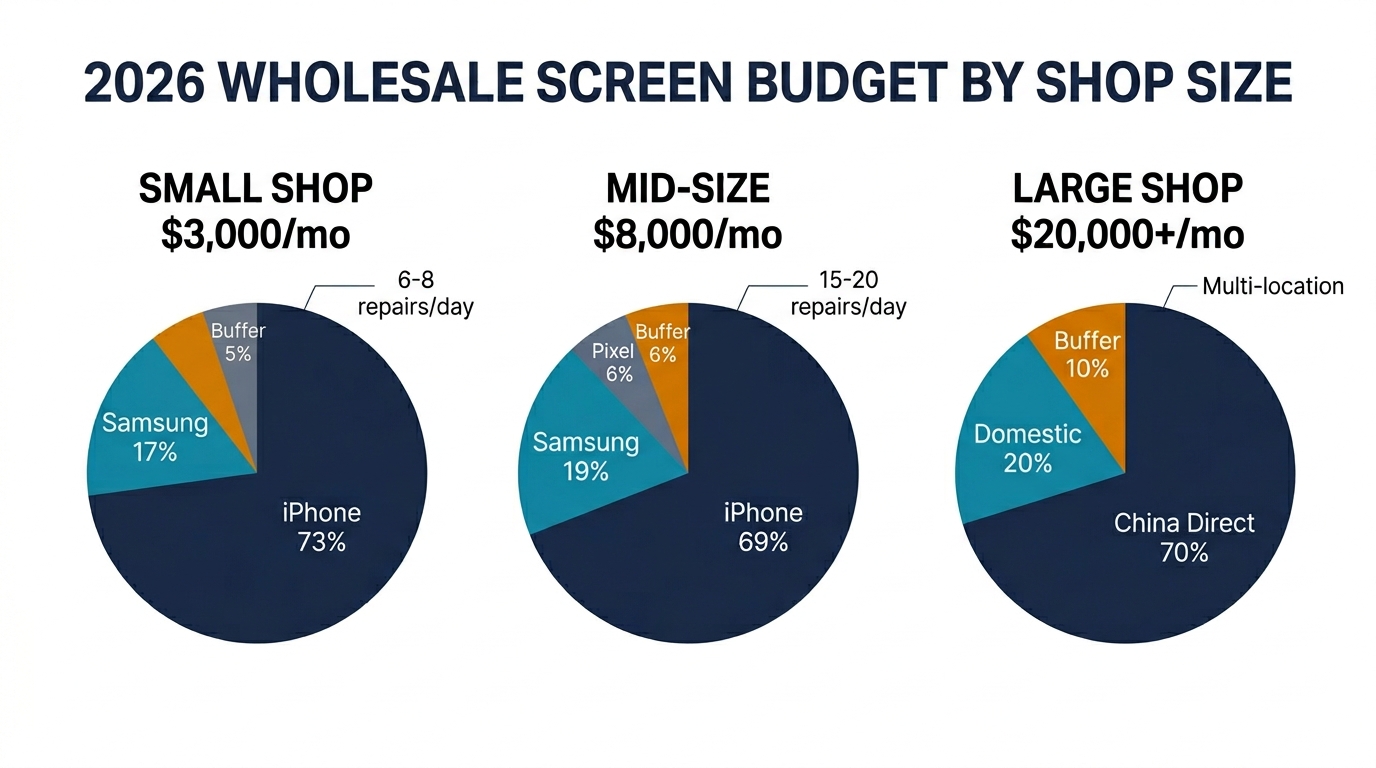
A 2026 cell phone screens wholesale budget is a monthly screen-spend plan that scales with shop size: about $3,000 for a small shop, $8,000 for a mid-size shop, and $20,000+ for a large or multi-location operation. For example, a $3,000 budget covers roughly 120 iPhone and 15 Samsung screens a month. The three templates below break down each budget by brand, model, and grade — adjust the mix to match your actual repair data.
Small Shop: $3,000/Month Screen Budget
A $3,000/month screen budget is the right starting point for a small shop doing 6–8 repairs a day, split roughly 73% iPhone, 17% Samsung, 5% Pixel, and 5% buffer. For example, that spend covers about 120 iPhone and 15 Samsung screens a month in 2026.
| Category | Allocation | Models | Grade Focus |
|---|---|---|---|
| iPhone | $2,200 (73%) | iPhone 14, 15, 13, 15 Pro | Hard OLED + Incell |
| Samsung | $500 (17%) | Galaxy S23, A54 | Aftermarket OLED |
| Pixel/Other | $150 (5%) | Pixel 8, 7a | On-demand |
| Buffer | $150 (5%) | Emergency restocks | — |
This covers ~120 iPhone screens + ~15 Samsung screens per month, supporting 6–8 repairs per day.
Mid-Size Shop: $8,000/Month Screen Budget
| Category | Allocation | Models | Grade Focus |
|---|---|---|---|
| iPhone | $5,500 (69%) | iPhone 14, 15, 15 Pro, 14 Pro, 13, 16 | Hard OLED + Soft OLED + Incell |
| Samsung | $1,500 (19%) | Galaxy S23, S22, A54, A34 | Soft OLED + Aftermarket |
| Pixel/Other | $500 (6%) | Pixel 8, 8a, 7 | Aftermarket OLED |
| Buffer | $500 (6%) | Emergency restocks + new model testing | — |
This covers ~250 iPhone screens + ~40 Samsung screens + ~15 Pixel screens, supporting 15–20 repairs per day.
Building your first wholesale screen budget? Tell us your daily repair count and top models — we'll customize a purchasing plan with grade recommendations and pricing for each model. Get a custom budget plan.
Large Shop / Multi-Location: $20,000+/Month Screen Budget
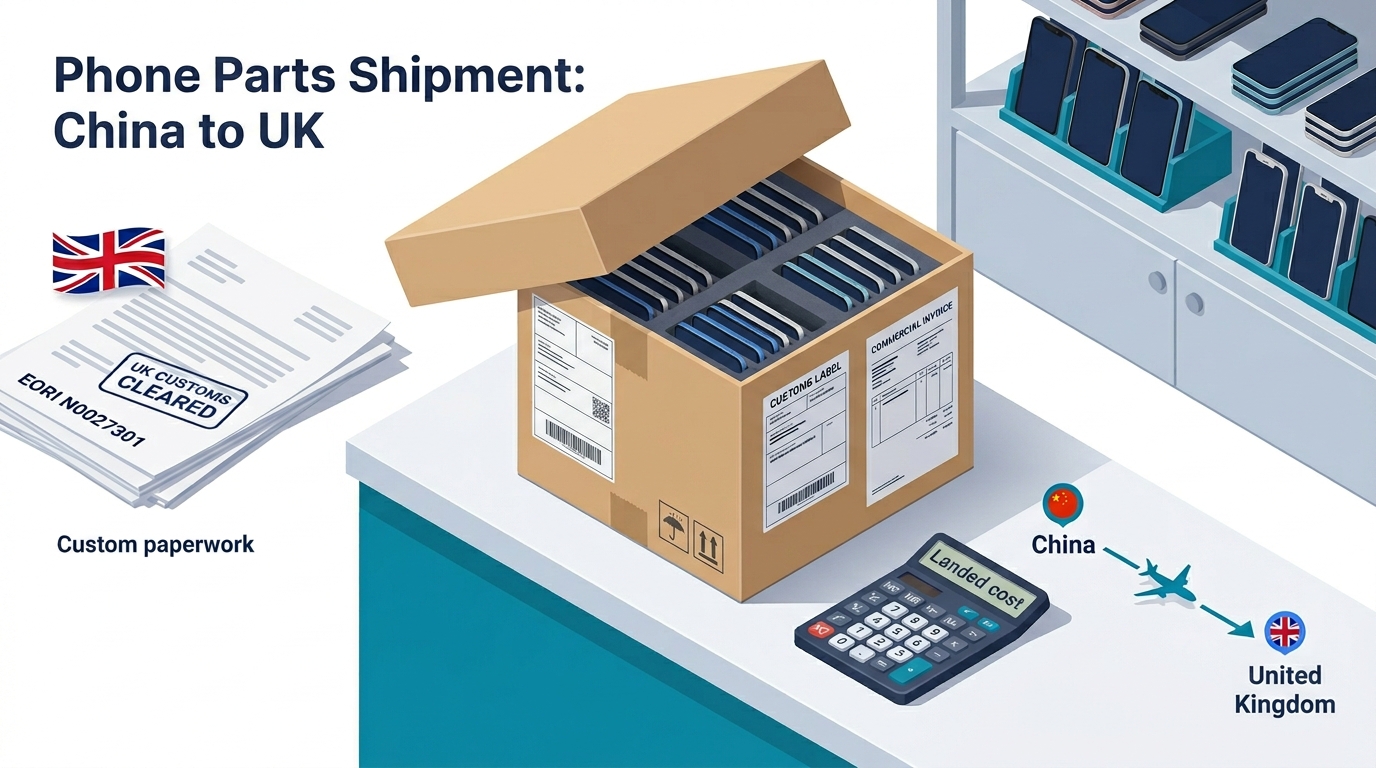
A $20,000+/month screen budget is a multi-source operation: source core inventory directly from China for 20–40% savings, and keep a domestic distributor for emergency restocks. For example, allocate 70% to monthly China-direct orders and 20% to weekly domestic restocks in 2026. Budget split:
- China direct orders (monthly): 70% of budget — core models, all grades, 3–4 week lead time
- Domestic distributor (weekly): 20% of budget — fast restocks of your top 5 models
- Buffer: 10% — new model testing, seasonal demand spikes, promotional repairs
For China sourcing logistics, see our guides on paying a China supplier and Huaqiangbei vs online sourcing.
Multi-location tip: Centralize purchasing but decentralize inventory tracking. One person negotiates with suppliers and places orders, but each location tracks its own usage data and submits reorder requests. This prevents Location A from hoarding iPhone 15 screens while Location B runs out. A shared spreadsheet updated weekly is enough — you don't need expensive inventory software to start.
5 Purchasing Mistakes Repair Shops Make in 2026
Each cell phone screens wholesale purchasing mistake below is a habit-driven error that costs real revenue in 2026. The five share one root cause: buying on habit instead of current demand data. They are ignoring Samsung entirely, over-stocking the iPhone 16 Pro Max, using one grade for everything, buying on last year's demand, and having no dedicated Samsung supplier. For example, an iPhone-only shop forfeits 25–30% of walk-in repair revenue, often $2,000–$4,000 a month. Each mistake below comes with its fix.
Mistake 1: Ignoring Samsung Entirely
Ignoring Samsung entirely is a mistake that leaves 25–30% of walk-in revenue on the table. The fix is small. Start with the Galaxy S23 and A54, two grades each. For example, those 4 SKUs cover most Samsung repairs in a typical area in 2026 — often 20–30% of total repair volume, worth $1,500–$3,000 monthly.
Mistake 2: Stocking iPhone 16 Pro Max Aggressively
Stocking the iPhone 16 Pro Max aggressively is a margin trap. Its soft OLED screens cost $60–$80 wholesale, so repair pricing must hit $220+ to hold margin. For example, most customers with a $1,199 phone choose Apple's own repair or an insurance claim over a third-party shop at that price. Stock 5–10 units maximum unless you have proven 2026 demand.
Mistake 3: Using One Grade for Everything
Using one grade for everything is a profit cap. Stocking only Incell saves cash upfront but limits revenue; stocking only soft OLED ties up capital. For example, the most profitable shops stock two grades per model — one mid-tier hard OLED and one premium soft OLED — and let the customer choose. That upsell adds $20–$40 per repair in 2026.
Mistake 4: Buying Based on Last Year's Demand
Buying based on last year's demand is a recurring error in 2026. The iPhone model that drove your 2025 volume is not necessarily your 2026 leader. For example, the iPhone 13 was many shops' #1 in 2024. By mid-2026 the iPhone 15 takes that spot — a 30–40% swing in repair share within a year, worth $1,000+ in misallocated stock. Update model priorities every quarter from installation data, not memory.
Mistake 5: No Dedicated Samsung Supplier
Having no dedicated Samsung supplier is a quality risk. Your iPhone supplier may also sell Samsung screens, but pricing and quality are rarely competitive, because Samsung needs different expertise — curved AMOLED, frame alignment, and fingerprint-sensor compatibility. For example, vet a Samsung-specialist supplier with the same rigor you used on iPhone screens — a quality mismatch can push Samsung RMA above 3% in 2026. Use our supplier scoring framework for evaluation.
The 2026 Repair Shop Screen Starter Kit
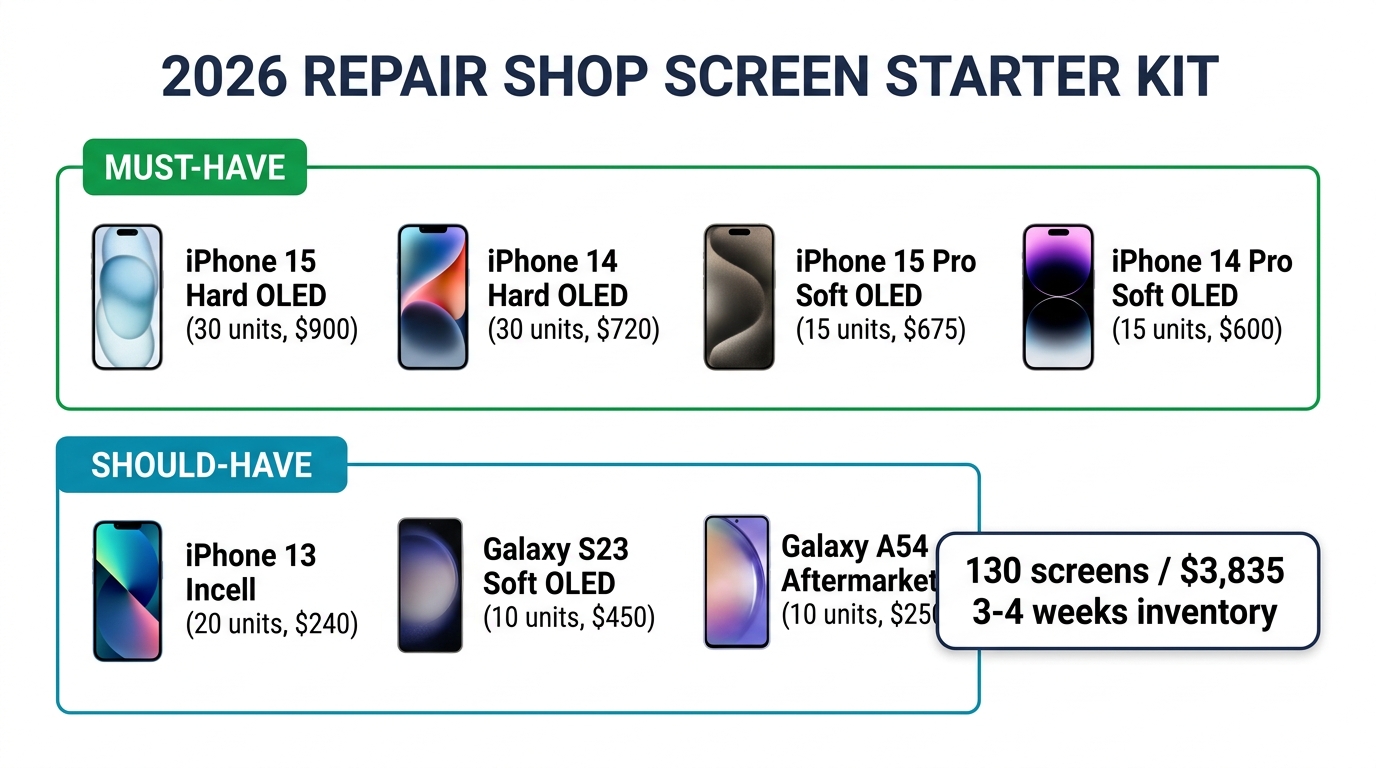
For shops opening in 2026 or completely rebuilding their inventory, here's a first-order recommendation:
| Model | Grade | Quantity | Est. Cost | Priority |
|---|---|---|---|---|
| iPhone 15 Hard OLED | Hard OLED | 30 | $900 | Must-have |
| iPhone 14 Hard OLED | Hard OLED | 30 | $720 | Must-have |
| iPhone 15 Pro Soft OLED | Soft OLED | 15 | $675 | Must-have |
| iPhone 14 Pro Soft OLED | Soft OLED | 15 | $600 | Must-have |
| iPhone 13 Incell | Incell | 20 | $240 | Should-have |
| Galaxy S23 Soft OLED | Soft OLED | 10 | $450 | Should-have |
| Galaxy A54 Aftermarket | Aftermarket OLED | 10 | $250 | Should-have |
| Total | 130 screens | $3,835 |
This starter kit covers the 7 highest-demand models across two brands, using the optimal grade for each. It supports approximately 3–4 weeks of inventory for a shop doing 6–8 repairs per day.
After your first month, adjust quantities based on actual repair data. Some models will move faster than expected, others slower. The starter kit gets you operational — your data refines it.
Frequently Asked Questions
What percentage of my screen budget should go to Samsung in 2026?
Samsung's share of a US repair shop's wholesale screen budget in 2026 is the 15–25% range. In markets with above-average Samsung usage — college towns and budget-conscious areas — push toward 25%; in iPhone-dominant affluent suburbs, 15% is enough. For example, start with the Galaxy S23 and Galaxy A54, because these two models cover the majority of Samsung repair demand. Review the split each quarter against point-of-sale data, since brand mix shifts faster than most shops expect.
Should I buy cell phone screens wholesale from China or a US distributor?
The best approach is a hybrid one. First, use a China-based supplier for planned monthly inventory: it runs 20–40% cheaper with a 7–15 day lead time. Second, keep a US distributor for emergency restocks, which deliver in 1–3 days at a higher per-unit cost. For example, order your monthly iPhone and Samsung screens from Shenzhen at volume pricing, then hold a thin US buffer for models that run out unexpectedly. This 2026 split gives the best pricing on planned orders and the speed you need on surprises.
How often should I update my wholesale screen inventory mix?
Updating a wholesale screen inventory mix is a quarterly task at minimum. Each quarter, pull the top 10 models by repair volume from point-of-sale data and compare against the current stocking list. For example, the iPhone 13 ranked #1 for many shops in late 2024 but dropped to #3 or #4 by early 2026. Models enter and exit the priority list within 6–12 months, faster than most owners expect. Monthly reviews are even better if the POS system makes the report easy to pull.
Is it worth stocking Google Pixel screens wholesale?
Stocking Google Pixel screens wholesale is a low-volume, high-margin play that pays off only at 3–4 repairs per week for a specific model. Pixel demand is growing in 2026 but still trails iPhone and Samsung by a wide margin. The advantage is low competition: under 10% of repair shops stock Pixel screens, so you can charge a premium. For example, start with 5–10 screens for a top model such as the Pixel 7, and gauge weekly demand before committing more budget.
What's the minimum budget to start buying cell phone screens wholesale?
The minimum budget to start buying cell phone screens wholesale is $2,000–$3,000, which buys 100–130 screens across your top 5–7 models. That inventory supports 3–4 weeks of repairs for a shop doing 5–8 jobs daily in 2026. Smaller budgets work if you narrow to fewer models and one grade per model — but expect more frequent reorders and some lost customers who want a grade you do not stock. PRSPARES sets no fixed MOQ, so shops can start small and scale.
Buy for 2026, Not 2024
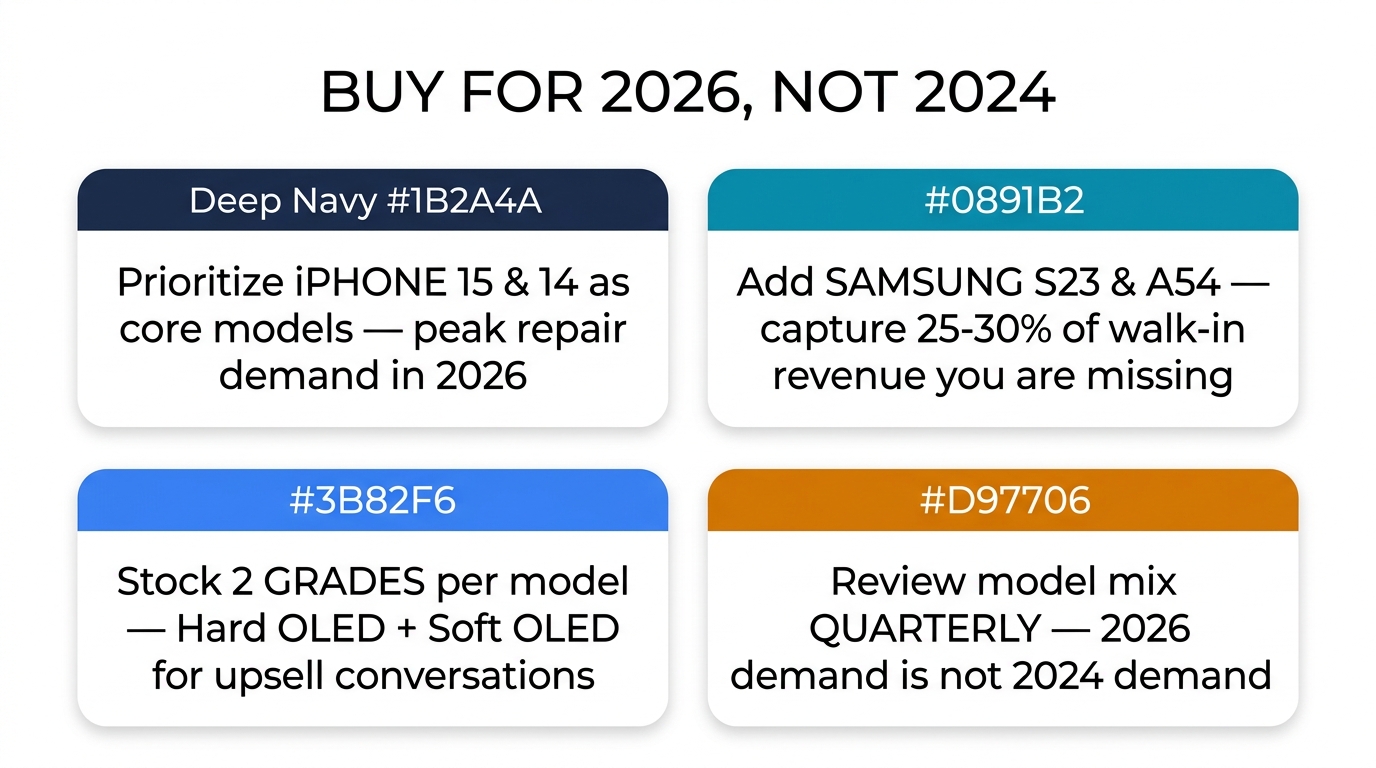
The 2026 cell phone screens wholesale market is a game of adaptation: it rewards shops that buy for current demand, not last year's inventory plan. For example, the winners prioritize the iPhone 15 and 14 as core models and review the budget every quarter. Prioritize iPhone 15 and 14 as your core models, add Samsung S23 and A54 to capture growing demand, stock two grades per model to maximize repair revenue, and keep your budget allocated with quarterly reviews.
Ready to build your 2026 screen inventory? Share your shop size, daily repair count, and current model mix. We'll create a customized ordering plan with model-specific grade recommendations and competitive pricing.
Request a 2026 Inventory Plan — include your details for a tailored recommendation within 24 hours.
Related reading: