
Wholesale Phone Screens vs OEM Pulls vs Aftermarket: Which Is Better for Profit?
Most repair shop owners think about screens in terms of quality grades — Incell, Hard OLED, Soft OLED, OEM. But the grade is only half the equation. The other half is where you buy it — and the sourcing channel you choose can change your profit per repair by $15–$30 on the same screen.
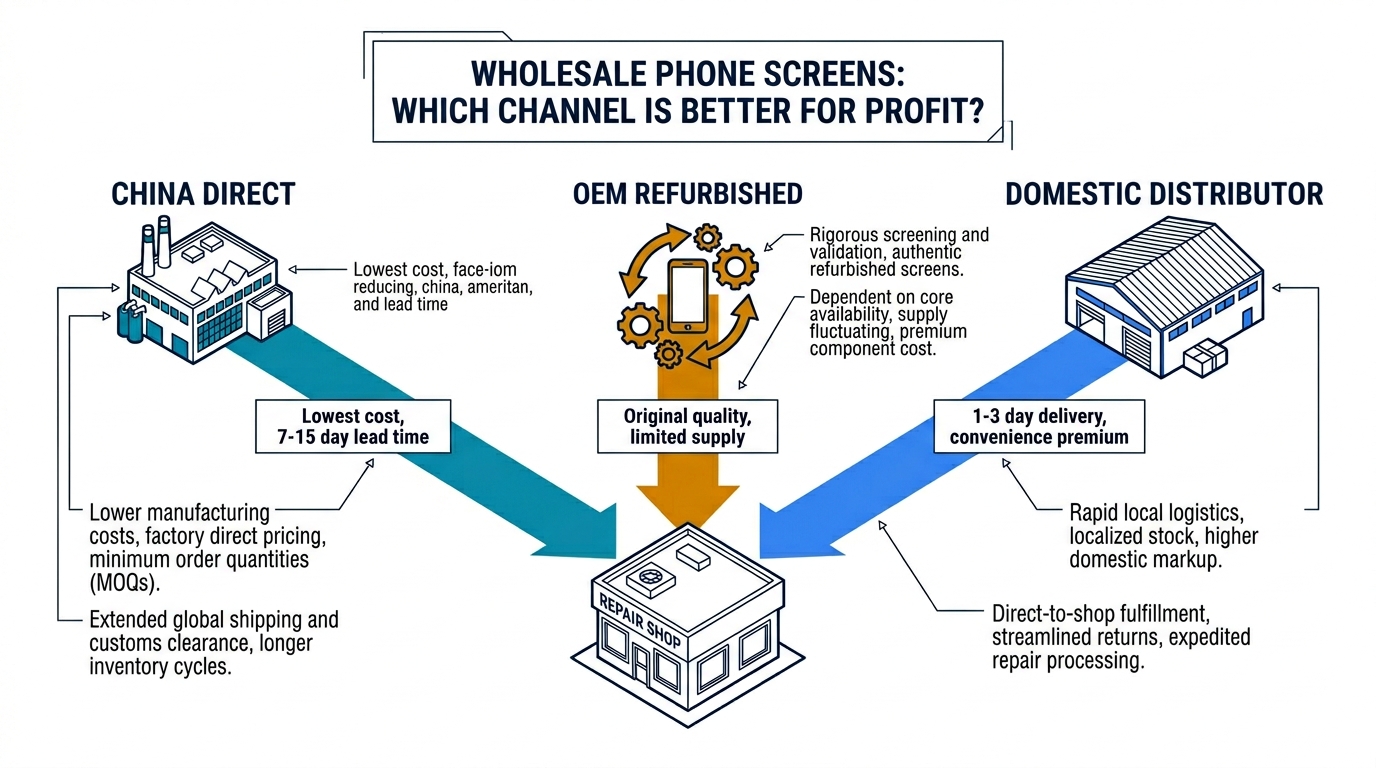
There are three main ways to source wholesale phone screens: direct from China (Shenzhen aftermarket), OEM pulls and refurbished panels, or through domestic aftermarket distributors. Each channel has a different cost structure, defect profile, and profit outcome. This guide compares all three with real numbers, so you can pick the channel — or combination — that puts the most money in your register.
Sourcing Replacement Screens in Bulk?
Incell / Hard OLED / Soft OLED grades — wholesale pricing, grade comparison on request.
Get Wholesale QuoteThree Wholesale Phone Screens Sourcing Channels Explained
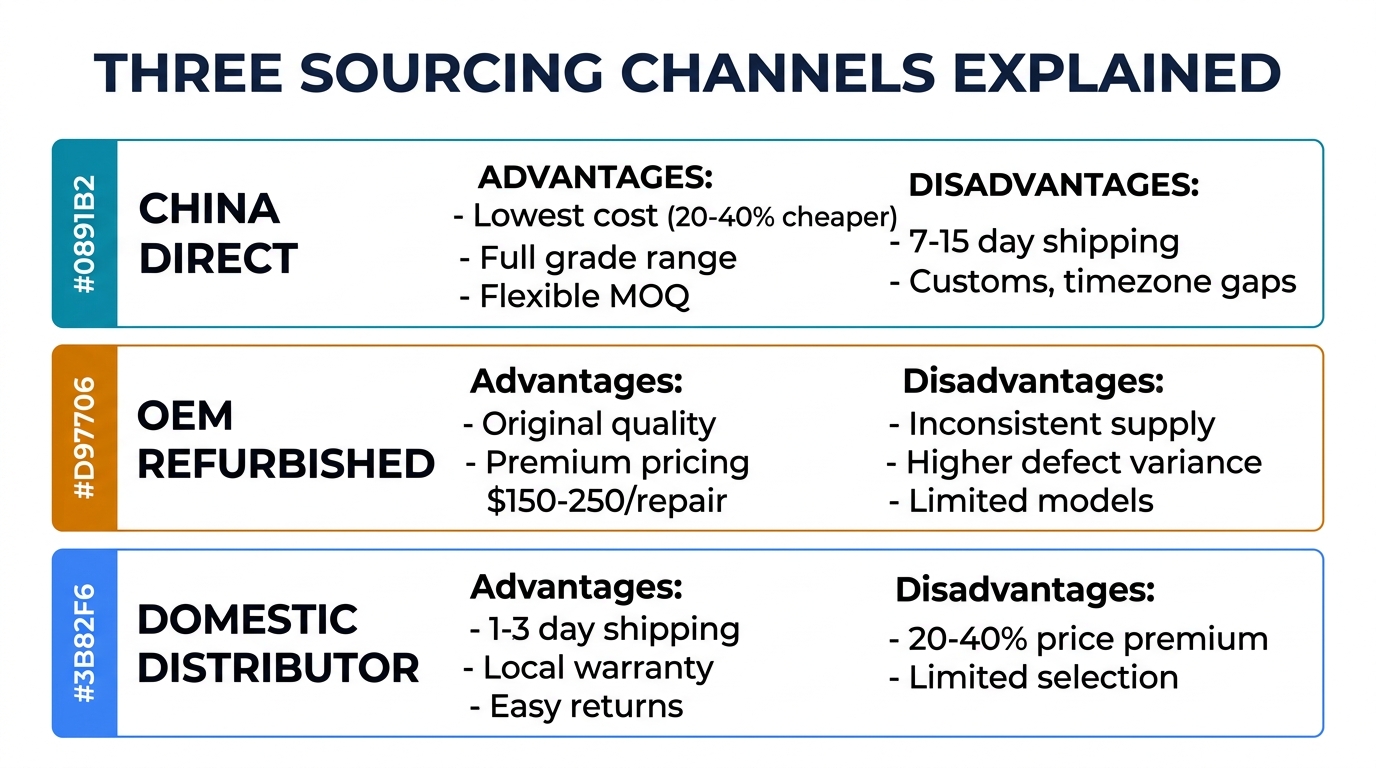
Before comparing profits, understand what each channel actually delivers.
Channel 1: Direct China Wholesale (Aftermarket)
You buy aftermarket screens (Incell, Hard OLED, Soft OLED) directly from a Shenzhen-based manufacturer or trading company. Screens ship by air express, arriving in 7–15 days.
What you get:
- Lowest per-unit cost in the market
- Full range of grades and models
- Mixed-model orders with flexible MOQ
- IC chip and testing level options you control
What you manage:
- International shipping and customs
- Currency conversion (USD to CNY)
- Communication across time zones
- Quality verification at a distance
Channel 2: OEM Pulls and Refurbished
You buy original Apple or Samsung display panels that have been removed from used devices and re-laminated with new glass. Sources include authorized refurbishers, recycling operations, and specialized OEM-pull suppliers (often based in China or Korea).
What you get:
- Original display quality (Samsung Display or LG OLED panels)
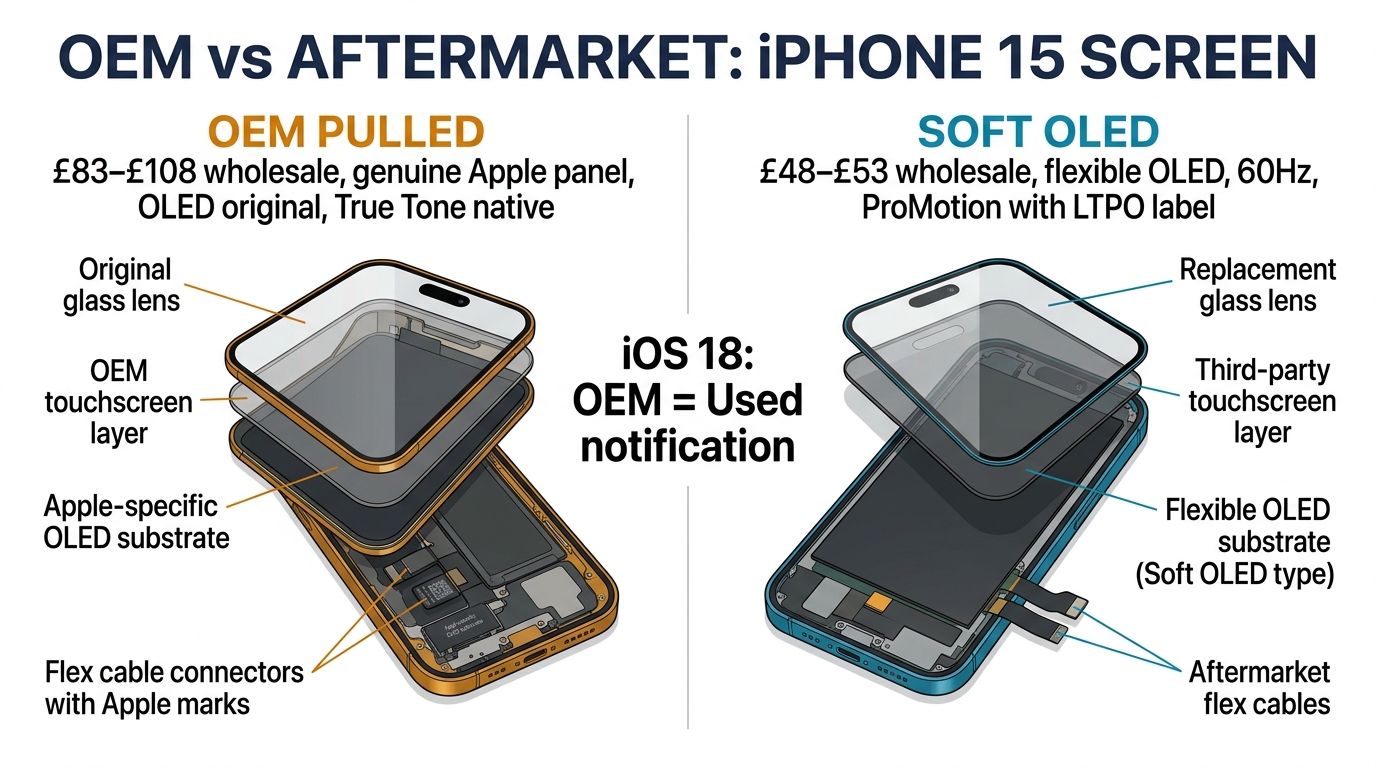
- No "non-genuine part" warnings on older iPhone models
- Premium repair pricing potential ($150–$250 per repair)
What you manage:
- Inconsistent supply (dependent on donor device availability)
- Higher defect variance (refurbishment quality varies batch to batch)
- Limited model availability (current-gen OEM pulls are scarce and expensive)
- Higher per-unit cost
Channel 3: Domestic Aftermarket Distributor (US/UK)
You buy aftermarket screens from a US or UK-based distributor who sources from China and resells domestically. Companies like Mobilesentrix, Injured Gadgets, or Parts4Cells operate in this space.
What you get:
- 1–3 day shipping (domestic)
- Returns and warranty handled locally
- No customs or international shipping hassle
- Often pre-tested with documented grade specs
What you manage:
- 20–40% price premium over direct China
- More limited model and grade selection
- Dependent on their supplier's quality (less control)
The Profit Comparison: Same iPhone 15, Three Channels
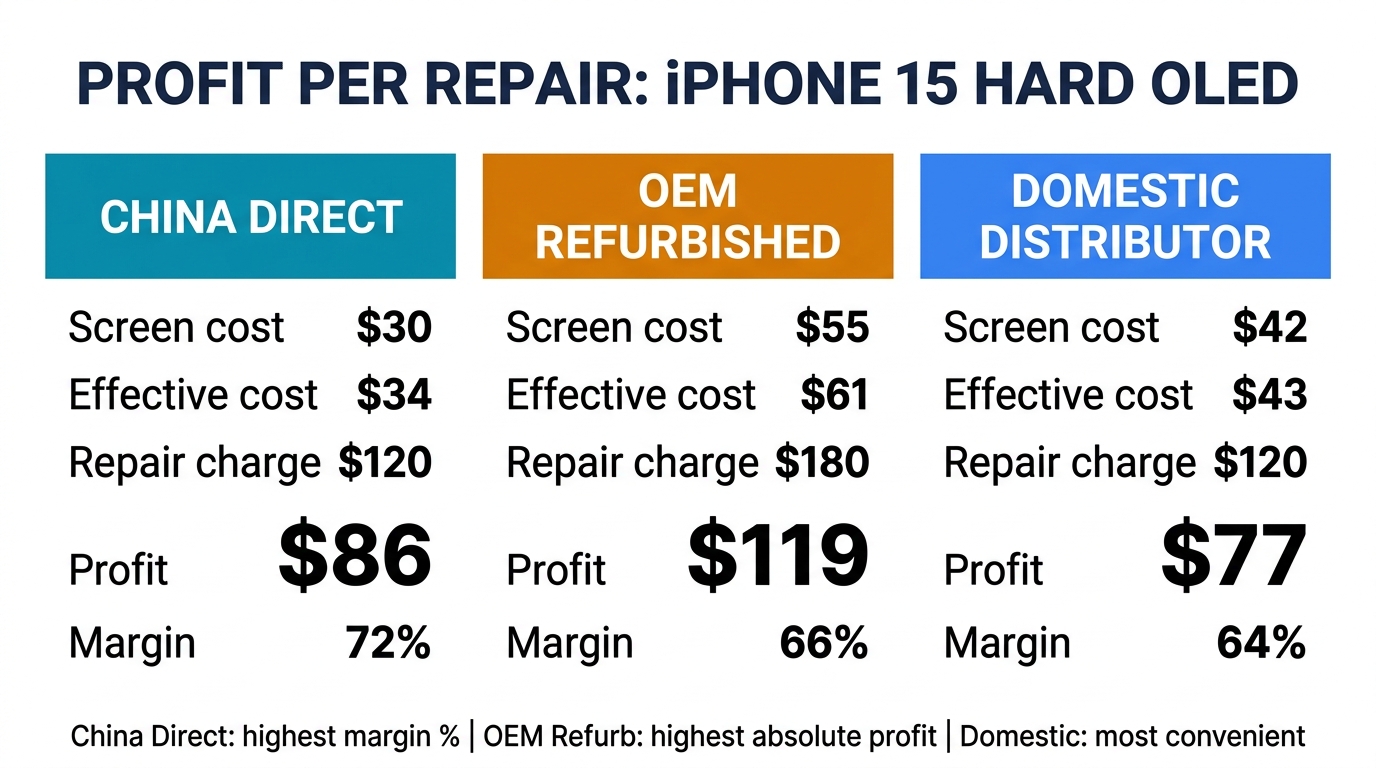
Here's where it gets concrete. Let's compare the profit per repair on an iPhone 15 screen replacement across all three channels, using current 2026 market pricing.
Hard OLED — iPhone 15
| Factor | China Direct | OEM Refurbished | Domestic Distributor |
|---|---|---|---|
| Screen cost (per unit) | $30 | $55 | $42 |
| Shipping cost (per unit) | $3 | $4 | $0 (free over $200) |
| Defect rate | 2% | 2.5% | 1.5% |
| Defect cost (per 100 units) | $66 | $149 | $65 |
| Effective cost per good unit | $34 | $61 | $43 |
| Typical repair charge | $120 | $180 | $120 |
| Profit per repair | $86 | $119 | $77 |
| Profit margin | 72% | 66% | 64% |
Soft OLED — iPhone 15
| Factor | China Direct | OEM Refurbished | Domestic Distributor |
|---|---|---|---|
| Screen cost (per unit) | $45 | $65 | $58 |
| Shipping cost (per unit) | $3 | $4 | $0 |
| Defect rate | 1.5% | 2% | 1% |
| Defect cost (per 100 units) | $72 | $138 | $58 |
| Effective cost per good unit | $49 | $70 | $59 |
| Typical repair charge | $150 | $200 | $150 |
| Profit per repair | $101 | $130 | $91 |
| Profit margin | 67% | 65% | 61% |
What the Numbers Reveal
China Direct wins on margin percentage. The 20–40% lower unit cost translates directly to higher profit per repair. For a shop doing 15 repairs a day, the $9 per-repair advantage over domestic distributors adds up to $135/day or roughly $3,500/month in additional profit.
OEM Refurbished wins on absolute profit per repair. Because you can charge $180–$200 for an "original quality" repair, the higher screen cost still delivers $119–$130 profit. But volume is limited — you can't build a 15-repair-per-day operation on OEM Refurbished alone because supply is inconsistent.
Domestic Distributor wins on convenience. Lower profit per repair, but zero international logistics hassle, next-day restocking, and local warranty support. The convenience premium costs you $9–$10 per repair compared to China direct.
The Grade-Channel Matrix: Which Grade from Which Channel?
Not every grade makes equal sense from every channel. Here's the optimal pairing:
| Grade | Best Channel | Why |
|---|---|---|
| Incell | China Direct | Incell margins are thin — the 20–40% savings from China direct is the difference between 55% and 70% margin. Domestic distributor pricing on Incell often eats too much of your repair profit. |
| Hard OLED | China Direct or Domestic | Hard OLED is the workhorse grade. China direct for planned inventory, domestic distributor for urgent restocks. The $8–$12 per-unit gap between channels is worth paying when you need screens tomorrow. |
| Soft OLED | China Direct | Soft OLED's higher unit cost ($45–$65) makes the percentage savings from China direct especially valuable — $10–$15 saved per screen at this price point. |
| OEM Refurbished | Specialized Supplier | OEM pulls require verification of panel authenticity and refurbishment quality. Use a supplier who specializes in OEM refurbishment, not a general aftermarket trader who happens to list OEM screens. |
This matrix applies to iPhone models specifically. For Samsung screens, the channel dynamics differ because Samsung AMOLED sourcing is more concentrated and curved panel options add complexity to channel selection — see our wholesale Samsung screens guide for Samsung-specific channel recommendations.
When Each Channel Makes the Most Sense
There's no single "best" channel. The right choice depends on your shop's size, cash flow, and operational capacity.
Choose China Direct When:
- You do 10+ repairs per day (volume justifies the logistics overhead)
- You can plan inventory 3–4 weeks ahead (lead time requires forecasting)
- You have $3,000+ available for a single order (minimum practical order size for international shipping)
- You're comfortable with international wire transfers and basic customs paperwork
Expected monthly savings vs domestic: $2,000–$5,000 depending on volume
For detailed guidance on China sourcing, see our guides on paying a China phone parts supplier and choosing the right wholesale phone screen supplier.
Choose OEM Refurbished When:
- Your shop positions as premium/quality-first
- Your customers ask for original parts and will pay the premium
- You do fewer but higher-value repairs ($150–$250 per repair)
- You can accept inconsistent supply on some models
Best use: Stock OEM Refurbished for your top 2–3 models as a premium tier, not as your only option. It's an upsell, not a default.
For OEM vs aftermarket grade details, see our complete grade comparison guide.
Choose Domestic Distributor When:
- You're a small shop (under 10 repairs/day) where logistics overhead doesn't pencil out
- You need same-week restocking and can't wait for international shipping
- You're starting out and learning which models and grades sell before committing to international sourcing
- You value local warranty claims and easy returns
Best use: Primary source for new shops. Transition to China direct for planned inventory once you hit 10+ daily repairs, keeping the domestic distributor as backup for urgent restocks.
Not sure which sourcing channel fits your shop? Tell us your daily repair volume, current supplier, and top models — we'll map out the most profitable channel mix. Get a sourcing recommendation.
The Hybrid Strategy: How Top Shops Source Wholesale Phone Screens from All Three Channels
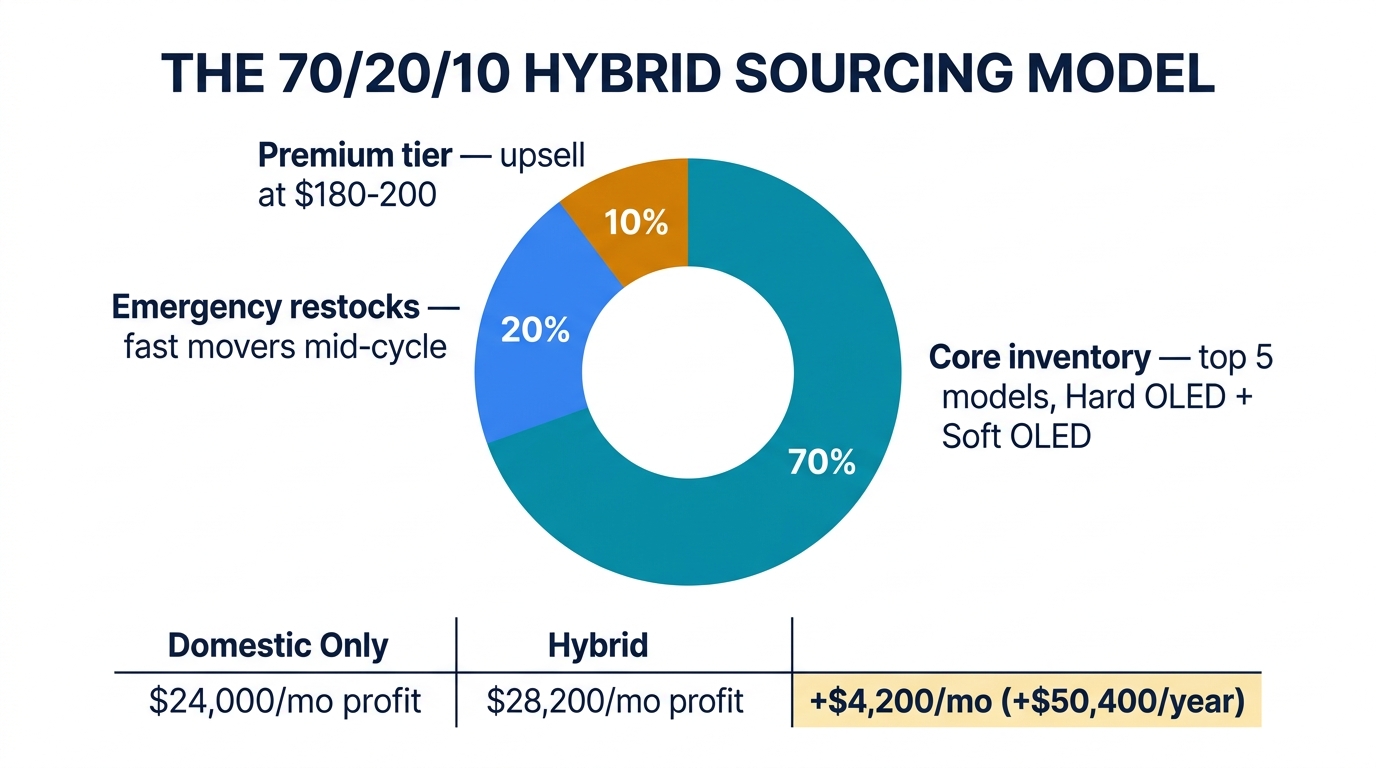
The most profitable repair shops don't pick one channel — they use all three strategically.
The 70/20/10 Model
| Channel | % of Monthly Spend | What You Buy | Why |
|---|---|---|---|
| China Direct | 70% | Core inventory — top 5 models, Hard OLED + Soft OLED | Lowest cost, highest margin |
| Domestic Distributor | 20% | Emergency restocks — fast movers that run out mid-cycle | Speed when you can't wait 10 days |
| OEM Refurbished | 10% | Premium tier — top 2 models only | Upsell opportunity at $180–$200 repairs |
How This Works in Practice
Week 1 of the month: Place your China direct order for the next 4 weeks. 70% of your monthly screen budget goes here.
Weeks 2–4: As models sell out faster than expected, restock from your domestic distributor. You pay more per unit, but you're covering 1–3 day gaps, not 2-week gaps.
Ongoing: Keep 10–15 OEM Refurbished screens on hand for customers who specifically request original quality. These are your $180–$200 repairs — low volume but high margin per repair.
Monthly Profit Impact: Hybrid vs Single Channel
Here's the math for a shop doing 300 iPhone screen repairs per month:
| Strategy | Avg Screen Cost | Avg Repair Charge | Monthly Screen Spend | Monthly Revenue | Monthly Gross Profit |
|---|---|---|---|---|---|
| 100% Domestic Distributor | $45 | $125 | $13,500 | $37,500 | $24,000 |
| 100% China Direct | $36 | $125 | $10,800 | $37,500 | $26,700 |
| Hybrid (70/20/10) | $38 | $132 | $11,400 | $39,600 | $28,200 |
The hybrid approach delivers $4,200/month more profit than domestic-only sourcing. The OEM Refurbished tier bumps your average repair charge by $7 across all repairs (even though only 10% are OEM-tier), and the China direct pricing on 70% of volume keeps your costs down.
Over a year, that's $50,400 in additional gross profit — enough to fund a second repair station, a marketing push, or simply a much healthier bottom line.
Cost Factors Most Buyers Forget to Include
The per-unit screen price is the number everyone compares. But three hidden costs change the real comparison between channels.
Shipping and Import Costs (China Direct)
- Air express (DHL/FedEx/UPS): $3–$5 per unit for orders under 50kg
- Economy air (YunExpress, 4PX): $1.50–$3 per unit, 10–20 day delivery
- Customs duties: Most phone parts enter the US duty-free under HTS 8517.70. UK charges 0% duty but 20% VAT on declared value
- Currency conversion: Wise or PayPal adds 0.5–1.5% to the cost
Total China Direct overhead: $4–$7 per unit on top of FOB price. Always add this to your FOB cost before comparing with domestic distributor pricing — the gap is real but smaller than the raw unit price suggests.
Inventory Carrying Cost
Money tied up in screen inventory isn't earning interest or funding other business needs. At 5% annual cost of capital:
- $10,000 in screen inventory costs you $42/month in carrying cost
- A 6-week inventory cycle costs 50% more in carrying than a 4-week cycle
China direct orders require larger upfront investment (minimum $2,000–$3,000 per order). Domestic distributors let you order $300–$500 at a time. The per-unit savings from China need to exceed your carrying cost advantage from smaller domestic orders.
Customer Satisfaction Cost
This is the hardest to quantify but the most important. A screen that generates a callback costs:
- 15–30 minutes of re-repair labor ($12–$25)
- A replacement screen if the original was defective ($20–$50)
- Potential lost customer lifetime value ($500–$2,000)
OEM Refurbished screens generate the fewest callbacks. Domestic distributor screens (pre-tested, with local warranty) generate fewer callbacks than China direct. The callback rate difference is typically 0.5–1% — small in percentage, meaningful in customer retention.
How to reduce callback cost on China direct screens: Invest 60 seconds per screen in incoming QC — check for dead pixels, touch responsiveness, and backlight bleed before installation. This catches 80% of defects before they reach a customer. For a complete incoming QC workflow, see our guide on incoming QC for wholesale phone screens.
Frequently Asked Questions
Is it always cheaper to buy wholesale phone screens from China?
Per unit, yes — China direct pricing is 20–40% below domestic distributors. But "cheaper per unit" doesn't always mean "more profitable." You need to add shipping ($3–$5/unit), factor in longer lead times (tying up more capital in inventory), and account for the effort of managing international logistics. For shops under 10 repairs per day, the overhead often eats the per-unit savings. Above 10 daily repairs, China direct almost always wins on total profitability.
Can I mix OEM Refurbished and aftermarket screens in my shop?
Yes, and you should. The most profitable approach is offering customers a choice: aftermarket (Hard OLED or Soft OLED) at your standard price, and OEM Refurbished at a premium. This upsell conversation adds $30–$50 per repair when a customer chooses the premium tier. Stock OEM Refurbished for your top 2–3 models only — supply is too inconsistent to cover your full model range.
How do I transition from a domestic distributor to China direct sourcing?
Start with a single test order ($1,500–$2,000) covering your top 3 models in one grade. Keep your domestic distributor active for everything else. Once the China order arrives, compare quality side-by-side with your domestic screens. If quality matches, shift 50% of your next month's volume to China direct. By month 3, you'll have enough data to move to the 70/20/10 hybrid model. Don't cut off your domestic supplier entirely — you need them for emergency restocks.
What profit margin should I target on phone screen repairs?
Target 65–75% gross margin on screens. That means if you charge $120 for a repair, your screen cost should be $30–$42. At 15 repairs per day, that's $1,170–$1,350 daily gross profit on screens alone. Shops that drop below 60% margin are usually overpaying for screens (domestic-only sourcing) or undercharging for repairs (not offering a premium tier). Both are fixable.
Are OEM pull screens worth the premium for a repair shop?
For select models and customers, yes. OEM Refurbished screens on iPhone 14 and 15 deliver $119–$130 profit per repair at $180–$200 repair pricing. The key is volume control — stock 10–15 OEM screens for your top models as an upsell option, not your default. If you default every repair to OEM, your inventory cost doubles and your overall margin drops even though the per-repair profit is higher. Use OEM as the premium choice, aftermarket as the standard.
Pick the Channel That Fits Your Profit Goal
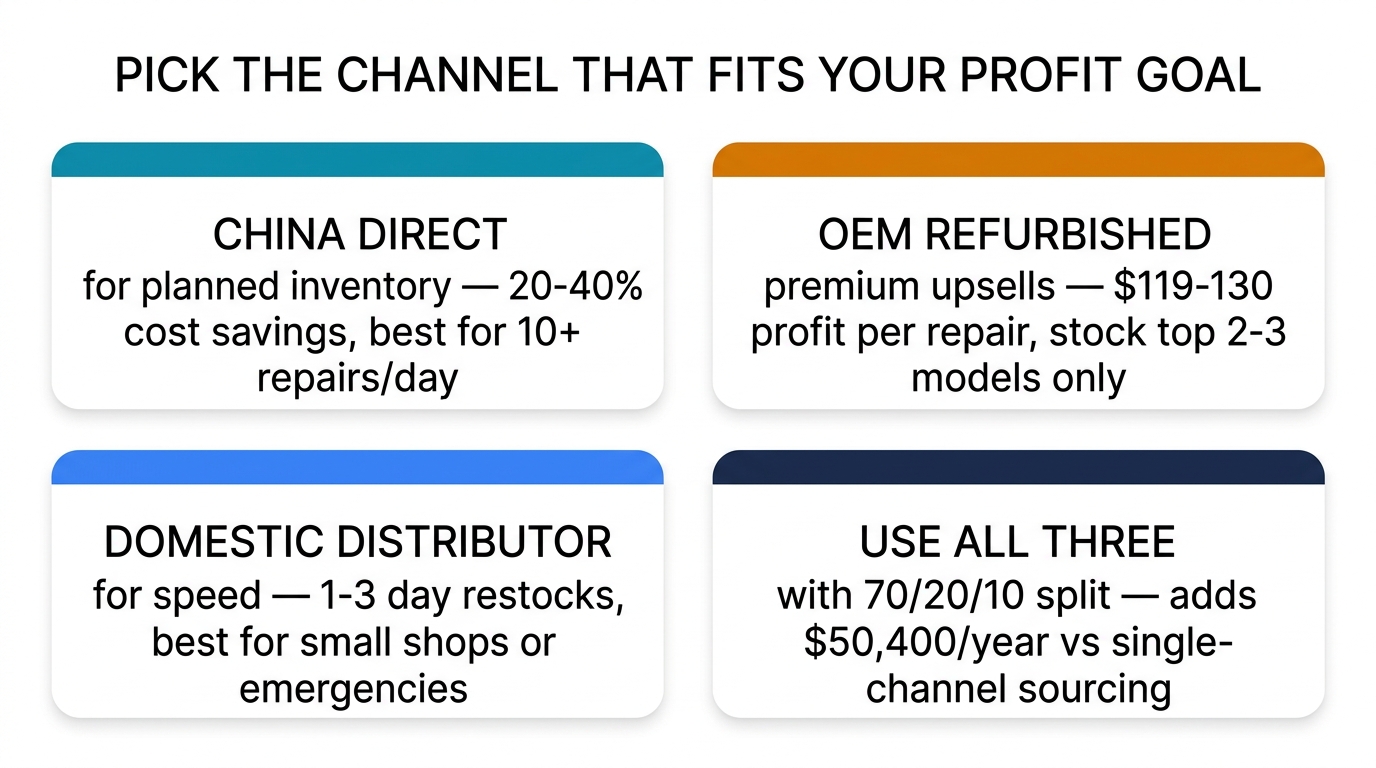
The best wholesale phone screens sourcing strategy isn't the cheapest per unit — it's the one that maximizes your total monthly profit given your shop size, repair volume, and operational capacity. Small shops start with domestic distributors. Growing shops add China direct for planned inventory. Smart shops layer in OEM Refurbished for premium upsells.
Run the numbers for your specific situation. A $9 per-repair savings on 300 monthly repairs is $2,700/month — that's real money worth optimizing for.
Want a channel-by-channel cost comparison for your exact model mix? Send us your top 5 models, daily volume, and current supplier pricing. We'll show you exactly how much you'd save with direct sourcing — with samples to verify quality before you switch.
Request a Sourcing Comparison — include your current pricing and model list for a personalized analysis within 24 hours.
Related reading: