
Wholesale iPhone Screens: How Buyers Compare Grades, Prices, and MOQ
Buying wholesale iPhone screens means comparing quotes — but most buyers compare the wrong number. You get two quotes for iPhone 15 screens. Supplier A offers $18 per unit. Supplier B wants $28. The obvious move is Supplier A — until you realize their screens have a 5% defect rate, no True Tone support, and a 3-month warranty. Supplier B's screens run at 1.5% defects, support IC transfer, and carry a 6-month warranty.
After factoring in returns, callbacks, and lost customers, Supplier B actually makes you more money per repair. This is the comparison most buyers get wrong: they compare price per screen when they should compare profit per repair. This guide shows you how to evaluate wholesale iPhone screen grades, pricing, and MOQ by the metric that actually matters — what each option puts in your pocket.
Sourcing Replacement Screens in Bulk?
Incell / Hard OLED / Soft OLED grades — wholesale pricing, grade comparison on request.
Get Wholesale QuoteThe 4 Wholesale iPhone Screen Grades — Ranked by Profit, Not Just Price
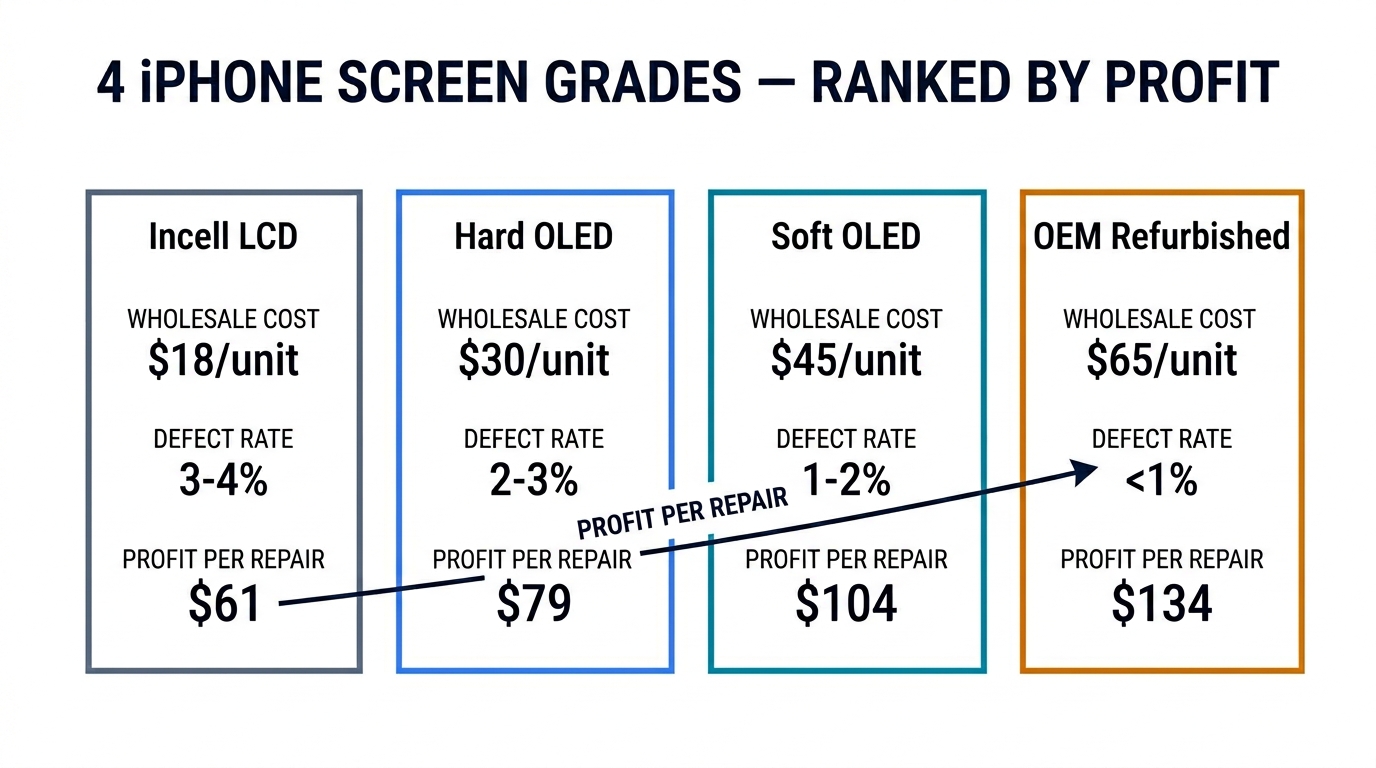
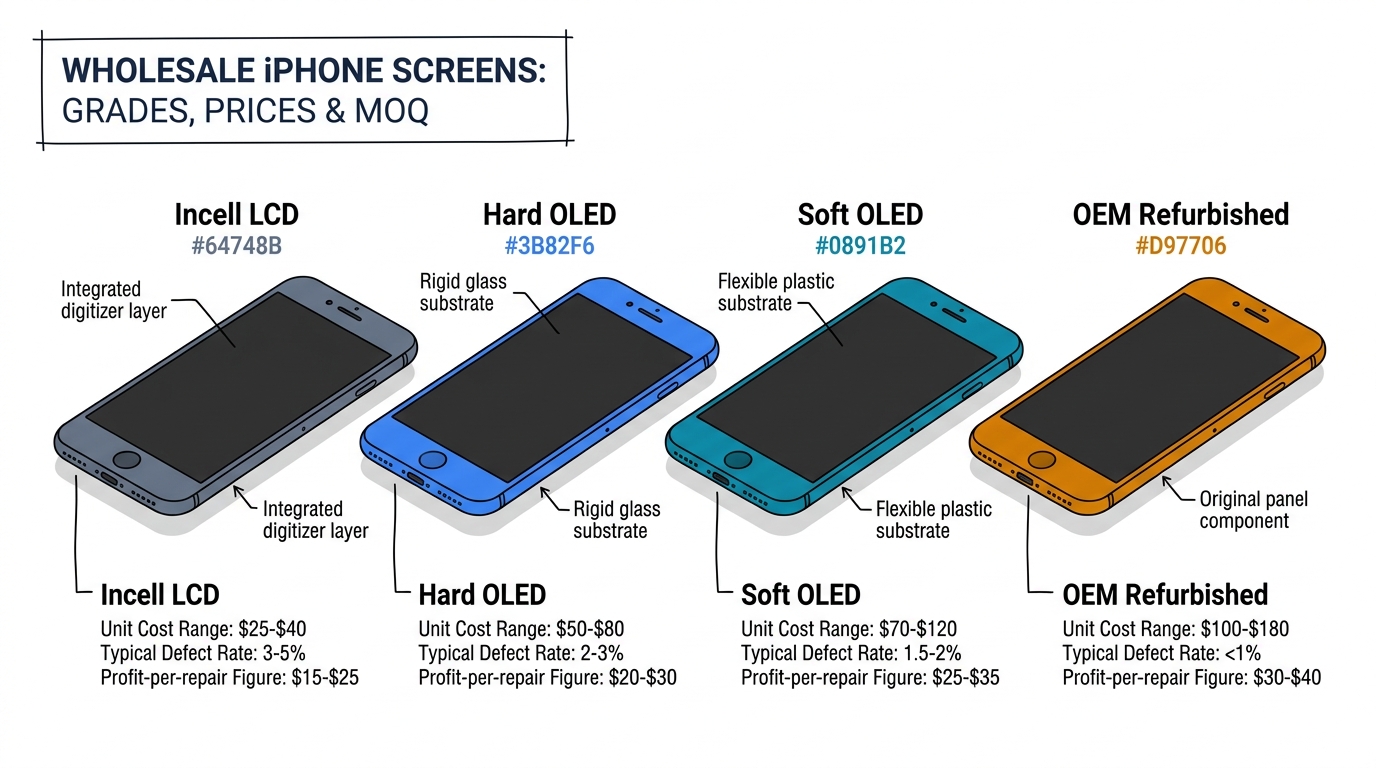
Every aftermarket iPhone screen falls into one of four grades. You already know the names. What most buyers don't calculate is the real cost once you factor in defect handling and customer perception.
Here's the math for an iPhone 15 standard model, based on current Shenzhen wholesale pricing and typical US repair shop charges:
| Grade | Unit Cost | Typical Repair Charge | Defect Rate | Defect Cost per 100 Units | Real Profit per Repair |
|---|---|---|---|---|---|
| Incell LCD | $18 | $80 | 3–4% | $63 (3.5 × $18) | $61 |
| Hard OLED | $30 | $110 | 2–3% | $75 (2.5 × $30) | $79 |
| Soft OLED | $45 | $150 | 1–2% | $68 (1.5 × $45) | $104 |
| OEM Refurbished | $65 | $200 | <1% | $49 (0.75 × $65) | $134 |
What this table reveals: Incell has the lowest unit cost but also the lowest profit per repair. Soft OLED costs 2.5× more than Incell but delivers 1.7× higher profit. The profit gap between grades comes from three places:
- Higher repair charges — customers accept premium pricing for better display quality
- Lower defect costs — fewer returns, fewer free re-repairs, less wasted inventory
- Fewer callbacks — a satisfied customer doesn't come back complaining about color shift or dim screens
This doesn't mean Incell is bad. For budget repairs where customers explicitly choose the cheapest option, Incell delivers a solid $61 per repair. But if you're defaulting every repair to Incell because it's "the cheapest screen," you're leaving $18–$43 per repair on the table.
One more thing the numbers don't capture: repeat business. A customer who gets a Soft OLED repair and can't tell the difference from original is more likely to come back — and refer friends. A customer who notices their screen is dimmer or yellower after an Incell repair may leave a bad review. That long-term value is hard to quantify but real.
For a detailed breakdown of how each grade technology works, see our OEM vs aftermarket phone screens comparison.
How to Compare Wholesale iPhone Screen Quotes
When you receive quotes from multiple suppliers, prices alone tell you almost nothing. Two "Hard OLED iPhone 15" quotes at different prices usually mean different products. Here's how to make an apples-to-apples comparison.
The 5-Point Quote Comparison Framework
For every quote, extract these five data points before comparing price:
| Data Point | What to Ask | Why It Matters |
|---|---|---|
| IC Chip | BOE, Tianma, or generic? | BOE adds $2–3/unit but resists iOS update breakage |
| Testing Level | Factory QC, batch sampling, or 100% device-tested? | 100% tested adds $0.50–$1.50 but cuts defects by 60% |
| True Tone | Supports IC transfer? Pre-programmed chip included? | Losing True Tone generates customer complaints on premium repairs |
| Warranty | 3 months? 6 months? What's covered? | Short warranty = supplier doesn't trust their own product |
| Defect Tolerance | What percentage does the supplier accept as normal? | "3–5% is normal" vs "under 2%" tells you their quality floor |
The Hidden Costs Behind a "Cheap" Quote
A screen that costs $5 less per unit but has a 5% defect rate instead of 2% costs you more in the end. Here's how to calculate the real price:
Real Unit Cost = Quote Price + (Defect Rate × Quote Price) + Callback Labor
Example with iPhone 14 Hard OLED:
- Supplier A: $24/unit, 4% defects, generic IC → Real cost: $24 + ($24 × 0.04) + $5 labor = $29.96
- Supplier B: $28/unit, 1.5% defects, BOE IC → Real cost: $28 + ($28 × 0.015) + $2 labor = $30.42
The $4 price gap shrinks to $0.46 — and Supplier B's screens have better iOS compatibility, fewer customer complaints, and a longer warranty. At scale, Supplier B wins.
Pro tip: Create a simple spreadsheet with these five columns for every quote you receive. After 3–4 suppliers, the real cost differences become obvious — and the "cheapest" quote often falls to second or third place.
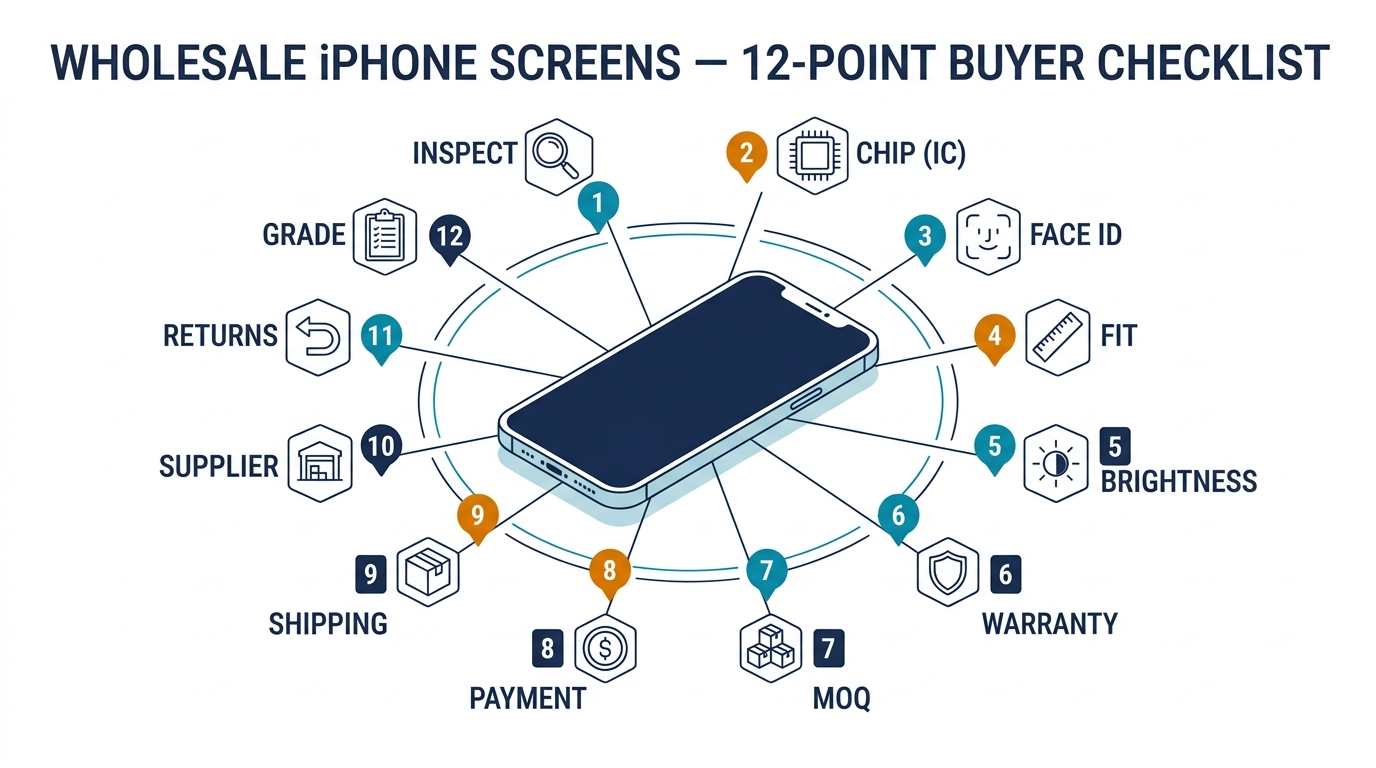
Use our wholesale iPhone screens buyer checklist to verify all 12 critical specs before placing any order.
Comparing quotes and not sure which grade fits your model mix? Send us your top 5 models and monthly volumes — we'll recommend the most profitable grade combination. Get a custom recommendation.
Wholesale iPhone Screens MOQ: How to Order Smart on a Limited Budget
MOQ (Minimum Order Quantity) is where budget meets reality. Most iPhone screen suppliers set MOQ per model — 50 units of iPhone 15, 50 units of iPhone 14, and so on. If you need screens for 6 models, that's 300 screens minimum before you've chosen a single grade.
Here's how experienced buyers optimize MOQ without overstocking.
Strategy 1: Mixed-Model Orders
Not every supplier requires per-model MOQ. Many accept a total quantity minimum — say 100 screens total, mixed across any models. This lets you order 30 iPhone 15 + 25 iPhone 14 + 20 iPhone 13 + 15 iPhone 14 Pro + 10 iPhone 12 = 100 units, covering your top 5 models without committing 50 of each.
How to negotiate: Ask upfront: "Is your MOQ per model or per order?" If it's per model, ask: "Can we do a mixed order at the same per-model price if the total hits your minimum?" Most suppliers say yes because they want the order.
Strategy 2: Grade Concentration
Instead of stocking all four grades, pick two that cover your customer mix. This halves the number of SKUs you manage and doubles your per-grade order volume — which gives you better pricing power.
| Shop Type | Recommended 2-Grade Mix | Why |
|---|---|---|
| Budget / high-volume | Incell + Hard OLED | Covers 80% of price-conscious walk-ins |
| Mid-range | Hard OLED + Soft OLED | Good margin on both, clear upgrade path for customers |
| Premium / Apple-specialist | Soft OLED + OEM Refurb | Matches customer expectations at premium repair shops |
Strategy 3: Budget Allocation by Model Priority
Don't spread your budget evenly. Allocate based on repair frequency:
For a $3,000 first order budget:
| Priority | Model | Grade | Units | Cost |
|---|---|---|---|---|
| 1st | iPhone 15 | Hard OLED | 30 | $900 |
| 2nd | iPhone 14 | Hard OLED | 30 | $720 |
| 3rd | iPhone 13 | Incell | 25 | $300 |
| 4th | iPhone 15 Pro | Hard OLED | 15 | $525 |
| 5th | iPhone 14 Pro | Hard OLED | 15 | $420 |
| — | Buffer for samples | Mixed | 5 | $135 |
| Total | 120 | $3,000 |
This covers your top 5 models with 4–6 weeks of stock at 5–6 repairs per day. The key insight: iPhone 13 gets Incell (because most iPhone 13 repair customers are budget-conscious), while iPhone 15 and Pro models get Hard OLED (because those customers expect better quality).
For detailed MOQ negotiation tactics and lead time planning, see our guide on MOQ, sample orders, and lead time.
Which Grade Mix Fits Your Shop? 3 Real Scenarios
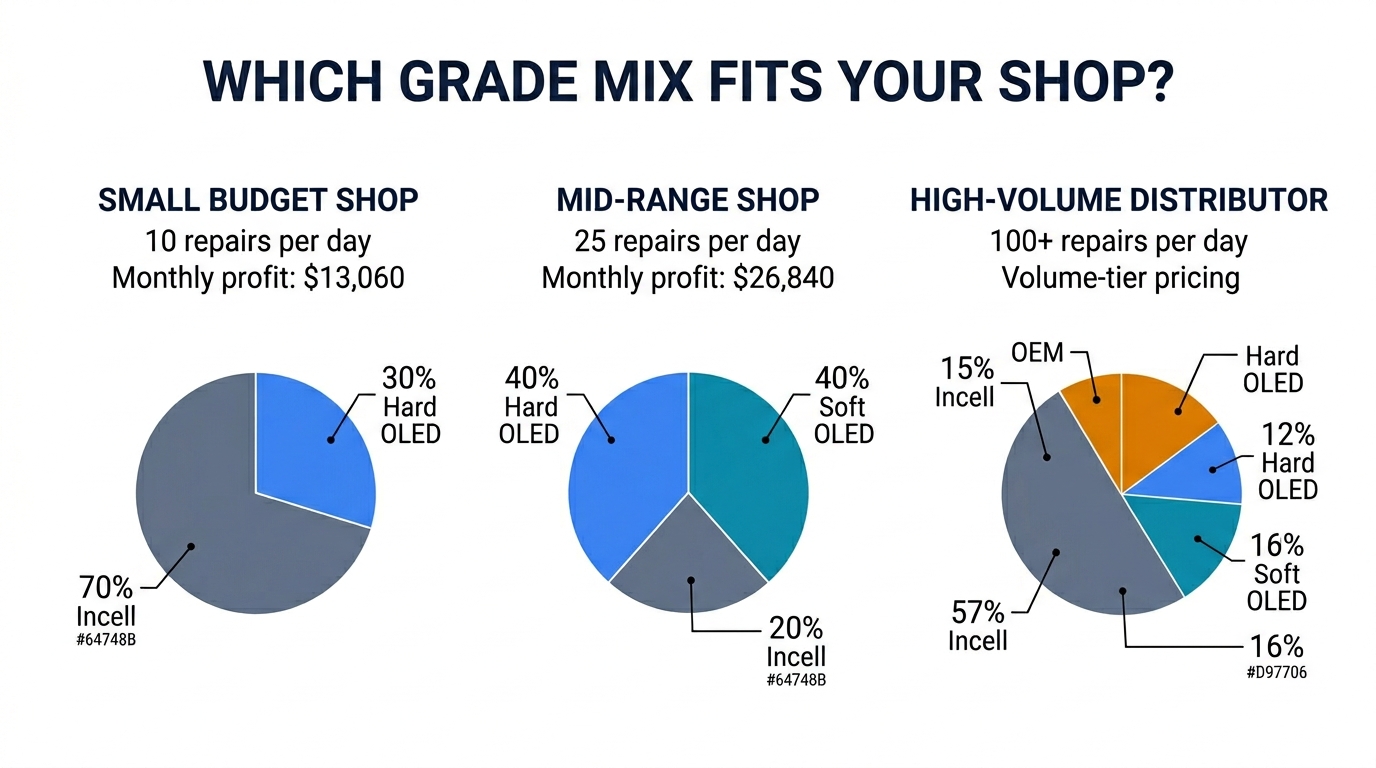
Theory is useful. Real numbers are better. Here are three shop profiles with specific grade strategies and projected monthly margins.
Scenario 1: Small Budget Shop — 10 Repairs/Day
- Monthly screen budget: ~$3,500
- Customer base: Price-sensitive, walk-in heavy
- Recommended mix: 70% Incell, 30% Hard OLED
| Model | Grade | Monthly Units | Cost | Revenue | Gross Profit |
|---|---|---|---|---|---|
| iPhone 14 | Incell | 60 | $840 | $4,800 | $3,960 |
| iPhone 13 | Incell | 45 | $495 | $3,150 | $2,655 |
| iPhone 15 | Hard OLED | 40 | $1,200 | $4,400 | $3,200 |
| Mixed older | Incell | 55 | $605 | $3,850 | $3,245 |
| Total | 200 | $3,140 | $16,200 | $13,060 |
Profit margin on screens: ~80%. The key is using Hard OLED only on newer models where customers accept higher repair prices. Notice that iPhone 13 Incell at $11/unit still delivers $59 profit per repair — for a budget shop, there's no reason to spend $30 on Hard OLED when the customer came in asking for the cheapest option.
Scenario 2: Mid-Range Shop — 25 Repairs/Day
- Monthly screen budget: ~$10,000
- Customer base: Mixed — some budget, some premium
- Recommended mix: 40% Hard OLED, 40% Soft OLED, 20% Incell
| Model | Grade | Monthly Units | Cost | Revenue | Gross Profit |
|---|---|---|---|---|---|
| iPhone 15/15 Pro | Soft OLED | 120 | $5,760 | $18,000 | $12,240 |
| iPhone 14/14 Pro | Hard OLED | 120 | $3,240 | $13,200 | $9,960 |
| iPhone 13 & older | Incell | 80 | $960 | $5,600 | $4,640 |
| Total | 320 | $9,960 | $36,800 | $26,840 |
Profit margin on screens: ~73%. Lower margin percentage than the budget shop, but $26,840 vs $13,060 in absolute gross profit. The Soft OLED investment on iPhone 15 drives this — $104 profit per repair vs $61 on Incell.
Scenario 3: High-Volume / Distributor — 100+ Repairs/Day or Resale
- Monthly screen budget: $30,000+
- Strategy: Volume pricing on core grades + premium margin on Soft OLED/OEM
At this scale, the game changes. You negotiate volume-tier pricing (often 10–15% below standard wholesale), carry all four grades, and your MOQ volume lets you demand 100% device-tested screens as standard.
Key differences at high volume:
- Dedicated account manager from your supplier, with priority on new model availability
- Net-30 or Net-60 payment terms instead of prepaid, improving your cash flow
- Custom packaging and labeling to streamline your internal warehouse operations
- First access to new model screens during the premium-priced launch window
The profit analysis shifts toward inventory turnover speed rather than per-unit margin — slow-moving stock ties up capital that could fund faster-turning models. We cover model selection strategy in our guide on which phone screen models to stock in 2026.
Wholesale iPhone Screens: Pricing Trends to Watch in 2026
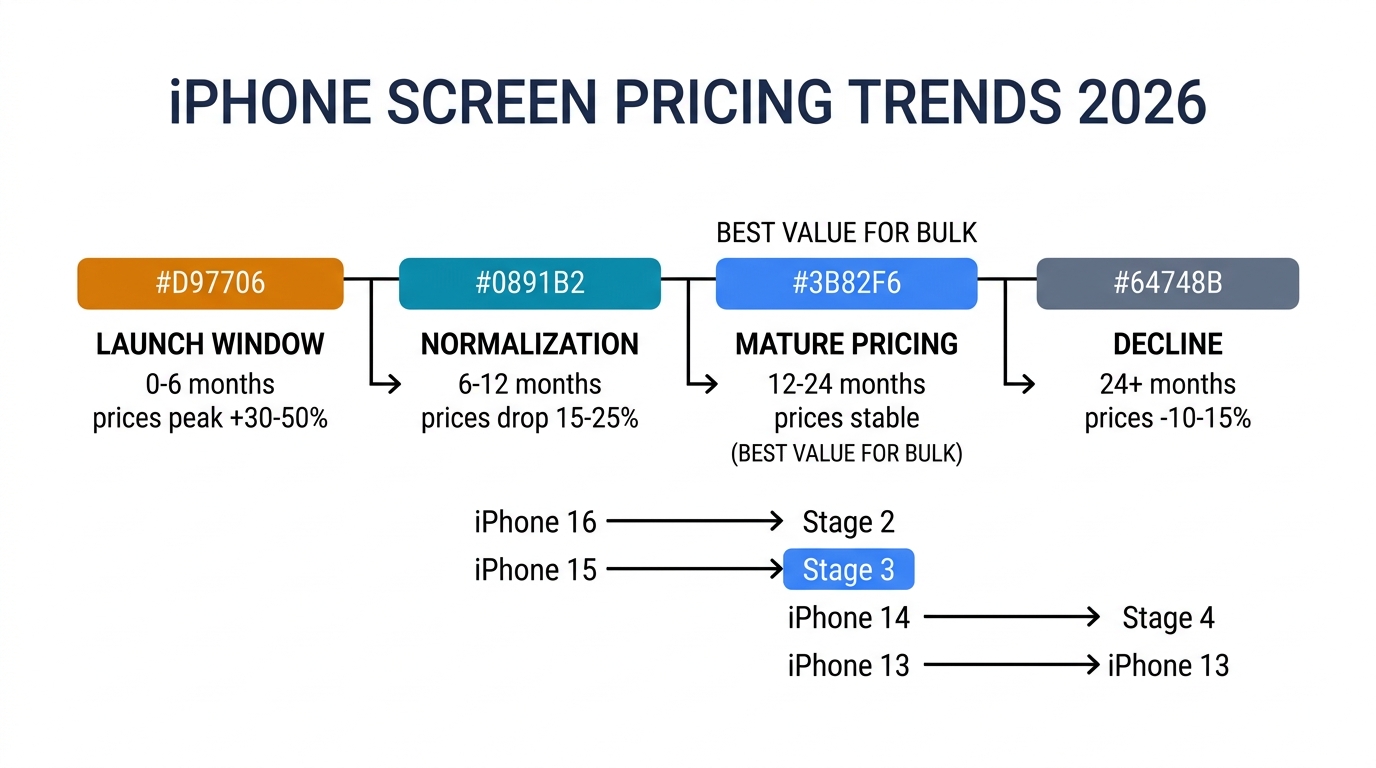
Screen prices aren't static. Understanding the cycle helps you time your orders and avoid overpaying.
The Model Depreciation Curve
Every iPhone screen follows a predictable price trajectory:
- Launch window (0–6 months after new iPhone release): Screens are scarce. Prices peak at 30–50% above baseline. Only stock if customer demand justifies the premium.
- Normalization (6–12 months): Supply catches up. Prices drop 15–25% as more manufacturers produce compatible screens.
- Mature pricing (12–24 months): Prices stabilize. This is the sweet spot for bulk ordering — predictable pricing, reliable supply, proven compatibility.
- Decline (24+ months): Demand drops as customers upgrade. Prices may tick down another 10–15%, but repair volume also falls. Don't overstock.
What this means for 2026 ordering:
- iPhone 16 screens: Still in normalization phase. Prices will drop through Q2–Q3 2026. Order conservatively.
- iPhone 15 screens: Entering mature pricing. Best value for bulk ordering right now.
- iPhone 14 screens: Mature to declining. Excellent per-unit pricing, but watch your demand trends.
- iPhone 13 screens: Declining. Stock lean — 2–3 weeks of inventory maximum.
For current model-by-model pricing, see our complete wholesale iPhone screens pricing guide.
IC Chip Pricing Shifts
BOE IC chips have become the aftermarket standard for iPhone 13 and newer. As BOE production scales, the price premium over generic ICs has dropped from $4–5 per unit to $2–3. In 2026, there's less reason to accept generic IC screens — the cost saving no longer justifies the iOS compatibility risk.
Frequently Asked Questions
Is it better to buy the cheapest wholesale iPhone screen grade?
Not if you factor in total cost. Incell screens cost the least per unit, but generate the lowest profit per repair ($61 vs $104 for Soft OLED on iPhone 15). They also have higher defect rates and more customer callbacks. Incell works well for budget repairs where customers explicitly choose the lowest price option. For your default repair tier, Hard OLED or Soft OLED delivers better overall returns.
How many screen grades should I stock for each iPhone model?
Two grades per model is the sweet spot for most repair shops. Stocking one grade limits customer choice. Stocking three or four grades per model fragments your inventory and increases the capital tied up in slow-moving SKUs. Pick two grades that match your customer mix — typically one mid-tier (Hard OLED) and one premium (Soft OLED).
What's a reasonable MOQ for a first wholesale iPhone screen order?
For a first order, target 50–150 total screens across your top 3–5 models. This gives you 3–4 weeks of inventory without excessive risk. Look for suppliers who accept mixed-model orders (total quantity minimum rather than per-model minimum). A $2,000–$4,000 first order is a manageable test that provides real data for your second, larger order.
Do wholesale iPhone screen prices change seasonally?
Yes. Prices typically peak in September–November (new iPhone launch drives demand for all models), dip in January–March (post-holiday slowdown), and stabilize through summer. The biggest price drops happen 6–12 months after a new iPhone release as aftermarket supply catches up to demand. Timing your bulk orders for Q1 or Q2 often gets you 5–10% better pricing than ordering during launch season.
How do I know if a supplier's wholesale iPhone screen grade is actually what they claim?
You can't know from a listing alone. The only reliable method is sample testing — order 5–10 units, install them in actual devices, and evaluate brightness, color accuracy, touch responsiveness, and True Tone functionality. Compare side-by-side with an original screen. Any supplier who won't send samples before a bulk order isn't worth the risk. For the full verification process, use our 12-point buyer checklist.
Compare First, Then Order
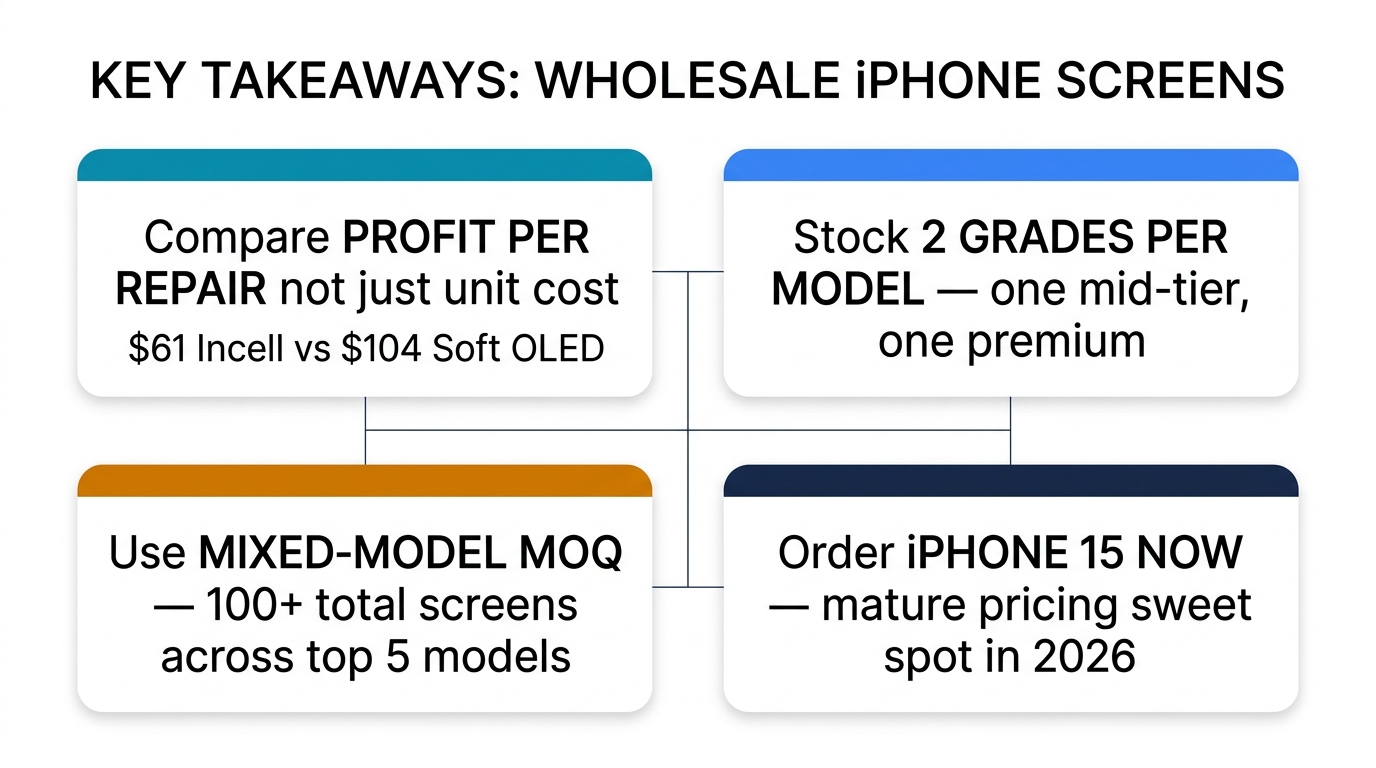
The difference between a profitable screen inventory and a money-losing one isn't finding the lowest price — it's finding the right grade-to-price ratio for your specific business. Calculate profit per repair, not just cost per screen. Consolidate your grades to two per model. Allocate your MOQ budget by repair volume, not equally across models.
Want a grade-by-grade quote tailored to your top iPhone models? Tell us your model mix, monthly repair volume, and budget range. We'll recommend the grade combination that maximizes your margin — and send samples so you can verify before committing.
Request a Custom Quote — include your top 5 models and preferred grades for pricing within 24 hours.
Related reading: