
OEM vs Aftermarket iPhone 15 Screens: Real Profit Margin Comparison for Repair Shops
Gross margin on an iPhone 15 screen repair looks straightforward: buy for £50, charge £150, pocket £100. The problem is that number doesn't hold when you factor in what actually happens after the repair leaves your shop.
A screen with a 15% callback rate means roughly 1 in 7 jobs comes back. Each return costs you 30–45 minutes of labour, often a replacement part, and sometimes the customer. Shops that price on gross margin alone and source the cheapest parts available frequently find their net margin is worse than shops charging less per job but generating fewer returns.
This article runs the actual numbers: gross margin by screen grade, then adjusts for real-world failure rates, IC transfer cost, and warranty exposure. The result isn't always what the headline wholesale price suggests.
Sourcing Replacement Screens in Bulk?
Incell / Hard OLED / Soft OLED grades — wholesale pricing, grade comparison on request.
Get Wholesale QuoteGross Margin at a Glance
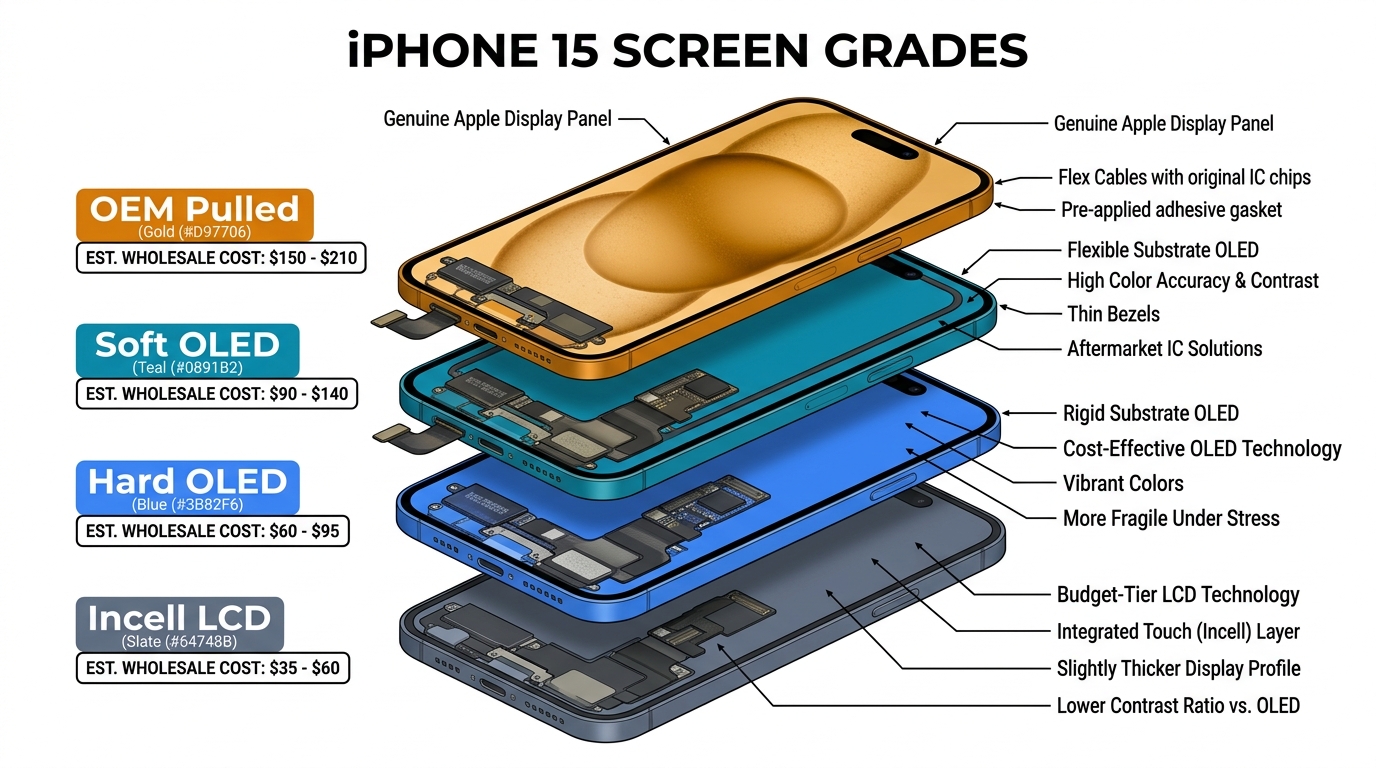
Before the adjustments, the base numbers for iPhone 15 screen replacement at UK wholesale costs and typical shop retail pricing:
| Grade | Wholesale (GBP) | Typical retail | Gross margin | Gross margin % |
|---|---|---|---|---|
| Incell LCD | £23–£26 | £80–£100 | £54–£77 | 67–75% |
| Hard OLED | £40–£45 | £120–£149 | £75–£109 | 62–72% |
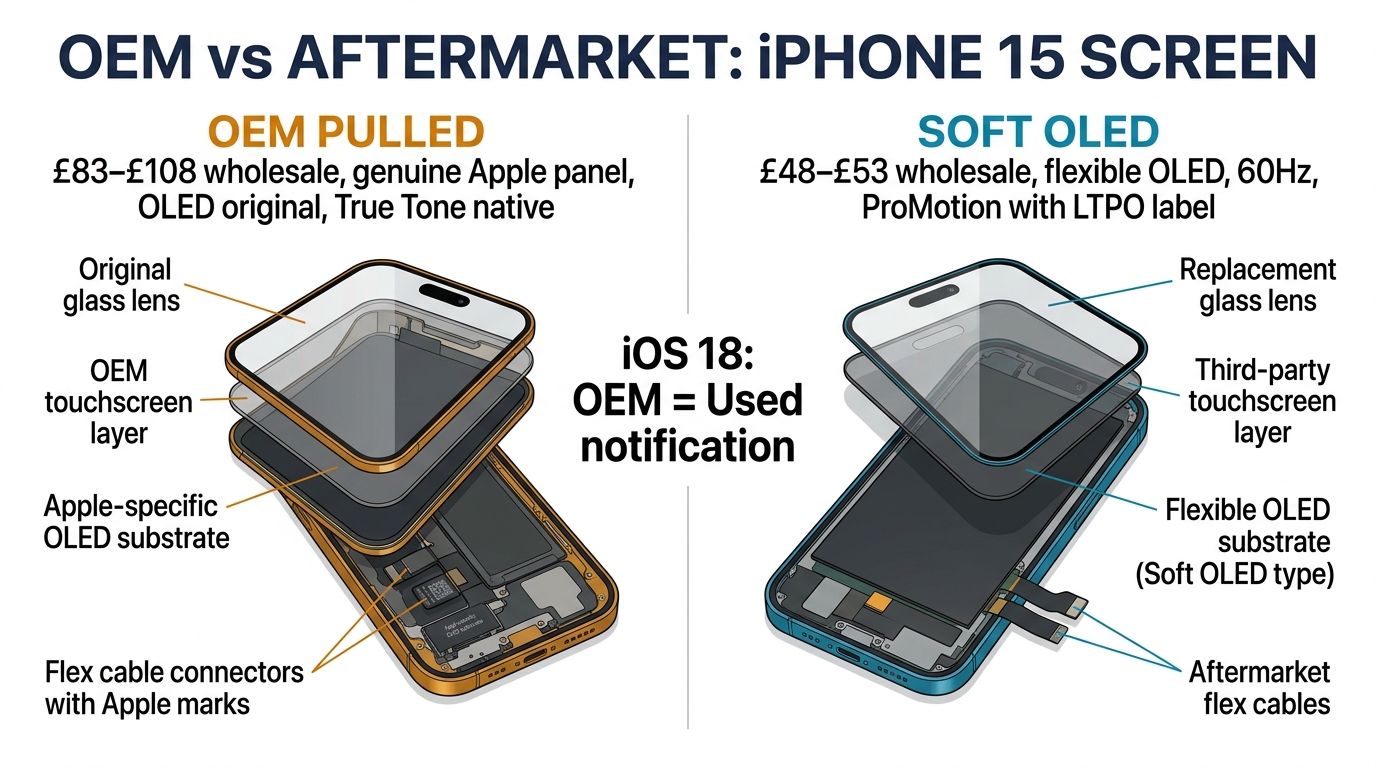
| Soft OLED | £48–£53 | £130–£165 | £77–£117 | 59–70% |
| OEM Pulled | £83–£108 | £190–£299 | £82–£216 | 43–72% |
Wholesale data from iphonelcd.net at 50+ unit quantities. OEM-pull sourced from established disassembly operations.
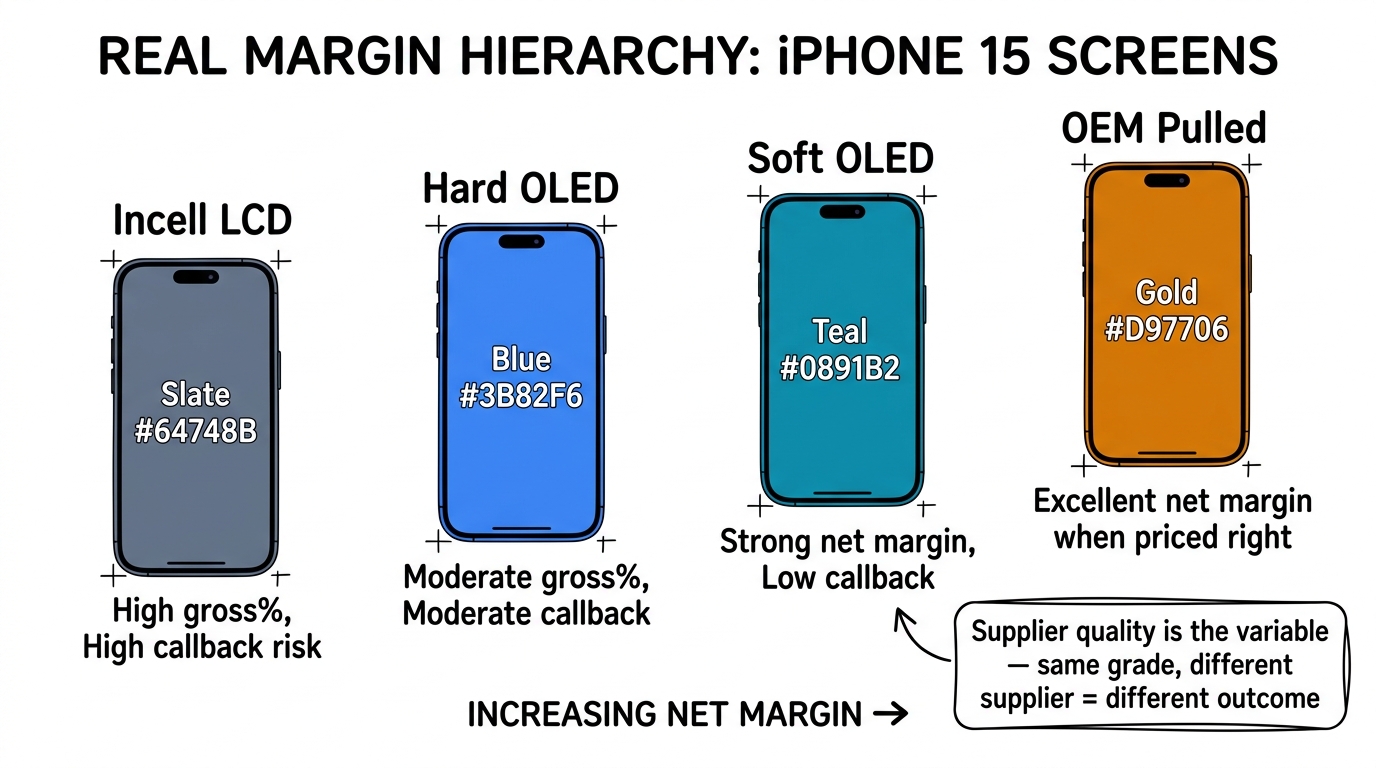
On gross margin percentage, Incell wins. On absolute margin, OEM-pull at the premium end wins. But neither figure tells you what you actually keep after the repair lifecycle plays out.
What Failure Rates Do to Your Real Margin
Aftermarket screen failures fall into two categories that most shops don't account for separately:
Immediate failures — touch dead zones, colour shifting, backlight bleeding. These show up in bench testing or within the first week. A functioning return policy from your supplier recovers the part cost, but not the labour.
Delayed failures (10–21 days post-install) — adhesive failures, proximity sensor interference, touch degradation, image retention. These hit after the job is closed and the customer has left. You've already consumed the gross margin before the callback arrives. Most supplier DOA policies don't cover failures at this lag. Source: fizonparts.com supply chain analysis.
A meaningful share of screen defects that eventually generate complaints won't appear on a standard bench test — they're quality distribution issues in lower-grade parts batches, not testing failures you can eliminate with a better protocol.
Hard OLED re-crack rate: Hard OLED panels re-crack at notably higher rates than Soft OLED. The rigid glass substrate is more brittle on impact than the flexible polymer substrate in Soft OLED. For customers in trades or physically active environments, this is worth flagging when choosing which grade to quote.
The Callback Cost Calculation
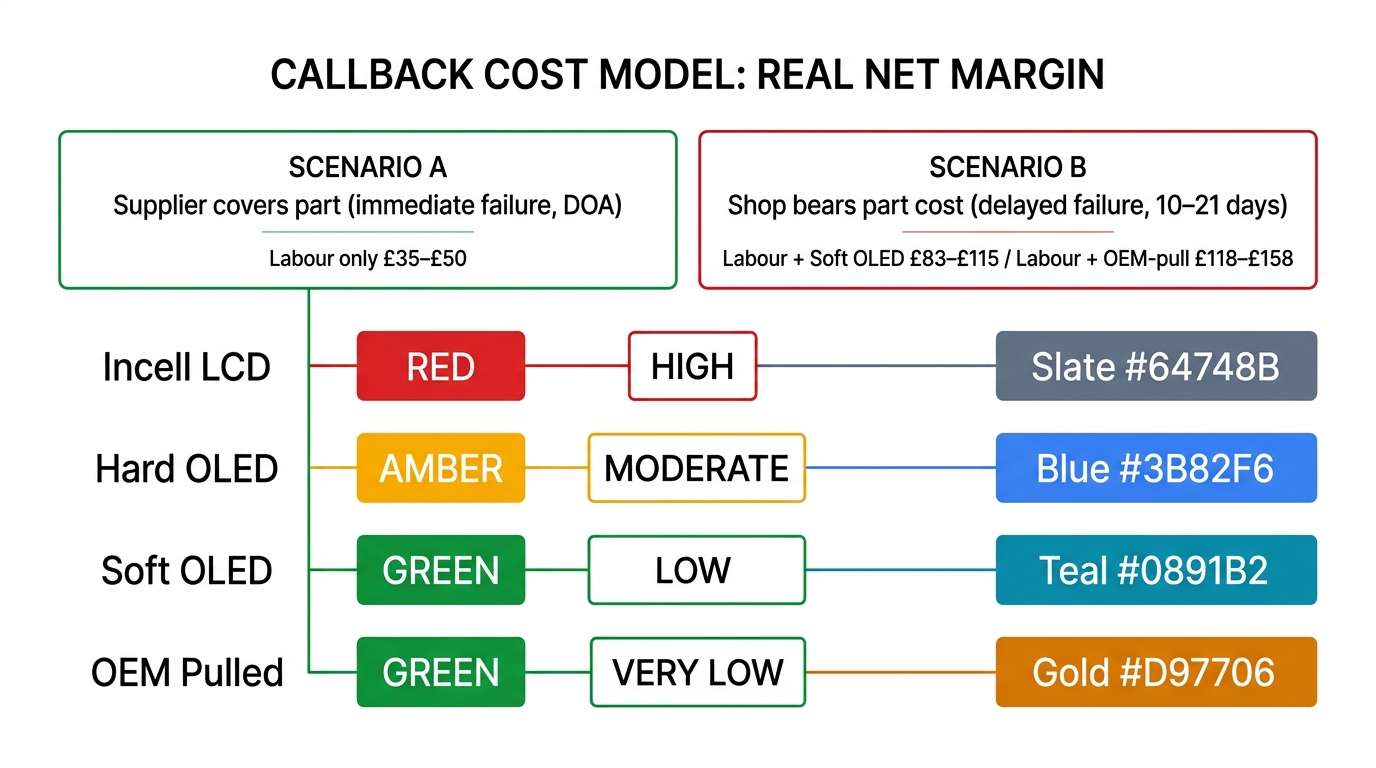
To turn failure rates into actual cost, you need a number for what a callback costs your shop. Cost breaks into two scenarios:
Supplier covers the part (immediate failure, DOA claim): Labour only — 30–45 minutes at bench rate, roughly £35–£50.
Shop bears the part cost (delayed failure, outside DOA window): Labour plus full replacement part at wholesale. For Soft OLED this runs £83–£115 per incident; for OEM-pull £118–£158. Since most delayed failures occur 10–21 days post-install, they're typically outside supplier DOA coverage — which is where the real margin erosion happens.
Add £0–£30 goodwill discount if you're trying to retain the customer.
Now apply that to grade-specific callback rates. Exact rates vary by supplier batch, but the directional pattern from shops that track callbacks:
| Grade | Relative callback rate | Net margin per 100 jobs |
|---|---|---|
| Incell LCD | High | Lower than gross margin suggests |
| Hard OLED | Moderate | Moderate |
| Soft OLED (reputable supplier) | Low | Strong |
| OEM Pulled (tested) | Very low | Excellent |
These are directional estimates, not audited shop figures — your actual rates depend heavily on supplier quality. But the finding holds: the gross margin advantage of cheap parts erodes significantly once you account for callbacks, and delayed failures are the category most shops undercount.
The practical implication: Soft OLED from a reputable supplier is typically the best risk-adjusted margin position. The part costs more than Incell or Hard OLED, but the callback rate is low enough that the net margin holds — and customer satisfaction supports repeat business and referrals.
IC Transfer: What It Actually Costs to Do Right
If you offer IC transfer — transplanting the Display Driver IC from the original screen to the replacement to eliminate the Unknown Part warning and restore True Tone — you need to price it correctly.
IC transfer requires: hot air rework station, BGA tools, microscope, flux, and consumables. The skill takes time to build, and the equipment has real capital cost. In terms of per-job pricing:
- Additional labour time: 20–30 minutes per screen
- Equipment amortisation: depends on setup, but roughly £3–£8 per job across typical shop volume
- Consumables (flux, solder): £1–£2 per job
Total IC transfer add-on cost: £25–£45 at typical shop labour rates, before profit.
Most shops offering IC transfer charge £20–£40 extra to customers, or bundle it into a "premium repair" price point. If you're doing IC transfer and not pricing it as an add-on, you're subsidising it from your screen margin.
The other constraint: not all aftermarket screens support IC transfer. The replacement screen must have solder-ready IC pads. Incell and Hard OLED screens from most suppliers don't have compatible pad layouts. This means IC transfer is primarily a Soft OLED and OEM-pull service — which aligns with the customers most likely to pay for a premium repair.
For a detailed walkthrough of the IC transfer process and equipment requirements, see our iPhone Unknown Part warning and IC transfer guide.
When OEM Pull Earns More Than Aftermarket
The common assumption is that OEM-pull is a premium option with high gross margin only for premium customers. The callback data suggests a more nuanced picture.
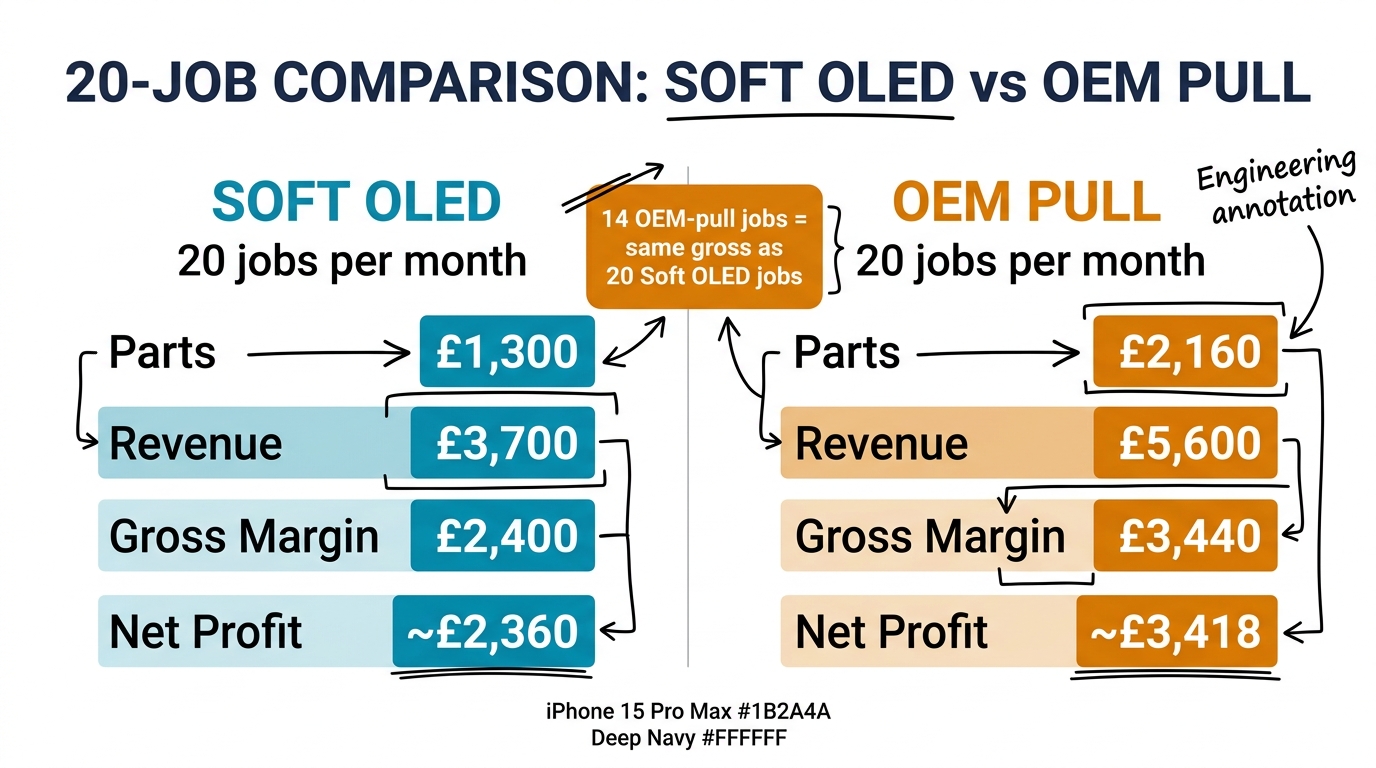
Consider a shop doing 20 iPhone 15 Pro Max screen repairs per month. Running Soft OLED at £65 wholesale vs OEM-pull at £108 wholesale:
| Soft OLED (20 jobs) | OEM Pull (20 jobs) | |
|---|---|---|
| Parts cost | £1,300 | £2,160 |
| Revenue (at £185 / £280) | £3,700 | £5,600 |
| Gross margin | £2,400 | £3,440 |
| Est. callbacks (lower vs very low rate) | ~1 job | ~0.5 jobs |
| Labour callback cost (est.) | £35–£50 | £18–£25 |
| Net margin (approx) | £2,350–£2,365 | £3,415–£3,422 |
The OEM-pull scenario generates roughly £1,050 more net margin — because the higher retail price more than offsets the higher parts cost, and fewer callbacks protect that margin. Put differently: 14 OEM-pull jobs at £280 yield roughly the same gross as 20 Soft OLED jobs at £185, with less bench time and fewer callbacks.
This comparison holds only if you can command £280 for a Pro Max OEM-pull repair. In a price-sensitive market with competition at £165, the premium needs justification — and you need customers who will pay for it. If your market won't support £280, run the maths at your local ceiling: the efficiency advantage of OEM-pull often still holds even at a narrower price gap.
On iOS 18's "Used" notification for OEM-pull screens: brief customers before the repair. The "Used" label appears because the panel was previously installed in another iPhone — it confirms the screen is genuine Apple hardware, not that something went wrong. Customers who aren't warned will call you about it; customers who are warned in advance almost never do.
Ordering iPhone 15 Pro Max screens for OEM-pull repairs? We supply tested Grade A pulls with brightness and pixel integrity data. Request a wholesale quote →
The Number That Actually Matters
Gross margin percentage looks good on Incell. Absolute gross margin looks good on OEM-pull. Net margin — after callbacks, warranty costs, and IC transfer labour — consistently points to Soft OLED as the most reliable position for volume repair shops.
One caveat applies across all grades: supplier quality is the variable that changes the outcome. A Soft OLED from a supplier who doesn't separate LTPO from standard, doesn't specify IC transfer pad compatibility, and doesn't provide a meaningful DOA window will underperform a properly sourced Hard OLED in real-world operation. For OEM-pull, verify that panels are tested for brightness and pixel integrity — unverified pulls from unknown disassembly sources are where quality variance is worst. The grade sets the ceiling; the supplier determines whether you get there.
If you're ordering iPhone 15 screens and want clear LTPO labelling, IC transfer-ready specs confirmed in writing, and tested OEM-pull panels, request a wholesale quote →
Frequently Asked Questions
Is OEM-pull always better quality than aftermarket? Better on average — but with variance. OEM-pull quality depends on where the panel came from. A screen pulled from a physically damaged device may have minimal hours; one pulled after 18 months of heavy use may have OLED degradation already underway. Reputable disassembly operations test for brightness and pixel integrity before selling. Verify this with any supplier before ordering at scale.
Why does Hard OLED have a higher re-crack rate than Soft OLED? Hard OLED uses a rigid glass substrate, which is more brittle on impact than the flexible polymer substrate in Soft OLED. For customers in trade or physically active environments, this difference matters and is worth disclosing when choosing which grade to quote.
Can you do IC transfer on an OEM-pull screen? It's already an OEM screen, so the IC is already paired to the device it came from — not to your customer's phone. IC transfer on OEM-pull involves transplanting the original screen's IC (from the customer's broken display) onto the OEM-pull replacement, the same process as with Soft OLED. This eliminates the "Used" notification and restores full True Tone calibration.
Related: iPhone 15 Screen Replacement: Full Technical Guide · Incell vs Hard OLED vs Soft OLED: Which Screen to Order by Model · OEM vs Aftermarket Phone Screens: The Wholesale Buyer's Guide