
OEM vs Aftermarket Phone Screens: A Wholesale Buyer's Guide to Quality Grades and Pricing
"OEM or aftermarket?" is the wrong question. At least, it's incomplete.
The OEM vs aftermarket phone screens debate matters less than understanding the four or five grades within those categories and knowing which one matches your business model. A repair shop doing 20 budget repairs a day has different needs from a premium service center doing 5 high-end repairs. A distributor supplying both types needs to stock accordingly.
This guide breaks down every screen grade available in the wholesale market — what they actually are, how they're made, what they cost, and which business model each one serves. No vague "aftermarket is cheaper" generalizations. Specific grades, specific numbers, specific trade-offs.
Sourcing Replacement Screens in Bulk?
Incell / Hard OLED / Soft OLED grades — wholesale pricing, grade comparison on request.
Get Wholesale QuoteWhat OEM and Aftermarket Actually Mean for Phone Screens
These terms get misused constantly. Here's what they mean in the phone parts wholesale market.
OEM (Original Equipment Manufacturer)
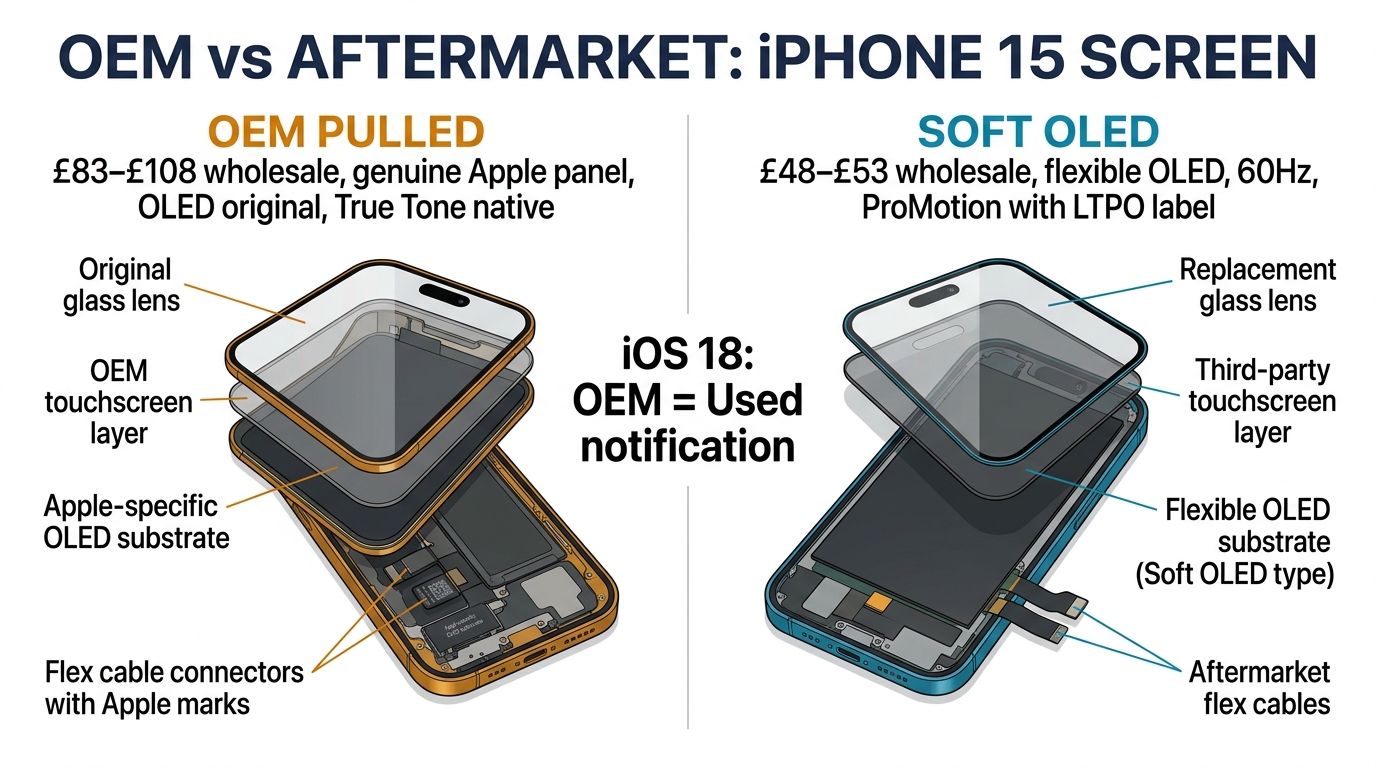
An OEM screen is manufactured by the same company that made the original screen for the phone. For iPhones, that's typically Samsung Display, LG Display, or BOE. For Samsung Galaxy phones, Samsung Display makes both the original and the OEM replacement.
OEM screens come in two forms:
- OEM Original (pulled/new): Removed from original devices or sourced directly from the display manufacturer's production line. Identical to what ships in the box. These are rare and expensive.
- OEM Refurbished: An original display panel that's been separated from its broken glass, re-laminated with new glass, and re-tested. The OLED/LCD panel is original; the glass and polarizer are new. Quality depends entirely on the refurbishment process.
Aftermarket
An aftermarket screen is manufactured by a third-party company — not the original display maker. Aftermarket screens vary enormously in quality because different manufacturers use different panel technologies, IC chips, and production standards.
This is where the real decision happens. "Aftermarket" isn't a single quality level. It's a category containing at least three distinct grades, each with different specs and prices.
Refurbished
Refurbished screens sit between OEM and aftermarket. They use an original OEM display panel paired with new aftermarket glass. The panel quality is original, but the glass and re-lamination quality depend on the refurbisher. Good refurbs are nearly indistinguishable from original. Bad refurbs have dust trapped under the glass, uneven backlighting, or weak adhesive that separates within months.
The Complete Phone Screen Grade Breakdown: OEM vs Aftermarket Compared
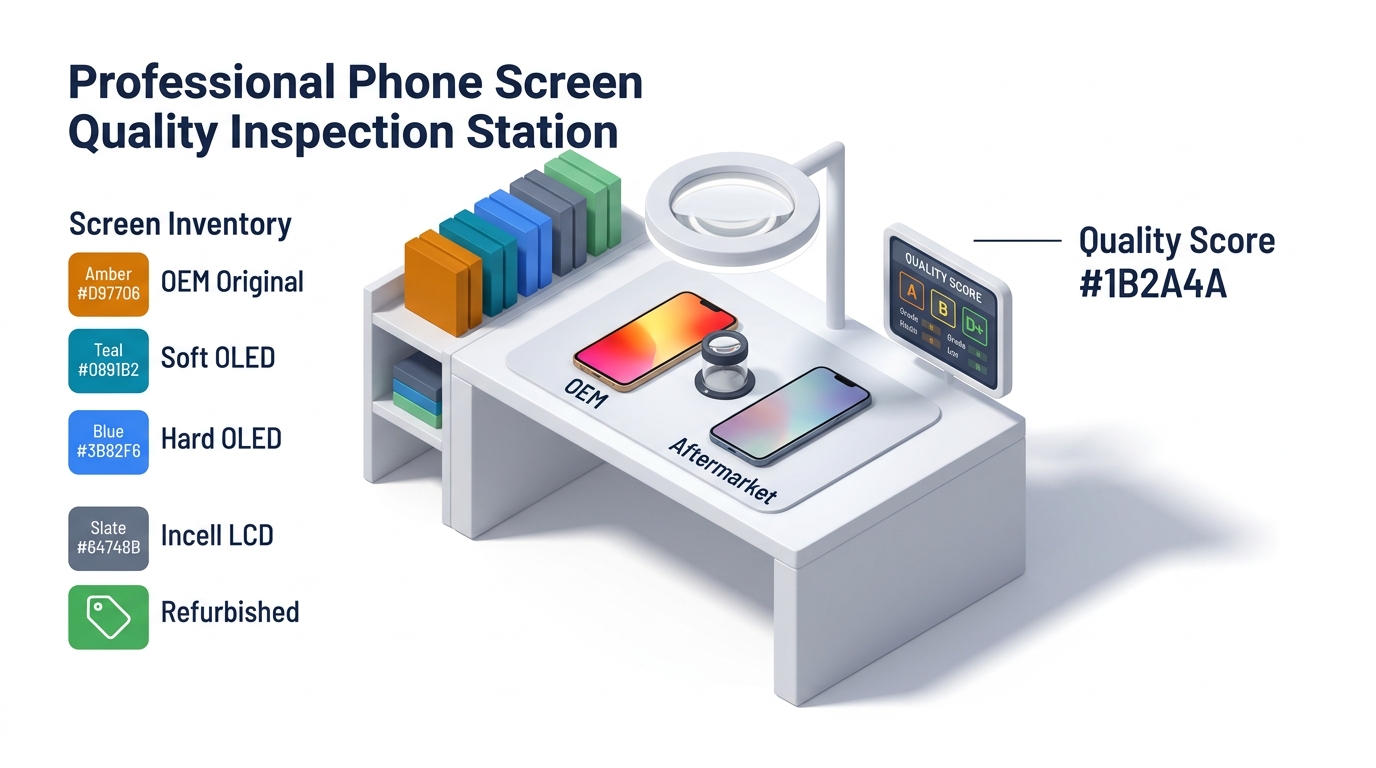
Here's where the abstract becomes concrete. Every wholesale buyer needs to understand these five grades.

Grade 1: Original OEM
- Panel: Original manufacturer (Samsung Display, LG, BOE)
- Glass: Original
- Touch IC: Original
- Color accuracy: 100% (reference standard)
- Typical defect rate: <0.5%
- Wholesale price range: $45–$90+ per unit (model dependent)
Who buys this: Premium repair centers, warranty service providers, customers who explicitly request "original parts." Volume is limited and supply is inconsistent — you can't build a high-volume operation around OEM-only stock.
Grade 2: OEM Refurbished
- Panel: Original OLED/LCD panel (reclaimed)
- Glass: New aftermarket glass, re-laminated
- Touch IC: Original (from donor panel)
- Color accuracy: 95–100% (depends on refurb quality)
- Typical defect rate: 1–3% (higher variance than new OEM)
- Wholesale price range: $30–$60 per unit
Who buys this: Mid-to-high-end repair shops that want near-original quality at lower cost. The risk here is refurbishment quality — a well-done refurb is indistinguishable from original, but a bad one has visible imperfections. Ask your supplier where their refurbs are processed and what QC steps they apply post-lamination.
Grade 3: Soft OLED (Aftermarket)
- Panel: Aftermarket flexible OLED
- Glass: New aftermarket
- Touch IC: Aftermarket (typically BOE or equivalent)
- Color accuracy: 90–95% of original
- Typical defect rate: 1–2%
- Wholesale price range: $25–$50 per unit
Who buys this: Repair shops positioning as "quality service at fair prices." Soft OLED is the sweet spot for many businesses — customers rarely notice the 5–10% color difference, but your per-unit cost is 30–50% lower than OEM. Deep blacks, good viewing angles, accurate touch response. The most popular grade for iPhone OLED model repairs in the wholesale market.
Grade 4: Hard OLED (Aftermarket)
- Panel: Aftermarket rigid OLED
- Glass: New aftermarket
- Touch IC: Aftermarket
- Color accuracy: 85–90% of original
- Typical defect rate: 1.5–3%
- Wholesale price range: $18–$35 per unit
Who buys this: High-volume shops and distributors serving price-sensitive markets. Hard OLED uses a rigid panel instead of flexible, making it slightly thicker (0.1–0.2mm difference). Color temperature runs slightly warmer than original, and maximum brightness is about 10–15% lower. For most end customers, these differences are invisible unless compared side-by-side with an original.
Grade 5: Incell LCD (Aftermarket)
- Panel: LCD with integrated touch layer
- Glass: New aftermarket
- Touch IC: Varies (Tianma, generic)
- Color accuracy: 70–80% of original
- Typical defect rate: 2–4%
- Wholesale price range: $7–$18 per unit
Who buys this: Budget repair shops, insurance replacement programs, high-volume operations maximizing margin. The quality gap is visible — blacks are grey, colors are cooler, and brightness is noticeably lower. But at $7–$12 per unit for older iPhone models, the margin per repair is highest of any grade.
Soft OLED vs Hard OLED: The Decision Most Wholesale Buyers Get Wrong

This is the comparison that matters most for the majority of wholesale buyers. "Soft OLED vs hard OLED" comes up in every sourcing conversation, and it's where the most money is either saved or wasted.
| Specification | Soft OLED | Hard OLED |
|---|---|---|
| Panel type | Flexible OLED | Rigid OLED |
| Thickness | ~1.1mm (closer to original) | ~1.3mm (slightly thicker) |
| Color accuracy vs. original | 90–95% | 85–90% |
| Maximum brightness | 90–95% of original | 85–90% of original |
| Black level | True black (identical to original) | True black (identical to original) |
| Touch responsiveness | Excellent | Good (slight lag on some models) |
| Cold-weather performance | Stable | Occasional touch sensitivity issues below 5°C |
| Typical defect rate | 1–2% | 1.5–3% |
| Price difference | 30–50% more than Hard OLED | Baseline |
The real question isn't which is "better" — it's which makes more money for your business.
If your average screen repair charges $80–$120 and your customers expect near-original quality, Soft OLED at $30–$40 per unit gives you strong margins with minimal complaints. If you're competing on price at $40–$60 per repair, Hard OLED at $20–$28 keeps your margin viable without sacrificing too much on quality perception.
Want to see the difference yourself? We can send a sample kit with Soft OLED, Hard OLED, and Incell for your top models — test them side by side before ordering in bulk. Request a sample kit.
Phone Screen Pricing Logic: Why the Same Grade Has Different Prices
You'll see the same "Hard OLED iPhone 15 screen" quoted at $22 from one supplier and $32 from another. The grade label is the same, but the product isn't. Here's what drives the difference.
IC Chip Quality
The integrated circuit controls touch responsiveness and display communication. Screens with BOE or Tianma ICs cost $2–$4 more per unit but have measurably better touch accuracy and lower failure rates. Generic ICs save money upfront but generate more post-installation returns.
Panel Manufacturer Tier
Within any grade, panels come from different factories. Tier-1 aftermarket manufacturers invest in better production controls, tighter color calibration, and more rigorous outgoing QC. A Soft OLED from a top-3 factory costs $5–$8 more than one from a no-name factory — but the defect rate is often half.
Testing Depth
- 100% individual testing: Every unit tested on real devices. Adds $0.50–$1.00/unit.
- Batch sampling (10–20%): Cheaper, but your incoming defect rate will be higher.
- No independent testing: Factory QC only. Cheapest option, highest risk.
The Price–Defect Tradeoff Table
| Price Tier | Testing Level | Expected Defect Rate | Net Cost on 200 Units (with rework) |
|---|---|---|---|
| Low ($18/unit Hard OLED) | Batch sampling | 4–5% | $3,780 |
| Mid ($24/unit Hard OLED) | 100% tested | 1.5–2% | $4,896 |
| High ($30/unit Hard OLED) | 100% + device verified | <1% | $6,060 |
The low-price option looks cheapest until you factor in 8–10 defective screens per shipment, each costing $15–$20 in labor for re-repair plus customer relationship damage. Mid-tier pricing is where most experienced buyers land.
Which Phone Screen Grade Fits Your Business Model
Choosing a grade isn't about finding the "best" screen. It's about matching screen quality to your business positioning and customer expectations.
Budget Repair Shop (High Volume, Low Price)
- Primary grade: Incell LCD (60–70% of stock)
- Secondary grade: Hard OLED (20–30% for customers who ask for "better")
- Average repair price: $40–$60
- Target margin per repair: $25–$40
Mid-Range Repair Shop (Balanced Quality/Price)
- Primary grade: Hard OLED (50–60%)
- Secondary grade: Soft OLED (30–40% for flagship models)
- Average repair price: $70–$100
- Target margin per repair: $35–$55
Premium Repair Center
- Primary grade: Soft OLED (50–60%)
- Secondary grade: OEM Refurbished or Original (30–40%)
- Average repair price: $100–$150
- Target margin per repair: $45–$70
Distributor (Stocking for Multiple Shop Types)
You need all grades. Typical inventory split:
- 35% Incell (fastest volume mover)
- 30% Hard OLED
- 25% Soft OLED
- 10% OEM Refurbished
How to Test Screen Quality Before Buying in Bulk

Never rely on grade labels alone. Here's a practical testing protocol for evaluating screens from a new supplier.
Visual Test (30 seconds per unit)
- Power on the screen with a test jig or installed in a device
- Open a full-white image — check for uneven backlight, yellow spots, or dead pixels
- Open a full-black image — on OLED grades, the screen should be completely dark with no light bleed
- Open a color gradient image — look for banding or abrupt color transitions
Touch Test (60 seconds per unit)
- Open a drawing app and draw diagonal lines corner to corner — the line should be smooth with no gaps or jumps
- Test multi-touch with a pinch-to-zoom gesture — both touch points should track accurately
- Test edge touch responsiveness — swipe from all four edges of the screen
- On OLED screens, test the always-on display function if applicable
Durability Indicators
- Oleophobic coating: Rub your thumb across the screen surface. A good screen resists fingerprints and feels smooth. Cheap screens feel "sticky" and smudge immediately.
- Glass hardness: Gently press the center of the screen — excessive flex indicates thin glass that's more prone to cracking.
- Frame fit: Install in the device. The screen should sit flush with no gaps, raised edges, or wobble.
The 7-Day Burn Test
For OLED grades, leave the screen displaying a static image (like a clock) for 7 days. Cheap OLED panels will show image retention or color shift within this window. Quality panels should show zero burn-in after a week.
Common Misconceptions About OEM vs Aftermarket Phone Screens
"Aftermarket always means low quality"
False. A top-tier Soft OLED from a reputable manufacturer delivers 90–95% of original quality. The problem isn't aftermarket as a category — it's the range within aftermarket. An Incell from a no-name factory and a Soft OLED from a tier-1 manufacturer are both "aftermarket," but they're entirely different products.
"OEM is always worth the premium"
Not always. For models older than 2 years, the price difference between OEM ($60+) and Soft OLED ($30) is hard to justify when most customers just want a working screen. OEM makes sense for current-generation flagships and customers who specifically request it.
"All Incell screens are the same"
Far from it. Incell screens using Tianma ICs have measurably better touch accuracy than those with generic ICs. The price difference is $2–$3 per unit, but the return rate difference can be 2–3x. "Incell" is a technology category, not a quality guarantee.
"Refurbished means used"
Partially true but misleading. The OLED panel is reclaimed from a used device, but it's the highest-quality component — original display technology that can't be replicated aftermarket. The glass and lamination are new. A well-refurbished screen is better than a new aftermarket screen in display quality.
Frequently Asked Questions
Is OEM or aftermarket better for iPhone screen repairs?
It depends on the model and your pricing. For iPhone 13 and older, aftermarket Soft OLED delivers near-original quality at 40–50% less cost — most customers can't tell the difference. For iPhone 15 Pro and newer flagships, OEM or OEM refurbished may be worth it if your customer base expects premium quality and is willing to pay for it.
What does "Soft OLED vs Hard OLED" mean for wholesale buyers?
Soft OLED uses a flexible panel (same technology as the original iPhone OLED), while Hard OLED uses a rigid panel. Soft OLED is thinner, brighter, and more color-accurate but costs 30–50% more. Hard OLED is the value option — 85–90% of original quality at a lower price point. Most buyers stock both: Soft OLED for flagship repairs, Hard OLED for price-conscious customers.
How can I tell if a screen is truly OEM or just relabeled aftermarket?
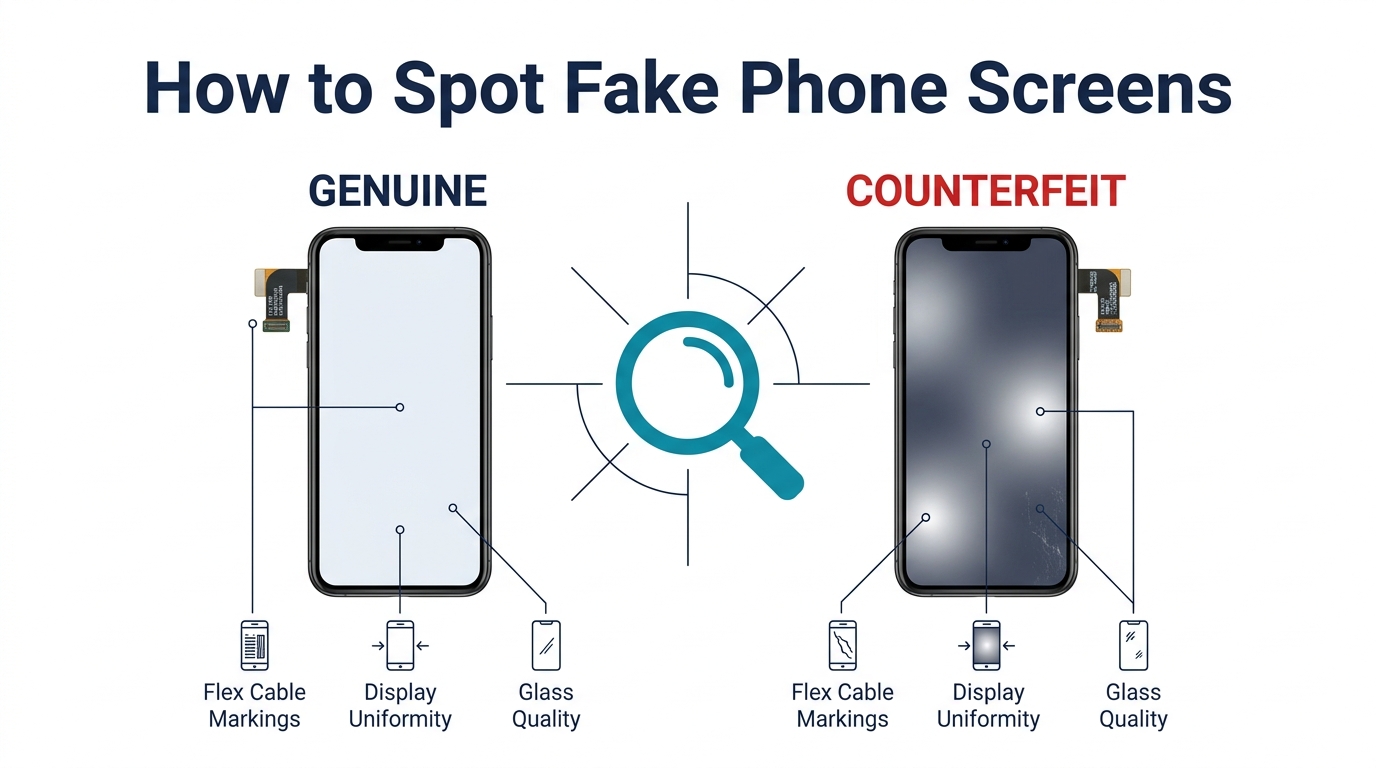
Check three things: (1) panel thickness — OEM panels are thinner, (2) color accuracy under a white screen test — OEM has warmer, more consistent whites, (3) the flex cable connector style and markings — OEM flex cables have specific part numbers from Samsung Display or LG. Also, if the "OEM" price is less than 60% of Apple/Samsung's official screen cost, it's almost certainly not genuine OEM.
Do aftermarket screens void the phone's warranty?
Using a third-party screen does not automatically void the entire phone warranty in most markets (the US Magnuson-Moss Warranty Act protects this). However, Apple and Samsung can refuse to cover screen-related issues if an aftermarket screen is installed. For warranty repairs, OEM is the safer choice.
Make the Grade Decision That Fits Your Business

The OEM vs aftermarket phone screens choice isn't binary. It's a spectrum with five distinct grades, each serving a different price point and customer expectation. The wholesale buyers who profit most aren't those buying the "best" grade — they're the ones stocking the right mix of grades for their market.
Know your customer base. Run the margin math per grade. Test samples from your supplier before committing volume. That's the formula.
Need grade recommendations for your specific market? Tell us your top repair models and your typical repair pricing — we'll suggest a grade mix that maximizes your margin.
Request a Wholesale Quote — include your models and volume, and we'll send pricing for each grade. Or browse the wholesale iPhone & Samsung screen catalog to see grades and SKUs first.
Related reading: