
Wholesale Samsung Screens: AMOLED Grades, Pricing, and What to Stock

Samsung screen repairs are the second-largest revenue stream for most repair shops — right behind iPhone. But sourcing wholesale Samsung screens is fundamentally different from sourcing iPhone screens, and the mistakes are more expensive.
Here's why: every Samsung flagship uses AMOLED display technology. There's no Incell LCD equivalent that works as a budget option the way there is for iPhones. When an aftermarket Samsung screen drops below a certain quality threshold, customers notice immediately — washed-out colors, visible backlight on what should be a pure-black display, fingerprint sensor failures. The margin for error is smaller.
This guide covers the Samsung screen grade system, realistic wholesale pricing for each tier, which models to prioritize for stocking, and the specific pitfalls that trip up buyers who are used to iPhone screen sourcing.
Sourcing Replacement Screens in Bulk?
Incell / Hard OLED / Soft OLED grades — wholesale pricing, grade comparison on request.
Get Wholesale QuoteSamsung vs iPhone Screens: Why the Sourcing Game Is Different
If you're already comfortable buying wholesale iPhone screens, you might assume Samsung works the same way. It doesn't, and here's what catches people off guard.
AMOLED Is the Baseline, Not a Premium
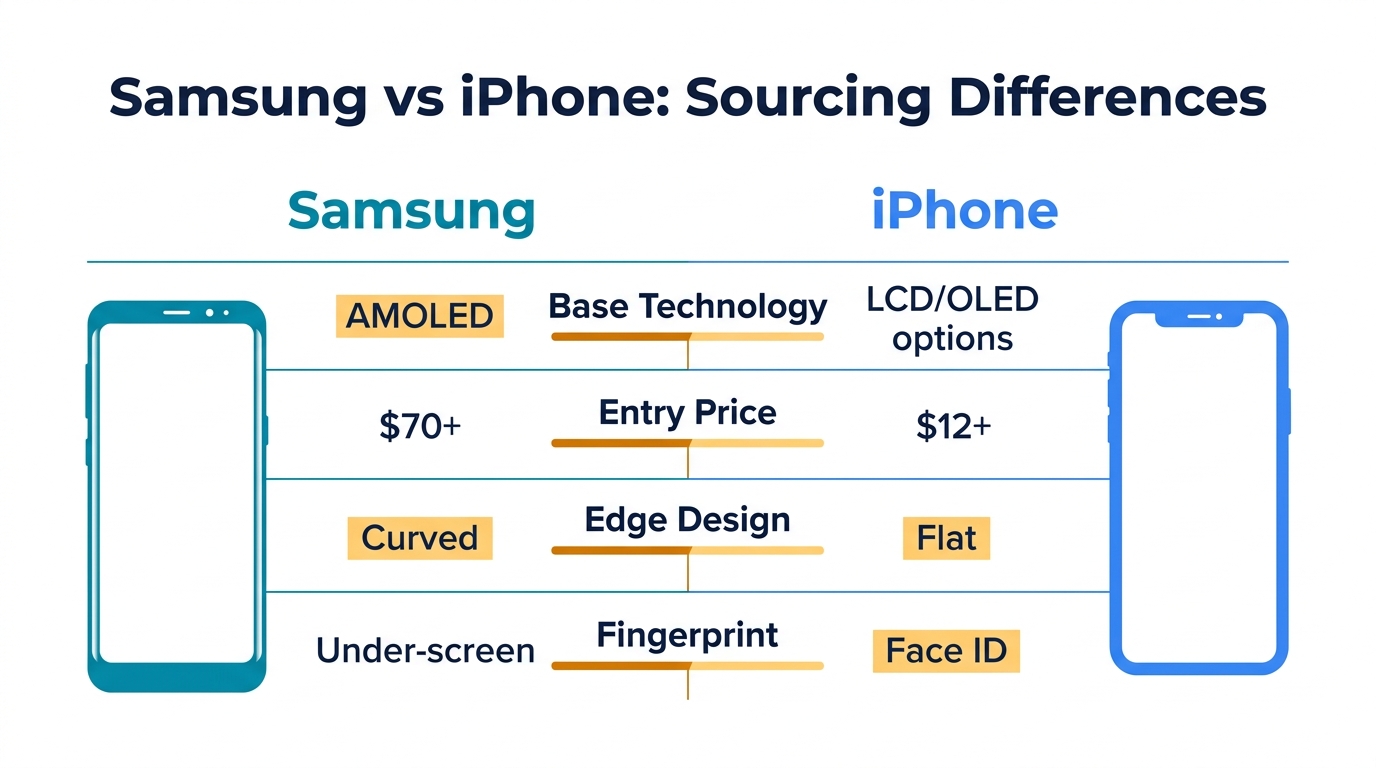
Every Samsung Galaxy S, Note, Z, and most A-series phones use AMOLED panels. Unlike iPhones — where you choose between Incell LCD ($12-18), Hard OLED ($25-35), and Soft OLED ($40-55) — Samsung screens start at a higher quality floor. There's no true LCD equivalent for Samsung flagships that customers will accept.
This means:
- Entry-level Samsung screens cost more than entry-level iPhone screens
- The price gap between grades is smaller but the quality gap is still significant
- Counterfeit risk is higher because the cost incentive to sell TFT/LCD copies labeled as "AMOLED" is enormous
Curved Edges Add Complexity
Samsung Galaxy S8 through S24 Ultra all have curved edge displays. Aftermarket manufacturers struggle to replicate the exact curve radius, edge touch sensitivity, and glass bonding quality. A curved Samsung screen that doesn't sit flush or has dead touch zones along the edges generates immediate customer complaints.
Samsung's Fingerprint Sensor Is Under the Screen
Galaxy S10 and later use an ultrasonic fingerprint sensor embedded in the display. Screen quality directly affects fingerprint recognition speed and accuracy. Cheap aftermarket screens frequently cause fingerprint failures — and your customer will blame you, not the screen.
The 4 Grades of Wholesale Samsung Screens
Grade 1: Original Samsung (OEM Pull / Service Pack)
These are genuine Samsung-manufactured AMOLED panels. They come in two forms:
- Service Pack: New, sealed screens supplied through Samsung's official parts program. Highest cost, highest quality, zero defects. Includes frame and adhesive.
- OEM Pull: Original screens carefully removed from devices with other damage (e.g., motherboard failure). Glass is replaced, AMOLED panel is original. Slightly lower cost than Service Pack.
| Spec | Detail |
|---|---|
| Display type | Super AMOLED / Dynamic AMOLED 2X |
| Fingerprint compatibility | Full compatibility, fast recognition |
| Curved edge quality | Perfect fit, full edge touch response |
| Typical defect rate | <0.5% |
| Price range (Galaxy S24 Ultra) | $180-250 |
| Best for | Premium repair services, warranty repairs |
Grade 2: Refurbished Original AMOLED
The original AMOLED panel is salvaged from a used device, tested, and re-bonded with new front glass. The display itself is genuine Samsung — colors, brightness, and sensor compatibility are near-original. The new glass may have slightly different feel or oleophobic coating quality.
| Spec | Detail |
|---|---|
| Display type | Original AMOLED panel + new glass |
| Fingerprint compatibility | Good — 90-95% of original speed |
| Curved edge quality | Good, slight variation possible at glass-to-frame junction |
| Typical defect rate | 2-4% |
| Price range (Galaxy S24 Ultra) | $110-160 |
| Best for | Mid-to-high-end repairs, price-conscious customers who still want AMOLED quality |
Grade 3: Aftermarket AMOLED
Third-party manufactured AMOLED panels. These are new screens, not salvaged — but made by aftermarket factories, not Samsung. Quality varies significantly by manufacturer. The best aftermarket AMOLEDs are 85-90% of original quality. The worst are barely better than TFT copies.
| Spec | Detail |
|---|---|
| Display type | Third-party AMOLED |
| Fingerprint compatibility | Variable — 70-85% of original speed, some models incompatible |
| Curved edge quality | Noticeable differences on edge touch, curve radius may vary |
| Typical defect rate | 3-6% |
| Price range (Galaxy S24 Ultra) | $70-110 |
| Best for | Budget-conscious repairs, insurance replacements, high-volume shops |
Grade 4: TFT/LCD Copy (Avoid for Flagships)
These are not AMOLED at all — they're TFT LCD panels designed to fit Samsung phone frames. They're the cheapest option but produce a dramatically inferior experience: no deep blacks, visible backlight, poor viewing angles, and fingerprint sensor usually doesn't work.
| Spec | Detail |
|---|---|
| Display type | TFT LCD (not AMOLED) |
| Fingerprint compatibility | Usually non-functional |
| Curved edge quality | Flat edges on curved models, poor fit |
| Typical defect rate | 8-15% |
| Price range (Galaxy S24 Ultra) | $30-50 |
| Best for | Only for very old models where customer expects a budget repair, or temporary replacements |
Want to compare grades side by side before ordering? We can send sample units of each Samsung screen grade. Request samples here.
Pricing Guide: What Wholesale Samsung Screens Actually Cost
Prices below are wholesale (50+ unit orders) as of Q1 2026. Actual prices vary by supplier and order volume.
Samsung Galaxy S Series
| Model | Original/Service Pack | Refurbished AMOLED | Aftermarket AMOLED | TFT Copy |
|---|---|---|---|---|
| Galaxy S24 Ultra | $180-250 | $120-160 | $75-110 | $35-50 |
| Galaxy S24/S24+ | $150-200 | $100-140 | $60-90 | $30-45 |
| Galaxy S23 Ultra | $160-220 | $100-140 | $65-95 | $30-45 |
| Galaxy S23/S23+ | $130-180 | $85-120 | $55-80 | $25-40 |
| Galaxy S22 Ultra | $140-190 | $80-120 | $50-75 | $25-38 |
| Galaxy S21/S21+ | $100-140 | $60-90 | $40-60 | $20-30 |
Samsung Galaxy A Series (Flat Screen — Easier to Source)
A-series screens are flat (no curved edges), making aftermarket manufacturing much simpler. Quality consistency is better across grades, and prices are lower.
| Model | Original | Aftermarket AMOLED | TFT/LCD |
|---|---|---|---|
| Galaxy A55 | $45-65 | $25-35 | $12-18 |
| Galaxy A54 | $40-55 | $20-30 | $10-15 |
| Galaxy A34 | $35-50 | $18-25 | $8-12 |
| Galaxy A15/A25 | $25-40 | $12-20 | $6-10 |
Samsung Galaxy Z Series (Foldable)
Foldable screens are the most expensive and complex. The inner folding display is a specialized flexible AMOLED that very few aftermarket manufacturers can replicate. Most repairs use refurbished original panels.
| Model | Original | Refurbished | Aftermarket |
|---|---|---|---|
| Galaxy Z Fold 5 | $280-380 | $180-250 | Limited availability, $140-200 |
| Galaxy Z Flip 5 | $180-250 | $120-170 | Limited, $90-140 |
Which Samsung Models to Stock: Priority Tiers
Not every model deserves shelf space. Based on repair demand data from shops across the US and UK, here's how to prioritize your Samsung screen inventory.
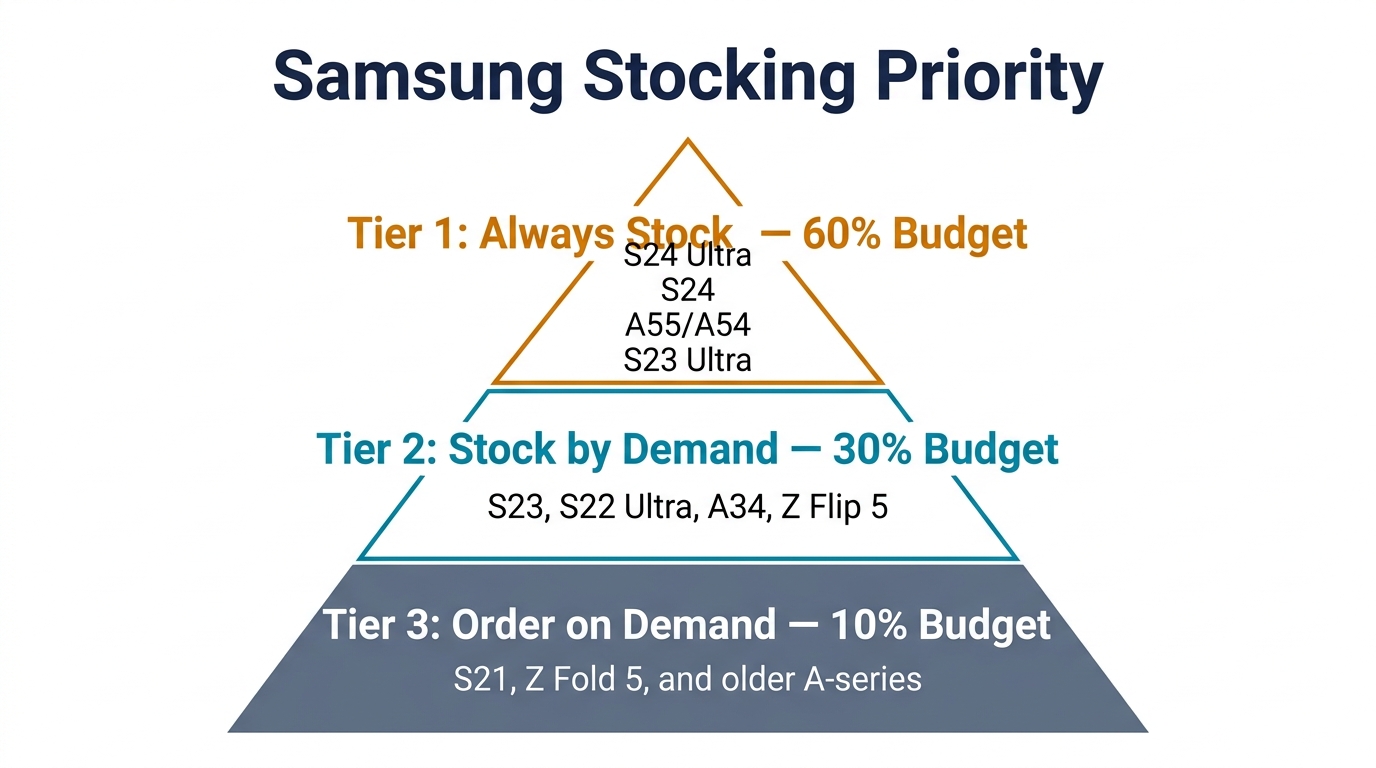
Tier 1: Always In Stock (60% of Your Samsung Budget)
- Galaxy S24 Ultra — Highest-demand flagship, customers willing to pay for quality repair
- Galaxy S24/S24+ — Strong volume across all markets
- Galaxy A55/A54 — The volume play. A-series repairs are frequent, screens are cheap, margins are solid
- Galaxy S23 Ultra — Still in high circulation, strong repair demand
Tier 2: Stock Based on Local Demand (30% of Budget)
- Galaxy S23/S23+ — Steady demand, declining as S24 ages in
- Galaxy S22 Ultra — Good volume in markets with 2-year upgrade cycles
- Galaxy A34/A25 — Budget segment, high volume in UK and EU markets
- Galaxy Z Flip 5 — Growing demand as foldables become mainstream
Tier 3: Order on Demand (10% of Budget)
- Galaxy S21 series — Declining, order as needed
- Galaxy Z Fold 5 — Low volume, high value per repair
- Older A-series (A13, A23) — Price-sensitive customers, only stock if your market demands it
For model selection strategy across both Samsung and iPhone, see our full guide on which phone screen models to stock in 2026.
Samsung-Specific Quality Checks
Beyond the standard incoming QC process, Samsung screens require these additional checks:
1. AMOLED Verification
Dial *#0*# on a Samsung device with the screen installed to open the hardware test menu. Run the black screen test — genuine AMOLED shows absolute black with zero backlight. Any glow means it's a TFT/LCD copy, regardless of what the packaging claims.
2. Fingerprint Sensor Test
Register a fingerprint and test recognition speed. Original and good refurbished screens recognize in under 0.5 seconds. Aftermarket AMOLED averages 0.5-1.0 seconds. TFT copies either fail entirely or take 2+ seconds with frequent misreads.
3. Curved Edge Inspection
For S-series phones, run your finger along the curved edge from top to bottom. Check for:
- Smooth, consistent curve (no flat spots or bumps)
- Touch registration along the entire curved surface
- No gap between the screen glass and the phone frame
- Edge lighting (for Edge notifications) displays evenly
4. Color Accuracy
Open a known reference image (use Samsung's built-in wallpapers). Compare color saturation, white balance, and viewing angle behavior against a known-original screen. Aftermarket AMOLED typically runs 5-10% cooler (bluer whites) than original Samsung panels.
For detailed guidance on identifying fakes, see our guide on how to spot fake phone screens.
Common Mistakes When Buying Wholesale Samsung Screens
Mistake 1: Buying TFT Copies for Flagship Repairs
A Galaxy S24 Ultra customer paying $250+ for a screen repair will notice a TFT display immediately. The no-black-blacks, poor viewing angles, and dead fingerprint sensor guarantee a complaint. TFT copies are only viable for Galaxy A-series budget repairs or temporary replacements.
Mistake 2: Assuming All "AMOLED" Labels Are Real
"AMOLED" on the packaging means nothing without verification. The most common fraud in wholesale Samsung screens is TFT panels labeled as AMOLED. Always run the *#0*# black test before accepting a batch. Read more about grade misrepresentation detection.
Mistake 3: Ignoring Curved Edge Quality
Screens that pass powered-on display tests can still fail on fitment. A screen with a slightly wrong curve radius creates a visible gap, feels wrong to the customer, and may pop out of the frame over time. Always check physical fitment before accepting a shipment.
Mistake 4: Over-Stocking Flagship, Under-Stocking A-Series
Many shops focus on expensive S-series screens and neglect the A-series. But A-series repairs often generate better percentage margins — a $15 aftermarket A54 screen installed for $80 is a better return on investment than a $120 refurbished S24 Ultra screen installed for $250.
Frequently Asked Questions
Can aftermarket Samsung screens match original AMOLED quality?
The best aftermarket AMOLED screens reach about 85-90% of original Samsung quality in terms of color accuracy, brightness, and viewing angles. The main gaps are fingerprint sensor speed (10-30% slower), curved edge precision, and long-term durability. For most customers getting a repair under $200, high-quality aftermarket AMOLED is a perfectly acceptable option. For premium customers, stick with refurbished original or Service Pack.
Why are Samsung screens more expensive than iPhone screens?
Samsung uses AMOLED technology across all flagship and most mid-range devices. AMOLED panels cost more to manufacture than the LCD/Incell screens that serve as budget iPhone options. Additionally, Samsung's curved edge design is harder for aftermarket factories to replicate, limiting competition and keeping prices higher. The silver lining: Samsung screen repairs also command higher prices from customers.
Should I stock refurbished or aftermarket Samsung AMOLED?
Stock both — they serve different customer segments. Refurbished original is your premium option for customers who want near-OEM quality at a lower price than Service Pack. Aftermarket AMOLED is your volume option for price-sensitive repairs. A good split for most shops: 40% refurbished, 50% aftermarket AMOLED, 10% original/Service Pack for warranty-grade repairs.
How do I verify a Samsung screen is genuine original AMOLED?
Three checks: (1) Run the *#0*# hardware test — genuine AMOLED shows absolute black with zero backlight bleed. (2) Check fingerprint sensor speed — original panels register in under 0.5 seconds. (3) Inspect the flex cable for Samsung-branded markings and QC stickers. Refurbished originals should still have the original Samsung flex cable with identifiable markings, even though the front glass is replaced.
Are foldable Samsung screens worth stocking?
Only if you have the technical capability and customer demand. Galaxy Z Flip repairs are becoming more common as the install base grows, but the screens are expensive ($120-250 wholesale) and installation requires specialized skills. Most shops order foldable screens on-demand rather than stocking them. If you're seeing 3+ foldable repair requests per week, consider keeping one Z Flip screen in stock.
Build Your Samsung Screen Inventory Right
Wholesale Samsung screens require more careful grade selection than iPhone screens because the AMOLED baseline is higher and customers' expectations match. The key is matching the right grade to the right repair tier: original for premium, refurbished for mid-range, aftermarket AMOLED for budget, and TFT only when absolutely necessary.
Start with your highest-demand models — S24 Ultra and A55/A54 — across two or three grades. Track which grade each customer segment prefers, then adjust your inventory mix quarterly.
Need help building your initial Samsung screen inventory? Contact our team for model-specific pricing and grade recommendations based on your market.