
Phone Parts Grading Explained: Why 'Grade A' Doesn't Mean the Same Thing at Every Supplier

The phone parts grade A meaning depends entirely on who you're buying from. One supplier's Grade A is a Soft OLED with OEM-equivalent color accuracy. Another supplier's Grade A is a Hard OLED with acceptable brightness. A third supplier's Grade A is an Incell LCD that turns on and responds to touch. All three will confidently call it "Grade A" — and all three are technically right, because there is no industry-wide standard for what phone parts grade A meaning actually is.
This isn't a scam — it's a structural problem. The wholesale phone parts industry has no governing body, no ISO standard, and no universal grading framework for aftermarket screens, batteries, or small parts. Every supplier creates their own grading labels, and those labels mean whatever that specific supplier defines them to mean.
For buyers, this means grade labels are comparison tools within a supplier's catalog, not between suppliers. Here's how grading actually works, what the common labels typically mean, and how to build your own verification standard that doesn't depend on anyone's marketing language.
Sourcing Replacement Screens in Bulk?
Incell / Hard OLED / Soft OLED grades — wholesale pricing, grade comparison on request.
Get Wholesale QuoteWhy There's No Universal Phone Parts Grading Standard

The grading problem exists because phone parts move through a fragmented supply chain where multiple parties apply labels at different stages:
Factory level: Screen manufacturers (BOE, Tianma, LG Display) produce panels in quality tiers based on QC pass rates. A factory might sort panels into Tier 1 (passes all specs), Tier 2 (minor color deviation), and Tier 3 (cosmetic defects but functional). These tiers are internal factory designations, not consumer-facing grades.
Assembler level: Companies that bond the display panel to a frame and flex cable add their own grading — often based on the panel tier they received plus the quality of the frame and flex they use. A Tier 1 panel with a quality flex cable might become "Premium." The same Tier 1 panel with a budget flex cable might become "Grade A."
Distributor/supplier level: The distributor who sells to repair shops adds yet another layer of grading. They may relabel the assembler's grades to match their own marketing, combine products from multiple assemblers under one grade name, or create entirely new grade tiers.
By the time a "Grade A" screen reaches your shop, the label has been applied or modified by 2–3 different companies — none of whom use the same criteria.
What Phone Parts Grade A (and Other Labels) Typically Mean

While there's no universal standard, common grade labels cluster around similar quality levels across most suppliers. Use this as a starting reference — then verify with your specific supplier's actual product.
Screen Grades
| Common Label | What It Usually Means | What It Doesn't Guarantee |
|---|---|---|
| Grade AAA / Premium / Tier 1 | Highest aftermarket quality — Soft OLED with OEM-equivalent specs, quality flex cable, consistent color | That it's actually OEM original. "Premium" aftermarket is still aftermarket. |
| Grade AA / Grade A+ | Upper-mid quality — Hard OLED or high-spec Soft OLED, good brightness and color, reliable flex | That it matches Soft OLED from another supplier's "Premium" tier. |
| Grade A | Mid-range quality — could be Hard OLED, could be high-end Incell on LCD models. Functional with acceptable display quality. | Anything specific. This is the most overused and least meaningful label. |
| Grade B / Standard | Budget quality — Incell LCD or lower-spec Hard OLED. Functional but visible quality gap from OEM. | Good outdoor visibility, accurate colors, or long-term reliability. |
| Grade C / Economy | Lowest functional quality — basic Incell or TFT. Works, but noticeable display and touch limitations. | Customer satisfaction beyond basic functionality. |
The key problem: "Grade A" spans from Hard OLED to high-end Incell depending on the supplier. If you compare prices between two suppliers who both offer "Grade A" and choose the cheaper one, you may be comparing a Hard OLED against an Incell — not two equivalent products.
Battery Grades
| Common Label | What It Usually Means | Key Concern |
|---|---|---|
| OEM / Original | Genuine cell from the original manufacturer (e.g., ATL, SDI) | May be OEM pull (used) with reset cycle count — verify with capacity test |
| Grade A / Premium | New aftermarket cell with TI gas gauge IC, rated capacity within 95% of OEM spec | Actual capacity may differ from rated — always discharge-test samples |
| Grade B / Standard | New aftermarket cell, possibly with Chipsea or other non-TI IC, capacity within 90% of spec | IC compatibility issues on some models, faster degradation over time |
| Refurbished | Used cell with refreshed cycle data, capacity typically 80–90% of original | Should be priced as refurbished, not new. Check with capacity test |
For detailed battery testing methods, see our guide on battery reset scams and how to verify battery quality.
How to Compare Grades Across Different Suppliers
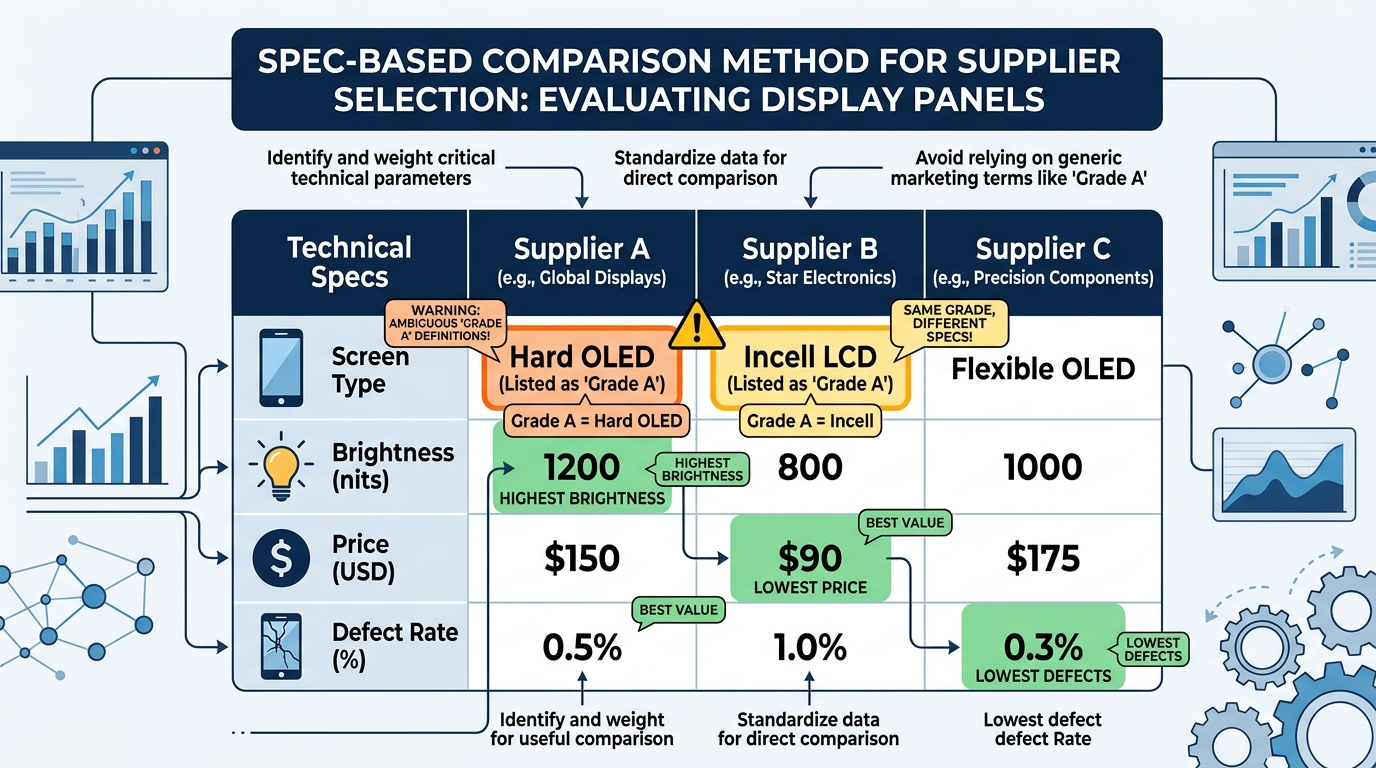
Since you can't trust grade labels to mean the same thing between suppliers, you need a comparison method that uses actual product specs instead of marketing names.
Step 1: Request Specification Sheets, Not Just Grade Names
Ask each supplier for the actual specifications behind their grades:
- Screens: Display technology (Incell/Hard OLED/Soft OLED), panel manufacturer, brightness rating (nits), color gamut coverage, flex cable brand
- Batteries: Cell manufacturer, actual mAh capacity (tested, not rated), gas gauge IC type, cycle rating
If a supplier can't provide specs beyond "Grade A" and a price, they either don't know what they're selling or don't want you to know. Either way, that's a red flag.
Step 2: Build a Comparison Table on Specs, Not Labels
Instead of comparing "Supplier A Grade A" vs. "Supplier B Grade A," compare the actual attributes:
| Attribute | Supplier A "Grade A" | Supplier B "Grade A" | Supplier C "Premium" |
|---|---|---|---|
| Screen type | Hard OLED | Incell LCD | Soft OLED |
| Brightness | 650 nits | 450 nits | 900 nits |
| Price (iPhone 14) | $18 | $11 | $28 |
| Defect rate (claimed) | 2% | 3% | 1% |
Now the comparison is meaningful. Supplier A and Supplier B both say "Grade A" but are selling completely different products. Supplier C's "Premium" at $28 is actually a different tier entirely.
Step 3: Verify with Sample Orders
Specs on paper are claims. Samples are evidence. Order 5–10 units from each supplier at their "Grade A" tier and run your own QC:
- Compare display quality side by side on the same phone model
- Measure brightness at maximum with a lux meter (or compare visually in direct sunlight)
- Test touch response across the full screen area
- Check batch consistency — do all 5 screens look and perform the same?
Your sample test results become your actual grading reference. From that point forward, you're not buying "Grade A" — you're buying the specific product you tested, and tracking whether the supplier maintains that quality over time.
For the complete sample testing process, see our guide on how to evaluate a supplier with a test order.
Want to cut through the grading confusion? PRSPARES labels every screen by actual technology type (Incell, Hard OLED, Soft OLED) with panel source and brightness specs — not just a letter grade. Request a comparison quote.
How to Build Your Own Grading Standard
The most successful repair shops don't rely on supplier grades at all. They build their own internal grading system based on customer-facing tiers.
Example internal grading system:
| Your Internal Grade | What It Includes | Which Supplier Products Map to It | Customer-Facing Name |
|---|---|---|---|
| Tier 1 | Soft OLED, 90%+ OEM brightness, IC transfer compatible | Supplier A "Premium," Supplier C "Grade AAA" | "Premium Repair" |
| Tier 2 | Hard OLED, 70%+ OEM brightness, True Tone programmable | Supplier A "Grade A," Supplier B "Grade AA" | "Standard Repair" |
| Tier 3 | Incell LCD, functional, basic touch response | Supplier B "Grade A," Supplier D "Standard" | "Economy Repair" |
This approach gives you three advantages:
- Consistent customer experience: Your "Standard Repair" always uses Hard OLED regardless of which supplier you bought from this month
- Supplier flexibility: If Supplier A raises prices, you can switch to Supplier B's equivalent product without changing your customer offerings
- Transparent pricing: Your repair tiers are based on actual display technology, not supplier marketing — customers understand what they're paying for
Red Flags in How Suppliers Use Grade Labels
Watch for these patterns that signal a supplier's grading is unreliable:
- Only one grade available: If every screen they sell is "Grade A" with no other tiers, the label is meaningless — it's just their product with a marketing name
- Grade inflation over time: They used to call Hard OLED "Grade A" but now call Incell "Grade A" while Hard OLED became "Grade AA" — the product didn't improve, just the label
- Different prices, same grade name: If their "Grade A" iPhone 13 screen is $11 and their "Grade A" iPhone 14 screen is $22, those aren't the same quality grade — the label is just covering whatever they have in stock for each model
- Resistance to providing specs: If they deflect questions about display technology, panel source, or brightness with "it's our Grade A, trust us," they're hiding behind the label
For more on evaluating suppliers with specific technical questions, see our guide on technical questions to screen suppliers.
Frequently Asked Questions
Is "Grade A" always better than "Grade B"?
Within the same supplier's catalog, yes — Grade A should be their higher-quality tier. But between suppliers, no. Supplier X's "Grade B" Hard OLED may outperform Supplier Y's "Grade A" Incell in every measurable way. This is why comparing by actual product specs (screen technology, brightness, defect rate) is more reliable than comparing grade labels.
Should I only buy the highest grade available?
Not necessarily. The right grade depends on the repair tier you're offering. If a customer is getting a budget repair on an older phone, a quality Incell screen (often labeled Grade B or Standard) at $8–12 delivers appropriate value. Stocking only premium Soft OLED means you can't compete on price-sensitive repairs. Most shops need 2–3 grades to serve their full customer range — see our guide on Incell vs Hard OLED vs Soft OLED for how to build the right mix.
Do grade labels matter for batteries and small parts?
For batteries, grade labels matter less than actual capacity testing. A "Grade A" battery with 2,800 mAh true capacity isn't better than a "Grade B" battery with 3,100 mAh true capacity — the capacity number is what counts. For small parts (charging ports, speakers, cameras), grading is simpler: the part either works correctly or it doesn't. Focus on DOA rates and functional testing rather than grade labels for these components.
How do I handle it when a supplier changes what their grades mean?
Document everything from your initial sample testing — take photos of flex cables, note brightness levels, record test results. When a new batch arrives and the product looks different from what you tested, you have evidence. Contact the supplier with specific comparisons: "Your Grade A iPhone 14 screen in March was Hard OLED at 650 nits. This April batch is Incell at 430 nits. The product changed but the grade label didn't." Suppliers who value the relationship will address this; those who don't aren't worth keeping.
Grade Labels Are Starting Points, Not Standards

The phone parts grade A meaning varies so widely across suppliers that the label alone tells you almost nothing about what you'll receive. The practical solution isn't to find a supplier with "correct" grading — it's to build your own verification system that translates any supplier's labels into your tested, documented quality tiers.
Start by asking for specs, not just grades. Verify with samples. Build your internal grading standard based on actual display technology and tested performance. Over time, your own data becomes more valuable than any supplier's label — and your customers get consistent quality regardless of where you sourced the part.
Want screens labeled by actual technology, not ambiguous grades? PRSPARES categorizes every screen by display type (Incell, Hard OLED, Soft OLED) with panel source and performance specs. See our screen catalog with transparent grading.
Related reading: OEM vs Aftermarket Phone Screens: What Wholesale Buyers Need to Know | How to Verify Original Phone Screens Without Trusting Supplier Labels