
Phone Parts Supplier Delays: Why Your Order Is Late and How to Prevent It
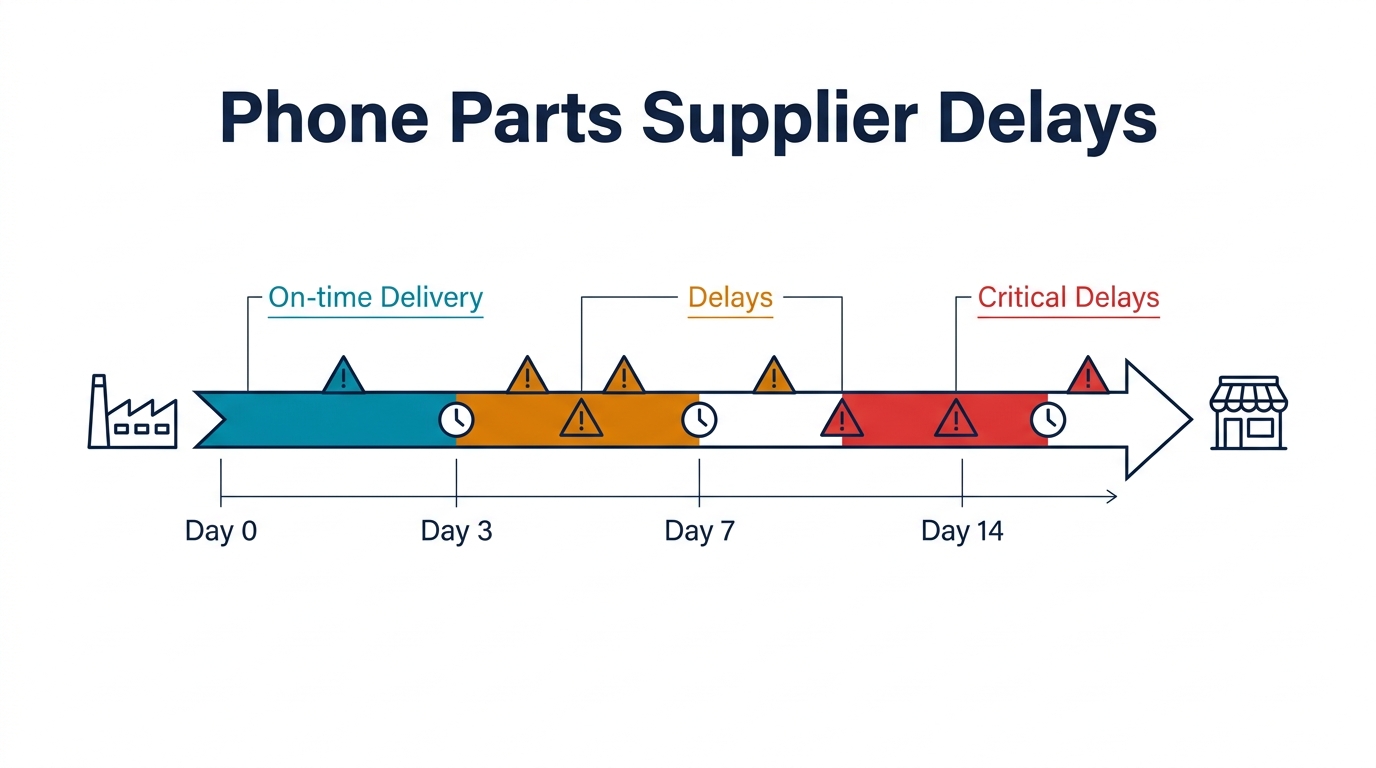
Your supplier said 7 days. It's now day 14. Your tracking number still shows "information received" — meaning the package hasn't actually shipped. Meanwhile, three customers are waiting for screen repairs and you're turning away walk-ins because you're out of iPhone 15 Pro Max panels.
Phone parts supplier delays are one of the biggest operational headaches for repair shops and distributors. A single late shipment can cascade into lost revenue, unhappy customers, and emergency purchases from local distributors at double the price.
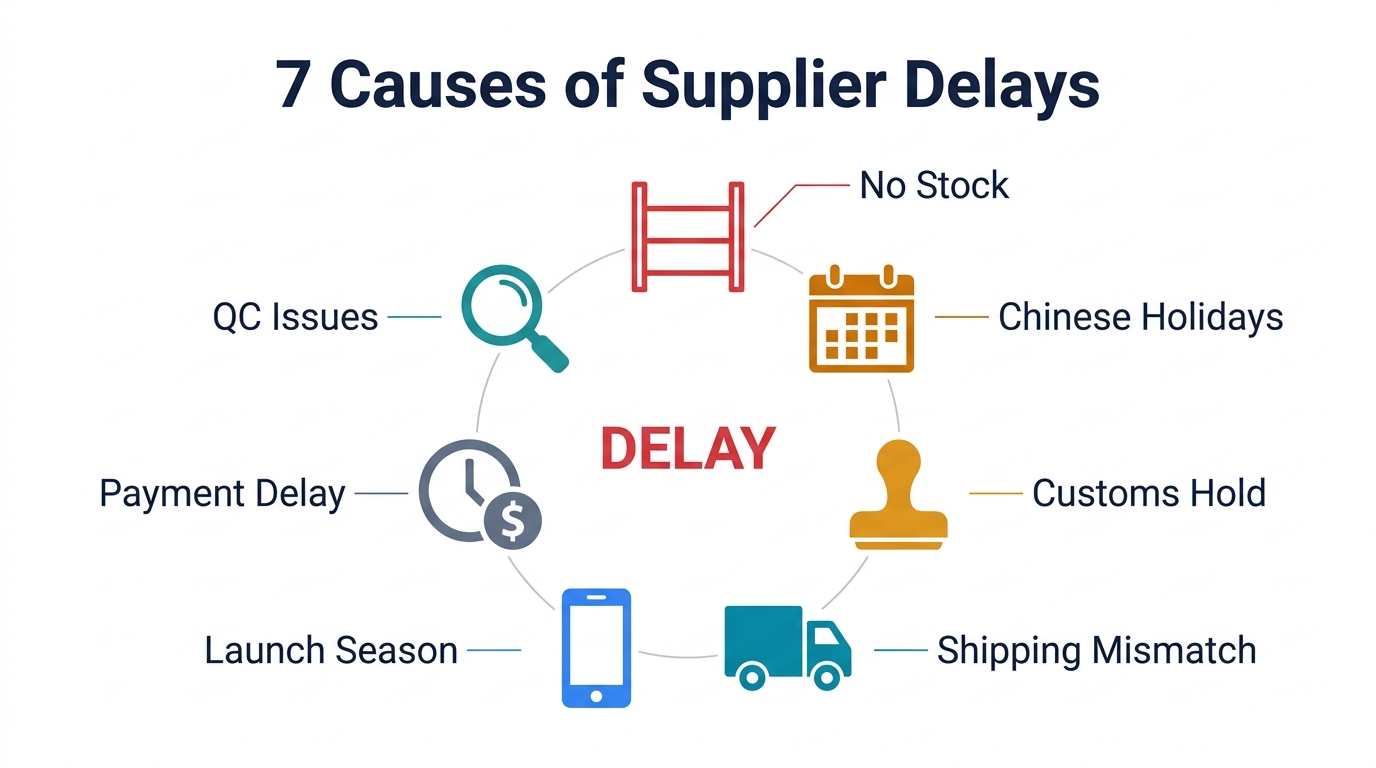
The frustrating part? Most delays are predictable and preventable — if you understand what causes them and build safeguards into your ordering process. This guide breaks down the seven most common reasons your wholesale phone parts order gets delayed, and the specific steps to avoid each one.
Sourcing Replacement Screens in Bulk?
Incell / Hard OLED / Soft OLED grades — wholesale pricing, grade comparison on request.
Get Wholesale QuoteThe Real Cost of a Late Phone Parts Shipment
Before diving into causes, let's quantify the damage. A 7-day delay on a 200-unit screen order doesn't just mean waiting longer. It means:
- Lost repair revenue: If you do 15 screen repairs per day at an average margin of $40, a week without stock costs you $4,200 in lost profit
- Emergency purchases: Buying 20 screens from a local distributor at $35 each instead of $22 wholesale = $260 extra cost just to keep your shop running
- Customer churn: Customers told "come back next week" often find another repair shop. Some never come back
- Scheduling chaos: Your technicians have gaps. Walk-in customers get turned away. Your Yelp rating takes hits from "they didn't have parts in stock" reviews
The math is clear: preventing a single delay saves more than the cost of every prevention measure combined.
7 Reasons for Phone Parts Supplier Delays
1. The Supplier Didn't Have Stock (But Took Your Order Anyway)
This is the most common cause — and the most avoidable. Many wholesalers operate on a "sell first, source later" model. They accept your order, collect payment, then source the screens from their own upstream supplier or factory. If that source is out of stock, your order sits in limbo.
Warning signs:
- Tracking number provided but no movement for 3+ days
- Vague responses like "shipping soon" or "preparing your order"
- The supplier doesn't mention a specific shipping date
How to prevent it: Before ordering, ask directly: "Do you have these units in your warehouse right now?" Request a photo of your specific order packed and ready to ship before you pay the balance. Any hesitation here means they don't have stock.
2. Chinese Holidays and Factory Shutdowns
The Shenzhen phone parts supply chain effectively stops during these periods:
| Holiday/Event | Dates (approximate) | Impact |
|---|---|---|
| Chinese New Year | Late Jan – mid Feb | 2-4 week shutdown. Factories close, logistics freeze. Orders placed in January may not ship until March |
| National Day (Golden Week) | Oct 1-7 | 1-week closure. Order before mid-September to avoid delays |
| Dragon Boat Festival | June (varies) | 3-day break. Minor impact if you plan ahead |
| Mid-Autumn Festival | September (varies) | 3-day break. Minor impact |
| Factory audits/inspections | Random, usually Q4 | 1-3 day production halt. Suppliers may not warn you in advance |
How to prevent it: Build a holiday calendar into your ordering schedule. Place Chinese New Year orders by early January at the latest. For Golden Week, order by September 15. Keep 3-4 weeks of safety stock before any major Chinese holiday.
3. Customs and Import Clearance Issues
International shipments pass through customs, and holds happen for several reasons:
- Incorrect HS codes: Phone screens have specific tariff classifications. Wrong codes trigger manual inspection
- Missing documentation: Commercial invoice doesn't match packing list, or value declarations look suspicious
- Random inspections: Customs agencies randomly select shipments for physical inspection, adding 3-7 days
- IPR (Intellectual Property Rights) flags: Shipments containing branded parts (Apple, Samsung logos) can trigger IP-related holds
Our guide on UK and EU import logistics covers customs clearance in detail. The short version: make sure your supplier uses correct HS codes, provides accurate commercial invoices, and properly declares the shipment contents.
4. Shipping Method Mismatch
Not all shipping methods are equal, and choosing the wrong one for your timeline causes problems:
| Method | Typical Transit Time | Best For |
|---|---|---|
| Air express (DHL/FedEx/UPS) | 3-7 days | Urgent orders, small-medium batches (under 50kg) |
| Air freight (cargo) | 7-14 days | Medium batches (50-200kg), cost-sensitive but time-important |
| Sea freight | 25-40 days | Large bulk orders (200kg+), price priority over speed |
| Economy/postal (ePacket, Yanwen) | 15-30+ days | Samples, very small orders. Unreliable tracking |
Common mistake: Choosing economy shipping to save $30 on a $2,000 order, then losing $500 in downtime waiting an extra two weeks. The shipping cost difference between air express and economy on a 20kg package is usually $40-80 — trivial compared to the cost of being out of stock.
How to prevent it: Match your shipping method to your actual timeline. If you need parts within 10 days, pay for air express. Factor shipping cost into your per-unit economics — a $0.50 per screen difference in shipping is worth the reliability.
5. New iPhone/Samsung Launch Season
Every September (iPhone) and January-February (Samsung Galaxy S), the entire supply chain shifts to new models. This affects your order even if you're ordering older models:
- Factory production lines switch to new model screens, reducing output of older models
- Shipping carriers are congested with new-model inventory flowing to distributors worldwide
- Suppliers prioritize large orders from big distributors over smaller repair shop orders
- Pricing fluctuates as demand spikes for new-model compatible screens
How to prevent it: Stock up on your highest-volume models 4-6 weeks before a major phone launch. Check our guide on which models to stock to plan your inventory ahead of launch season.
6. Payment Confirmation Delays
Your order doesn't start processing until payment is confirmed — and confirmation isn't instant for all methods:
- Wire transfer (T/T): 1-3 business days for international transfers to clear
- PayPal: Usually instant, but large amounts may trigger a security review (24-48 hours)
- Alibaba Trade Assurance: Payment held in escrow; supplier sees "pending" until platform releases funds (can take 1-2 days)
- Letter of credit: Can take 5-10 days for bank processing before the supplier ships
How to prevent it: Confirm payment timing with your supplier before ordering. Send wire transfers on Monday morning (not Friday afternoon). For urgent orders, use PayPal or a method with instant confirmation. Read our full breakdown of payment methods for China suppliers.
Tired of tracking delays and chasing suppliers? We ship within 48 hours of confirmed payment, with real-time tracking on every order. Get a quote.
7. Quality Issues Caught Late
Sometimes delays happen because the supplier's own QC catches a problem — and this is actually the good scenario. The alternative is shipping defective screens that create a bigger problem on your end.
Late-stage QC rejections that cause delays:
- A batch fails touch sensitivity testing and needs to be re-sourced
- The screen model you ordered had a factory recall on the latest production run
- Your specific order was pulled from a batch that showed higher-than-normal defect rates
How to prevent it: You can't fully prevent this, and you shouldn't want to — a supplier who delays to fix a quality issue is better than one who ships defective product on time. But you can minimize the impact by maintaining buffer stock and having a backup supplier for your highest-volume models.
How to Build a Delay-Proof Ordering System
Prevention isn't about one trick — it's about a system. Here's the framework that keeps repair shops in stock consistently.

1. Calculate Your Reorder Point
Don't order when you run out. Order when you hit a calculated threshold:
Reorder point = (Daily usage × Lead time in days) + Safety stock
Example: You use 5 iPhone 15 screens per day. Lead time from your supplier is 10 days. Safety stock is 15 units (3 days buffer).
Reorder point = (5 × 10) + 15 = 65 units
When your iPhone 15 inventory hits 65 units, place the next order — regardless of how much stock you still have on the shelf.
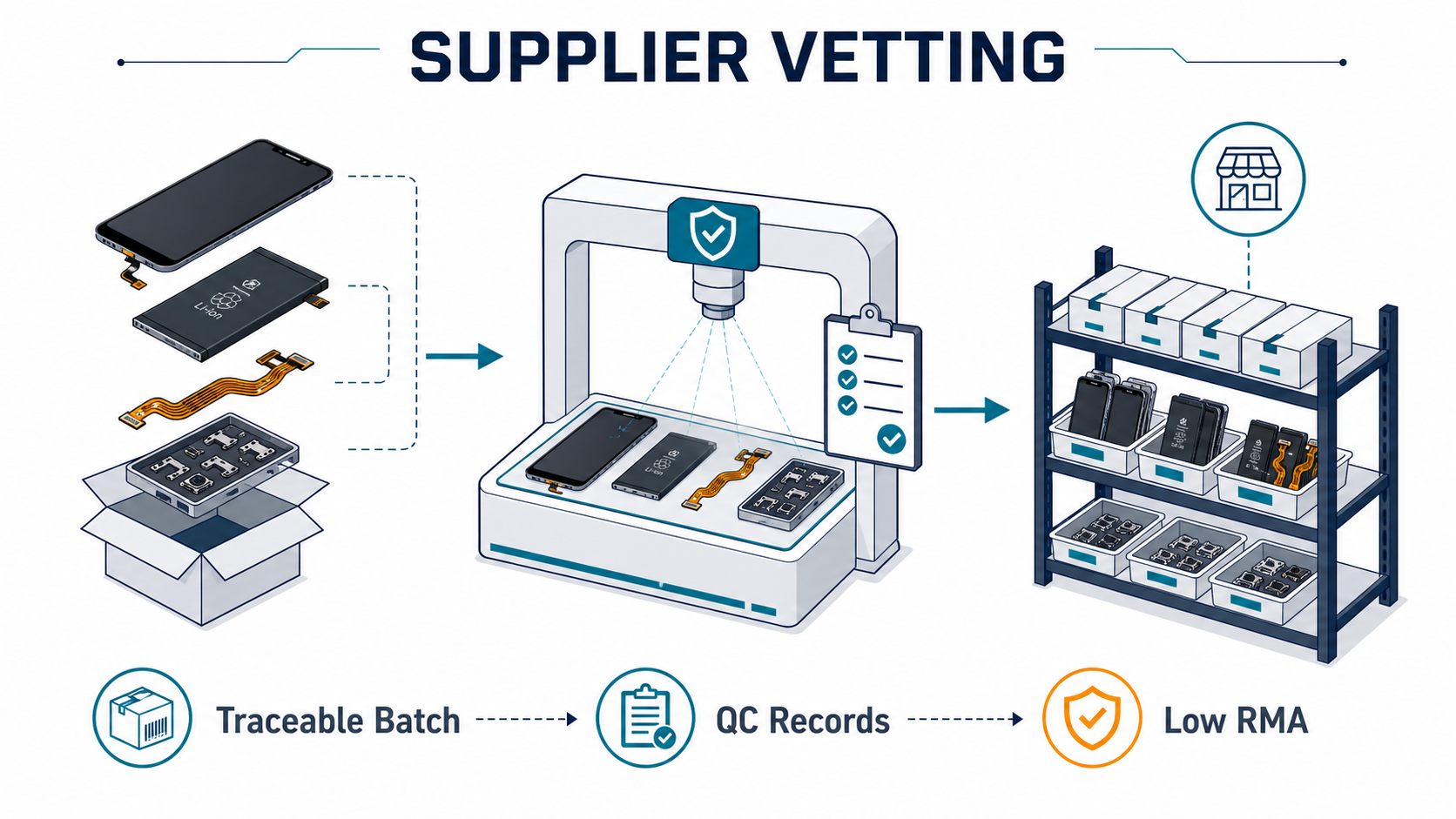
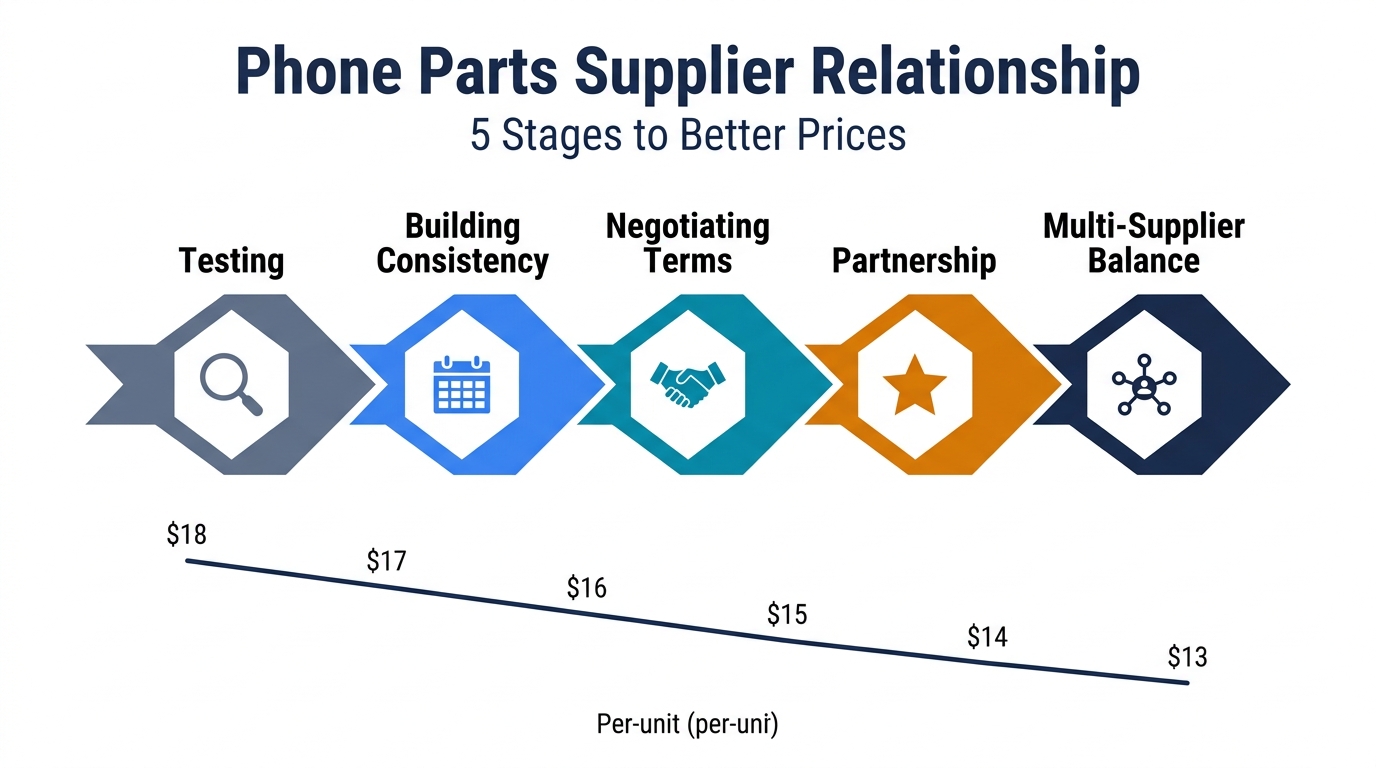
2. Maintain Two Qualified Suppliers
Your primary supplier handles 70-80% of your orders. Your backup supplier is pre-vetted and tested so you can switch within 24 hours if the primary fails. This isn't about playing suppliers against each other — it's about business continuity.
Use our guide on choosing a reliable supplier to vet your backup.
3. Stagger Your Orders
Instead of one large monthly order, place smaller orders every 1-2 weeks. Benefits:
- If one shipment is delayed, the others still arrive
- You can adjust quantities based on actual demand rather than forecasting a month ahead
- Cash flow is more manageable with smaller, frequent payments
See our guide on MOQ and lead time optimization for negotiating flexible order sizes.
4. Communicate Proactively
Don't wait for the tracking to update. After placing an order:
- Day 0: Confirm order receipt and expected ship date
- Day 2: Ask for packing photos and tracking number
- Ship date: Verify tracking shows actual movement (not just "label created")
- Day after expected delivery: If not arrived, contact supplier immediately
Early communication catches problems before they become costly delays.
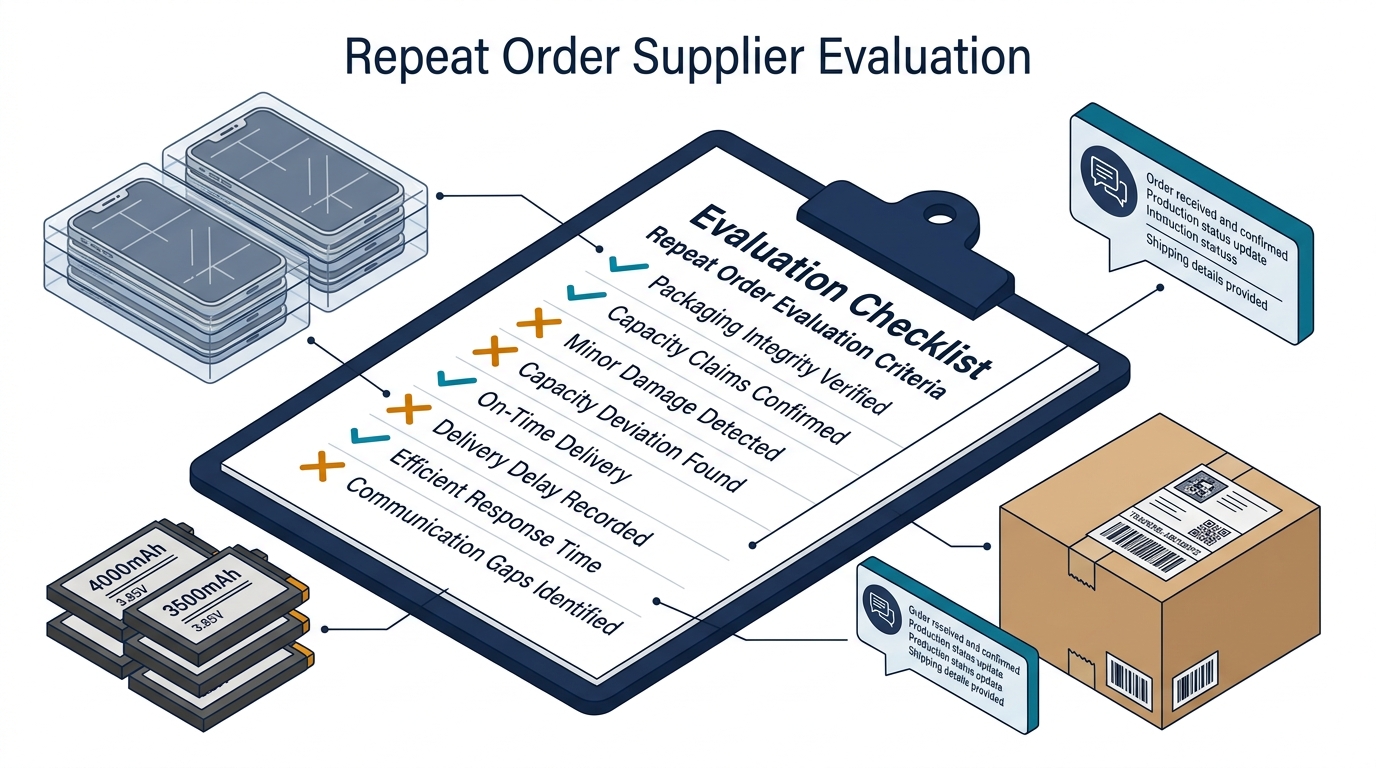
5. Track and Score Your Suppliers
Keep a simple spreadsheet logging every order:
- Order date → Ship date → Delivery date
- Promised lead time vs. actual lead time
- Any issues (wrong items, defects, quantity shorts)
After 10 orders, you'll have hard data on each supplier's reliability. A supplier who averages 9-day delivery on a promised 7-day lead time is consistently 2 days late — that's useful information for adjusting your reorder point.
Frequently Asked Questions
How long should wholesale phone parts take to ship from China?
Air express (DHL/FedEx/UPS) typically delivers in 3-7 business days from Shenzhen to the US or UK. Air freight takes 7-14 days. Sea freight runs 25-40 days. Add 1-3 days for customs clearance in most countries. If your supplier promises 5-day delivery via air express and it consistently takes 10+, the delay is on their end — they're likely not shipping when they say they are.
What should I do if my supplier keeps missing delivery dates?
First, document the pattern with data — dates promised vs. dates delivered across your last 5-10 orders. Present this to the supplier and ask for an explanation. If the issue is systemic (they consistently overpromise), either adjust your expectations and reorder point accordingly, or begin testing an alternative supplier. Two missed deadlines in a row on urgent orders is a clear signal to activate your backup supplier.
Should I pay extra for faster shipping on phone parts?
Almost always yes, unless you have significant buffer stock. The cost difference between air express and economy shipping on a typical 20-unit screen order is $30-60. One day of being out of stock on a popular model costs most repair shops $100-200 in lost repair margin. The math overwhelmingly favors paying for speed. Reserve economy shipping only for non-urgent restocking of slow-moving models.
How much safety stock should a repair shop keep?
A good baseline is 5-7 days of demand for your top 5 models, and 3-5 days for everything else. Increase to 2-3 weeks before Chinese New Year and major phone launches. Track your actual usage for a month to set accurate numbers rather than guessing. Under-stocking costs more than the carrying cost of a few extra screens on the shelf.
Can I hold a supplier accountable for delays?
If you used Alibaba Trade Assurance with a guaranteed delivery date, you can file a dispute for delays beyond the agreed timeframe. For direct orders, accountability depends on your contract terms. Including a clause like "shipment must occur within X business days of confirmed payment" gives you written grounds for compensation. Without written terms, you're relying on the supplier's goodwill — which is why we recommend clear warranty and delivery terms in every purchase agreement.
Stop Reacting to Delays — Start Preventing Them
Phone parts supplier delays will always be a factor in wholesale sourcing. But the repair shops that rarely run out of stock aren't lucky — they've built systems that absorb delays without disrupting their business.
The three highest-impact changes: calculate your reorder points, qualify a backup supplier, and always use trackable air express shipping. These three steps alone eliminate 80% of stockout situations.
If you need a supplier with consistent lead times and transparent tracking, reach out to our team. We'll give you exact delivery timelines based on your location before you place your first order.