
What to Check Before Placing a Repeat Order with the Same Phone Parts Supplier
Your first order went well. The screens looked good, the batteries tested at advertised capacity, and shipping was on time. So you're ready to double the quantity and make this your regular supplier.
Not so fast. A single successful order doesn't tell you everything. Placing a repeat order with a phone parts supplier without proper evaluation is one of the most common mistakes small buyers make. Quality can vary between batches. Communication changes after the initial sale effort. Pricing might shift without notice. The real test of a supplier isn't the first order — it's whether they deliver the same standard on the fifth, tenth, and fiftieth order.
Before you scale up, run through this evaluation. It takes 30 minutes and can save you thousands in bad inventory, repair callbacks, and customer complaints.
Looking for a Reliable Wholesale Parts Supplier?
Factory-direct from Shenzhen — transparent grades, invoices & 12-month warranty.
Get Wholesale QuoteReview Quality Consistency from Your First Order
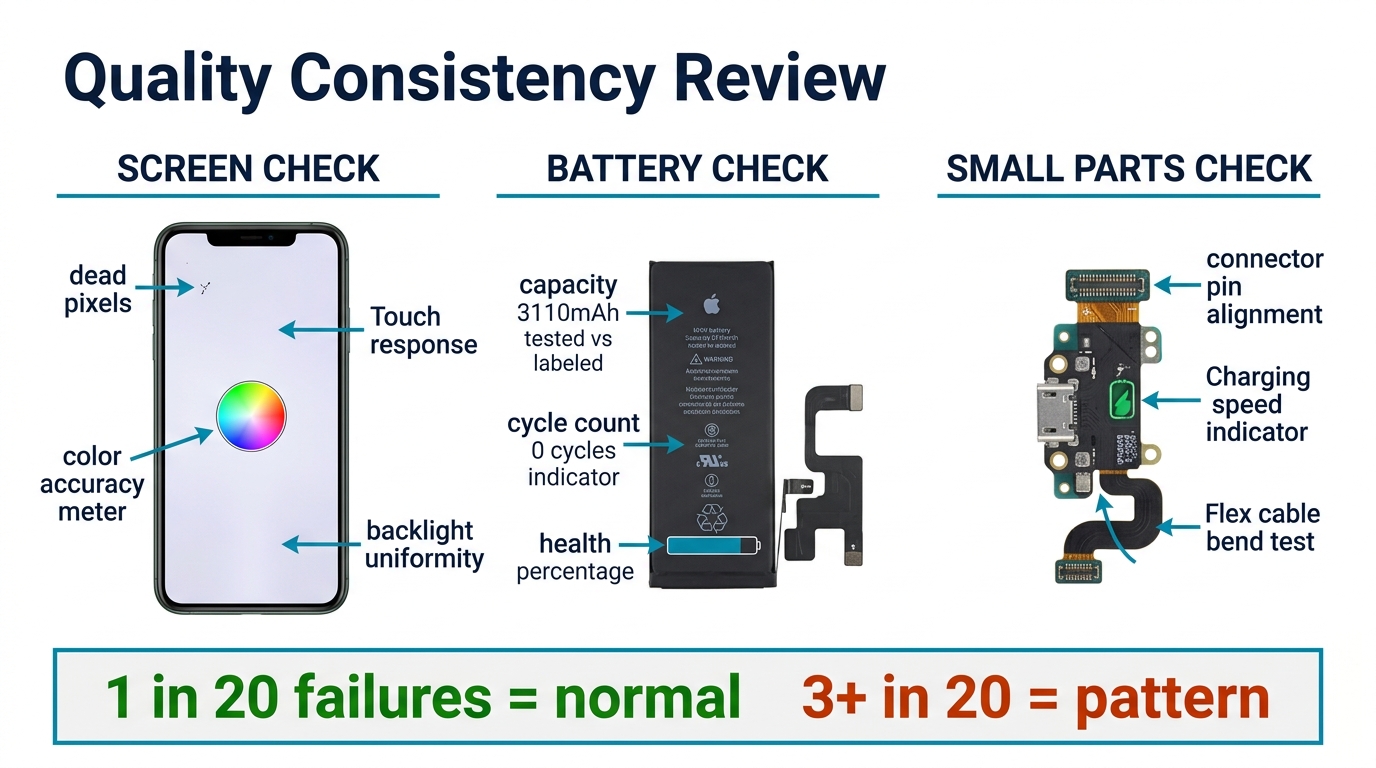
The most important check: did the parts from your first order actually perform in real repairs?
Screen Performance After Installation
Don't just inspect screens when they arrive — evaluate them after you've installed them in customer devices and had 2-3 weeks of real-world use.
Check for:
- Post-installation failures: Did any screens develop dead pixels, touch issues, or backlight bleeding after a few days of customer use? One failure in 20 units is within normal aftermarket range. Three or more failures in 20 units is a pattern.
- Customer feedback: Have any customers come back complaining about color accuracy, brightness, or responsiveness? Track which units generated complaints and check if they came from the same batch or grade.
- Grade consistency across units: If you ordered 10 Incell screens of the same model, did they all look and perform similarly? Visible variation within the same grade and batch is a warning sign — it means the supplier isn't applying consistent quality control.
Battery Performance After Installation
Batteries need even more post-installation time to evaluate:
- Capacity accuracy: Did the batteries hold the charge that the supplier claimed? A battery labeled 3,110 mAh that drains noticeably faster than expected in customer devices failed this test.
- Zero-cycle verification: Were the batteries genuinely new? If customers report battery health showing 95% or lower immediately after installation, you may have received refurbished cells.
- Callback rate: Batteries should not generate callbacks within the first 30 days. If customers return within a month reporting fast drain or overheating, the batch quality is poor.
Small Parts Functionality
Charging ports, earpieces, and flex cables are less complex than screens but still need evaluation:
- Did charging ports deliver full-speed charging consistently?
- Did earpieces maintain audio clarity at all volume levels?
- Did any flex cables break during installation?
If your incoming QC process caught issues on arrival, note those too. A supplier whose products consistently pass your initial inspection but fail in real-world use has a deeper quality problem than one whose packaging is messy but products work fine.
Evaluate Communication Quality After the Sale
How a supplier communicates before your first order is marketing. How they communicate after is reality.
Response Time to Issues
If you reported any quality issues from your first order, evaluate:
- How quickly did they respond? Within 24 hours is good. Within 4-6 hours is excellent. More than 48 hours is concerning.
- Did they acknowledge the problem or argue? A good supplier says "Send us photos, we'll check with our QC team." A bad supplier says "All our products are tested, the problem must be on your end."
- Did they offer a resolution? Credit on your next order, replacement units, or a partial refund are all acceptable responses. Silence or excuses are not.
Proactive Communication
Did the supplier do any of the following without you asking?
- Notify you that a model you previously ordered was temporarily out of stock
- Alert you to a price change (up or down) before you placed a new order
- Follow up to ask how the first order performed
- Share information about new products or grades relevant to your order history
Proactive communication signals a supplier who sees you as a long-term relationship, not a one-time transaction. It's not required, but it strongly predicts future reliability.
Language and Documentation Quality
For international suppliers, communication clarity matters:
- Are invoices clear and itemized correctly?
- Can you understand written messages without confusion?
- Are product specifications documented accurately (model, grade, quantity)?
Miscommunication on order details leads to wrong shipments. If your first order had any specification errors, assess whether they were corrected promptly.
Check Pricing and Terms Stability
Pricing for aftermarket phone parts fluctuates — panel costs change, shipping rates shift, currency moves. But a good supplier communicates changes transparently.
Price Consistency
Compare the prices in your first order to the current quote for the same items:
- Small adjustments (5-10%) are normal and typically reflect market movements. A supplier who explains "iPhone 12 Incell prices went up 8% because panel supplier costs increased" is being transparent.
- Unexplained jumps (15%+) are a red flag. Either the supplier underpriced your first order to win your business, or they're testing whether you'll accept a higher margin.
- Sudden discounts can also be suspicious. If the same screen that cost $12 on your first order is now $8, ask why. It could be a legitimate price drop — or a grade downgrade at a lower price point.
MOQ Flexibility
Your first order may have benefited from relaxed MOQ as a trial accommodation. Check whether the supplier:
- Still offers the same MOQ threshold, or is pushing for larger minimums now
- Allows mixed-model orders at the same terms
- Is willing to accommodate your actual monthly volume, even if it's smaller than their standard MOQ
A supplier who was flexible on MOQ for your test order but now demands much higher minimums may not be the right fit for a small shop's regular ordering pattern. See our guide on MOQ, sample orders, and lead time for benchmarks.
Payment Terms
If you paid upfront for your first order (standard for new relationships), check whether the supplier offers any credit or flexible terms for repeat orders:
- Net 15 or Net 30 payment after the second or third order is common with reliable suppliers
- Partial payment (50% upfront, 50% after shipping) shows trust is building
- No improvement in payment terms after multiple successful orders suggests the supplier doesn't invest in buyer relationships
Run a Quick Competitive Check
Before committing to a repeat order, spend 15 minutes checking alternatives. Not because you should switch suppliers after every order — switching is costly and disruptive. But because knowing the market keeps you from overpaying.
What to Compare
- Request quotes from 1-2 other suppliers for your top 3-5 items. You don't need to order — just get pricing for context.
- Check whether your current supplier's pricing is within 10-15% of alternatives. If they're significantly more expensive, it's worth a conversation about pricing before your next order.
- Compare claimed grades. If another supplier offers "A-grade" at a much lower price, they may be grading differently — not necessarily offering a better deal.
When to Stay vs. When to Switch
Stay with your current supplier when:
- Quality from the first order was consistent and met your standards
- Communication was responsive and honest
- Pricing is within market range (not necessarily the cheapest — consistency and reliability have value)
- They showed willingness to build the relationship (flexible MOQ, proactive updates)
Consider switching when:
- Quality issues were unresolved or dismissed
- Communication degraded after the first sale
- Pricing jumped significantly without explanation
- The supplier can't accommodate your actual ordering pattern
For more on what makes a supplier relationship worth maintaining long-term, see our guide on building supplier relationships.
The Repeat Order Checklist
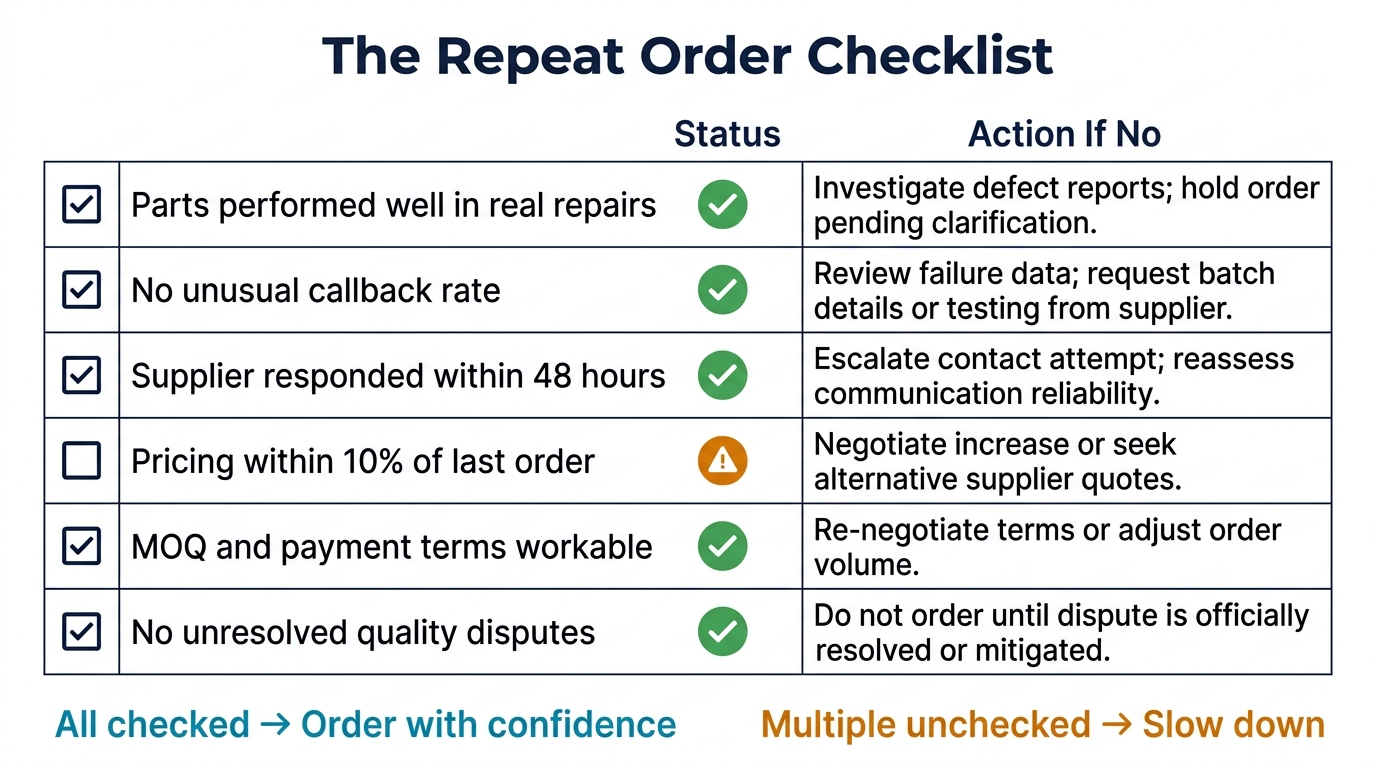
Before placing your second (or third, or tenth) order, confirm:
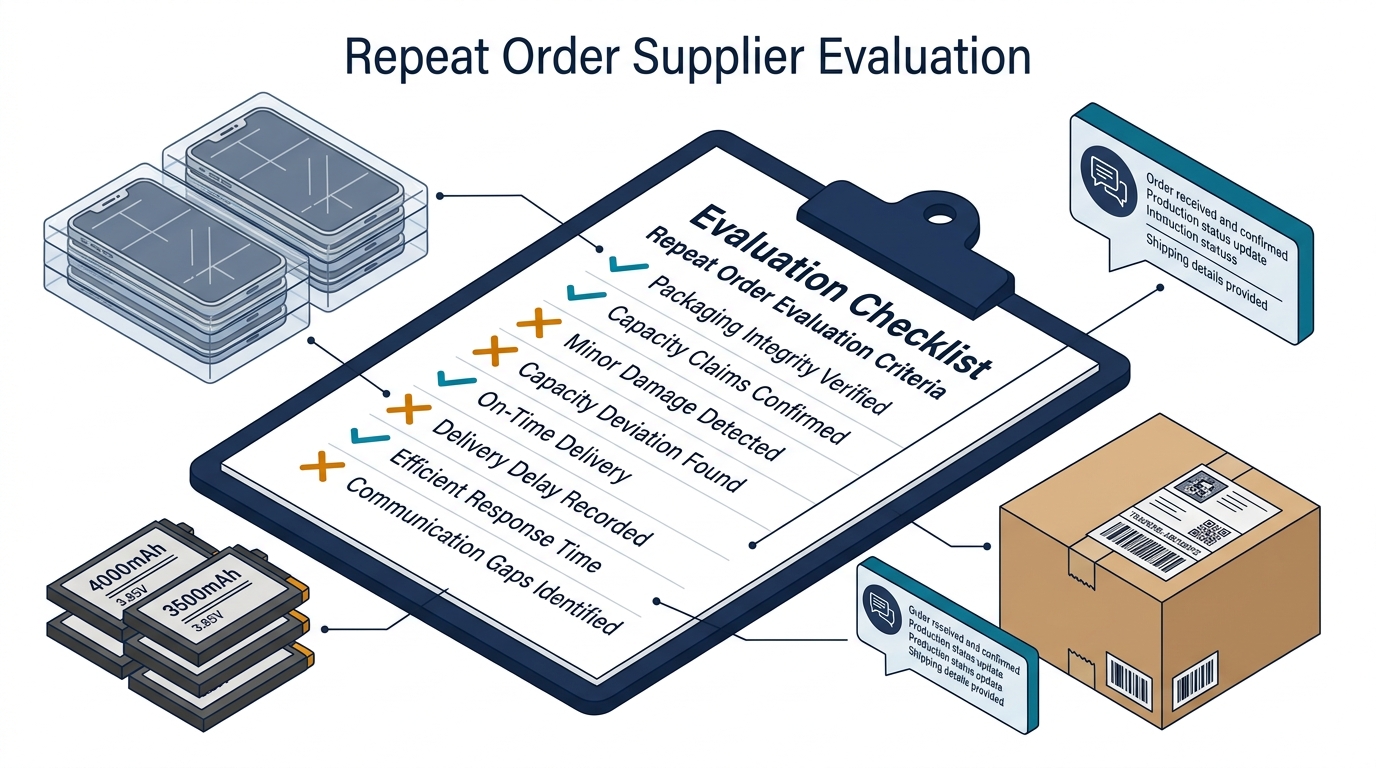
| Check | Status | Action If No |
|---|---|---|
| Parts from last order performed well in real repairs | ☐ | Reduce quantity or switch items that failed |
| No unusual callback rate on any product | ☐ | Flag specific SKUs and request replacement samples |
| Supplier responded to any issues within 48 hours | ☐ | Address communication expectations directly |
| Pricing is within 10% of last order (or explained) | ☐ | Ask for explanation; get competitive quotes |
| MOQ and payment terms are still workable | ☐ | Negotiate or explore alternatives |
| No unresolved quality disputes | ☐ | Resolve before ordering more |
If all boxes are checked, order with confidence and increase volume on the items that performed best. If multiple boxes are unchecked, slow down — either address the issues with the supplier or begin evaluating alternatives.
Scaling Up: What a Healthy Repeat Relationship Looks Like
When the evaluation looks good and you're ready to scale, here's the typical progression:
- Order 2 (4-6 weeks after first): Same product mix, 50-100% increase in quantity on items that performed well. Drop items that didn't meet standards.
- Order 3-4: Introduce new models or grades you didn't test initially. Lock in a regular order cadence (monthly or bi-weekly).
- Order 5+: Negotiate improved pricing based on your track record. Discuss priority stock allocation, pre-packing for your standard models, or credit terms.
The goal isn't just "buying parts" — it's building a supply chain you don't have to think about. When your supplier knows your models, grades, and quantities, they prepare your orders faster, flag issues earlier, and give you better terms because your business is predictable and reliable.
This is the same principle behind building long-term supplier relationships — and it starts with doing your homework before each reorder.
Frequently Asked Questions
How many successful orders before I can trust a supplier?
Three orders minimum. One order can be lucky. Two orders show a pattern. Three orders — spanning different product batches and possibly different seasons — give you real confidence in consistency. After three clean orders, you can safely increase quantities and commit to a regular cadence.
Should I test parts from every batch, or only the first order?
Test every batch — at least a random sample of 10-20% of screens and batteries. Quality can vary between production runs even from the same supplier. It doesn't have to be exhaustive: install a few screens from each shipment in test devices, check battery capacity on 3-5 units, verify small parts functionality on one of each type.
What if the supplier is great on screens but poor on batteries?
This is more common than you'd expect. Some suppliers specialize in screens and source batteries and small parts from sub-suppliers they don't control as tightly. You have two options: use one supplier for screens and another for batteries, or tell your current supplier exactly which battery items failed and give them a chance to source better ones. If they can't improve after one more order, split your purchasing.
My first order was small — should I jump to a much larger second order?
No. Double the quantity at most. Going from a $300 test order to a $2,000 regular order skips the verification step. Increase gradually — $300 → $500-600 → $800-1,000 — so each order validates the last one before you commit more capital.
Verify Before You Scale
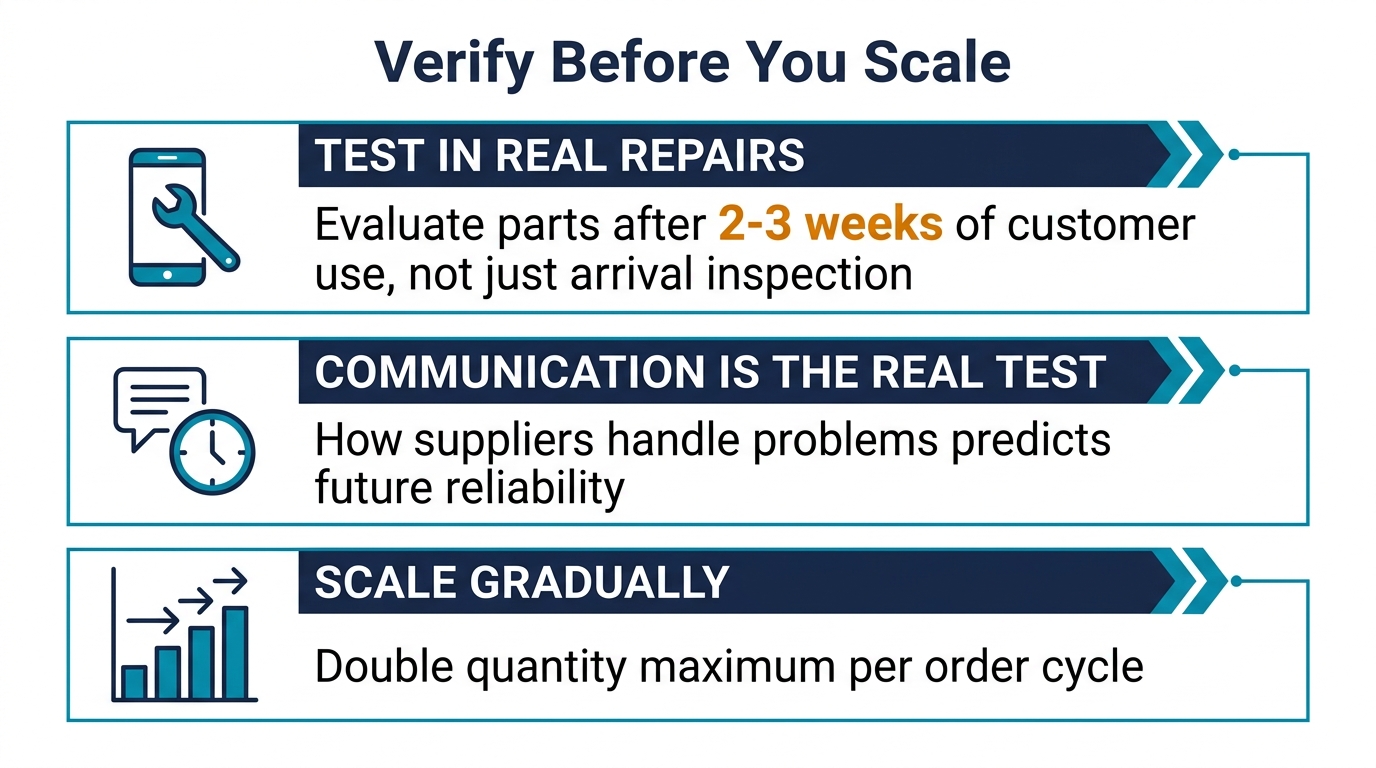
The gap between "one good order" and "reliable supplier" is wider than most buyers think. A 30-minute evaluation before each reorder protects your inventory quality, your customer relationships, and your cash flow.
Use the checklist above before every order for the first 3-4 cycles. After that, you'll know your supplier well enough to streamline the process — but never stop spot-checking quality entirely.
Ready for your next order? Send us your reorder list and we'll confirm current pricing, stock availability, and delivery time. If anything has changed since your last order, we'll flag it upfront — no surprises.
Related reading: