
How Repair Shops Should Use Technical Questions to Screen Suppliers

Most repair shop owners evaluate suppliers by asking about price, MOQ, and shipping time. These are basic commercial questions — and every supplier, regardless of quality, has polished answers ready. The supplier who sells reset batteries at "new" prices quotes the same confident delivery timeline as the one shipping genuinely tested parts.
The faster way to separate knowledgeable suppliers from resellers is to use technical questions to screen suppliers — questions about their product's actual specifications, grading process, and quality control. A supplier who truly sources, tests, and grades their own inventory will answer technical questions with specific, verifiable detail. A reseller or broker who just passes through products from upstream will give vague, deflecting, or overly generic answers.
Here are the questions that reveal the most, organized by product category.
Sourcing Replacement Screens in Bulk?
Incell / Hard OLED / Soft OLED grades — wholesale pricing, grade comparison on request.
Get Wholesale QuoteScreen Questions That Expose Supplier Knowledge
Screens are the highest-value, highest-risk product in the phone parts supply chain. These questions test whether a supplier actually understands what they're selling.
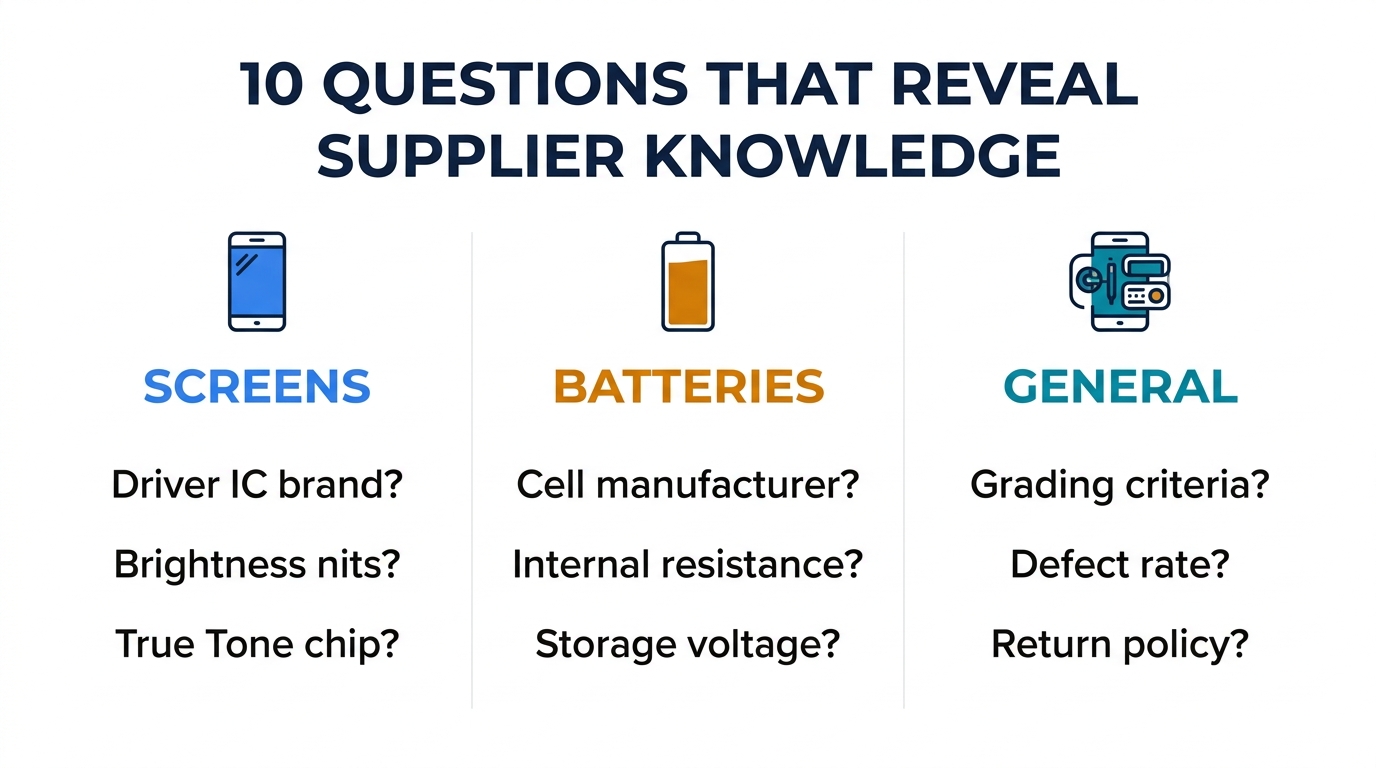
Question 1: "What display driver IC does your Incell screen for iPhone 14 use?"
Why this works: Every screen has a display driver IC (the chip that controls how pixels render). Different ICs produce different display quality. A knowledgeable supplier will name the specific IC brand and model (e.g., Parade, FocalTech, Novatek). A reseller will say something like "high quality IC" or "best grade chip" — because they don't actually know what's inside the screen they're selling.
Good answer: "Our iPhone 14 Incell uses the FocalTech FT8726 driver IC with a Parade touch IC." Red flag answer: "It's original quality IC, best on the market."
Question 2: "What's the brightness range on your Hard OLED for iPhone 13 Pro, and how does it compare to OEM?"
Why this works: OEM iPhone 13 Pro OLED hits roughly 1,000 nits peak (HDR) and 800 nits typical. Aftermarket Hard OLED varies widely — good ones reach 600–800 nits, poor ones drop to 400–500. A supplier who knows their product will give you a nit range. One who doesn't will say "same as original."
Good answer: "Our Hard OLED reaches 700–750 nits typical brightness, about 85% of OEM peak." Red flag answer: "Same brightness as original, no difference."
Question 3: "Do your screens come with the True Tone chip pre-soldered, or does it need data transfer?"
Why this works: This tests whether the supplier understands the iPhone screen ecosystem. OEM pull screens have the original True Tone chip. Aftermarket and refurbished screens require True Tone data transfer using a programmer. The answer tells you both the screen type AND whether the supplier understands their buyer's installation workflow.
Good answer: "Our aftermarket Incell screens require True Tone data transfer — the chip is pre-soldered but needs programming from the customer's original screen." Red flag answer: Confused response or "True Tone works automatically."
Question 4: "What's your defect rate on this screen grade, and what's your process when I receive a defective unit?"
Why this works: Every supplier has defects. The question isn't whether they have them — it's whether they track the rate and have a clear resolution process. A supplier who quotes "zero defects" is either lying or doesn't test. A good supplier will give you a number (e.g., "under 2% on our Grade A Incell") and explain their credit/replacement process.
Good answer: "Our defect rate on Grade A Incell runs 1–2%. If you receive a defective unit, send a photo and we'll credit it on your next order within 48 hours." Red flag answer: "We don't have defects" or vague promises without a specific process.
Battery Questions That Reveal Sourcing Honesty
Batteries are where reset scams are most common. These questions help verify whether the supplier is selling genuinely new cells.
Question 5: "What cell manufacturer makes the battery cells you sell for iPhone 13?"
Why this works: iPhone batteries use cells from specific manufacturers (ATL, Sunwoda, Desay in recent models). A supplier sourcing genuine new cells will know the cell manufacturer. A supplier selling reset or generic cells typically won't — or will give a vague answer like "high quality brand."
Good answer: "Our iPhone 13 batteries use ATL cells, same manufacturer as Apple's OEM supplier." Red flag answer: "Top brand cells" with no manufacturer name.
Question 6: "What's the typical internal resistance on a new battery from your stock?"
Why this works: Internal resistance is a physical property that can't be faked by resetting the battery's chip. New iPhone batteries typically measure 40–70 mΩ. If the supplier has never measured IR on their batteries, they're likely not testing quality at all — they're just passing through whatever their upstream source provides.
Good answer: "Our new iPhone 13 batteries measure 45–55 mΩ on the batches we've tested." Red flag answer: "What's internal resistance?" or "I can check with the factory."
Question 7: "At what voltage are your batteries shipped?"
Why this works: Properly stored new batteries ship at approximately 3.7–3.8V (50% charge), following manufacturer guidelines for long-term storage. Batteries shipped at 4.2V (full charge) or below 3.5V (deeply discharged) are either mishandled or have been cycled. This is a quick knowledge test — a supplier who cares about battery quality will know the correct storage voltage.
Good answer: "We ship at 3.7–3.8V storage voltage per manufacturer recommendation." Red flag answer: "Fully charged" or no awareness of storage voltage.
General Supplier Knowledge Questions
These work for any product category and test the supplier's overall depth.
Question 8: "Can you walk me through your grading system? What specifically distinguishes your Grade A from Grade B?"
Why this works: Grade labels (A, B, C, Premium, etc.) have no industry standard. Every supplier defines them differently. A supplier with a real grading system will explain specific, measurable criteria (e.g., "Grade A passes all functional tests with brightness above 90% OEM. Grade B has minor cosmetic marks on the frame but identical functional performance"). A supplier without a real system will say "Grade A is the best quality."
Question 9: "If I order your Grade A Incell screens and your Grade A pricing changes next month, does that mean the grade specs changed too?"
Why this works: This catches a common tactic — suppliers reduce price by quietly downgrading the actual product while keeping the same grade label. A transparent supplier will explain what drives their pricing (component costs, exchange rate, supplier change) and confirm that grade specs remain fixed regardless of price changes.
Question 10: "What models have you seen the highest return rates on this year, and why?"
Why this works: This is an openness test. Every supplier has models that are harder to source quality parts for. A supplier who admits "iPhone 12 Mini screens have a higher defect rate across the industry because of the smaller panel size" is being honest. One who says "zero returns on everything" is selling you a story, not a product.
Want to verify a supplier's answers with actual product? PRSPARES provides test samples with documented specifications — IC type, brightness readings, and grade criteria — so you can compare claims against reality. Request test samples here.
How to Read Supplier Responses
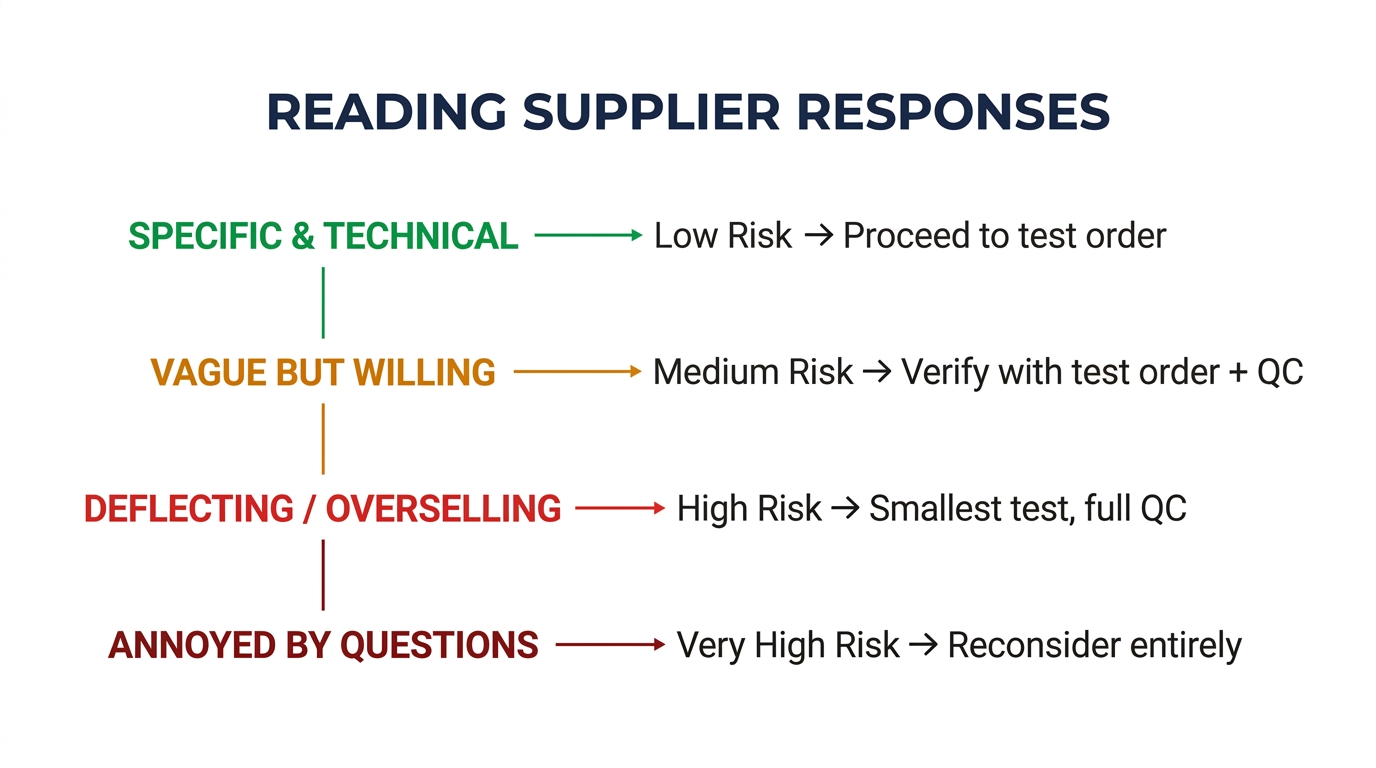
The questions above aren't a quiz with right-or-wrong answers. They're a calibration tool. Here's how to interpret the patterns:
| Response Pattern | What It Means | Risk Level | Your Next Step |
|---|---|---|---|
| Confident, specific, technical | Supplier works directly with their product — tests, grades, and understands it | Low | Proceed to test order |
| Vague but willing to check | Mid-tier reseller with real upstream source — doesn't test themselves | Medium | Verify through test order + your own QC |
| Deflecting or overselling ("best quality, same as original") | Doesn't know product or intentionally avoiding specifics | High | Smallest possible test order, full QC |
| Annoyed by technical questions | Treats buyer knowledge as distrust | Very High | Reconsider — if they resist questions now, imagine defect claims later |
Building Your Question Set Over Time
The 10 questions above are a starting point. As you gain experience with specific products and suppliers, develop your own custom questions based on problems you've encountered:
- Had ghost touch issues on iPhone 15 screens? Ask new suppliers specifically about their touch IC calibration process
- Seen battery swelling on Samsung A-series? Ask about cell source and storage conditions
- Received inconsistent screen brightness across a batch? Ask how they sort and match panels within a grade
Your technical questions to screen suppliers should evolve with your experience. The most effective questions come from real problems you've had — because those are the problems your next supplier needs to prove they can prevent.
For more on building a full supplier evaluation process, see our guide on how to choose a reliable phone parts supplier and using a test order to evaluate suppliers.
Frequently Asked Questions
Won't asking too many technical questions annoy the supplier?
It might annoy the wrong supplier — and that's useful information. Suppliers who are confident in their product welcome technical questions because it signals a knowledgeable buyer who will reorder consistently. If a supplier gets defensive or dismissive when you ask about IC brands or defect rates, that tells you something about how they'll handle quality issues later. Ask your questions. The supplier's reaction is itself a screening tool.
What if I don't understand the technical details myself?
Start with the questions where you can verify the answer independently. For example, you can check a battery's resting voltage with a $10 multimeter. You can compare screen brightness by powering two screens side by side. You don't need deep electrical engineering knowledge — you need enough to tell if the supplier's answer matches what you observe in the product. Over time, each product problem you encounter builds your technical vocabulary naturally.
Should I ask all these questions at once, or spread them out?
Start with 3–4 questions from the relevant product category during your initial conversation. Save the rest for after you receive your test order — that's when you can compare their answers against the actual product. "You told me this was a FocalTech IC, but the chip marking says something different" is a much more powerful conversation than asking all 10 questions upfront.
Your Questions Are Your First Quality Filter
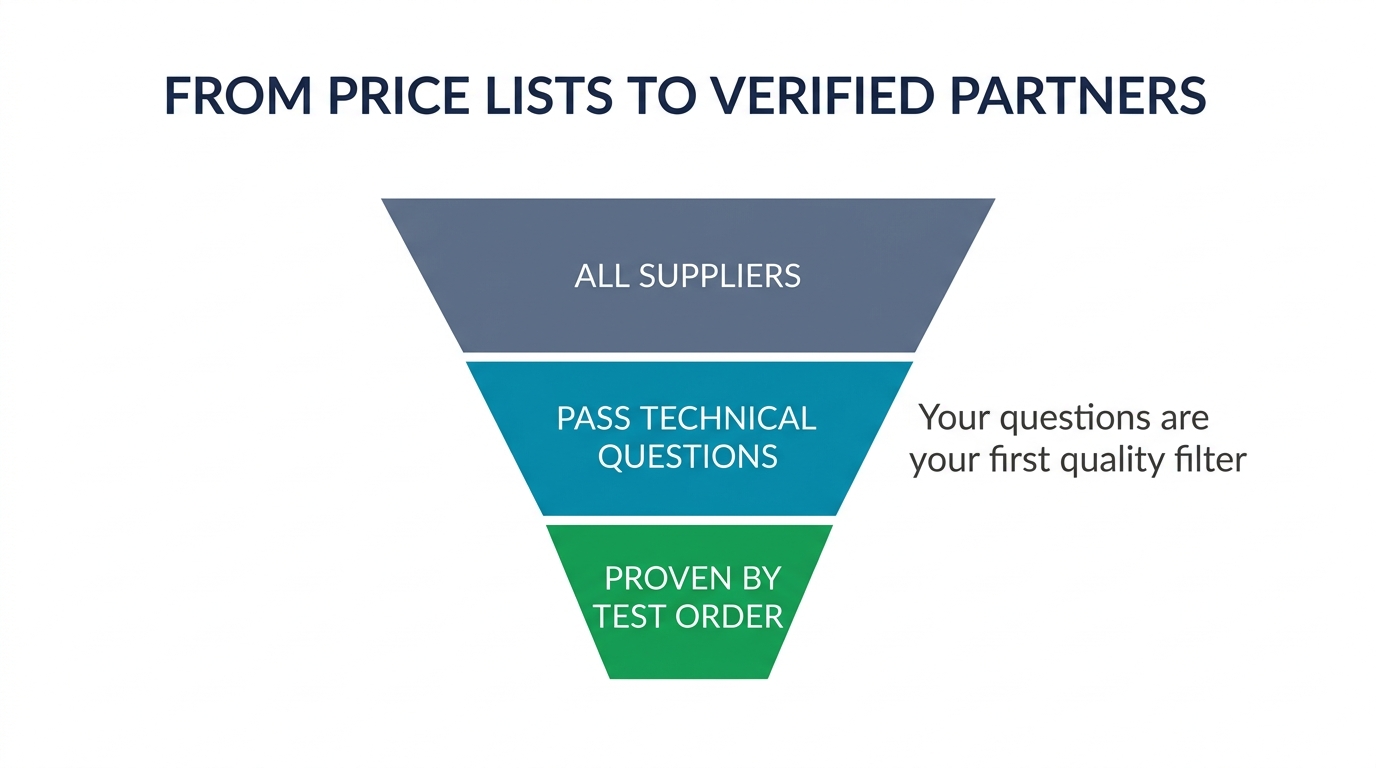
Price, MOQ, and delivery time are table stakes — every supplier answers those. Technical questions to screen suppliers are your first quality filter: they separate sellers who know their product from sellers who just know their price list.
You don't need to be a supply chain expert to ask these questions. You just need to ask them — and pay attention to whether the answers are specific or vague, consistent or contradictory, confident or defensive. The pattern of responses tells you more about a supplier's reliability than any number of testimonials or website claims.
Ready to work with a supplier who welcomes technical questions? PRSPARES provides full product specs, grade documentation, and QC data — before you place your first order. Start a conversation here.
Related reading: How to Choose a Reliable Phone Parts Supplier | How to Verify Original Phone Screens Without Trusting Supplier Labels