
Small Repair Parts Explained: Earpiece, Speaker, Camera Lens, and Flex Cable Quality Guide
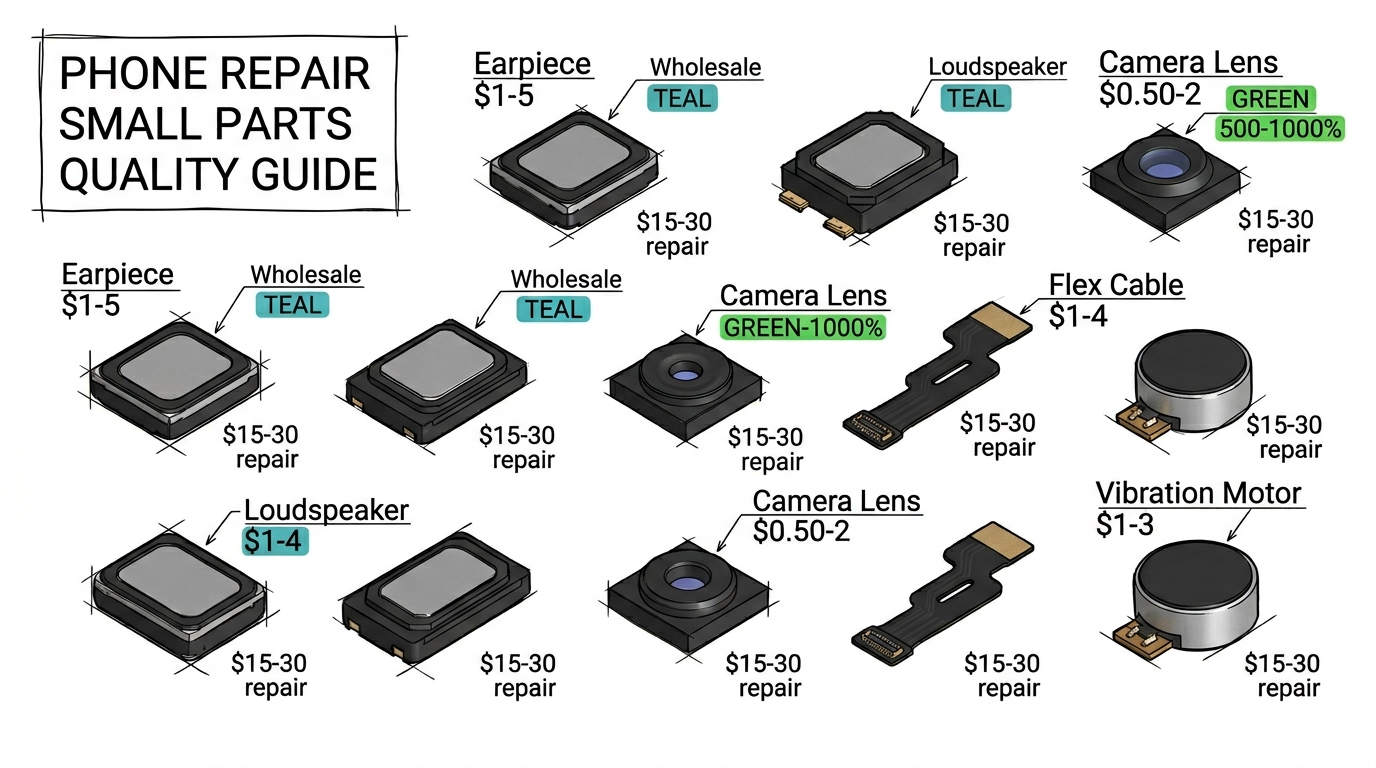
Screens and batteries get most of the attention when repair shops build their wholesale orders. But phone repair small parts — earpieces, loudspeakers, camera lenses, flex cables, vibration motors — are where a lot of shops quietly lose money or leave it on the table.
They lose money by buying cheap small parts that fail within weeks, triggering callbacks and free re-repairs. They leave money on the table by telling customers "we don't stock that" and sending them elsewhere for a $15 earpiece swap that takes 10 minutes.
Small parts typically cost $0.50-5 wholesale and sell as $15-30 repairs. The margins are excellent — often better percentage-wise than screen replacements. But the category is confusing because there are dozens of part types, quality varies wildly between suppliers, and most wholesale guides don't cover them at all.
This guide breaks down the most common phone repair small parts categories, what quality issues to watch for in each, and which ones are worth stocking for your repair shop.
Need Camera Modules in Bulk?
Wholesale rear camera assemblies — tested, factory-direct pricing.
Get Wholesale QuoteWhat Counts as "Small Parts" in Phone Repair
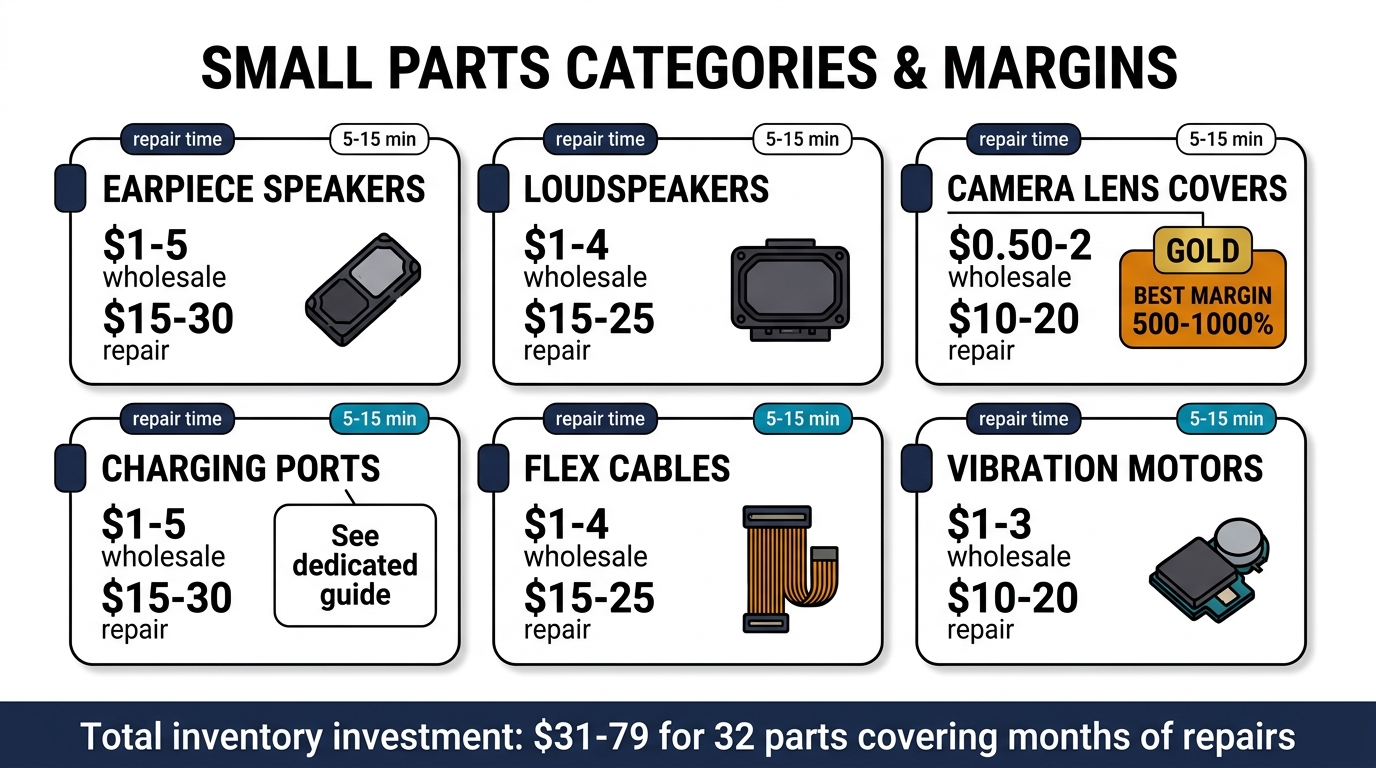
Small parts is the catch-all category for everything that isn't a screen, battery, or housing. In practice, the parts that actually generate repair revenue fall into six groups:
| Category | Examples | Wholesale Price Range | Typical Repair Price |
|---|---|---|---|
| Earpiece speakers | Top speaker, proximity sensor flex | $1-5 | $15-30 |
| Loudspeakers | Bottom speaker, ringer | $1-4 | $15-25 |
| Camera lens covers | Rear camera glass, lens protector | $0.50-2 | $10-20 |
| Charging ports | USB-C / Lightning flex assembly | $1-5 | $15-30 |
| Flex cables | Power/volume button flex, home button flex | $1-4 | $15-25 |
| Vibration motors | Taptic engine (iPhone), vibration motor | $1-3 | $10-20 |
Charging ports are technically small parts but get their own articles because of the repair volume they generate. This guide focuses on the other five categories — the ones most shops overlook.
Earpiece Speakers: The Most Common Quality Problem
Earpiece speakers (the small speaker at the top of the phone, used during calls) are one of the highest-demand small parts repairs, especially on iPhones. Common customer complaints: "I can barely hear the other person," "calls sound muffled," "earpiece crackles."
What causes earpiece failures
- Dust and debris buildup in the speaker mesh (cleaning can fix this without replacement)
- Water damage corroding the speaker diaphragm
- Physical impact cracking the speaker membrane
- Natural wear after 3-4 years of daily use
Quality issues to watch when buying
The #1 problem with aftermarket earpieces is volume mismatch. A cheap replacement earpiece might work, but output 20-30% less volume than the original. Customers notice this immediately — "it's quieter than before you fixed it" is a callback you don't want.
What to check:
- Sound output level. Test against a known-good original part. If the replacement is noticeably quieter, the batch is substandard.
- Proximity sensor integration. On iPhones 11+, the earpiece assembly includes the proximity sensor and ambient light sensor. A bad flex cable in this assembly can cause the screen to stay black during calls or auto-brightness to malfunction. This is the most common callback trigger for earpiece repairs.
- Connector fit. Loose or misaligned connectors cause intermittent audio — the speaker works sometimes and cuts out randomly. Test each unit before installing.
Stocking recommendation
Stock earpiece assemblies for your top 3-4 iPhone models (11, 12, 13, 14). Keep 3-5 units each. For Samsung, earpieces are simpler (standalone speaker module, no sensor flex) and cheaper ($1-2) — stock 2-3 for your top Samsung models.
Loudspeakers: Simpler Part, Fewer Quality Issues
The loudspeaker (bottom speaker, used for speakerphone, media, ringtones) fails less often than earpieces but still generates consistent repair demand. Customer complaints: "no sound on speakerphone," "speaker sounds distorted," "ringtone is very quiet."
Quality issues to watch
Loudspeakers are simpler components with fewer quality pitfalls:
- Distortion at high volume is the main differentiator between good and bad replacements. Test at maximum volume — cheap speakers distort or rattle.
- Waterproof gasket quality. On newer iPhones and Samsung flagships, the loudspeaker has a waterproof gasket. Aftermarket speakers sometimes skip this or use thinner gaskets, reducing water resistance. If your customers care about water resistance (most do), check that the gasket is present and properly seated.
- Screw hole alignment. Misaligned screw holes mean the speaker doesn't seat flush, which causes buzzing or rattling sounds.
Stocking recommendation
Lower priority than earpieces. Stock 2-3 units for your top 2 iPhone models. Loudspeaker failures are less common, so you'll turn through inventory more slowly. Order per job for Samsung models — the demand is too low to justify shelf space.
Camera Lens Covers: Cheapest Part, Biggest Margin
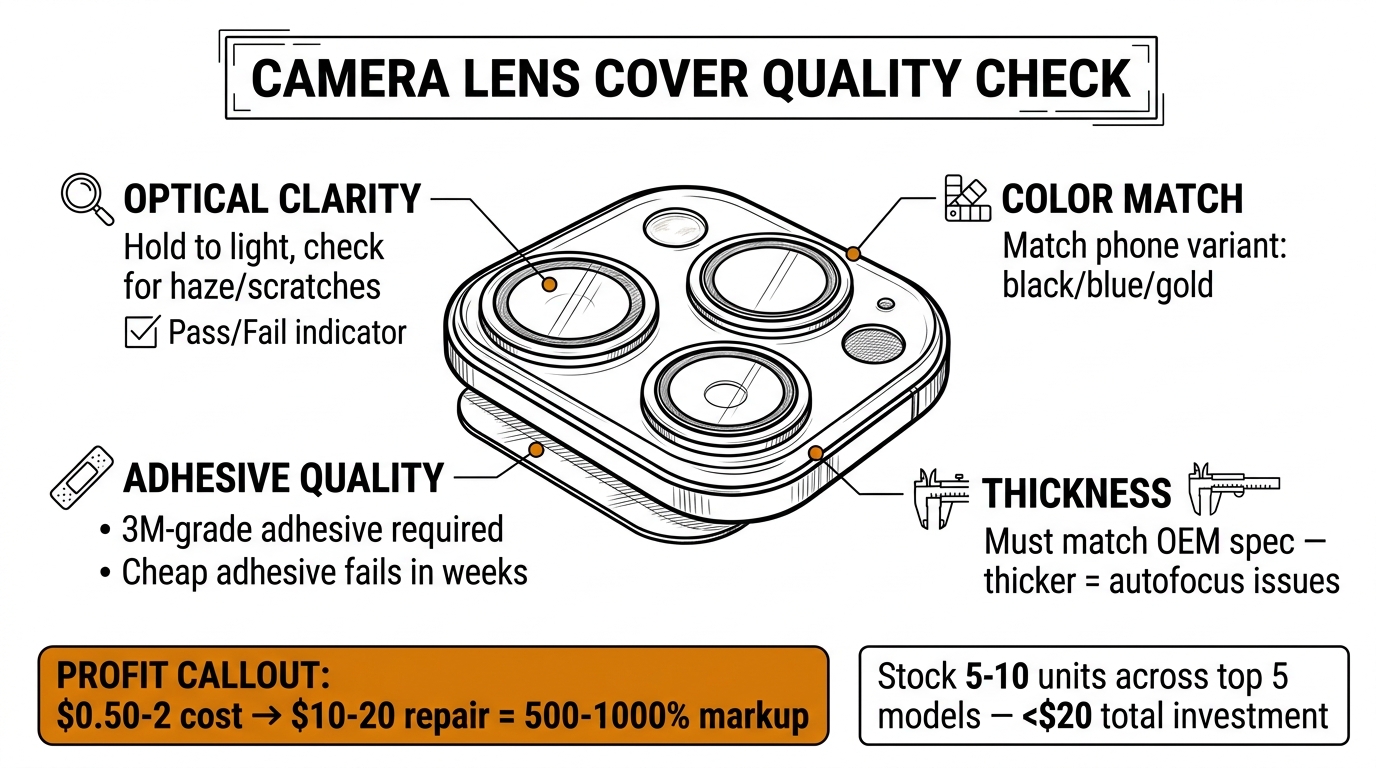
Camera lens covers (the glass piece covering the rear camera) are one of the best-kept secrets in repair shop profitability. The part costs $0.50-2 wholesale. The repair takes 5-10 minutes (heat, remove, adhesive, replace). You can charge $10-20.
Customer complaints: "my camera is blurry," "photos have spots," "the camera glass is cracked."
Quality issues to watch
- Optical clarity. This is the only thing that matters. Hold the lens up to a light source. Any haze, scratches, or uneven coating means the photos will look worse than the original. Customers will blame you, not the part.
- Adhesive quality. The lens attaches with pre-cut adhesive. Cheap adhesive fails within weeks — the lens pops off or moisture gets underneath. Use parts with 3M-grade adhesive or add your own.
- Color match. Camera lens covers come in different tints to match phone color variants. Make sure you're ordering the right variant — a blue-tinted lens on a black phone looks wrong.
- Thickness. Aftermarket lens covers that are slightly thicker than original can interfere with the camera's autofocus, causing consistently soft images. Stick with suppliers whose tolerances match OEM specs.
Stocking recommendation
This is the one small part you should always stock. Camera lens covers are cheap enough to stock 5-10 units across your top 5 models (iPhone 12-15, Samsung A14/A15). The space they take up is negligible, the capital investment is under $20, and the margin per repair is 500-1000%.
Flex Cables: Where Quality Variance Hits Hardest
Flex cables are the ribbon cables that connect buttons, sensors, and modules to the phone's main board. The most common repairs involve:
- Power/volume button flex — button stops clicking or becomes unresponsive
- Home button flex (older iPhones) — Touch ID stops working
- Charge port flex — covered in our charging port replacement guide
- Antenna flex — signal problems after a drop
Quality issues to watch
Flex cables have the widest quality variance of any small part category. A bad flex cable can cause problems that look like unrelated hardware issues:
- Trace thickness. Cheap flex cables use thinner copper traces that are more prone to cracking from repeated bending. This causes intermittent failures — the button works sometimes but not always. Extremely frustrating to diagnose.
- Connector pin quality. Poorly plated connector pins corrode faster and make unreliable contact. If a flex cable connector feels loose or doesn't click firmly into the board socket, reject it.
- FPC stiffener alignment. The small rigid backing plate on flex cable connectors must be precisely positioned. Misalignment means the cable doesn't seat properly, causing intermittent connections that show up as random button failures or sensor glitches.
- Adhesive backing. Flex cables route along specific paths inside the phone. If the adhesive backing is weak, the cable shifts during use and can get pinched or damaged when the phone is reassembled.
Stocking recommendation
Stock power/volume flex cables for iPhone 11 and 12 — these are the most common flex cable repairs. Keep 2-3 units each. For other models and cable types, order per job. Flex cables are cheap enough ($1-3) that ordering a few extras during your regular wholesale order adds minimal cost.
For broader guidance on which parts generate the most repeat business, see our guide on which replacement parts bring the most repeat orders.
Vibration Motors: Low Volume, Easy Repair
Vibration motor repairs are infrequent but straightforward — "my phone doesn't vibrate anymore" is a clear diagnosis, and the fix takes 10-15 minutes.
Quality issues to watch
- Vibration intensity. Test against original — weak aftermarket motors feel noticeably different. Customers notice.
- Noise level. Cheap motors are louder (more rattle, less smooth haptic). On iPhones with Taptic Engine, aftermarket replacements rarely match the precise haptic feedback of the original — set customer expectations before installing.
Stocking recommendation
Don't stock vibration motors. The demand is too low. Order per job when a customer needs one. The exception: if you see a pattern of iPhone 12/13 Taptic Engine failures (it happens in batches), buy 5 units preemptively.
How to Evaluate Small Parts Quality From a New Supplier
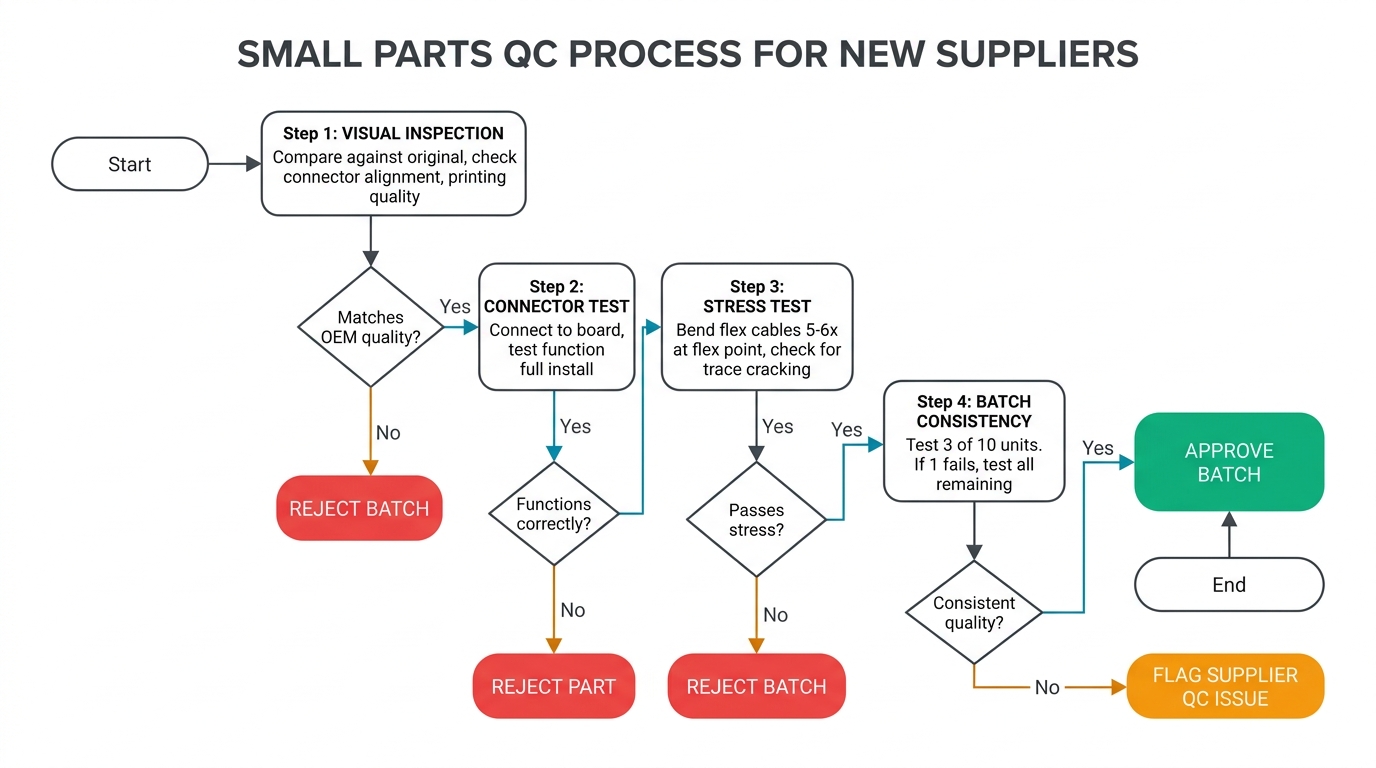
When you receive small parts from a supplier for the first time, run through this quick QC process before installing anything:
-
Visual inspection. Compare the part against an original (or a known-good replacement). Look for color differences, connector alignment, label printing quality. Genuine-quality parts have clean printing and precise cuts. Cheap parts have rough edges and misaligned labels.
-
Connector test. Before full installation, connect the part to the phone's board and test functionality. Earpiece — make a call. Speaker — play audio. Camera lens — take a photo. This catches dead-on-arrival parts before you've done the full repair.
-
Stress test. For flex cables, gently bend the cable 5-6 times at the flex point. If you see any trace cracking or the cable kinks unnaturally, reject it. Quality flex cables withstand 10,000+ bend cycles.
-
Batch consistency. If you ordered 10 earpieces, test 3. If all 3 pass, the batch is likely good. If one fails, test all remaining units. Inconsistency within a batch is a red flag about the supplier's QC.
For a comprehensive approach to incoming quality inspection, see our guide on incoming QC for wholesale phone screens — the principles apply to small parts too.
Building Small Parts Into Your Wholesale Orders
Small parts shouldn't be a separate purchase. They should be line items in your regular screen and battery orders. Here's why:
- Shipping cost per unit drops. Adding 20 camera lenses ($10-20 total) to a 50-screen order costs essentially nothing extra in shipping.
- MOQ becomes irrelevant. Most suppliers don't enforce per-SKU minimums on small parts when they're bundled with screens and batteries.
- You avoid emergency orders. Having 3-5 of each common small part on hand means you never need to rush-order a single earpiece at retail markup.
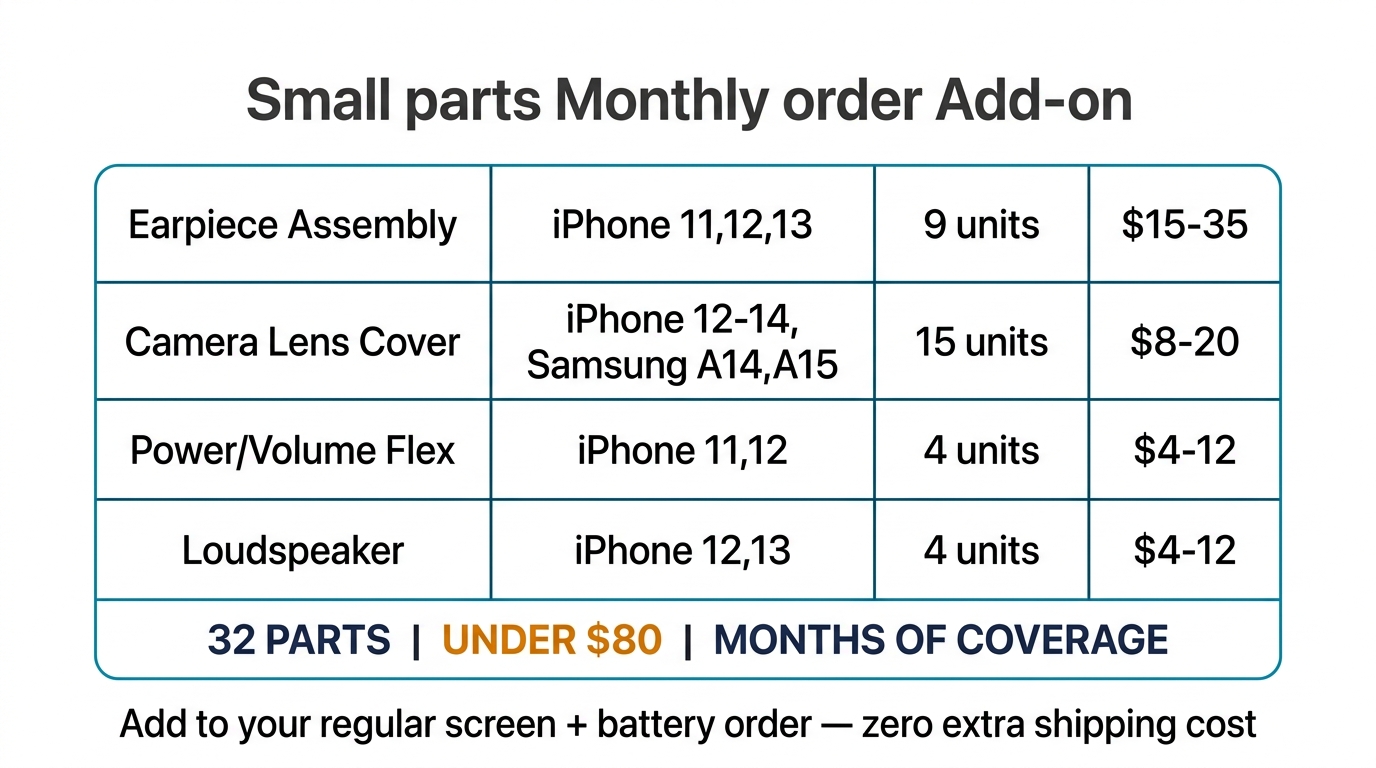
A practical small parts add-on for a typical monthly wholesale order:
| Part | Models | Qty | Est. Cost |
|---|---|---|---|
| Earpiece assembly | iPhone 11, 12, 13 | 3 each (9 total) | $15-35 |
| Camera lens cover | iPhone 12, 13, 14, Samsung A14, A15 | 3 each (15 total) | $8-20 |
| Power/volume flex | iPhone 11, 12 | 2 each (4 total) | $4-12 |
| Loudspeaker | iPhone 12, 13 | 2 each (4 total) | $4-12 |
| Total | 32 parts | $31-79 |
That's under $80 for a complete small parts inventory that covers months of repairs. For a broader view on how to combine small parts with screens and batteries, check our first wholesale order templates.
FAQ
Which phone small parts have the highest profit margin?
Camera lens covers have the best margin — $0.50-2 wholesale, $10-20 repair price, 500-1000% markup. Earpiece speakers are second ($1-5 wholesale, $15-30 repair). Both are quick repairs (5-15 minutes), so your effective hourly rate is high.
Should I stock small parts for Samsung A-series phones?
Stock camera lens covers for A14 and A15 — they break frequently on budget phones. For earpieces and speakers, Samsung A-series parts are cheaper ($1-2 each) but demand is lower than iPhone. Keep 2-3 of each for your top Samsung model and order the rest per job.
How do I tell if a flex cable is low quality before installing it?
Check three things: connector pins should be evenly plated with no dull spots; the flex material should bend smoothly without kinking; and the FPC stiffener should be precisely aligned with the connector. If the connector feels loose when you test-fit it to the board, reject it — loose connectors cause intermittent failures that are hard to diagnose later.
Do small parts need the same warranty terms as screens and batteries?
Yes — negotiate the same 30-90 day warranty on small parts that you get on screens. The wholesale cost is minimal, so reputable suppliers don't resist this. If a supplier won't warranty $2 earpieces, that's a signal about their confidence in their own product quality.
How long can small parts be stored before quality degrades?
Most small parts (speakers, motors, camera lenses) are inert and store indefinitely at room temperature. Flex cables are the exception — extended storage in humid conditions can oxidize connector pins. Store flex cables in sealed anti-static bags. First-in-first-out rotation applies, same as batteries.
Small Parts, Big Impact
Small parts won't be the core of your business. But stocking $50-80 worth of earpieces, camera lenses, and flex cables turns away-jobs into done-today jobs. Customers who come in for a cracked camera lens and leave happy are the same customers who come back when they crack their screen.
If you're building your next wholesale order and want to add small parts, contact our team for current pricing on bundled orders. We include small parts at no additional MOQ when combined with screen and battery orders from Shenzhen.