
iPhone Charging Port Replacement: Common Faults, Repair Decisions, and Parts Quality
iPhone charging port replacement is the second most common repair job after screen replacement in most shops — and it's growing. As iPhones age past their AppleCare+ coverage, charging issues become one of the primary reasons owners walk into repair shops. But unlike screen replacement, where the diagnosis is usually obvious (cracked glass), charging port problems have multiple possible causes. Not every "my iPhone won't charge" complaint needs a port replacement, and misdiagnosing the issue wastes parts and labour.
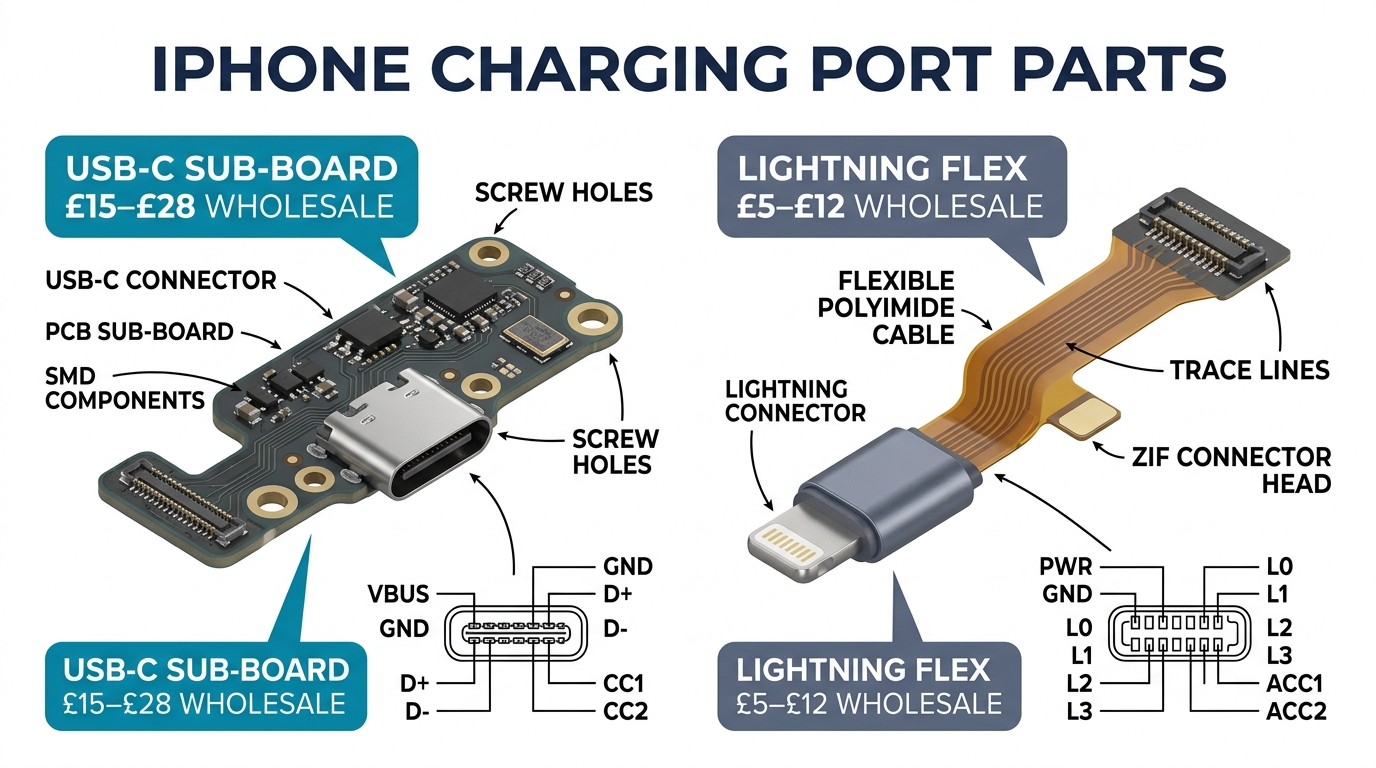
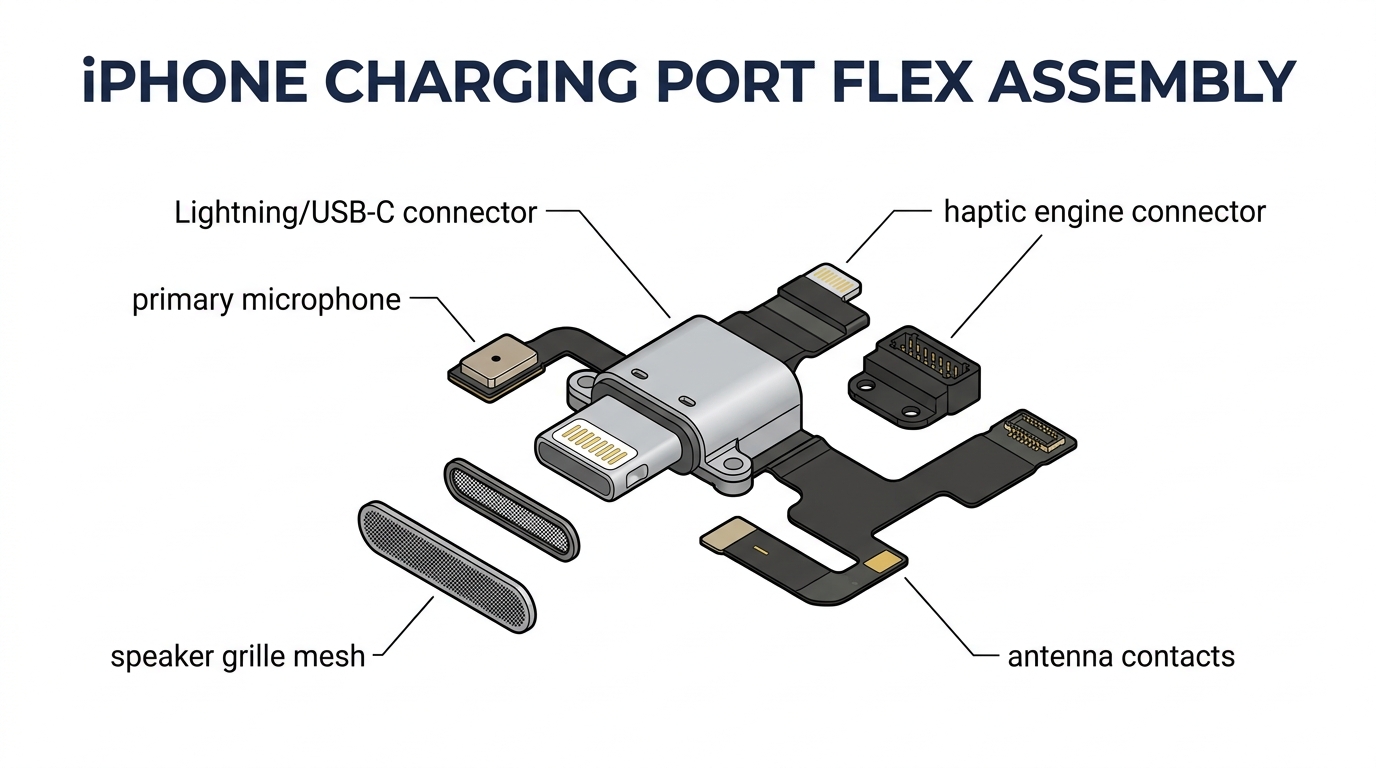
The iPhone charging port isn't just a connector. On most iPhone models, the charging port flex cable assembly includes the Lightning or USB-C connector, the primary microphone, the speaker grille mesh, and the haptic engine connector. Replacing the port means replacing this entire flex assembly — and the quality of that assembly affects more than just charging.
This guide covers how to diagnose charging faults accurately, when a port replacement is the right fix, what quality differences exist in replacement parts, and what the margins look like for repair shops.
Need Charging Port Flex in Bulk?
Wholesale charging port assemblies for iPhone & Samsung — tested, factory-direct.
Get Wholesale QuoteThe 4 Most Common iPhone Charging Faults (and Which Ones Need a Port Replacement)
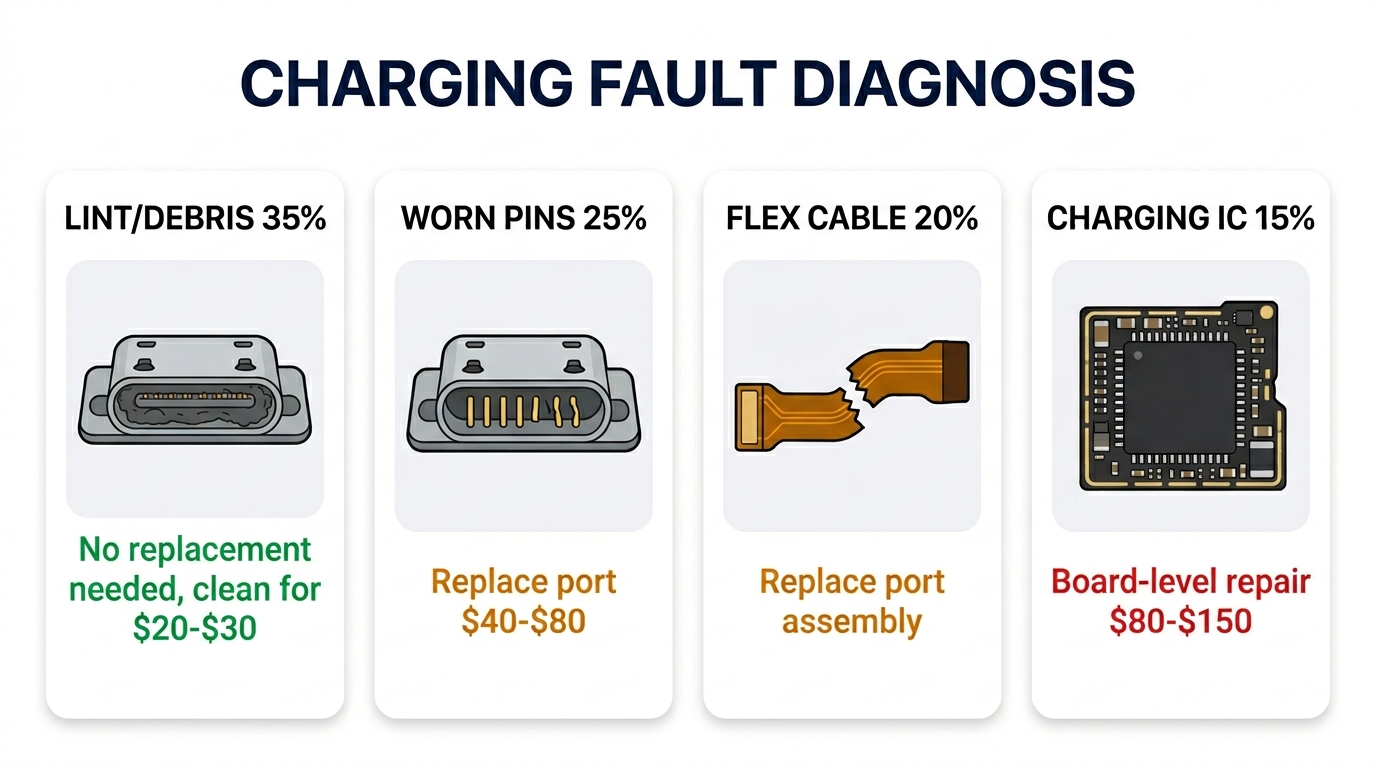
Not every charging problem requires a new port. Here's what repair shops actually see, ranked by frequency.
1. Lint and Debris in the Port
Frequency: ~35% of "won't charge" walk-ins Needs port replacement? No Fix time: 2–5 minutes
This is the most common charging complaint — and the easiest to fix. Pocket lint, dust, and fabric fibres pack into the bottom of the Lightning or USB-C port over months of daily use. The debris prevents the cable from seating fully, creating an intermittent or non-existent connection.
How to fix: Power off the phone. Use a plastic or wooden pick (never metal — it can short the connector pins) to carefully remove compacted debris. Compressed air helps with loose particles but often doesn't dislodge tightly packed lint. A soft anti-static brush works for stubborn buildup.
For the shop: This is a quick-win repair. Many shops charge $20–$30 for a port cleaning. The parts cost is zero, labour is 5 minutes, and the customer walks out happy. Always check for lint before assuming the port needs replacement — it saves you a part and builds trust when you solve the problem without an expensive repair.
2. Worn or Damaged Connector Pins
Frequency: ~25% of "won't charge" walk-ins Needs port replacement? Yes Fix time: 20–45 minutes depending on model
After 3–4 years of daily plugging and unplugging, the spring-loaded pins inside the Lightning or USB-C connector wear down. The cable no longer makes firm contact, causing slow charging, intermittent connections, or complete failure. On Lightning connectors, the centre pins are most vulnerable. On USB-C, the contact surfaces on the tongue wear first.
Physical damage — a cable yanked sideways, a child jamming a charger in the wrong way, or liquid corrosion — also causes pin failure. Inspect the port under magnification: bent, missing, or blackened pins confirm the diagnosis.
How to fix: Replace the charging port flex assembly. This is a genuine port replacement job.
3. Flex Cable Failure
Frequency: ~20% of "won't charge" walk-ins Needs port replacement? Yes Fix time: 20–45 minutes
The charging port flex cable carries power and data signals between the connector and the logic board. Over time, the flex cable can develop internal breaks — especially at stress points where it bends during reassembly or from the phone flexing in a back pocket.
Symptoms: the phone charges intermittently, only charges at certain angles, or the microphone stops working (because it's on the same flex cable). If cleaning the port doesn't help and the connector pins look fine, flex cable failure is likely.
How to fix: Replace the full charging port flex assembly.
4. Logic Board Charging IC Failure
Frequency: ~15% of "won't charge" walk-ins Needs port replacement? No — this is a board-level issue Fix time: Board-level repair (1–2 hours)
The Tristar (iPhone 7 and earlier) or Hydra (iPhone 8 and later) charging IC on the logic board manages the power negotiation between the charger and the battery. When this IC fails, the phone won't charge even with a brand-new port. Symptoms include: charging with some cables but not others, charging only when the phone is off, or the phone drawing zero current despite a good cable and port.
How to diagnose: If a port replacement doesn't fix the charging issue, or if you test with a USB ammeter and see zero current draw with a known-good cable, the charging IC is the likely culprit.
How to fix: This requires micro-soldering to replace the Tristar/Hydra IC. Not every shop handles board-level work — if you don't, diagnose accurately, explain to the customer, and refer to a specialist. Charge a diagnostic fee.
Quick Diagnostic Summary
| Symptom | Most Likely Cause | Fix |
|---|---|---|
| Cable doesn't click in fully | Lint/debris in port | Clean port ($20–$30) |
| Charges intermittently | Worn pins or flex cable | Replace port assembly ($40–$80) |
| Only charges at certain angle | Flex cable partial break | Replace port assembly |
| Microphone also stopped working | Flex cable failure (mic is on same flex) | Replace port assembly |
| Won't charge with any cable/port | Charging IC failure | Board-level IC replacement ($80–$150) |
| Charges when off, not when on | Charging IC or software | IC replacement or iOS restore |
iPhone Charging Port Replacement Cost: Shop Margins by Model
Apple charges $119–$199+ for out-of-warranty charging port repairs depending on model. Third-party shops price significantly below Apple, and the parts cost makes this a high-margin repair.
Parts Cost and Repair Margins
| iPhone Model | Port Assembly Cost (Wholesale) | Typical Customer Charge | Gross Margin |
|---|---|---|---|
| iPhone 11 / 11 Pro / 11 Pro Max | $4–$8 | $50–$70 | $42–$66 |
| iPhone 12 series | $5–$10 | $55–$80 | $45–$75 |
| iPhone 13 series | $6–$12 | $60–$90 | $48–$84 |
| iPhone 14 series | $8–$15 | $70–$100 | $55–$92 |
| iPhone 15 series (USB-C) | $10–$18 | $80–$120 | $62–$110 |
| iPhone 16 series (USB-C) | $12–$22 | $90–$130 | $68–$118 |
Key observation: Charging port parts are dramatically cheaper than screen assemblies ($4–$22 vs $15–$130), but shops charge $50–$130 for the repair. This makes charging port replacement one of the highest-margin repairs in a shop — often 80–90% gross margin on the part alone.
The labour is the main cost. A charging port swap takes 20–45 minutes depending on model complexity. iPhone 12 and newer models use more adhesive and tighter component layouts, making the repair slightly more involved than older models.
Parts Quality: What Matters in Charging Port Assemblies
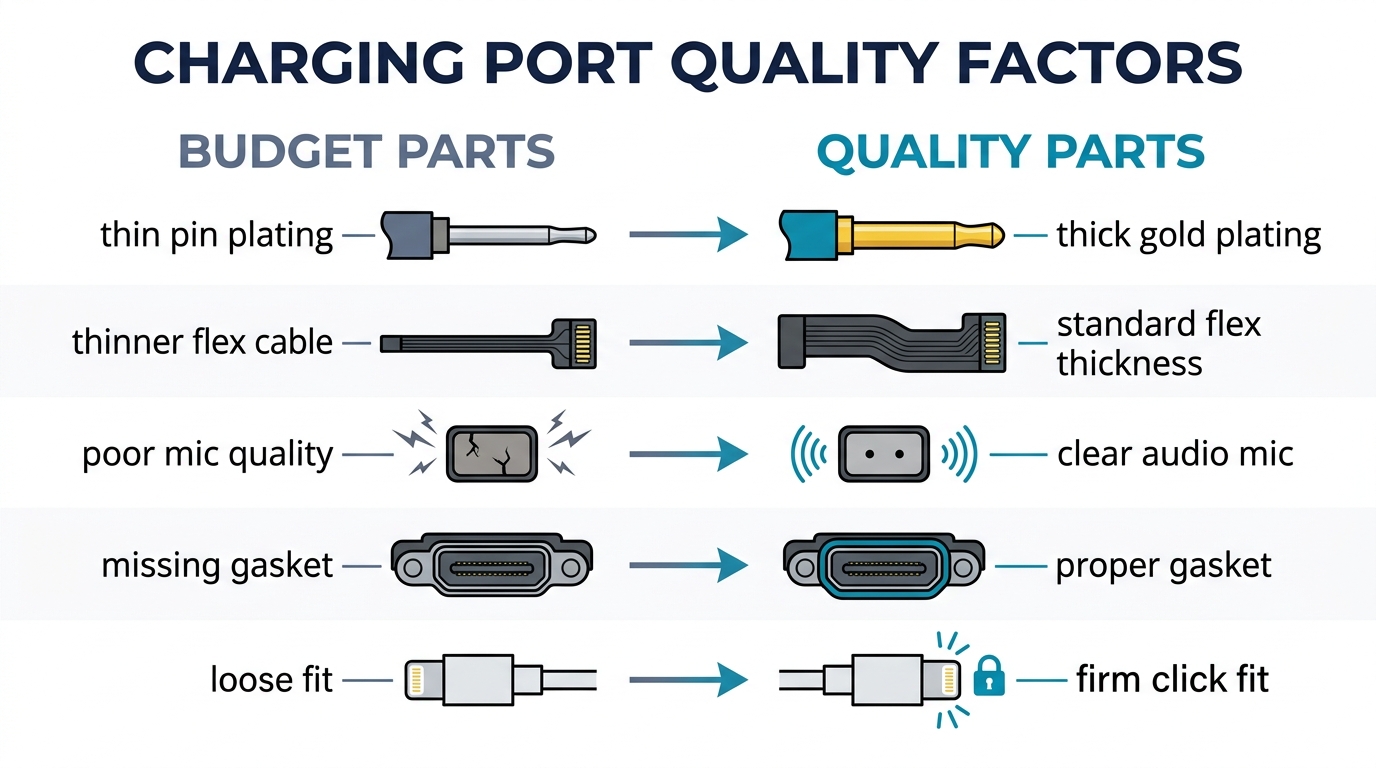
Unlike screens where grade differences are visually obvious, charging port quality differences are harder to spot — but they affect repair reliability just as much.
What's in the Assembly
The iPhone charging port flex assembly is more than just the connector. Depending on the model, it typically includes:
- Lightning or USB-C connector — the physical port
- Primary (bottom) microphone — used for phone calls and voice memos
- Haptic engine connector — connects to the Taptic Engine
- Speaker grille mesh — covers the bottom speaker opening
- Antenna contacts — cellular antenna connection points on some models
A quality replacement gets all of these right. A cheap one might have a working connector but a microphone that picks up static, a haptic connector that loosens over time, or antenna contacts that cause signal degradation.
Quality Differences to Watch For
| Quality Factor | Budget Parts | Quality Parts |
|---|---|---|
| Connector pin material | Thin plating, wears faster | Thicker gold plating, longer life |
| Flex cable thickness | Thinner, more prone to internal breaks | Standard thickness, reliable flex |
| Microphone quality | Static, low volume, or non-functional | Clear audio, consistent across units |
| Waterproof gasket | Often missing or poor fit | Proper gasket maintains some water resistance |
| Connector fit | Loose cable fit, intermittent connection | Firm click, reliable contact |
How to Evaluate Suppliers for Charging Port Parts
Charging port assemblies don't have the same grade system as screens (Incell/Hard OLED/Soft OLED). Instead, quality varies by supplier. Here's what to check:
- Test the microphone after every port replacement. This is the most common quality failure on cheap assemblies — the connector works fine but the mic is terrible. If you're getting mic complaints after port repairs, switch suppliers.
- Check connector fit with an OEM cable. The cable should click in and hold firmly. If it slides in loosely, the connector tolerances are poor.
- Inspect the flex cable under magnification. Look for even copper traces, clean solder joints at the connector, and proper insulation. Cheap assemblies sometimes have visible solder bridges or uneven traces.
- Order samples before bulk. Same principle as screens — test 3–5 units in actual repairs before committing to volume orders.
For general principles on evaluating parts suppliers, see our how to choose a phone parts supplier guide.
Expanding your parts inventory beyond screens? We supply iPhone charging port flex assemblies for iPhone 11 through iPhone 16 series, with tested microphone function and connector fit. Request samples and pricing to evaluate quality before ordering in volume.
Lightning vs USB-C: What Changed for Repair Shops
The iPhone 15 (September 2023) marked Apple's switch from Lightning to USB-C. This has practical implications for repair shops in 2026.
Current Inventory Split
- Lightning models still in active repair: iPhone 8 through iPhone 14 series — these are the bulk of charging port repairs in 2026
- USB-C models entering repair cycle: iPhone 15 and 16 series — charging port repairs are less common on newer phones but will increase as they age
Key Differences
Lightning port repairs are well-established. Parts are cheap ($4–$15), the repair procedure is documented for every model, and supply is abundant. Most shops have these repairs down to a 20-minute routine.
USB-C port repairs are newer territory. The USB-C connector is physically more robust than Lightning (the tongue is in the cable, not the phone), so pin wear is less common. However, the connector assembly is slightly more complex, and parts cost more ($10–$22 wholesale). USB-C ports also handle data transfer at higher speeds, which means the connector quality matters more — a cheap USB-C assembly might charge fine but fail at USB 3.0 data speeds.
For inventory planning: In 2026, stock Lightning port assemblies for iPhone 11–14 (your highest volume) and USB-C assemblies for iPhone 15–16. iPhone 8–10 repairs still happen but volume is declining.
The Most Expensive Charging Port Mistake
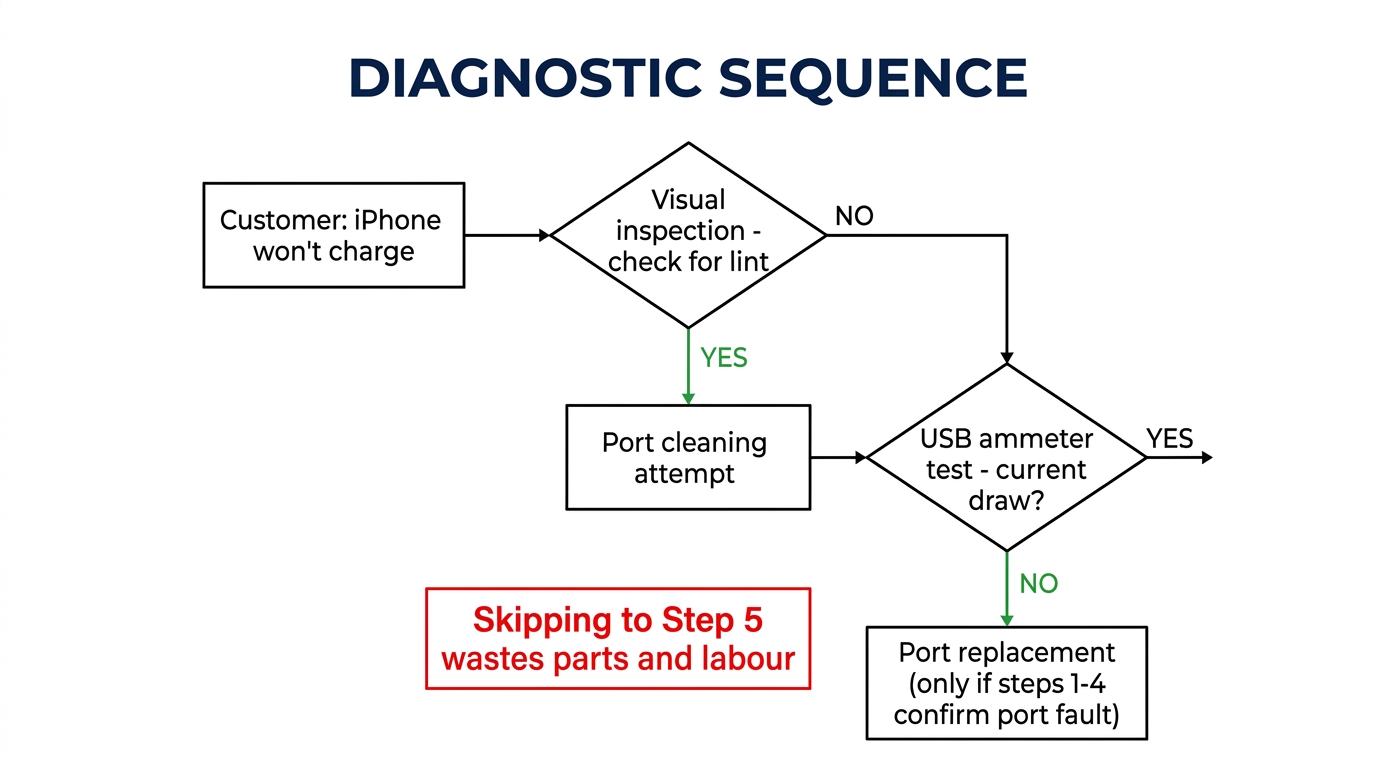
The costliest mistake in charging port repair is the same as in screen repair: replacing a part without proper diagnosis.
If a customer's iPhone won't charge and you replace the port without checking for lint first, you've spent $5–$15 on a part and 30 minutes on labour for a problem that needed a toothpick and 2 minutes. Worse, if the real problem is a charging IC failure, you've replaced the port for nothing and now have to explain to the customer that the fix didn't work.
The diagnostic sequence should always be:
- Visual inspection — check for lint, debris, liquid damage indicators
- Port cleaning — attempt to clean before committing to replacement
- Cable test — try multiple known-good cables (rules out cable faults)
- USB ammeter test — measure current draw. Zero current with a clean port and good cable = charging IC, not port
- Port replacement — only if Steps 1–4 point to a port hardware fault
This sequence takes 5–10 minutes and prevents misdiagnosis. It also builds customer trust — explaining "I checked three things before recommending a port replacement" is far more convincing than "your port is broken, that'll be $80."
For more on systematic repair diagnostics, see our guide on diagnosing phone screen and charging issues.
Frequently Asked Questions
How much does iPhone charging port replacement cost?
Apple charges $119–$199+ for out-of-warranty charging port repair depending on model. Third-party repair shops charge $50–$130, with most iPhone 13 and 14 repairs falling in the $60–$100 range. The wholesale cost of the replacement part is only $4–$22, making this one of the highest-margin repairs for shops.
Can you replace an iPhone charging port yourself?
It's possible but more difficult than a screen replacement. The charging port flex cable runs along the bottom of the phone and connects to the logic board, speaker, and haptic engine. It requires removing the battery and several brackets. iPhone 12 and newer models are more complex due to additional adhesive and tighter tolerances. If you've done screen replacements successfully, a charging port is the next step up in difficulty.
How do I know if my iPhone charging port is broken or just dirty?
Shine a flashlight into the port and look at the bottom. If you see packed lint or debris, clean it with a plastic pick first. If the port is clean but the cable doesn't click in firmly, or if you see bent/blackened pins, the port needs replacement. If the port looks fine and a known-good cable still won't charge, the issue may be the charging IC on the logic board, not the port itself.
Is it worth replacing the charging port on an older iPhone?
For iPhone 11 and newer, absolutely — the repair cost ($50–$100 at a shop) is well below the phone's residual value. For iPhone X and older, compare the repair cost to the phone's trade-in value. An iPhone X is worth about $80–$100 in 2026, so a $60 port repair still makes sense. Below iPhone X, the economics get tight.
Does replacing the charging port affect water resistance?
The original iPhone charging port assembly includes a waterproof gasket. Quality aftermarket replacements include a gasket, but it won't match Apple's original seal exactly. Budget parts often skip the gasket entirely. After any port replacement, the phone's water resistance is reduced compared to factory spec. Inform customers of this, especially for iPhone 12 and newer models that had IP68 rating.
Charging Port Repairs: High Margin, Low Parts Cost
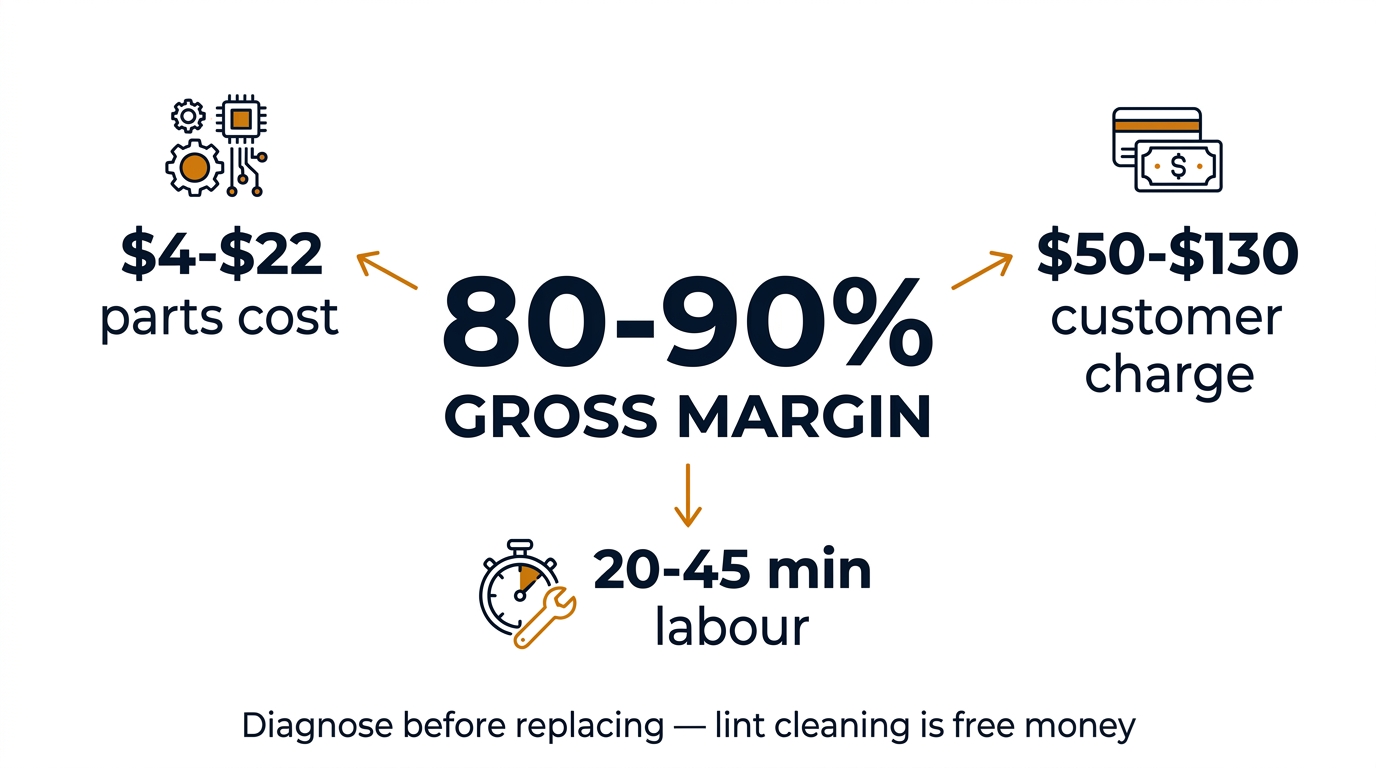
iPhone charging port replacement is a high-margin, bread-and-butter repair that every shop should offer. The parts are cheap ($4–$22), the repair is straightforward once you've done a few, and customers pay $50–$130 — producing some of the best per-repair margins in the business.
The keys to doing it profitably: diagnose before replacing (lint cleaning is free money), use quality assemblies that include a working microphone and proper connector fit, and stock the models your customers actually bring in (iPhone 11–14 Lightning, iPhone 15–16 USB-C).
Ready to add or upgrade your charging port inventory? We supply tested charging port flex assemblies for iPhone 11 through iPhone 16, with verified microphone function and connector quality. Get wholesale pricing and sample units to test before committing to volume.