
Cell Phone Parts Wholesale: The Complete Sourcing Guide for Repair Businesses

Buying cell phone parts wholesale is the process of sourcing screens, batteries, and small parts in bulk directly from manufacturers or distributors, usually at 30–50% below retail-channel pricing. Your first order is effectively a bet: money sent to a supplier you have never visited, for screens you have never touched. Get it right and you lock in a reliable supply chain at margins that keep a repair business profitable; get it wrong and you are stuck with screens that yellow after two weeks or batteries that drain in three hours.
This 2026 guide breaks down everything needed to buy cell phone parts wholesale — quality grades, pricing logic, supplier evaluation, MOQ negotiation, and the mistakes that cost new buyers thousands in returns. One thing worth saying up front: we sell phone parts wholesale out of Shenzhen, so this is written from the seller's side of the table — the part you do not see from a catalog page.
Sourcing Replacement Screens in Bulk?
Incell / Hard OLED / Soft OLED grades — wholesale pricing, grade comparison on request.
Get Wholesale QuoteWhy Cell Phone Parts Wholesale Saves More Than You Think
Buying cell phone parts at retail or small-batch prices might work when you're repairing five phones a week. Once you're doing 20, 30, or 50+ repairs a day, parts cost becomes the single biggest factor in your margin.
Here's a rough comparison for iPhone 14 replacement screens:
| Buying Method | Price Per Unit (Incell) | MOQ | Lead Time |
|---|---|---|---|
| Retail (Amazon/eBay) | $25–$35 | 1 unit | 2–5 days |
| Small wholesale (US distributor) | $15–$22 | 10 units | 1–3 days |
| Direct wholesale (China supplier) | $8–$14 | 50–100 units | 7–15 days |
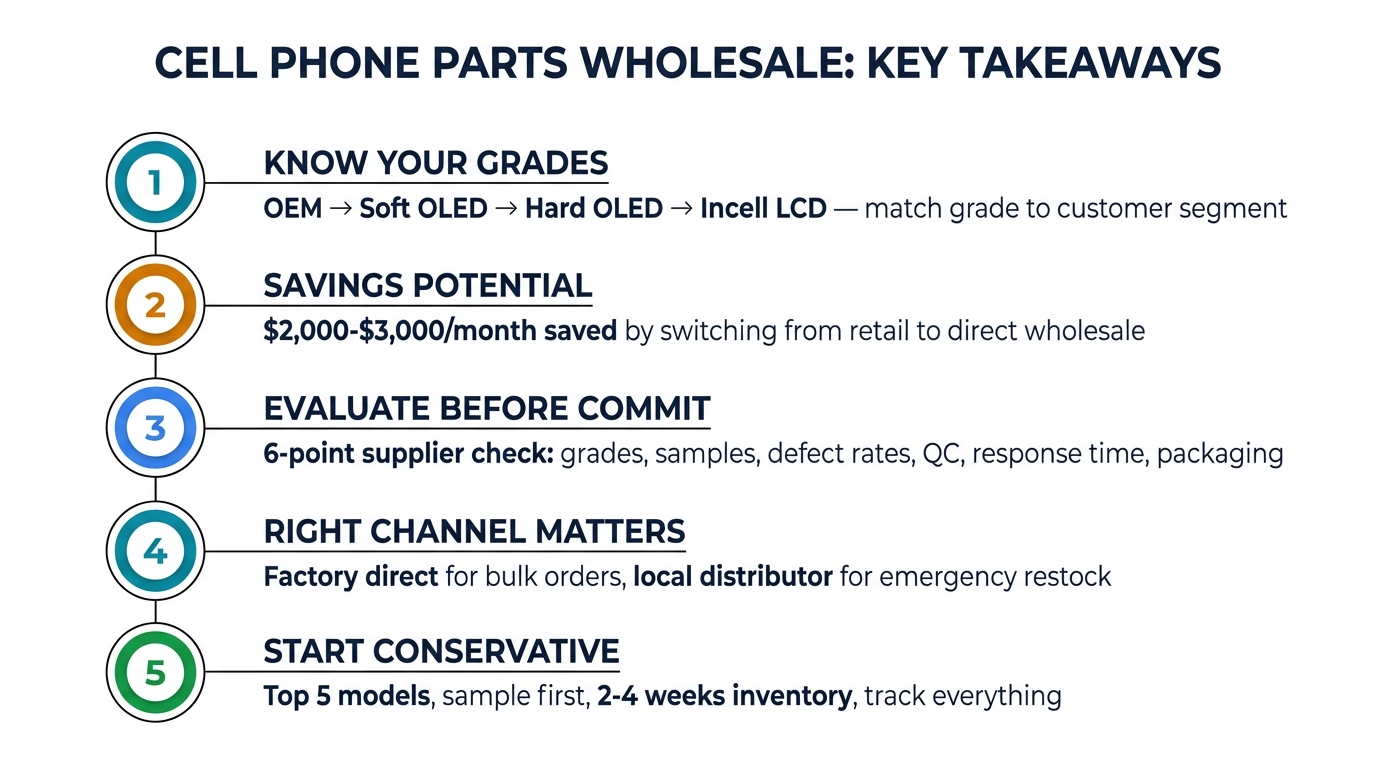
That $10–$15 per-unit difference adds up fast. A repair shop doing 200 screen replacements a month could save $2,000–$3,000 monthly just by moving from retail to direct wholesale sourcing.
But price isn't the only reason to go wholesale. Consistent quality is harder to maintain when you buy from five different sellers on marketplaces. A dedicated wholesale supplier gives you batch consistency — every screen from the same production line, tested to the same standard.
The Three Tiers of Suppliers — and Why It Decides Everything
Here's something you only learn from the seller's side of this market: every company selling "cell phone parts wholesale" is really one of three things, even though they all use the same word. Knowing which tier you're talking to is the single most useful skill in sourcing — more useful than any price comparison.
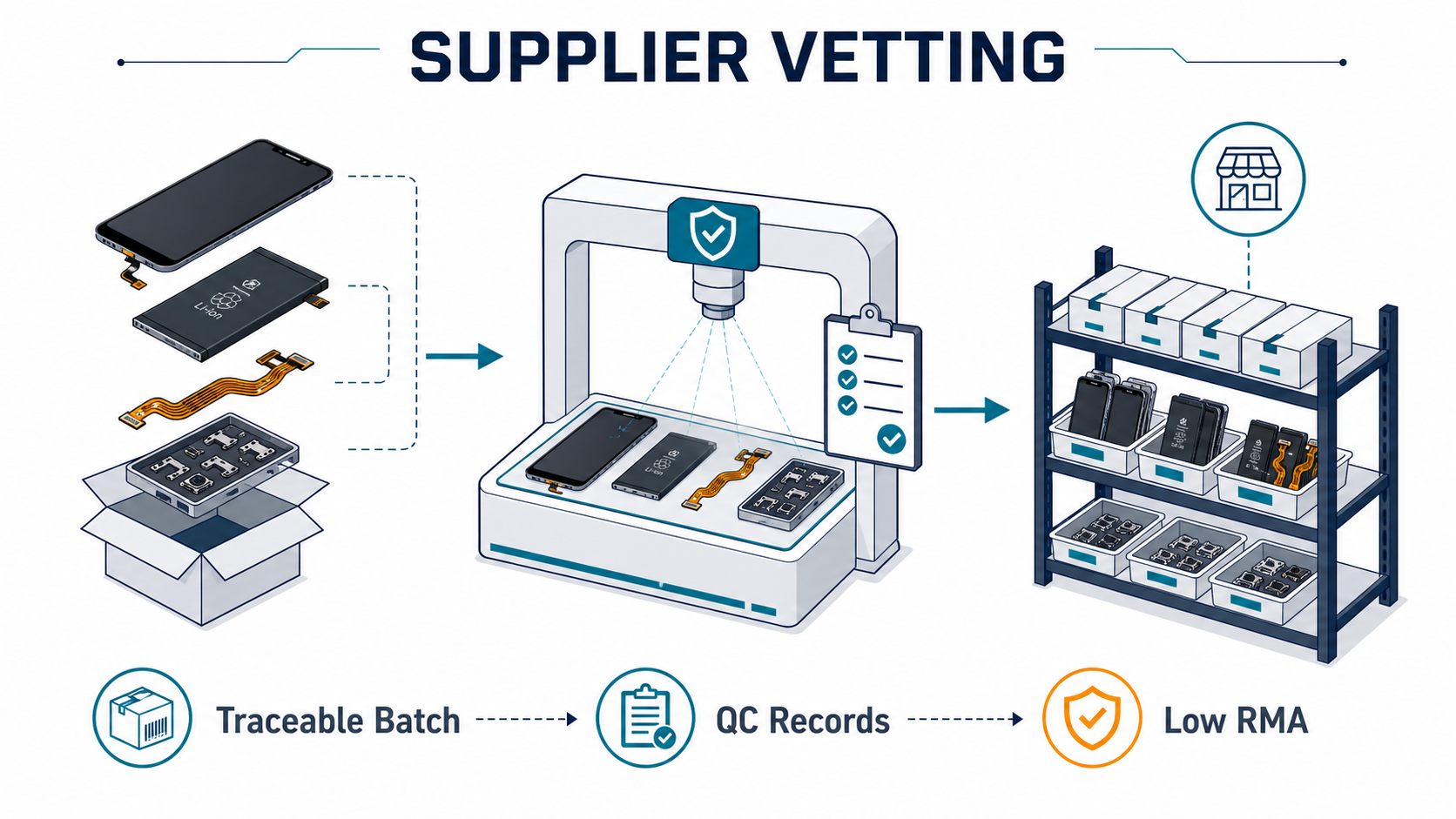
Tier 1 — The factory (or genuine factory-direct). They make the parts, or hold a locked relationship with the line that does. The tells: they can name the factory and production line for a specific batch, they talk about QC process before price, their pricing is stable batch-to-batch (because their source is stable), and they don't get nervous when you ask for test documentation.
Tier 2 — The distributor / consolidator. They buy from multiple factories and resell. Legitimate and useful — you get selection and one invoice across many part types. The risk is batch-to-batch consistency, because the underlying factory can change without you being told.
Tier 3 — The middleman / gray-market reseller. This is the one that hurts you. They own nothing and buy whatever is cheap this week — including factory rejects, 混货 (mixed-quality batches), and 后压屏 (relaminated aftermarket glass sold as better than it is). The tells:
- They reply to your WeChat in five minutes at 2am. A real factory contact — a "Keyman" who actually runs production — has a day job. Instant 24/7 replies usually mean a reseller whose entire job is chasing orders.
- When you ask "这批货是哪个厂的?" (which factory is this batch from?), they go vague or can't answer.
- Their price swings every time you order — because their source swings every time.
The hidden rule almost no buyer learns: the gap between a $40 screen and a "same" $25 screen often isn't quality at all — it's whether that unit passed the factory's QC or was rejected and resold. Same factory, same line: one passed, one didn't. A Tier-3 reseller relabels the reject and sells it as a bargain. That's the screen that installs fine and starts coming back on day 30.
The move that separates pros from tourists: don't accept a grade word — make the supplier name the physical part and its source. A Tier-1 supplier answers instantly. A Tier-3 reseller stalls.
Understanding Phone Screen Quality Grades
This is where most new buyers get confused — and where bad suppliers make their money. Not all "replacement screens" are the same. The industry uses a grading system based on the display technology and manufacturing source.
Original OEM Screens
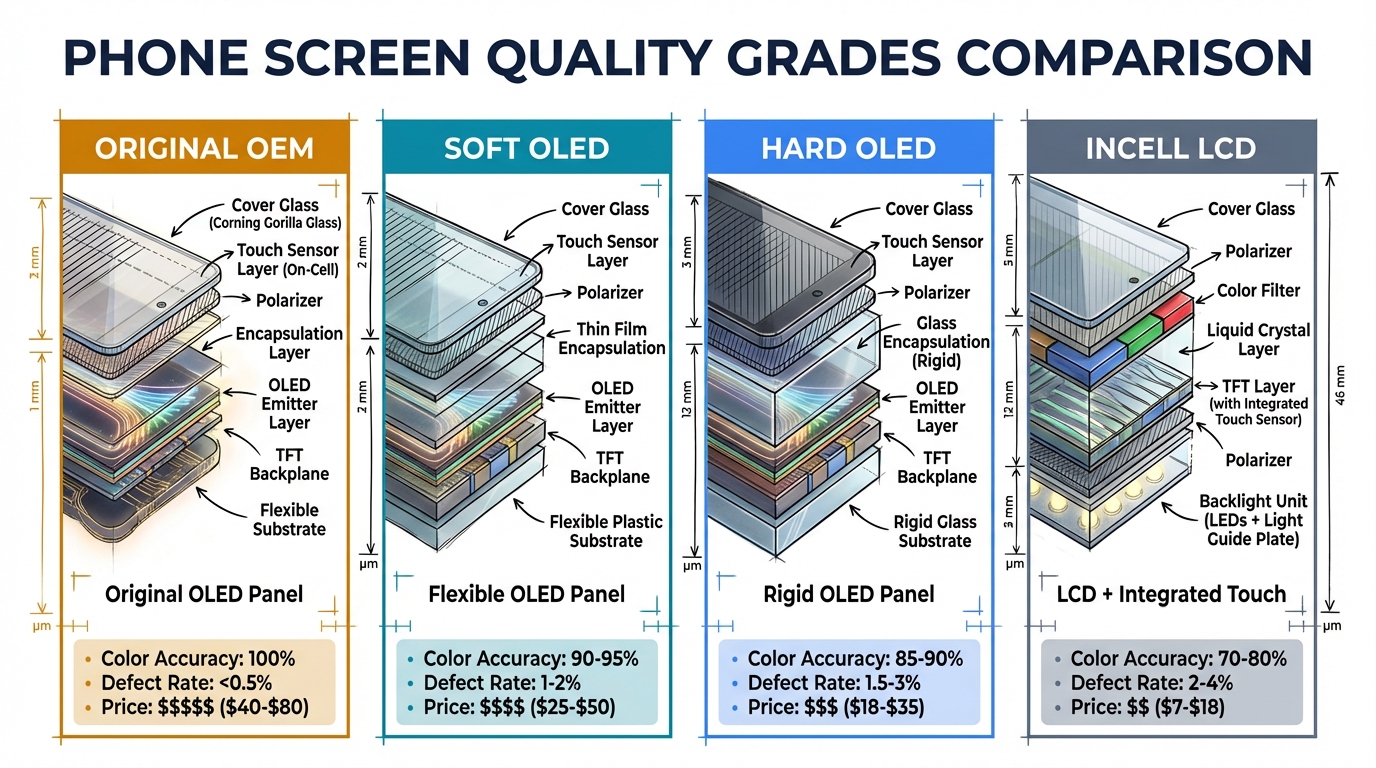
These are pulled from original devices or manufactured by the original display maker (Samsung Display, LG Display, BOE for certain models). They offer identical color accuracy, brightness, and touch responsiveness to what came in the phone.
- Price range: $40–$80+ per unit (varies by model)
- Best for: Premium repair services, warranty-backed repairs
- Downside: Limited supply, high cost, hard to verify authenticity
Soft OLED (Aftermarket)
Aftermarket screens built with flexible OLED panels. The closest aftermarket option to original quality. Color accuracy is 90–95% of OEM, with good viewing angles and deep blacks.
- Price range: $25–$50 per unit
- Best for: Repair shops positioning as mid-to-high quality
- Downside: Price still significant; quality varies between manufacturers
Hard OLED (Aftermarket)
Uses rigid OLED panels instead of flexible ones. Slightly thicker than Soft OLED, with marginally lower color accuracy. Still a strong option for most repairs.
- Price range: $18–$35 per unit
- Best for: Balanced quality-cost ratio for mainstream repairs
- Downside: Slightly lower color temperature accuracy; may not pass side-by-side comparison with original
Incell LCD
The most affordable option. Uses LCD technology with integrated touch, making it thinner than traditional LCDs. Color reproduction is noticeably different from OLED — whites are cooler, blacks are grey rather than true black.
- Price range: $7–$18 per unit
- Best for: Budget repairs, insurance replacements, high-volume shops prioritizing margin
- Downside: Visible quality difference from original OLED; some models have touch sensitivity issues in cold weather
Quick Grade Comparison
| Grade | Display Tech | Color Accuracy | Typical Defect Rate | Price Level |
|---|---|---|---|---|
| Original OEM | Original OLED | 100% | <0.5% | $$$$$ |
| Soft OLED | Aftermarket OLED (flex) | 90–95% | 1–2% | $$$$ |
| Hard OLED | Aftermarket OLED (rigid) | 85–90% | 1.5–3% | $$$ |
| Incell LCD | LCD + integrated touch | 70–80% | 2–4% | $$ |
The key insight: There's no universally "best" grade. The right choice depends on your customer base, pricing model, and acceptable return rate. A shop in a price-sensitive market doing 100 repairs a day will choose differently from a boutique repair service doing 10 premium repairs.
Beyond Screens: Other Cell Phone Parts Wholesale Categories
Screens account for roughly 60% of repair parts revenue, but smart buyers diversify. Here's what moves volume and what to watch out for in each category.
Batteries
The second most-ordered repair part, and the one with the most safety risk. Wholesale phone batteries require UN38.3 certification for air freight — without it, your shipment gets rejected at customs. Look for batteries with TI (Texas Instruments) or ATL (Amperex Technology) cells. These are the same chip and cell manufacturers used in original batteries, and they directly affect charge cycles and swelling risk.
| Battery Quality Indicator | What to Check |
|---|---|
| Cell manufacturer | TI or ATL — avoid generic "China cell" |
| Cycle life | 500+ cycles to 80% capacity |
| Certification | UN38.3, MSDS report |
| Swelling rate | <0.5% within 6 months |
- Typical wholesale price: $3–$8 per unit (iPhone models)
- Typical MOQ: 100–500 units per model
- Key risk: A single swelling battery complaint can cost you a customer and a review. Don't cheap out here.
Charging Ports and Flex Cables
High failure rate parts that move in volume. Wholesale price ranges from $1–$5 per unit, but the quality spread is the widest of any part category. Poor-quality flex cables are the #1 cause of "ghost touch" complaints after repair — the ribbon connector oxidizes within weeks, causing intermittent touch failures.
What separates good from bad: Check the gold contact thickness on the flex connector. Thin plating (visible copper underneath) = returns within 60 days. Name-brand connectors from Luxshare or JAE cost $0.30 more per unit and cut flex-related returns by half.
Back Glass and Housing
Growing fast as newer phones use glass backs. Laser-cut aftermarket back glass runs $3–$8 per unit wholesale. Two things to inspect: adhesive layer quality (cheap adhesive lifts within a month) and camera cutout precision (off by 0.5mm and the customer notices immediately). For housing replacements, check that the color match is within Delta E <3 — anything higher looks visibly different under store lighting.
Small Parts Bundles
Screws, brackets, adhesive strips, earpiece meshes — the parts nobody thinks about until they're missing. Sold in model-specific kits at $0.50–$2.00 per kit. The margin on labor is high here: a $1 bracket kit saves 15 minutes of hunting for the right screw size. Stock these alongside every screen model you carry.
How to Evaluate a Cell Phone Parts Wholesale Supplier
Finding suppliers is easy. Finding reliable suppliers is the hard part. Here's what to check before you commit to a first order.
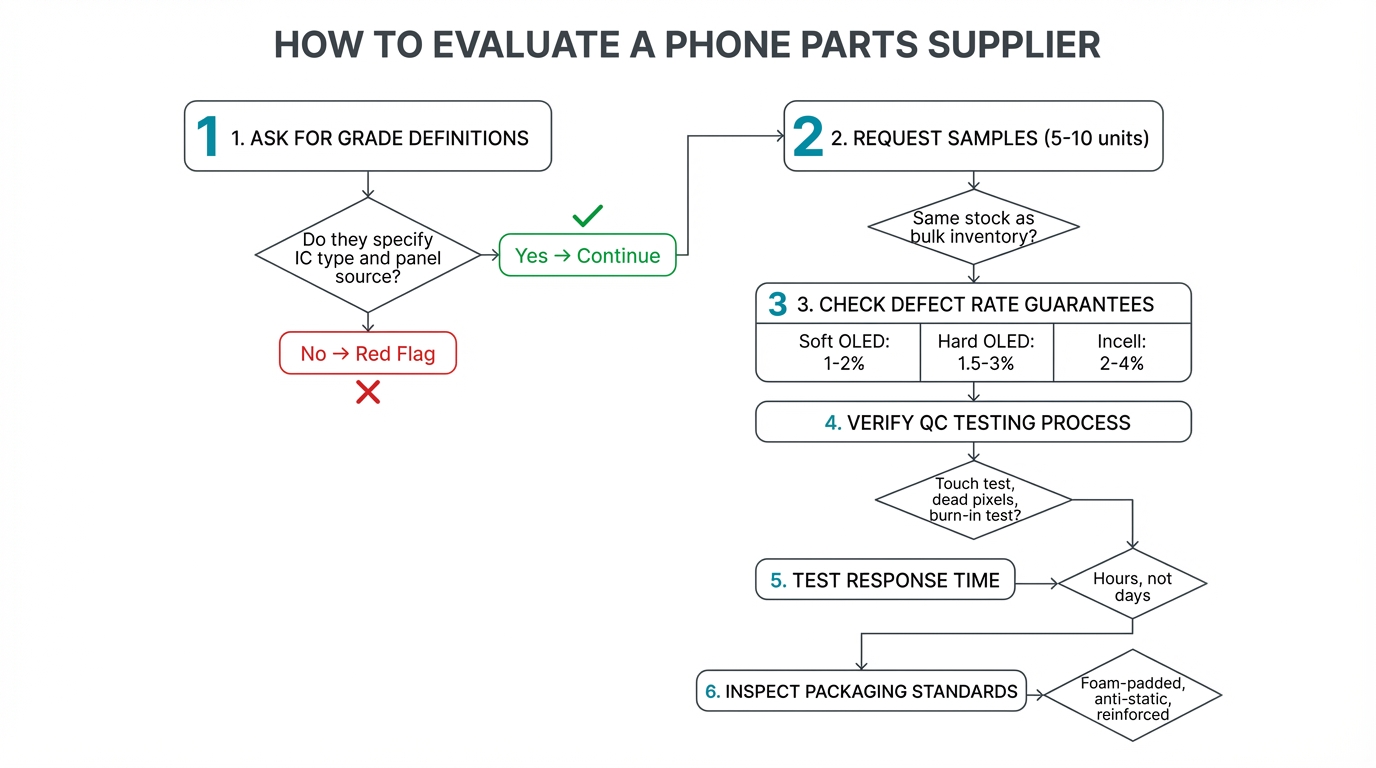
1. Ask for Quality Grade Definitions
A good supplier will clearly define what each grade means and what defect rate to expect. If a supplier just says "high quality" without specifics, that's a red flag. You want to hear terms like "Incell with Tianma IC" or "Soft OLED with Samsung panel" — this tells you they actually know what they're selling.
2. Request Sample Orders
Any supplier worth working with will let you order 5–10 units to test before committing to bulk. If they refuse samples or require minimum 100 units on a first order, move on. The sample should be the same stock they sell in bulk — not a cherry-picked unit.
3. Check Defect Rate Guarantees
Ask directly: "What is your defect rate on [specific grade] for [specific model], and what's your replacement policy for defective units?"
Reasonable benchmarks:
- Soft OLED: 1–2% defect rate
- Hard OLED: 1.5–3% defect rate
- Incell: 2–4% defect rate
If a supplier claims 0% defect rate, they're either lying or haven't shipped enough volume to know.
4. Verify Testing Procedures
Professional suppliers test every screen before shipping. Ask about their QC process:
- Do they test touch functionality on all screen areas?
- Do they check for dead pixels and backlight bleeding?
- Do they test with actual devices or just test jigs?
- Is there a burn-in test for OLED screens?
5. Evaluate Communication and Response Time
When your latest batch has an issue and 15 customers are waiting, you need a supplier who responds in hours, not days. Test this before ordering — send a technical question and measure response time and accuracy.
6. Ask About Packaging and Shipping
Screens are fragile. Good suppliers use individual foam-padded boxes, anti-static bags, and reinforced outer packaging. Ask for photos of their packaging. If they ship screens loose in a box with bubble wrap, your breakage rate on arrival will cost you more than you saved on the unit price.
Pricing Logic: Why the Same Part Has Different Prices
New buyers are often confused by the price range they see. The same "iPhone 15 Incell screen" might be quoted at $9 from one supplier and $16 from another. Here's why.
IC Chip Source
The integrated circuit (IC) on the screen affects touch performance and compatibility. Screens using Tianma or BOE ICs typically cost more but have better compatibility and lower defect rates than generic ICs.
Panel Manufacturer
Even within the same grade, panels from different manufacturers perform differently. A Hard OLED with a panel from a top-3 Chinese manufacturer will cost more — and last longer — than one from a no-name factory.
Testing Level
Some suppliers do 100% testing (every unit individually checked). Others do batch testing (spot-check 10% of each batch). Full testing adds $0.50–$1.00 per unit but cuts your incoming defect rate significantly.
Order Volume
Standard volume pricing tiers in the industry:
| Order Size | Typical Discount |
|---|---|
| 1–49 units | List price |
| 50–199 units | 5–10% off |
| 200–499 units | 10–15% off |
| 500+ units | 15–25% off (negotiable) |
Shipping Method
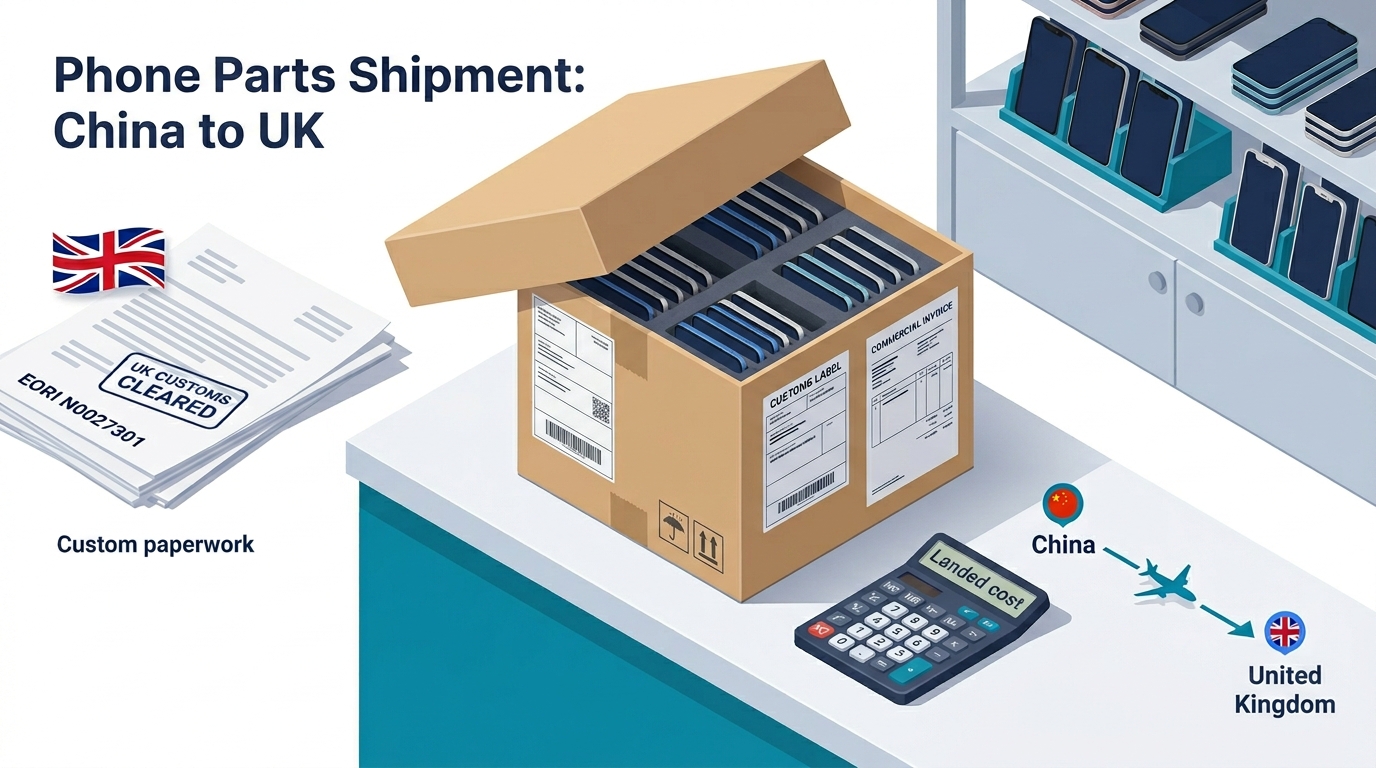
Air freight vs. sea freight can change your landed cost by $1–$3 per unit on screens. Sea freight makes sense for orders above 500 units where you can wait 25–35 days. For smaller, time-sensitive orders, air express (DHL, FedEx, UPS) in 5–7 days is standard.
Not sure which screen grade fits your repair volume? We can send you a sample kit with Incell, Hard OLED, and Soft OLED so you compare side by side. Request a sample kit here.
MOQ: What to Expect and How to Negotiate
Minimum Order Quantity (MOQ) is one of the first questions every buyer asks. Here's how it actually works in the cell phone parts wholesale market.
Typical MOQ Ranges
| Supplier Type | Typical MOQ | Flexibility |
|---|---|---|
| Factory direct (China) | 100–500 units per model | Low — they run production batches |
| Trading company (China) | 50–100 units per model | Medium — they aggregate orders |
| Regional distributor (US/UK) | 10–50 units per model | High — they stock inventory |
How to Work With MOQ as a Smaller Buyer
If you can't meet a 100-unit MOQ for a single model, here are practical approaches:
- Mix models: Many suppliers allow you to hit MOQ across multiple models. Instead of 100 iPhone 15 screens, order 30 iPhone 15 + 30 iPhone 14 + 40 iPhone 13.
- Start with popular models: Focus your first order on your highest-volume repair models. Don't spread across 20 models with 5 units each.
- Build up gradually: Place a 50-unit first order, reorder in 2 weeks. Once you've ordered 3–4 times, most suppliers will lower their MOQ for you.
- Join a buying group: Some repair shop networks pool orders to get factory-direct pricing. This works well if you're in a market with other independent shops.
Sourcing Channels: Where to Find Wholesale Suppliers
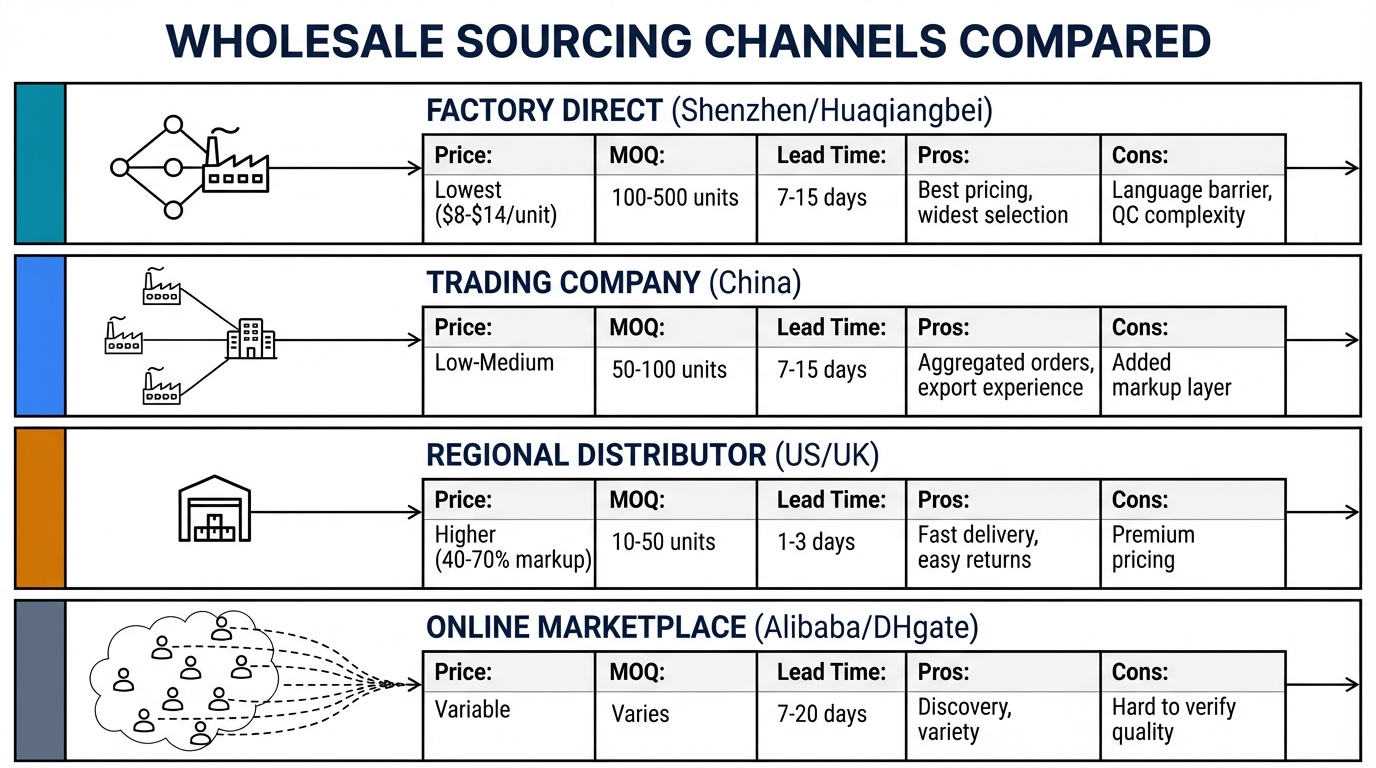
Direct from Shenzhen / Huaqiangbei
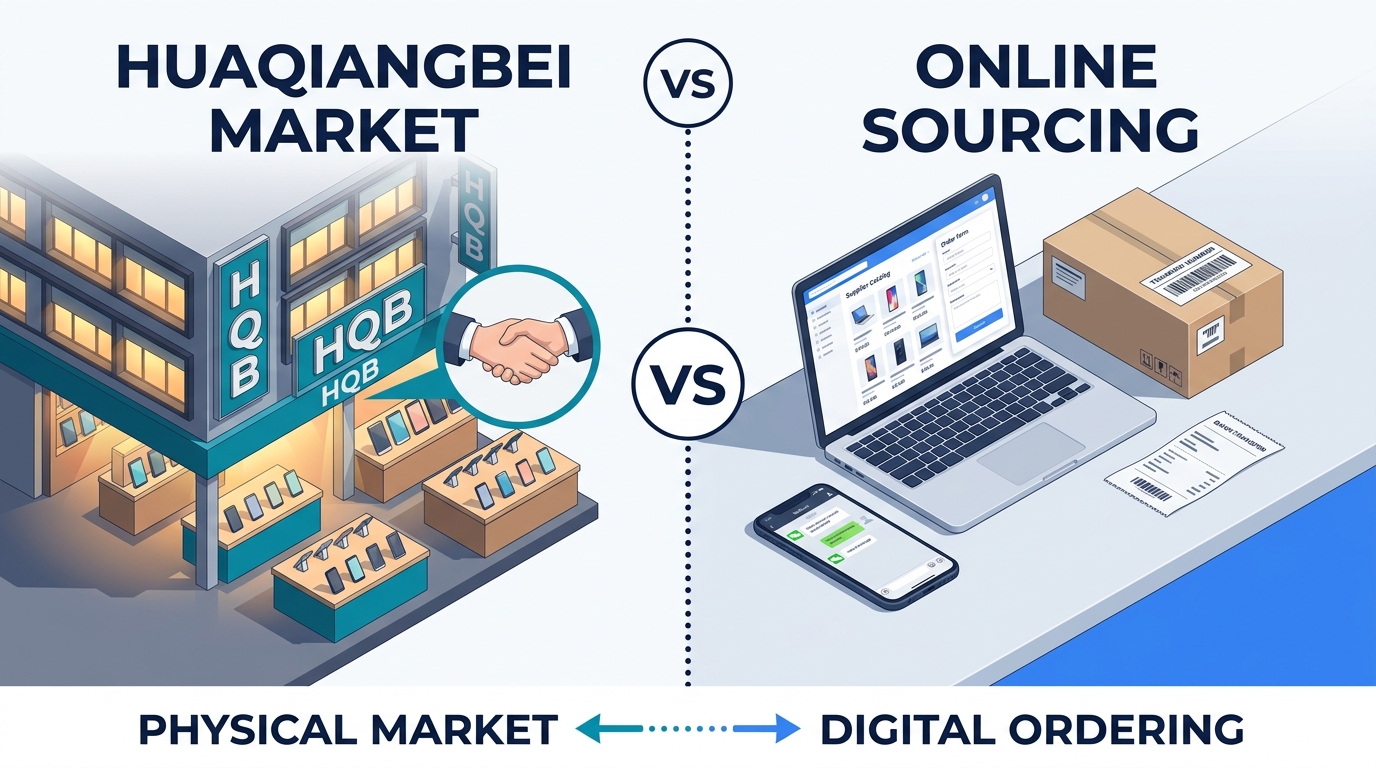
Shenzhen's Huaqiangbei district is the global hub for cell phone parts. Thousands of suppliers operate from multi-story electronics markets, with everything from screens and batteries to specialized repair tools.
Pros: Lowest prices, widest selection, ability to inspect goods in person Cons: Requires travel or a local sourcing agent, language barrier, harder to enforce quality guarantees from abroad
For buyers who can't visit in person, working with a Shenzhen-based supplier who has their own QC team and export experience is the next best thing. They bridge the gap between factory pricing and the reliability you need.
Online Directories and Discovery
Online supplier directories can help you discover names, but they can't tell you which of the three tiers you're looking at — the polished storefront of a Tier-3 reseller often looks slicker than a real factory's. Treat any profile, badge, or "verified" label as a lead to investigate, never as proof. The only things that actually reveal a supplier's tier are the factory-name question, a real first-order batch test, and a logged RMA rate. Verify the business entity, request samples from real stock, and start small no matter how impressive the listing looks.
US/UK-Based Distributors
Regional distributors stock inventory domestically and ship within 1–3 days. You'll pay 40–70% more per unit than China-direct pricing, but you get faster delivery, easier returns, and no customs paperwork.
When to use a local distributor vs. a China-direct supplier:
| Factor | Local Distributor | China-Direct Supplier |
|---|---|---|
| Unit price | Higher (40–70% markup) | Lowest |
| Delivery speed | 1–3 days | 7–15 days |
| MOQ | Low (10–50 units) | Higher (50–500 units) |
| Return process | Easy, same-country | Slower, cross-border |
| Quality control | You rely on their grading | You can specify grade + QC level |
A practical strategy: use a China-direct supplier for your regular bulk orders, and keep a local distributor as your emergency restock source for fast-moving models.
Trade Shows
Events like the Global Sources Mobile Electronics show (Hong Kong), CES, and regional repair industry expos let you meet suppliers face to face. You can compare screen samples side by side, negotiate in person, and build relationships that lead to better terms long-term.
Your First Wholesale Order: A Step-by-Step Approach
If you're placing your first cell phone parts wholesale order, follow this sequence to minimize risk.
Step 1: Define Your Top 5 Models
Look at your repair data from the past 3 months. Which phone models do you repair most? For most shops in 2026, this list looks something like:
- iPhone 14 / 14 Pro
- iPhone 15 / 15 Pro
- iPhone 13
- Samsung Galaxy S23 / S24
- Samsung Galaxy A-series (A14, A15, A54)
Step 2: Choose Your Grade Mix
Don't go all-in on one grade. A practical first order might be:
- 60% Incell (for budget repairs and high-volume models)
- 30% Hard OLED (for mid-range quality requests)
- 10% Soft OLED (for premium repairs and flagship models)
Step 3: Test the Batch, Not Just Samples
Samples are cherry-picked — you find out who a supplier really is from a batch. Request 3–5 units per grade for your top 2 models, install them, and run these fast checks (each under a minute):
- Black-screen test: display full black at 100% brightness in a dark room. Any backlight glow on something sold as OLED means it's an LCD mislabeled as OLED — reject it.
- Slow-mo flicker test: point your phone camera at 240fps at the screen set to ~25% brightness. Heavy visible flicker = aggressive PWM, exactly the "eye strain" complaint that wrecks your reviews.
- Consistency check: compare color and touch across several units — consistency between units matters more than any single unit looking good.
Then ask the question that sorts tiers: "这批屏幕是哪个厂的?有没有检测报告?" (Which factory is this batch from? Is there a test report?) A Tier-1 supplier answers with a name and a document. A reseller can't. Only after a batch survives this test should you place your bulk order.
Step 4: Place a Conservative First Bulk Order
Don't order 6 months of inventory on your first try. Order 2–4 weeks of stock based on your current repair volume. This limits your risk while you validate the supplier's consistency.
Step 5: Track Everything
For your first 3 orders, track:
- Incoming defect rate (dead on arrival)
- Post-install return rate (failures within 30 days)
- Customer complaints per grade
- Delivery time vs. promised lead time
This data is your negotiation leverage for better pricing and your decision-making tool for which grades and models to reorder.
Common Mistakes That Cost Wholesale Buyers Money

After working with hundreds of repair businesses and distributors, these are the patterns we see again and again.
Chasing the Lowest Price
This is the mistake that funds the entire Tier-3 reseller market. The cheapest quote almost always hides the highest total cost — not because the screen looks worse on day one, but because of what happens on day 30.
Do the math on 100 screens of one model:
- Documented, batch-tested supplier: ~$35/unit at ~1.1% return rate → $3,500, plus roughly $150–250 in returns.
- "Bargain" mixed / gray stock: ~$25/unit ($10 cheaper!) but a 3–8%+ return rate → $2,500, plus roughly $800–1,500 once you count replacement parts, reinstall labor ($30–60/unit), refunds, and the customers who quietly don't come back.
The $1,000 you "saved" on purchase price gets wiped out — and then some. This is why shops that scale profitably treat RMA rate as the primary KPI, not headline unit price. Always calculate total cost including defect rate.
Ordering Too Many Models at Once
New buyers often try to stock every model. Spread across 30 models with 5 units each, your capital is tied up in slow-moving inventory while you're out of stock on your top sellers. Focus on your top 5–8 models first.
Skipping Incoming Inspection
Even with a great supplier, you should spot-check every incoming shipment. Spending 10 minutes checking 10% of your screens saves you hours of rework later. Look for dead pixels, touch dead zones, and backlight uniformity.
Ignoring Shipping Insurance
International shipments of fragile electronics should always be insured. A $3,000 order that arrives with 20% breakage and no insurance is a $600 loss. Insurance typically costs 1–3% of order value.
Not Building a Backup Supplier
Relying on a single supplier is risky. Supply chain disruptions, quality dips, and shipping delays happen. Maintain relationships with at least two suppliers so you can switch quickly when needed.
Frequently Asked Questions
What is the minimum order quantity for wholesale cell phone parts?
The minimum order quantity (MOQ) for wholesale cell phone parts is the smallest batch a supplier will sell per model, and it varies sharply by supplier type in 2026. Factory-direct suppliers typically require 100–500 units per model. Trading companies and export-focused suppliers often accept 50–100 units. US or UK-based distributors may go as low as 10–50 units. In practice, many suppliers let you mix models to reach the minimum, so a 100-unit MOQ can be split across your top 3 to 4 models. For example, a new buyer can meet a factory's 200-unit MOQ by combining iPhone 11, 12, and 13 screens rather than committing 200 of a single model.
How do I tell if a wholesale phone screen is good quality before buying in bulk?
Telling whether a wholesale phone screen is good quality before buying means testing a paid sample, never trusting the quote. Order 3 to 5 sample units per grade and install them in actual devices for 5–7 days, the same protocol vetted buyers use in 2026. First, check color accuracy against an original screen. Second, test touch responsiveness across the entire display surface. Third, monitor for backlight bleed, dead pixels, or yellowing. In practice, a supplier confident in its grade provides samples without hesitation, while a reseller moving mixed stock resists sample requests. For example, a sample that yellows within 7 days signals a low-grade panel that would fail across a full 200-unit batch.
Is it cheaper to buy cell phone parts from China directly?
Yes, typically 30–50% cheaper than buying from a US or UK distributor. However, factor in shipping costs (air express adds $2–$5 per unit for screens), customs duties, longer lead times (7–15 days), and the risk of quality issues being harder to resolve across borders. For orders above 200 units, direct sourcing from China usually makes financial sense.
What's the difference between OEM and aftermarket phone screens?
The difference between OEM and aftermarket phone screens is a question of who manufactures the panel and to what spec. OEM screens are made by the original display maker, such as Samsung Display, and match the phone's original specifications exactly. Aftermarket screens are made by third-party manufacturers at lower cost, available in grades like Soft OLED, Hard OLED, and Incell LCD. In practice, OEM costs 2–4x more but carries the lowest defect rate, while most repair shops in 2026 use a mix of aftermarket grades matched to customer segments. For example, a budget repair can use Incell LCD while a flagship repair justifies Hard OLED or OEM.
How do I handle defective parts from a wholesale order?
Handling defective parts from a wholesale order means agreeing on a written defect policy before you order, not after the first problem. Standard industry practice is that the supplier replaces defective units in your next order or issues credit. First, document every defective unit with photos and test results. Second, file the claim inside the supplier's window. In practice, professional suppliers expect a 1–3% claim rate and handle it smoothly, while a supplier who fights legitimate claims is one to replace. For example, on a 200-unit order a 2% defect rate means about 4 units — a routine credit for a real factory, a dispute for a gray-market reseller.
How do I know if a supplier is selling mixed or rejected stock?
Spotting a supplier that sells mixed or rejected stock means watching four signals. First, prices that swing every order. Second, vague answers about which factory a batch came from. Third, instant 24/7 replies, which point to a full-time reseller rather than a factory contact. Fourth, resistance to a real first-order batch test. The Chinese terms to know are 混货 (mixed-quality batches) and 后压屏 (relaminated aftermarket glass). In practice, the only reliable test is the first real shipment plus a logged RMA rate — never the quote or a cherry-picked sample. For example, a quote 30% below every other supplier almost always signals 混货.
What return (RMA) rate should I expect on wholesale screens?
A realistic RMA rate on wholesale screens is the single metric that tells you whether to scale a supplier or walk away. Aftermarket screen RMA is commonly discussed in the 3–5%+ range and runs far higher on unvetted mixed batches. Vetted, factory-traceable supply tracks lower: we track around 1.1% on screens over the last 6 months, counting warranty and RMA cases but excluding installation damage. In practice, log your own RMA by supplier and model every month. For example, a supplier whose RMA climbs from 2% to 8% across two orders is sliding into mixed stock and should be re-vetted before the next purchase.
Start Sourcing Smarter

The margin difference between a struggling repair business and a thriving one often comes down to sourcing. Right grades, right supplier, right order cadence — it compounds over every repair.
If you're looking to source wholesale cell phone parts with clear quality grades, tested inventory, and transparent pricing, we can help. Our team works directly from Shenzhen with hands-on QC for every batch we ship.
Request a Wholesale Quote — tell us your top models and volume, and we'll send you grade options with pricing within 24 hours.
Related reading: