
LCD vs OLED vs Hard OLED vs Soft OLED: Which One Should Repair Shops Buy?

If you've ever searched "hard OLED vs soft OLED" trying to figure out which screen grade to stock, you're not alone. A customer walks in with a cracked iPhone 13. You offer the $45 Incell repair or the $85 Soft OLED option — but you're not entirely sure what the actual difference is beyond price. And honestly, you're not sure your supplier knows either.
This confusion costs repair shops real money. Stock the wrong grade and you'll either eat into your margins with unnecessary quality, or deal with callbacks from customers who notice their new screen looks "off." The aftermarket phone screen market now has four distinct grades — LCD (Incell), Hard OLED, Soft OLED, and OEM Original — and each one serves a different purpose in your business.
This guide breaks down all four grades side by side: what they actually are, how they differ in real-world performance, what each costs at wholesale, and which grade you should stock for which repair scenarios. No jargon without context, no sales pitch — just the information you need to make smarter purchasing decisions.
Sourcing Replacement Screens in Bulk?
Incell / Hard OLED / Soft OLED grades — wholesale pricing, grade comparison on request.
Get Wholesale QuoteThe Four Replacement Screen Grades, Explained
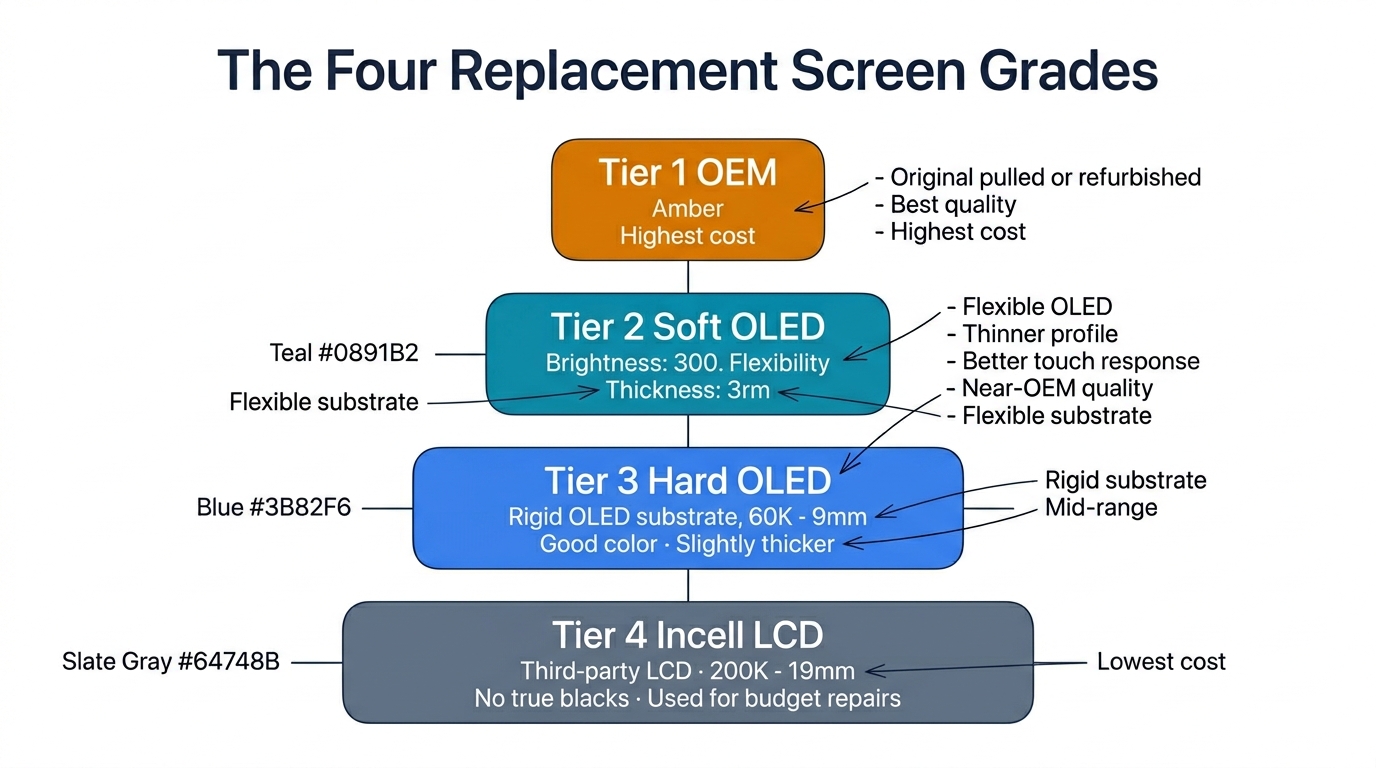
Before comparing, let's be precise about what each grade actually is. The terminology in the aftermarket screen market is messy — suppliers use different names for the same thing. Here's what matters.
LCD (Incell)
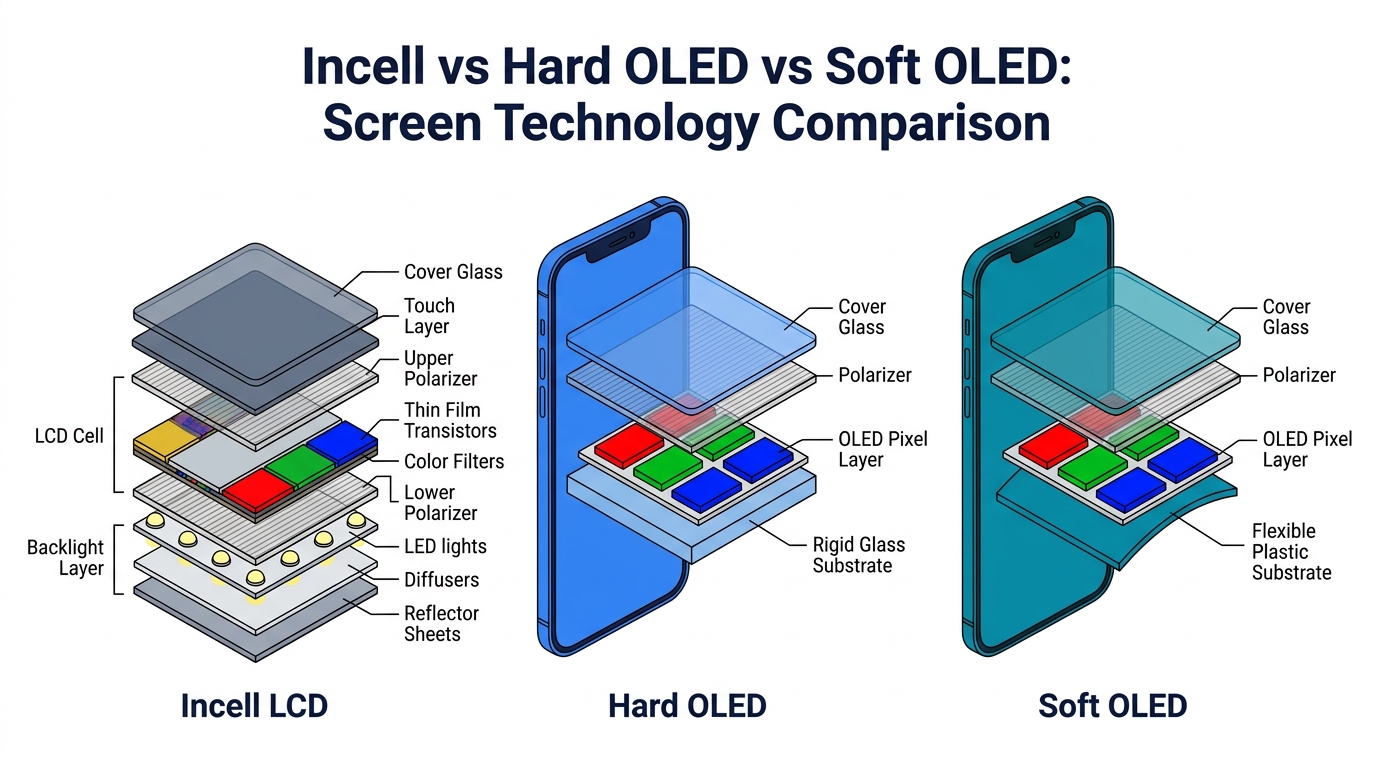
Incell LCD is the most affordable aftermarket option. The term "Incell" refers to the touch sensor layer being integrated inside the LCD panel itself, making the assembly thinner than traditional LCDs. For iPhones that originally shipped with OLED displays (iPhone X and later), an Incell screen is a technology downgrade — you're replacing an OLED panel with an LCD one.
What that means in practice: lower contrast ratio, no true blacks (the backlight is always on), slightly washed-out colors, and a visible difference in screen brightness. On an iPhone 11 or SE, which originally had LCD screens, an Incell replacement is a like-for-like swap. On an iPhone 12 or newer, your customer will likely notice the difference.
For a deeper look at how Incell compares to OLED in bulk buying scenarios, see our Soft OLED vs Hard OLED vs Incell comparison for bulk buyers.
Hard OLED
Hard OLED uses the same self-emitting pixel technology as the original iPhone display, but it's built on a rigid glass substrate instead of a flexible plastic one. This makes it cheaper to manufacture but also thicker and more fragile during installation.
The display quality is a significant step up from Incell: true blacks, higher contrast, and better color accuracy. Most customers won't notice the difference between a Hard OLED and the original screen in normal use. The trade-off is that the rigid glass makes it less resistant to drops — the panel can crack more easily on impact compared to Soft OLED.
Soft OLED
Soft OLED is built on a flexible plastic substrate, the same construction method used in original iPhone screens. This flexibility gives it two advantages: better shock absorption (the screen can bend slightly on impact instead of cracking) and a thinner profile that sits flush in the phone housing.
In terms of display quality, Soft OLED is the closest you'll get to the original without buying an OEM panel. Brightness, color accuracy, viewing angles, and touch responsiveness are all near-original. It's also the easiest to install because the flexible substrate is more forgiving during the fitting process. The downside? It costs roughly 40-60% more than Hard OLED.
OEM Original
OEM Original screens are either pulled from working devices or sourced as genuine manufacturer parts. They're identical to what the phone shipped with — same display quality, same True Tone support (on iPhones), same everything.
The catch is supply and price. Genuine OEM screens are scarce, expensive, and sometimes hard to verify as authentic. For most repair shops, OEM screens only make sense for high-end repairs where the customer specifically demands original parts and is willing to pay a premium.
Hard OLED vs Soft OLED vs Incell: Side-by-Side Comparison
Here's how the four grades stack up on the specs that actually matter to repair shops:
| Feature | Incell LCD | Hard OLED | Soft OLED | OEM Original |
|---|---|---|---|---|
| Display Technology | LCD with integrated touch | OLED on glass substrate | OLED on flexible substrate | Original OLED (flexible) |
| Contrast Ratio | ~1,500:1 | ~100,000:1 | ~100,000:1 | ~100,000:1+ |
| True Blacks | No (backlight always on) | Yes | Yes | Yes |
| Brightness | 60-70% of original | 80-85% of original | 90-95% of original | 100% |
| Color Accuracy | Noticeable shift, especially in dark scenes | Good, slight warm/cool shift possible | Near-original | Original |
| Touch Responsiveness | Good | Good | Excellent | Excellent |
| Thickness | Thin | Thicker than original | Same as original | Same as original |
| Drop Resistance | Moderate | Lower (rigid glass cracks) | Higher (flexible, absorbs shock) | Higher |
| Installation Difficulty | Easy | Moderate (rigid, less forgiving) | Easy (flexible) | Easy |
| True Tone Support | No (most models) | Varies by supplier | Varies by supplier | Yes |
| Wholesale Price (iPhone 13) | $8-12 | $15-22 | $25-38 | $45-70 |
| Typical Repair Charge | $45-65 | $65-90 | $85-120 | $120-180 |
Key takeaway: The jump from Incell to Hard OLED is the biggest quality leap. The jump from Hard OLED to Soft OLED is more subtle — it's mostly about durability, brightness, and that last 10-15% of display quality.
Which Grade Fits Which iPhone Model?
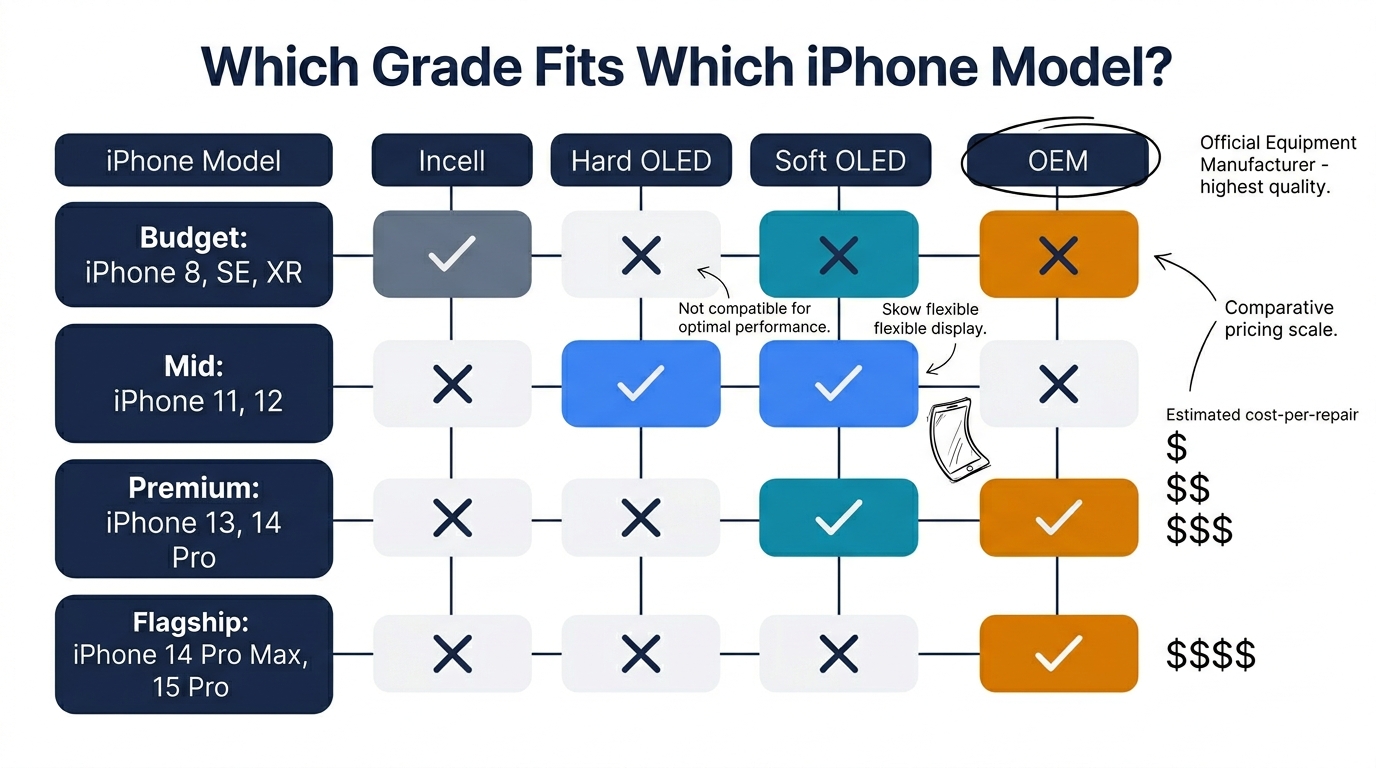
Not every iPhone needs the same screen grade. The right choice depends on the original display technology the phone shipped with and what your customers expect.
iPhones That Originally Had LCD Screens
iPhone 11, XR, SE (2nd/3rd gen)
These phones shipped with LCD displays, so an Incell LCD replacement is the natural match. Customers won't notice a quality difference because there isn't one — you're replacing LCD with LCD. Stocking Hard or Soft OLED for these models doesn't make economic sense unless the customer specifically requests an upgrade.
iPhones That Shipped With OLED
iPhone X, XS, 11 Pro, 12 series, 13 series, 14 series, 15 series
This is where grade selection gets strategic:
- Budget repairs / price-sensitive customers: Incell LCD works, but be transparent — tell the customer the screen quality will be lower than original. Some shops use Incell as their "economy" tier. It protects your margin on older models (iPhone X, XS) where the repair value is low anyway.
- Standard repairs / most customers: Hard OLED is the sweet spot. Most customers can't tell the difference from the original in daily use, and your parts cost stays 30-50% below Soft OLED. This is where the bulk of your profit sits for iPhone 12 and 13 repairs.
- Premium repairs / quality-conscious customers: Soft OLED is the right pick. Better brightness, better durability, and easier installation. Worth it for iPhone 14 and 15 repairs where the phone's residual value is higher and customers expect near-perfect results.
Which Grade to Stock by Model — Quick Reference
| iPhone Model | Budget Tier | Standard Tier | Premium Tier |
|---|---|---|---|
| iPhone X / XS | Incell | Hard OLED | Soft OLED |
| iPhone 11 | Incell (LCD match) | — | — |
| iPhone 11 Pro / Pro Max | Incell | Hard OLED | Soft OLED |
| iPhone 12 / 12 Pro | Incell | Hard OLED ★ | Soft OLED |
| iPhone 13 / 13 Pro | — | Hard OLED ★ | Soft OLED |
| iPhone 14 / 14 Pro | — | Hard OLED | Soft OLED ★ |
| iPhone 15 / 15 Pro | — | Hard OLED | Soft OLED ★ |
★ = Recommended default for that model
For the iPhone 12 and 13, Hard OLED hits the right balance of cost and quality. For the iPhone 14 and newer, Soft OLED is worth the extra cost because these customers have newer phones, higher expectations, and you're competing with Apple Store pricing.
For model-specific grade recommendations, check our detailed guides on iPhone 14 screen grades for repair shops and iPhone 15 screen grade selection.
Price, Cost, and Profit Margin Breakdown
Let's talk numbers. Here's how the math works for an iPhone 13 screen replacement — one of the highest-volume repair jobs in most shops:
| Grade | Wholesale Cost | Typical Repair Price | Gross Margin | Margin % |
|---|---|---|---|---|
| Incell LCD | $8-12 | $50-65 | $42-53 | ~82% |
| Hard OLED | $15-22 | $70-90 | $55-68 | ~78% |
| Soft OLED | $25-38 | $90-120 | $65-82 | ~72% |
| OEM Original | $45-70 | $130-180 | $85-110 | ~64% |
The counter-intuitive insight: Incell has the highest margin percentage, but Hard OLED and Soft OLED generate more absolute profit per repair. A shop doing 15 iPhone 13 screen repairs per week earns roughly $225 more per week by defaulting to Hard OLED instead of Incell — that's over $11,000 per year from one model alone.
Soft OLED pushes the absolute profit even higher, but you need customers willing to pay $90-120 for the repair. In markets where Apple Store pricing is the benchmark (like the US and UK), that's achievable. In price-sensitive markets, Hard OLED is the safer bet.
The Real Cost Factor: Callbacks and Returns
Cheap screens have hidden costs that don't show up on the invoice. From our experience supplying repair shops across 40+ countries, here's what we see:
- Incell on OLED phones: 8-12% callback rate within 30 days, mostly display complaints (dim screen, color shift, visible difference from original)
- Hard OLED: 3-5% callback rate, mostly related to brightness in direct sunlight
- Soft OLED: 1-3% callback rate, on par with OEM screens
Each callback costs you 30-60 minutes of labor plus potential parts replacement. At scale, a 5% difference in callback rate can easily wipe out the savings from buying cheaper screens.
Common Mistakes When Choosing Screen Grades
After working with thousands of repair shops, these are the patterns we see most often:
Mistake #1: Using only Incell for all repairs. Some shops buy exclusively Incell to maximize margin percentage. This works short-term but leads to customer complaints, negative reviews, and lost repeat business — especially on newer iPhone models where the quality gap is obvious.
Mistake #2: Buying Soft OLED for old models. Stocking Soft OLED for iPhone X or XS repairs doesn't make sense. The phone's residual value is too low — customers won't pay $100+ to repair a phone worth $120. Hard OLED or even Incell is the right call for aging models.
Mistake #3: Not offering tiered pricing. The most profitable repair shops give customers a choice: "We can do a standard repair for $70 or a premium repair for $95." This lets price-sensitive customers self-select while capturing higher margins from those who want the best. If you only offer one option, you're leaving money on the table.
Mistake #4: Ignoring supplier consistency. Two "Hard OLED" screens from different suppliers can vary wildly in quality. The grade name is just a starting point — what matters is the specific factory, the QC standards, and batch consistency. Always test samples before committing to a bulk order with a new supplier. Our guide on how to choose a reliable phone parts supplier covers what to look for in detail.
Mistake #5: Not understanding the OEM vs aftermarket distinction. Some suppliers label high-grade Soft OLED as "OEM quality" or "original quality," which muddies the waters. True OEM screens are manufacturer parts — aftermarket Soft OLED, even at its best, is still aftermarket. Know what you're buying and price accordingly. See our OEM vs aftermarket comparison for the full breakdown.
How to Start Stocking the Right Mix
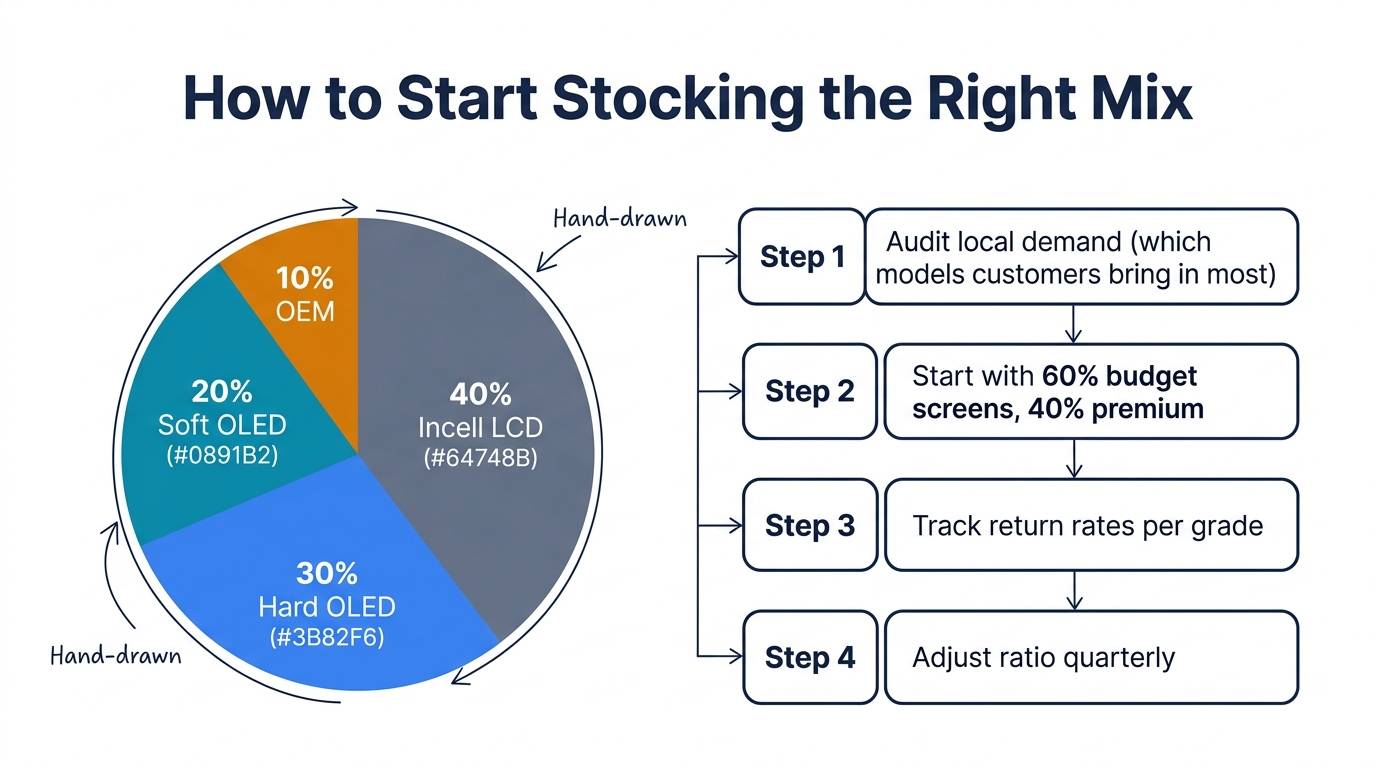
If you're currently buying only one screen grade, here's a practical starting plan:
- Audit your repair volume by model. Which iPhone models make up 80% of your screen repairs? That's where your stocking decisions matter most.
- Start with two tiers. For most shops, Hard OLED + Soft OLED covers 90% of OLED iPhone repairs. Add Incell only if you do significant volume on older models or serve a price-sensitive market.
- Order samples first. Before committing to a 100-unit bulk order, get 5-10 units of each grade from your supplier. Install them, test them, and see the quality yourself.
- Track callbacks by grade. After 30 days, compare return rates between grades. This data will tell you where the real cost-quality sweet spot is for your specific market.
FAQ
Which is better: Hard OLED or Soft OLED?
Soft OLED is objectively better in display quality, durability, and installation ease. But "better" depends on your use case. For iPhone 12 and 13 repairs, Hard OLED offers 80-85% of Soft OLED's quality at 40-60% of the cost. For iPhone 14 and 15 repairs, Soft OLED is worth the premium because customers with newer phones expect near-original quality.
Does Apple use Hard OLED or Soft OLED?
Apple uses Soft OLED (flexible OLED) in all iPhone models from the iPhone X onward. The original panels are manufactured by Samsung Display and LG Display on flexible plastic substrates. Hard OLED is strictly an aftermarket product — Apple has never used rigid glass substrate OLED in any iPhone.
Can customers tell the difference between Incell and OLED?
Yes, on OLED iPhones the difference is visible. Incell LCD screens lack true blacks — dark scenes look gray instead of black, and overall brightness is noticeably lower. Most customers won't know the technical reason, but they'll sense something is "off" compared to their original screen. On LCD iPhones (iPhone 11, XR, SE), Incell is a like-for-like replacement and customers won't notice any difference.
Is Hard OLED safe to use for professional repairs?
Yes. Hard OLED is a legitimate aftermarket grade used by thousands of repair shops worldwide. The main consideration is that the rigid glass substrate is less forgiving during installation — you need to be careful not to apply excessive pressure. Quality also varies by manufacturer, so source from suppliers who test each batch and can provide consistent defect rates below 2%.
What does "Incell" actually mean?
Incell refers to the manufacturing method where the touch sensor layer is integrated directly into the LCD panel, rather than being a separate layer bonded on top. This makes the display thinner and cheaper to produce. In the aftermarket repair market, "Incell" has become shorthand for an LCD-based replacement screen for iPhones that originally had OLED displays.
Make Smarter Screen Purchasing Decisions
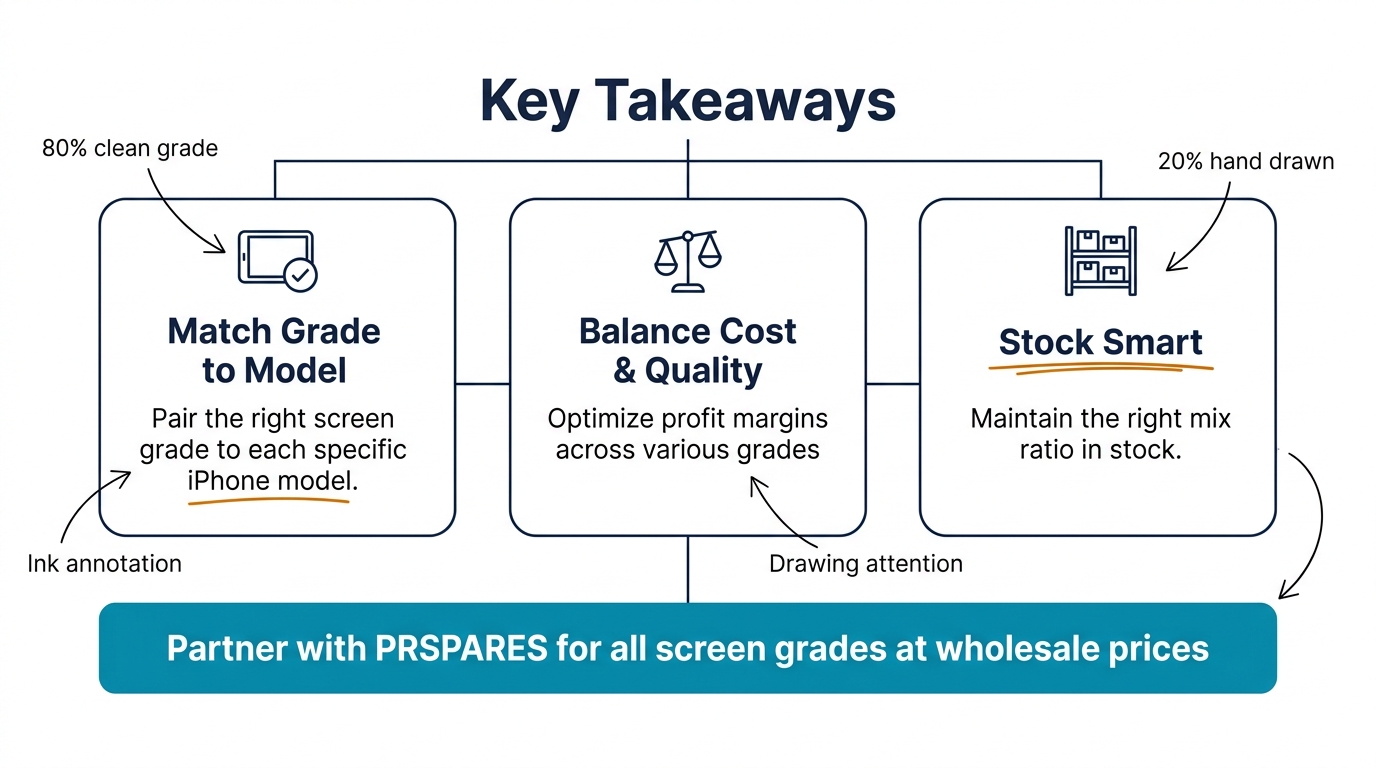
The right screen grade isn't about buying the cheapest or the most expensive option — it's about matching the grade to the repair job, the customer's expectations, and your target margin.
For most repair shops, the winning strategy is a two-tier approach: Hard OLED as your standard option for iPhone 12/13 repairs, and Soft OLED as your premium option for iPhone 14/15 and quality-conscious customers. Add Incell for budget repairs and LCD-model iPhones if your market demands it.
If you're comparing screen grades from different suppliers and want to see the quality difference firsthand, we can send you test samples of each grade. We supply Incell, Hard OLED, and Soft OLED screens for all major iPhone and Samsung models with MOQs starting at 10 units for mixed orders — browse the wholesale screen catalog or see pricing, grades and MOQ details.