

INCELL vs Soft OLED vs Hard OLED: Real Cost & Margin Analysis for Repair Shops
The incell vs OLED cost debate comes down to one question: which screen grade makes you the most money per completed repair? You stock three grades of iPhone screens. Incell gives you 80% margins — but on Pro models, 31% of customers come back within 90 days wanting an upgrade. Hard OLED looks like the middle ground until you learn it breaks "like crackers" on drops. Soft OLED costs 3x more but keeps customers coming back.
This article gives you the actual wholesale cost, margin math, and defect data to build a stocking strategy that maximizes profit per repair — not just profit per screen. If you want the technical differences between these three screen types, read our Incell vs Hard OLED vs Soft OLED buying guide first. This article is about the money.
Buying Phone Batteries Wholesale?
OEM-cell batteries with safety packaging — iPhone, Samsung & more, factory-direct.
Get Wholesale Quote30-Second Tech Recap: Why the Price Gap Exists
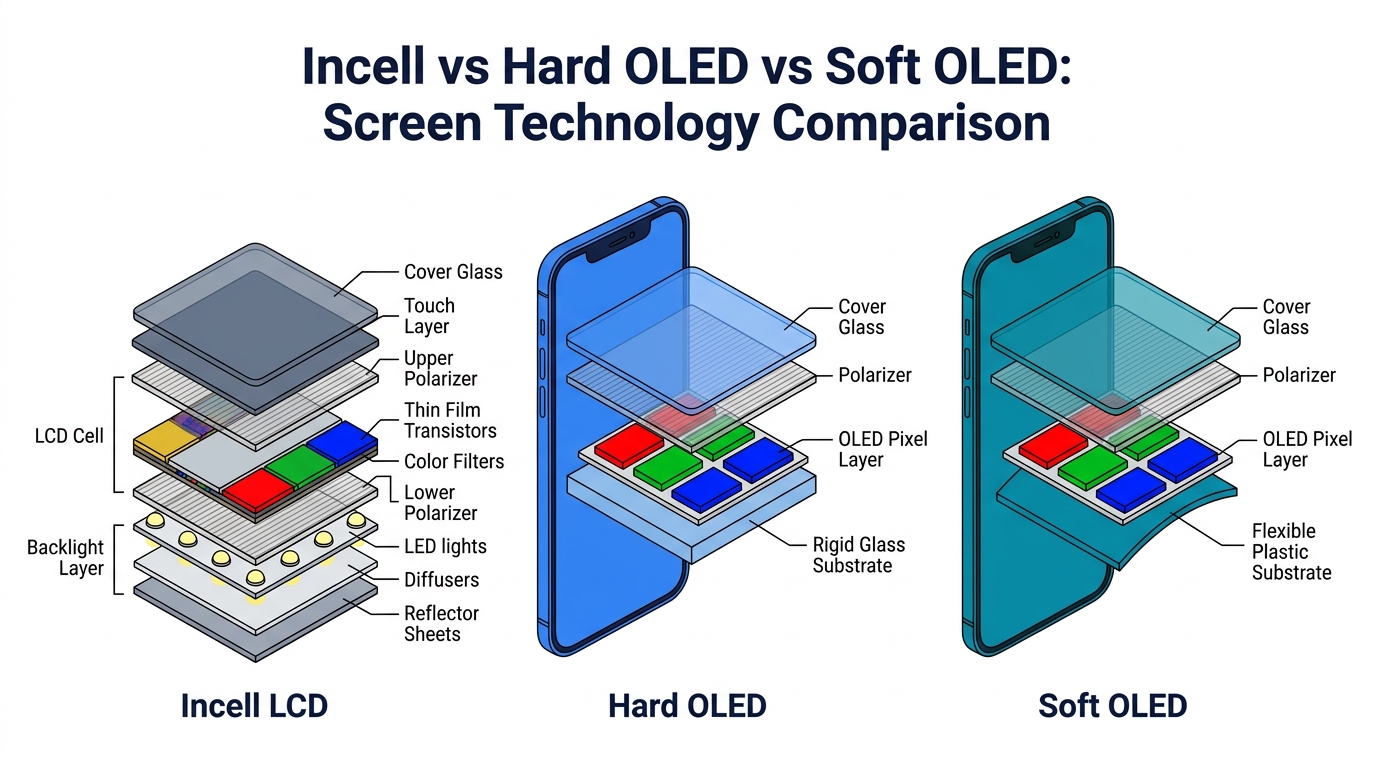
The price difference between these three grades comes from how the display panel is built.
Incell LCD uses a backlight behind liquid crystals. It's the same fundamental technology as original iPhone 8 and earlier screens, repurposed as an aftermarket option for OLED-era iPhones. It's cheap to manufacture, but on phones designed for OLED, the backlight draws more power than the original display. One tech on r/mobilerepair documented his iPhone 12 Pro Max dropping from 94% to 76% battery health in seven months after installing an Incell screen.
Hard OLED puts self-emitting OLED pixels on a rigid glass substrate. True blacks, good color — but the glass substrate cracks easily on impact. The drop test pass rate is 65% compared to Soft OLED's 85%.
Soft OLED uses the same flexible plastic substrate as Apple's original screens. Closest to OEM quality, highest durability, lowest return rate. It's also the most expensive aftermarket option.
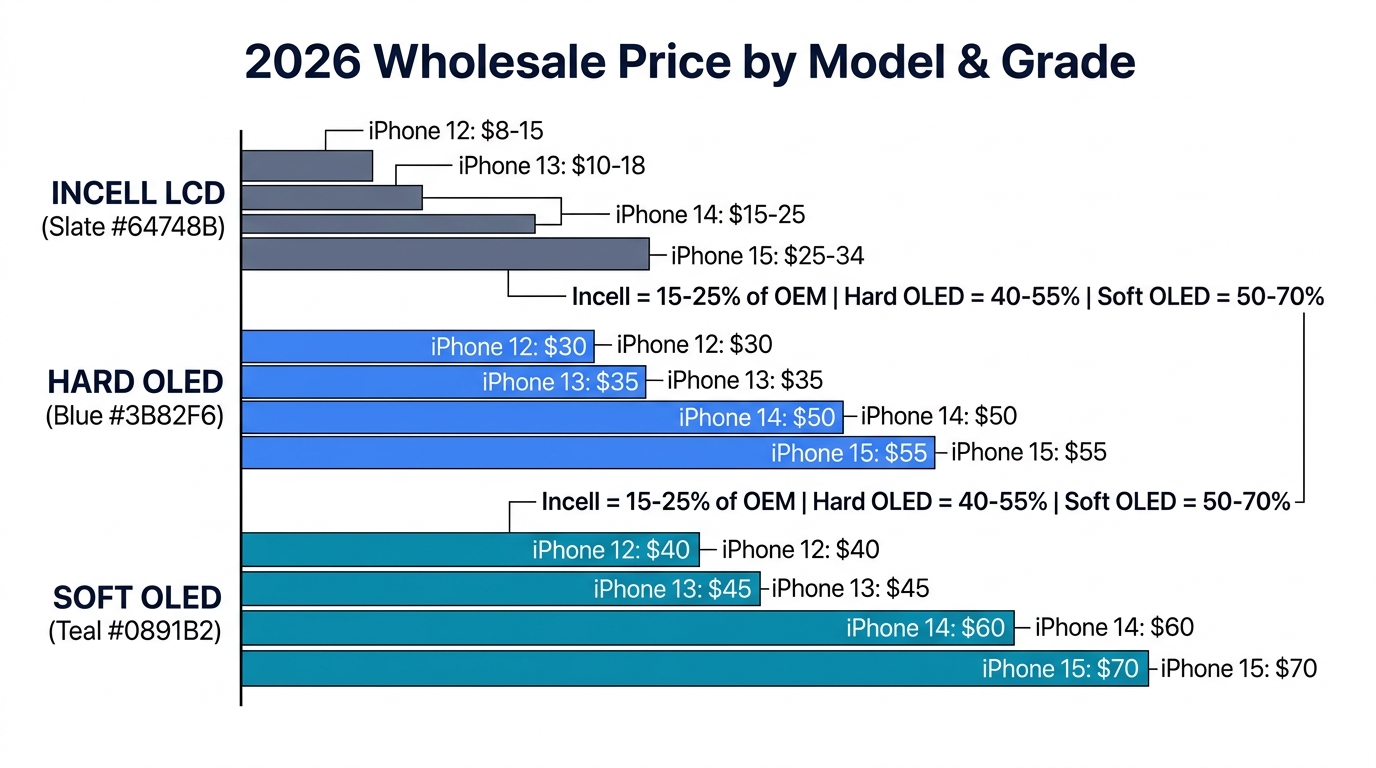
Incell vs OLED Cost: What Each Grade Actually Costs You (2026 Wholesale)
Here's what you're paying per unit at B2B wholesale, based on US distributor pricing and Alibaba direct.
| Model | Incell LCD | Hard OLED | Soft OLED | OEM/Original |
|---|---|---|---|---|
| iPhone 12 | $8–15 | ~$30 | ~$40 | $65–80 |
| iPhone 13 | $10–18 | ~$35 | ~$45 | $70–90 |
| iPhone 14 | $15–25 | ~$50 | ~$60 | $90–120 |
| iPhone 14 Pro Max | $20–30 | ~$113 | ~$124 | $140–170 |
| iPhone 15 | $25–34 | ~$55 | ~$70 | $100–130 |
| iPhone 15 Pro Max | $28–38 | ~$100 | ~$130 | $170+ |
Sources: irepart.com and MobileSentrix for US pricing; Alibaba seller blog for China-direct (Soft $123.99 vs Hard $112.99 on iPhone 14 Pro Max). Prices fluctuate with exchange rates and MOQ.
The pattern: Incell runs 15–25% of OEM cost. Hard OLED sits at 40–55%. Soft OLED lands at 50–70%. The gap widens on Pro Max models where OEM screens are more expensive to source.
Note on Pro Max Incell: yes, it exists — MobileSentrix lists it. But it lacks ProMotion 120Hz support, and customer complaints on Pro models are significantly higher. More on that below.
What Your Margins Actually Look Like
Raw margin percentages don't tell the full story. Here's the math for a typical mid-range model (iPhone 13/14).
| Grade | Wholesale | You Charge | Gross Margin |
|---|---|---|---|
| Incell LCD | $15 | $80 | 81% |
| Hard OLED | $40 | $130 | 69% |
| Soft OLED | $50 | $170 | 71% |
Incell wins on percentage margin by a wide gap. But that's only the first calculation.
Pro Max models flip the equation. Hard OLED at ~$113 sold at $170 gives you 34% margin. Soft OLED at ~$124 sold at $200 gives you 38%. Incell at ~$25 sold at $90 gives you 72% — but that's before accounting for the hidden costs.
The Hidden Costs That Eat Your Margins
Return rates from 18,000 installations
Data from a PRSPARES network study across 150 repair shops tracking iPhone 13 screen replacements:
| Grade | RMA Rate | Customer Satisfaction |
|---|---|---|
| Incell LCD | 4.0% | — |
| Hard OLED | 2.2% | 7.5/10 |
| Soft OLED | 0.7–1.1% | 8.3–8.8/10 |
The Incell-to-Hard OLED gap is only 1.8 percentage points. But Soft OLED's sub-1% RMA rate is in a different league — your warranty rework on 100 Soft OLED installs is roughly one callback. On 100 Incell installs, it's four.
Each callback costs you 20–30 minutes of bench time, a replacement screen, and a customer who's now skeptical. At $30/hour labor, four callbacks per 100 installs adds ~$60–$80 in hidden cost.
The Pro model problem
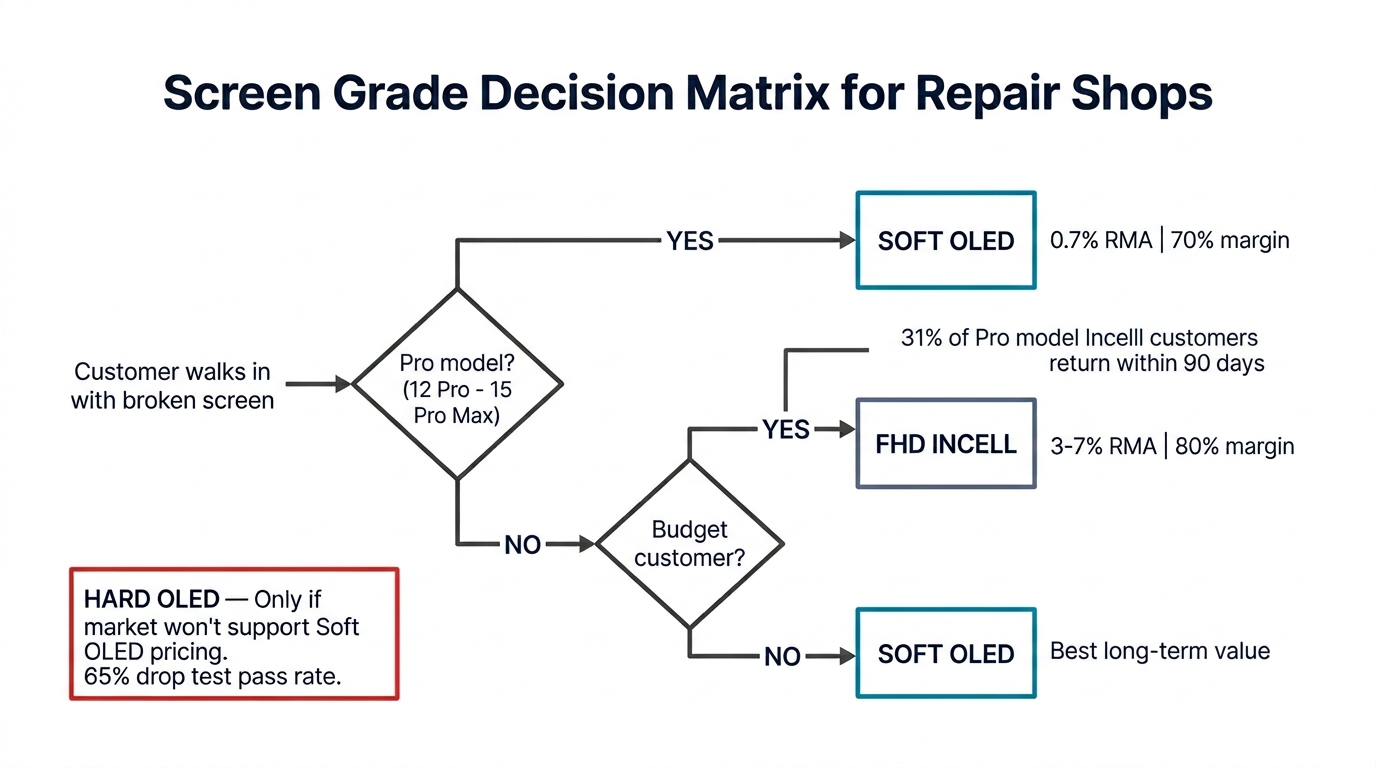
A separate PRSPARES study of 10,000+ iPhone 14 Pro Max replacements found that 31% of customers who received an Incell screen returned within 90 days requesting an upgrade. Not a defect return — a dissatisfaction return. These customers notice the missing ProMotion, the dim blacks, the battery drain. They come back wanting OLED.
That 31% stat is specific to iPhone 14 Pro Max — don't extrapolate it to all models. On non-Pro iPhones without 120Hz, the difference is less noticeable and customer complaints are lower.
Battery drain: the sleeper issue
The top comment on r/mobilerepair's "DO NOT USE INCELL" thread (86 upvotes) explains it clearly: "The LCD backlight draws more power than an OLED so it destroys the battery if the phone wasn't built for LCD in the first place."
This is the complaint that generates the most customer anger — not color or brightness, but "my battery life is terrible since you fixed my screen." Aftermarket screens in general can draw up to 20% more power than originals, but the gap is largest with Incell on OLED-designed phones.
Counter-point: one tech reports running an Incell on a 13 Pro Max for three years with 85% battery health. Results vary by usage pattern and screen quality tier (FHD Incell performs significantly better than HD Incell).
Choosing screen grades for your next order? We stock Incell, Hard OLED, and Soft OLED across the full iPhone lineup — wholesale, with per-model pricing. Request a quote and tell us your typical model mix.
Which Grade for Which Customer
Stop thinking about "best screen" and start thinking about "best screen for this repair."
Budget / non-Pro models → FHD Incell
For iPhone 12, 13, 14 (non-Pro) customers who want the cheapest fix, FHD Incell is defensible. The key: use FHD tier, not HD. HD Incell failure rates run 7–12% compared to FHD's 3–7%. The $1/unit price difference pays for itself in avoided callbacks.
Always disclose. Tell the customer: "This is an LCD screen, not OLED. Colors will be slightly different and battery may drain faster. It works, but it's not original quality." Shops that pass off Incell as OLED are the ones generating the angry Reddit posts — and exposing themselves to deceptive trade practice claims under state consumer protection laws.
Pro models / quality-conscious customers → Soft OLED
For iPhone 12 Pro through 15 Pro Max, Soft OLED is the rational stocking choice. The 31% upgrade-return rate on Pro Incell installs means your effective cost per completed repair is higher than it looks on paper. A $25 Incell that turns into a $25 Incell + a $50 Soft OLED replacement + 30 minutes of rework labor is not a $25 repair — it's a $105 repair with an unhappy customer.
The Hard OLED question
Hard OLED looks like the logical middle ground. It's OLED technology at a lower price than Soft. But the 2.2% RMA rate and 7.5/10 satisfaction score put it closer to Incell than to Soft OLED in real-world outcomes. The rigid glass substrate is the problem — customers who drop their phone (the reason they needed a screen replacement in the first place) crack the Hard OLED again.
Hard OLED makes sense in one scenario: high-volume shops serving extremely price-sensitive markets where Soft OLED pricing would push your retail price above what customers will pay. Otherwise, the durability gap makes it a liability.
How to Verify Screen Grades on Delivery
Suppliers occasionally ship the wrong grade. Here's how to check before installing.
Incell vs OLED: Display a fully black image. Incell will show a dark gray glow (backlight). OLED shows true black (pixels off). In a dark room, the difference is unmistakable.
Hard vs Soft OLED: Gently flex the screen. Soft OLED bends without resistance — it's built on plastic. Hard OLED resists and feels rigid like glass, because it is. Also check the chin bezel — Hard OLED typically has a slightly wider bottom bezel.
Push test: Apply light pressure to the display surface. LCD screens produce a rainbow discoloration pattern; OLED screens show no color change.
FAQ
Is Incell LCD bad for iPhones with OLED screens?
Not inherently bad — it works. But on OLED-designed phones, the LCD backlight draws more power than the original display, leading to faster battery drain and potential overheating. FHD-grade Incell performs significantly better than HD grade. The biggest issue isn't the technology itself — it's shops installing Incell without telling the customer, which creates trust problems when they notice the difference.
Does Hard OLED cause battery drain like Incell?
Hard OLED draws slightly more power than Soft OLED due to the rigid substrate's lower efficiency, but the difference is much smaller than the Incell-to-OLED gap. One tech documented battery drain on a Hard OLED iPhone 12 replacement, but this is less common than with Incell.
Which aftermarket screen grade is closest to Apple original?
Soft OLED. It uses the same flexible plastic substrate as Apple's genuine screens, achieves 90–97% of OEM color accuracy, and has the lowest defect rate (0.7–1.1%). The only screen closer to original is a refurbished genuine Apple display.
Can customers tell the difference between Incell and OLED?
Most customers notice immediately. The blacks are gray instead of true black, the colors are less vibrant, and the screen may feel slightly less responsive. On Pro models with ProMotion, the missing 120Hz refresh rate makes scrolling feel noticeably different. Some customers don't care — but you should always disclose before installation, not after.
Build Your Screen Inventory Around Margins, Not Markups
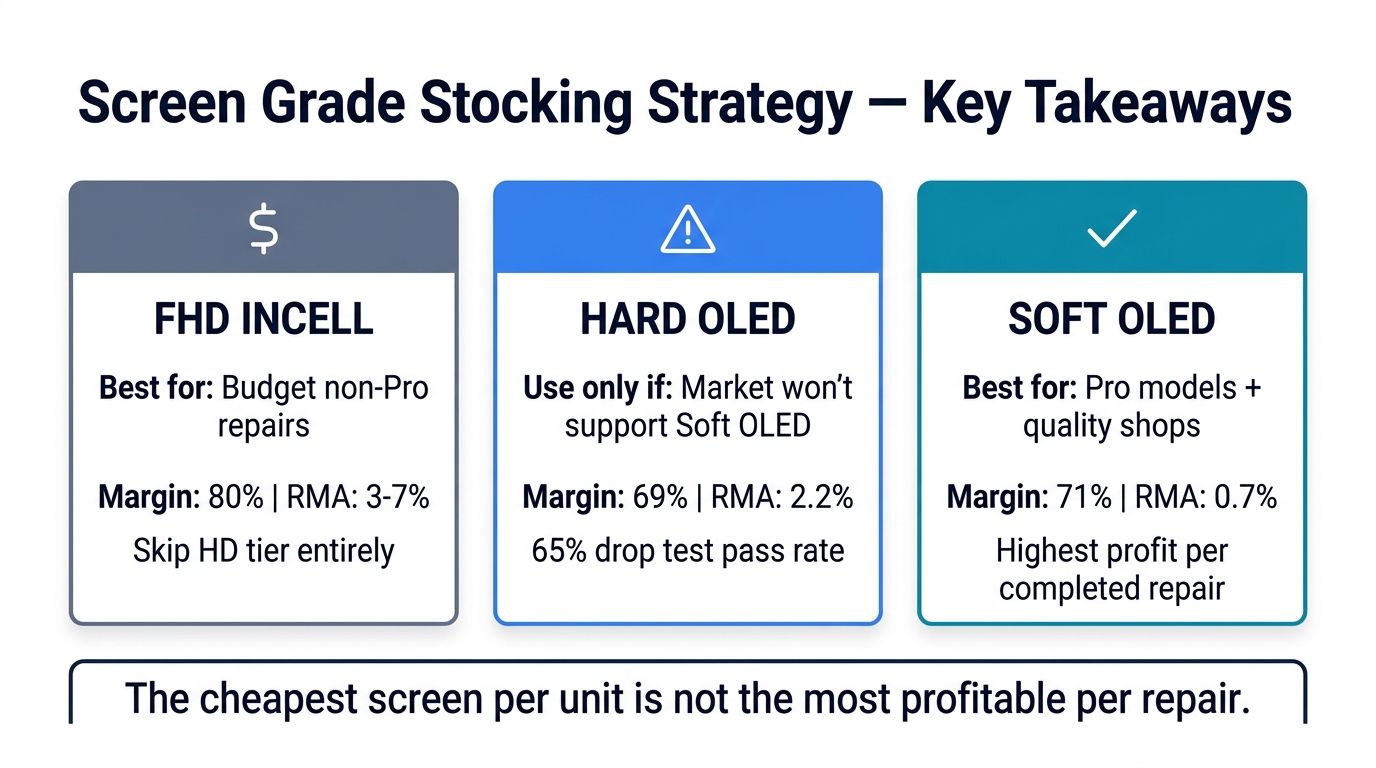
The screen grade that looks cheapest per unit isn't always the most profitable per repair. Incell at $15 with an 80% gross margin looks great until four out of every hundred come back as warranty claims or upgrade requests. Soft OLED at $50 with a 70% margin and sub-1% returns actually nets you more per completed repair over the quarter.
The smart stocking strategy for most shops: Soft OLED for Pro models, FHD Incell for budget non-Pro repairs, and Hard OLED only if your market won't support Soft OLED pricing. Skip HD Incell entirely — the failure rates aren't worth the $1/unit savings.
We supply all three grades across the full iPhone lineup, with model-specific pricing and per-batch QC data. Request wholesale pricing or browse our screen catalog to see what's in stock.