
iPhone 11 Screen Replacement in 2026: Is It Still Worth Repairing?
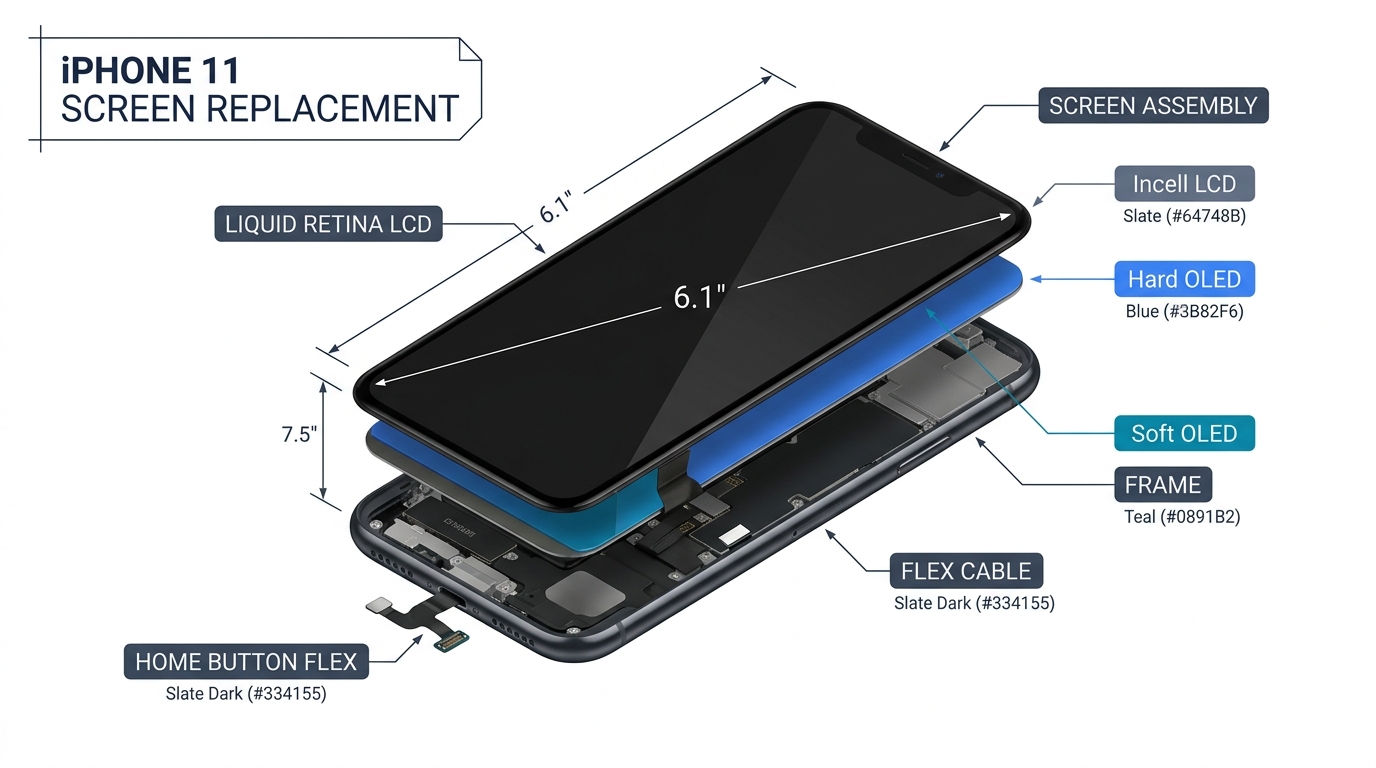
The iPhone 11 is seven years old. It launched in September 2019, and in 2026 it's still one of the most repaired phones in any shop — but it's also the model where the "is it worth fixing?" question gets asked most often. At seven years old, the phone is approaching the end of its practical life cycle, and spending money on a screen replacement only makes sense if the numbers work.
Here's what makes the iPhone 11 screen replacement decision different from newer models: the original display is an LCD, not OLED. That means the cheapest aftermarket screen (Incell LCD) actually matches the original display technology — while OLED upgrades are available for customers who want better display quality than Apple originally shipped. This changes the grade selection logic entirely compared to iPhone 12 and newer.
This guide covers the real cost breakdown, the phone's current residual value, which screen grade makes sense for different situations, and where the repair margins sit for shops still servicing iPhone 11s in 2026.
Sourcing Replacement Screens in Bulk?
Incell / Hard OLED / Soft OLED grades — wholesale pricing, grade comparison on request.
Get Wholesale QuoteHow Much Does iPhone 11 Screen Replacement Cost in 2026?
The iPhone 11 screen replacement cost varies by more than 10x depending on where and how the repair happens.
| Repair Channel | Cost Range | Screen Type Used | Warranty |
|---|---|---|---|
| Apple (Out-of-Warranty) | $199 / £169 | OEM Original LCD | 90 days |
| Apple (AppleCare+) | $29 / £25 | OEM Original LCD | AppleCare term |
| Third-Party Shop (Premium) | $100–$160 | Soft OLED / Hard OLED | 30–180 days |
| Third-Party Shop (Budget) | $50–$90 | Incell LCD | 30–90 days |
| DIY (iFixit Kit) | $65 | LCD | Lifetime (iFixit) |
| DIY (Amazon/AliExpress) | $15–$35 | Incell LCD | Varies |
Apple charges $199 in the US for an out-of-warranty iPhone 11 screen replacement — significantly less than the $279 they charge for iPhone 13, because the iPhone 11 uses a cheaper LCD panel rather than OLED. In the UK, Apple charges £169.
Third-party repair shops typically charge $50–$160 depending on screen grade and location. Budget shops using Incell LCD can price as low as $50–$70 and still maintain healthy margins because the wholesale screen cost is remarkably low for this model.
For a full breakdown of screen replacement costs across all iPhone models, see our iPhone screen replacement cost guide.
iPhone 11 Screen Grades: LCD Original vs OLED Upgrade
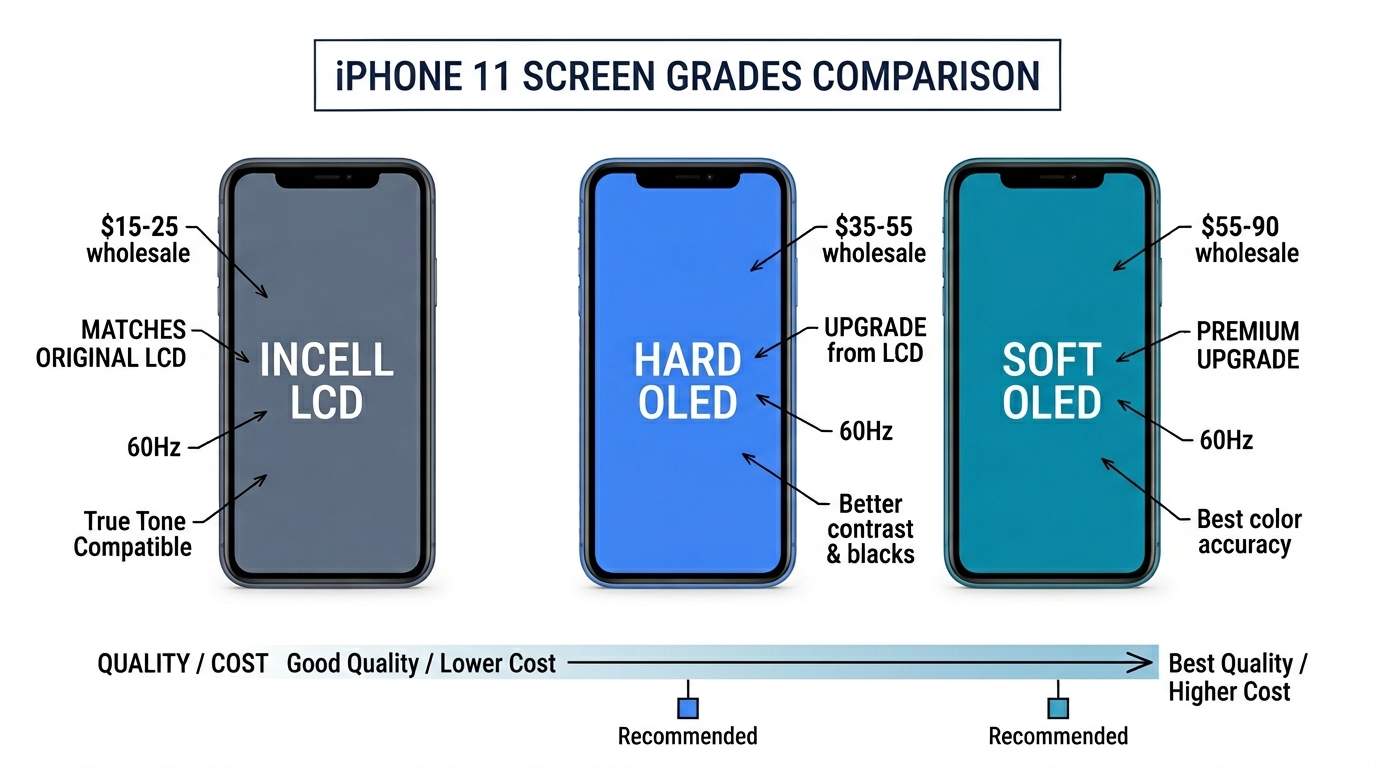
Here's the critical difference between the iPhone 11 and every iPhone from the 12 onwards: the iPhone 11 shipped with a Liquid Retina LCD display, not OLED. This means the grade selection logic is fundamentally different.
Incell LCD — Matches the Original
Incell LCD is the standard aftermarket replacement for the iPhone 11. Because the original screen was LCD, an Incell replacement is the closest match to what Apple put in the phone. Wholesale cost runs $8–$15 per unit in bulk.
Display quality is comparable to the original: similar colour temperature, similar contrast ratio, similar brightness. An Incell screen in an iPhone 11 looks natural because the phone was designed around LCD technology. There's no "downgrade feeling" like you get when putting an Incell in an iPhone 12 or 13 that originally had OLED.
Best for: Most iPhone 11 repairs. Budget customers. Any customer who just wants their phone back to how it was.
Hard OLED — The Mid-Tier Upgrade
Hard OLED screens give the iPhone 11 a display upgrade it never had from the factory. The OLED panel delivers true blacks, higher contrast, and more vivid colours than the original LCD. Wholesale cost is $25–$40 per unit.
This is a genuine upgrade path. Customers who've used newer iPhones and gotten used to OLED displays sometimes ask for a "better screen" when repairing their iPhone 11. Hard OLED delivers that improvement at a reasonable cost.
Best for: Customers who want a display upgrade. Shops that want to offer a "premium" tier on iPhone 11 repairs. Customers who plan to keep the phone for another 1–2 years.
Soft OLED — The Premium Upgrade
Soft OLED uses a flexible plastic substrate and delivers the best display quality available for the iPhone 11 — significantly better than the phone's original LCD. Wholesale cost is $35–$55 per unit.
In practice, this puts an iPhone 12-quality display in an iPhone 11 body. The difference from the original LCD is immediately visible: deeper blacks, wider colour gamut, better sunlight readability. For an iPhone 11 owner who doesn't want to upgrade their phone but does want a better screen, this is the option.
Best for: Premium repairs on well-maintained iPhone 11s. Customers keeping the phone long-term. Shops offering "upgrade your display" as a value-add service.
Grade Comparison Table
| Screen Grade | Wholesale Cost | vs Original Display | True Blacks | Best For |
|---|---|---|---|---|
| Incell LCD | $8–$15 | Matches original | No | Budget repairs, standard replacement |
| Hard OLED | $25–$40 | Upgrade | Yes | Mid-tier, customers wanting better display |
| Soft OLED | $35–$55 | Significant upgrade | Yes | Premium repairs, long-term keepers |
| OEM Original | $80–$120 | Identical | No (LCD) | OEM-spec restoration |
For a detailed comparison of these screen technologies and their trade-offs, see our Soft OLED vs Hard OLED vs Incell guide.
Is the iPhone 11 Still Worth Repairing? The Real Numbers
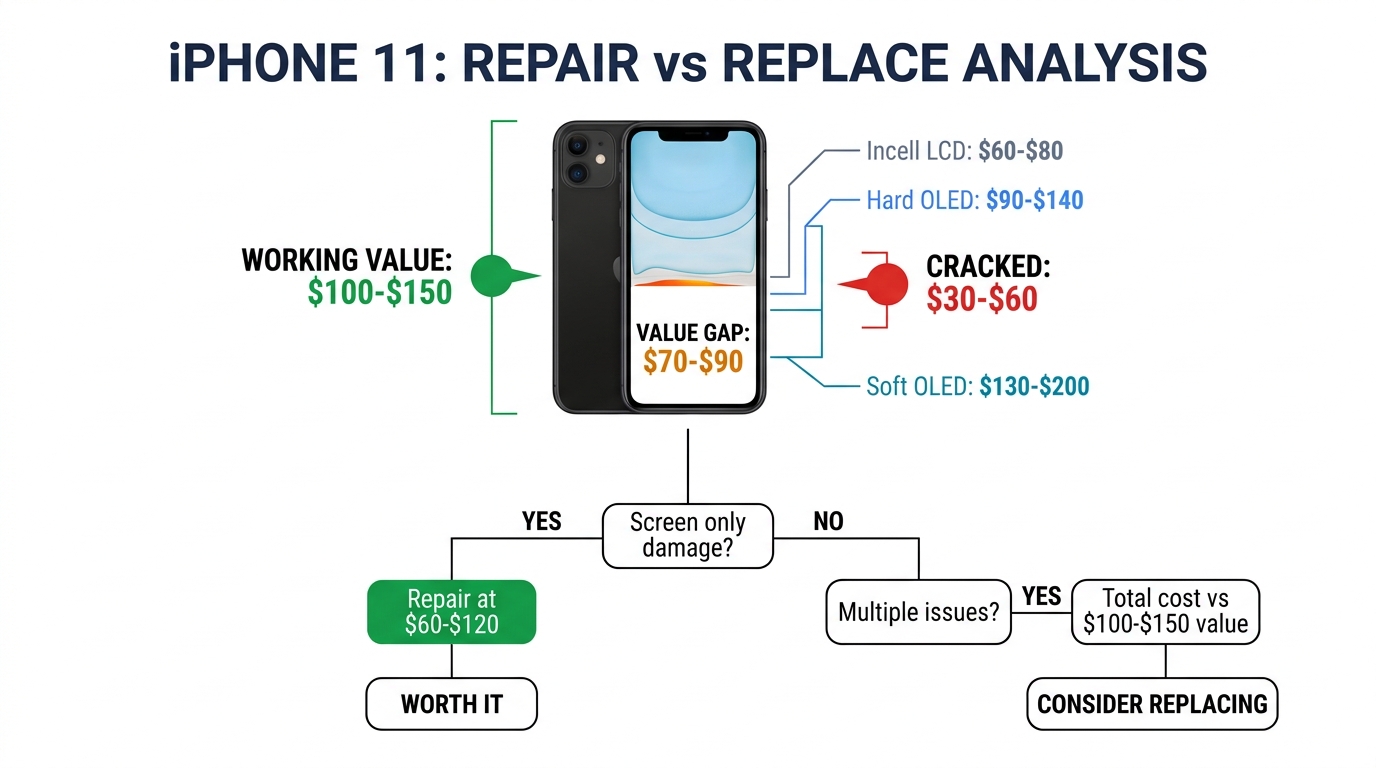
This is where the calculation gets tighter than for newer models. The iPhone 11's residual value is lower, so the repair cost needs to be low enough to justify the fix.
iPhone 11 Residual Value in 2026
As of early 2026, a used iPhone 11 (64GB, good condition) sells for approximately:
- Trade-in to Apple: $80
- Resale (Swappa/eBay): $100–$150
- Trade-in (carrier programs): $60–$100
- Cracked screen condition: $30–$60
A working iPhone 11 is worth $100–$150. A cracked one drops to $30–$60. That $70–$90 gap is what makes or breaks the repair decision — the repair cost needs to be comfortably below that gap.
The Repair vs. Replace Calculation
| Scenario | Cost | Outcome |
|---|---|---|
| Repair at Apple | $199 | Same phone, OEM screen — doesn't make financial sense |
| Repair at shop (Incell LCD) | $50–$90 | Same phone, original-quality screen — makes sense |
| Repair at shop (Hard OLED) | $80–$120 | Same phone, upgraded screen — makes sense if under $100 |
| DIY (Amazon Incell) | $15–$35 | Same phone, budget screen — cheapest option |
| Sell cracked + buy used iPhone 13 | $200–$300 net | Newer phone, OLED display, 5G |
Apple's $199 repair doesn't make financial sense for iPhone 11 in 2026. The repair costs more than the phone is worth. But third-party Incell LCD repairs at $50–$90 absolutely make sense — the repair cost is well below the phone's post-repair value.
The break-even point: iPhone 11 screen replacement stops making financial sense when the repair cost exceeds about $100. Below that, repair wins. Above that, the customer should consider whether putting $100+ into a 7-year-old phone makes more sense than putting that money toward a newer model.
When It Still Makes Sense to Repair
Even at seven years old, there are clear scenarios where iPhone 11 screen replacement is the right call:
- The phone still works perfectly otherwise. Battery health above 80%, no other issues, iOS 18 runs fine — why replace a working phone?
- The owner doesn't need 5G or new features. For calls, messaging, social media, and basic apps, the iPhone 11 does everything most people need.
- It's a secondary or family device. Kids' phones, backup phones, and business phones don't need to be the latest model.
- Budget is the priority. A $60 screen repair is dramatically cheaper than any replacement phone.
When Replacement Makes More Sense
- Battery health is below 75%. A screen repair plus battery replacement pushes total cost to $80–$130, getting close to the phone's total value.
- Other issues exist. Charging port problems, speaker issues, or camera defects stack up. Multiple repairs on a 7-year-old phone rarely make economic sense.
- The customer wants 5G. The iPhone 11 doesn't support 5G. If the customer's carrier is phasing out 4G LTE or they need faster data, repair just delays an inevitable upgrade.
iPhone 11 Screen Replacement Margins for Repair Shops
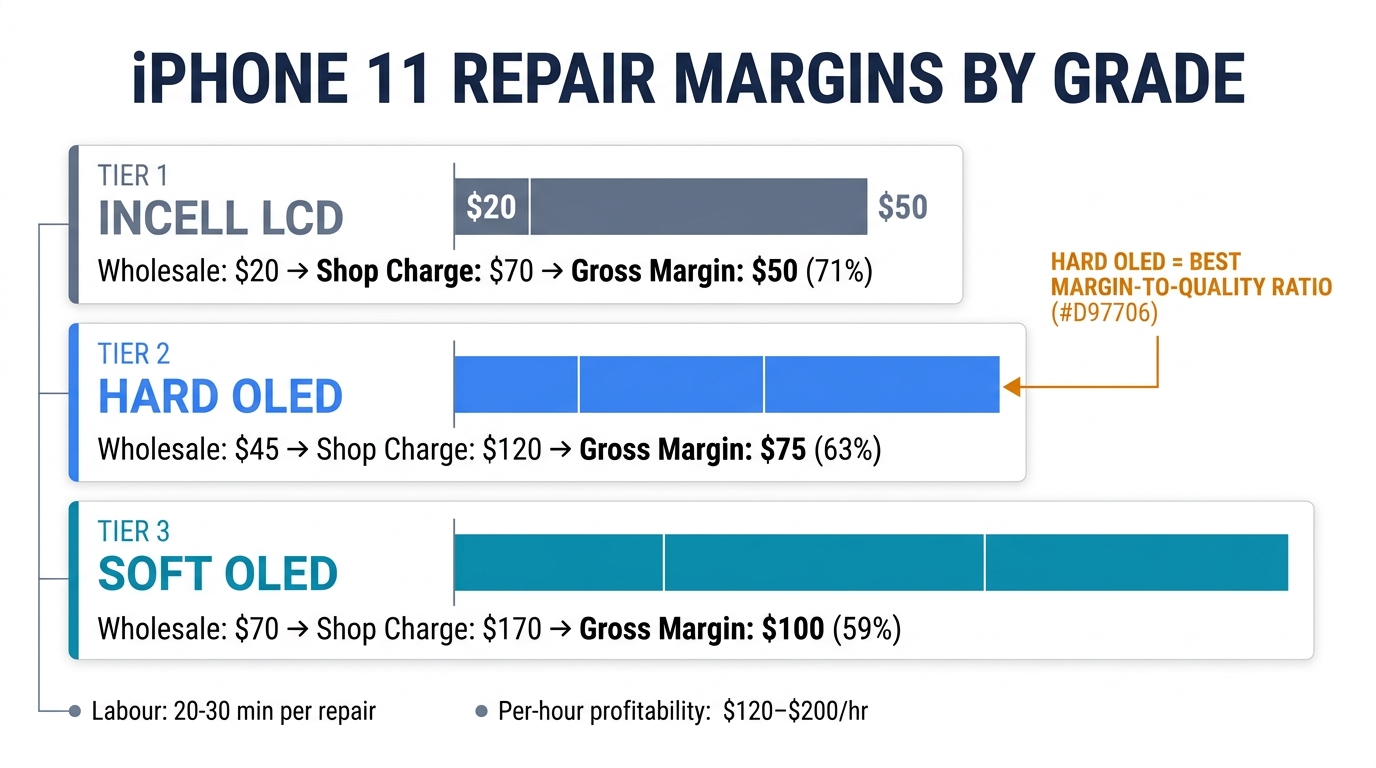
For repair shops, iPhone 11 screen repairs are among the highest-margin jobs in the shop — the screen costs are the lowest of any actively serviced iPhone model.
Margin Analysis by Grade
| Screen Grade | Wholesale Cost | Typical Charge (US) | Gross Margin | Margin % |
|---|---|---|---|---|
| Incell LCD | $10 | $65 | $55 | 85% |
| Hard OLED | $30 | $99 | $69 | 70% |
| Soft OLED | $45 | $139 | $94 | 68% |
UK Market
| Screen Grade | Wholesale Cost | Typical Charge (UK) | Gross Margin | Margin % |
|---|---|---|---|---|
| Incell LCD | £8 | £49 | £41 | 84% |
| Hard OLED | £25 | £79 | £54 | 68% |
| Soft OLED | £38 | £109 | £71 | 65% |
The iPhone 11 Incell repair is arguably the most profitable screen job in any shop. The wholesale screen cost of $8–$15 is the cheapest of any current iPhone model, and customers still pay $50–$70 for the repair. At 85% gross margin on parts, even a high-volume, low-price shop makes solid money.
The OLED upgrade tiers are interesting because they let shops offer something most competitors don't: a display upgrade on a budget phone. Charging $99–$139 for an OLED-upgraded iPhone 11 is an easy sell when the customer's alternative is spending $400+ on a newer phone.
Stocking iPhone 11 screens? We supply Incell LCD, Hard OLED, and Soft OLED screens for the iPhone 11 at wholesale pricing. The iPhone 11 Incell is one of our highest-volume, lowest-cost SKUs. Request a quote to see bulk pricing and sample options.
For more on how to structure repair pricing by screen grade, see our phone screen repair pricing strategy guide.
The iPhone 11 Repair Lifecycle: Where We Are in 2026
Understanding where the iPhone 11 sits in its repair lifecycle helps shops decide how much inventory to hold.
Peak repair volume (2021–2023): The iPhone 11 was the most-repaired model in most shops during this period. AppleCare+ coverage had expired for most units, and the phone was still the daily driver for millions of users.
High-volume phase (2024–2025): Repair volume remained strong as phones aged into their 4th and 5th years. Battery replacements became common alongside screen repairs.
Declining but significant phase (2026): Volume is dropping as owners upgrade to newer models. But search data still shows 6,600–9,900 monthly searches for "iPhone 11 screen replacement" in the US alone — proving significant demand remains. The phone still runs iOS 18 and receives security updates.
For inventory planning: Don't overstock iPhone 11 screens, but keep 3–5 Incell units on hand for walk-in demand. Order OLED grades on-demand unless you have consistent premium repair volume for this model. For a broader inventory strategy, see our small repair shop stock guide.
Common iPhone 11 Screen Replacement Mistakes
Not Offering an OLED Upgrade Option
Most shops default to Incell LCD for iPhone 11 because the original was LCD. But offering a Hard OLED or Soft OLED upgrade is a straightforward upsell that adds $30–$50 to the ticket. The customer gets a better screen than Apple ever put in the phone, and the shop earns more margin. At least mention the option — many customers don't know it exists.
Ignoring Battery Health During Screen Repair
An iPhone 11 coming in for a screen repair in 2026 almost certainly has degraded battery health. Check it and offer a battery replacement while the phone is open. The incremental labour is minimal (the phone is already disassembled), and a $5–$8 battery adds $30–$50 in revenue. For battery quality guidance, see our iPhone battery quality guide.
Quoting Apple's $199 Price as the Baseline
Some shops quote Apple's $199 as the reference price and then price their repair "just below Apple." For iPhone 11 in 2026, this is a mistake. The phone isn't worth $199 — customers know this. Price the repair against the phone's actual value, not against Apple's out-of-touch rate. A $60–$90 Incell repair feels right for a 7-year-old phone. A $180 repair feels like a ripoff regardless of the grade used.
Frequently Asked Questions
How much does it cost to replace an iPhone 11 screen in 2026?
Apple charges $199 for iPhone 11 screen replacement, but most third-party shops charge $50–$140 depending on screen grade. Budget Incell LCD repairs (which match the original display technology) cost $50–$90 at a shop or $15–$35 for DIY. OLED upgrade options cost $80–$140 at a shop and deliver better display quality than the original. For most iPhone 11 owners, a $50–$90 repair is the sweet spot.
Is it worth replacing the screen on an iPhone 11 in 2026?
At a third-party shop, yes — if the phone is otherwise in good condition. A working iPhone 11 is worth $100–$150, and Incell LCD screen repairs cost $50–$90. The math works. Apple's $199 repair doesn't make sense because it exceeds the phone's value. If the battery is also degraded or other components need repair, consider whether the total repair cost stays below $100 before committing.
What is the best screen grade for iPhone 11 replacement?
Incell LCD is the best value choice because it matches the iPhone 11's original LCD display technology — there's no quality downgrade. For customers who want better display quality, Hard OLED ($25–$40 wholesale) provides a noticeable upgrade with true blacks and higher contrast. Soft OLED ($35–$55 wholesale) delivers the best display quality available but is harder to justify on a 7-year-old phone unless the customer specifically requests it.
Is the iPhone 11 still supported by Apple in 2026?
The iPhone 11 still runs iOS 18 and receives security updates as of 2026. Apple classifies it as a supported device, though it's the oldest model still receiving iOS updates. Based on Apple's typical support cycle, the iPhone 11 may lose iOS support in 2026 or 2027, which would still leave it functional but without new features or timely security patches.
Can you upgrade an iPhone 11 screen from LCD to OLED?
Yes. Aftermarket Hard OLED and Soft OLED screens are available for the iPhone 11 and deliver better display quality than the original LCD — true blacks, higher contrast ratio, and more vivid colours. This is a genuine upgrade option that doesn't require any software modification. The phone works normally with an OLED replacement; it just looks noticeably better. Repair shops can offer this as a "display upgrade" service.
Still Worth Repairing — At the Right Price
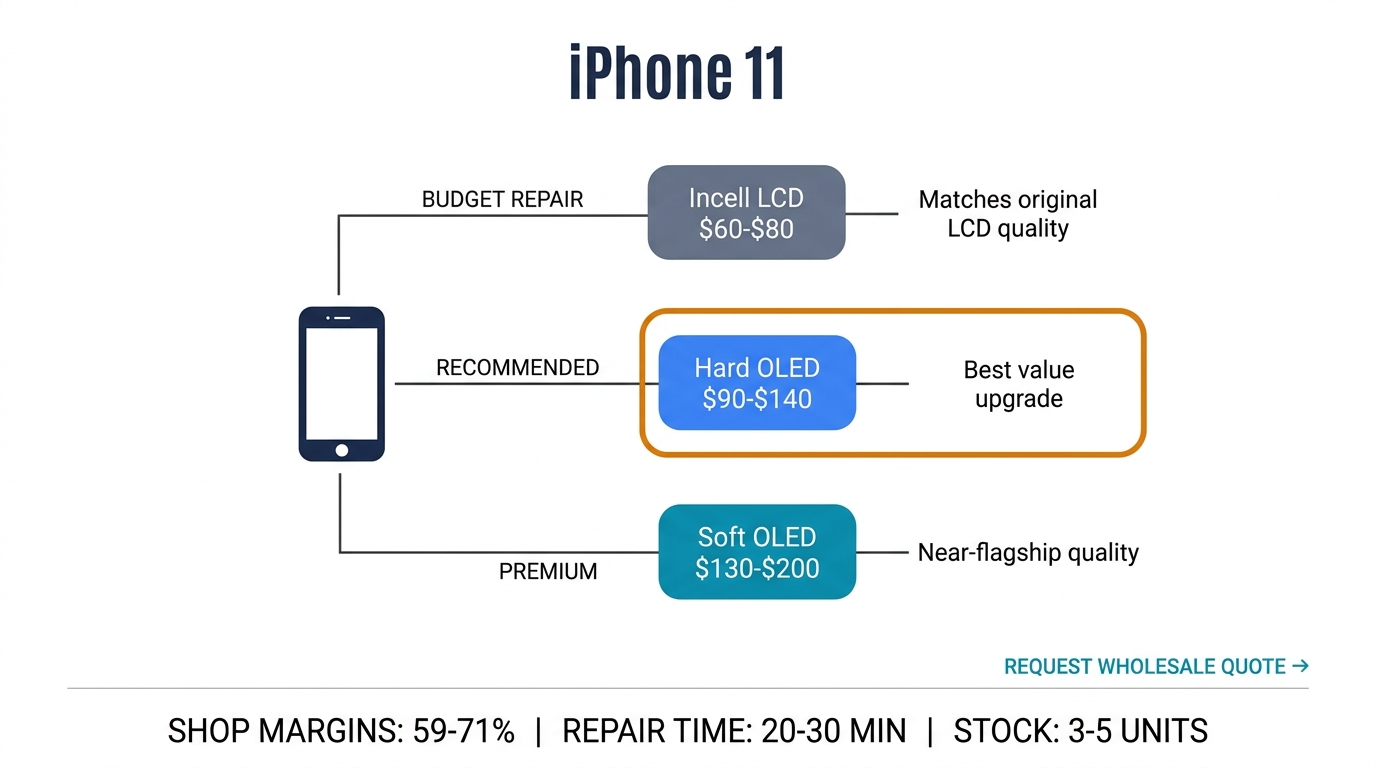
The iPhone 11 screen replacement is still worth it in 2026, but the math is tighter than for newer models. The key is matching the repair cost to the phone's actual value. At $50–$90 for an Incell LCD repair, the numbers work clearly. At Apple's $199, they don't.
For repair shops, the iPhone 11 remains a reliable margin generator — Incell screens cost $8–$15 wholesale and the repair commands $50–$90, producing some of the best percentage margins in the shop. The OLED upgrade option adds a premium tier that most competitors don't offer on this model.
Stock a few Incell screens for walk-in demand, offer OLED as an upsell, and always check the battery while the phone is open. That's the iPhone 11 playbook for 2026.
Need wholesale iPhone 11 screens? We supply tested Incell LCD, Hard OLED, and Soft OLED screens for the iPhone 11 at bulk pricing. Request a wholesale quote to get grade samples and volume pricing for your shop.