
iPhone Battery Replacement: How Repair Shops Should Choose Battery Quality for Different Customers

iPhone battery replacement is the third most common repair job after screen and charging port fixes — and it's the one where parts quality is hardest to verify before installation. With screens, you can see the display quality immediately. With batteries, the real quality only shows up weeks or months later when the battery either holds its capacity or starts degrading.
The aftermarket iPhone battery market ranges from $3 cells that barely last 6 months to $12 cells that perform near-OEM levels for 2+ years. Between those extremes is a confusing landscape of capacity claims, cycle ratings, and quality certifications that most repair shops don't have time to decode. But getting battery quality wrong creates the worst kind of callback — the kind that happens 3–6 months later when the customer's "new" battery is already at 85% health.
This guide explains what actually differentiates battery quality grades, how to match quality to customer type, and how to source batteries that won't generate callbacks.
Buying Phone Batteries Wholesale?
OEM-cell batteries with safety packaging — iPhone, Samsung & more, factory-direct.
Get Wholesale QuoteWhat Makes One iPhone Battery Better Than Another
All aftermarket iPhone batteries look similar from the outside. The difference is in the cells, the protection circuitry, and the manufacturing consistency.
Cell Quality and Actual Capacity
The single most important quality factor is the battery cell itself. Every iPhone battery has a rated capacity in milliamp-hours (mAh) — for example, the iPhone 13 battery is rated at 3,227 mAh. Aftermarket batteries are supposed to match or exceed this capacity.
In practice, cheap batteries often fall short. A battery labelled "3,227 mAh" might actually deliver 2,800–3,000 mAh when tested. The label says one thing; the cell delivers another. This gap comes from using lower-grade lithium cells or cells that were rejected from higher-tier production lines.
How to verify: Use a battery tester that measures actual discharge capacity. Tools like the SUNSHINE DT-890 or iCopy Plus can measure real mAh output. If a "3,227 mAh" battery consistently tests at 3,100+ mAh, the cells are genuine quality. If it tests below 2,900 mAh, the cells are substandard.
Cycle Life
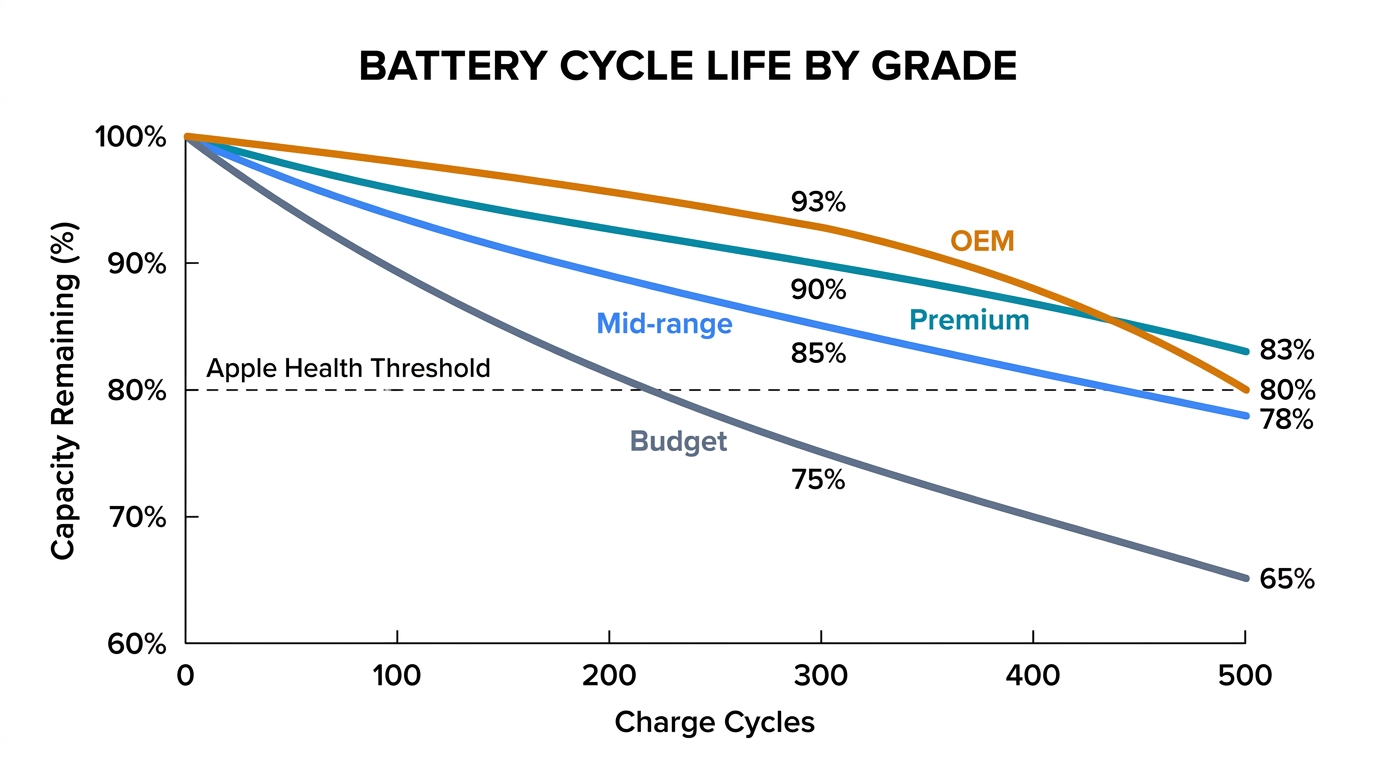
Cycle life measures how many charge-discharge cycles a battery can handle before its capacity drops below 80% of original. Apple's OEM batteries are rated for approximately 500 cycles. Aftermarket batteries vary dramatically:
| Battery Grade | Typical Cycle Life | After 300 Cycles | After 500 Cycles |
|---|---|---|---|
| Budget ($3–$5) | 200–300 cycles | 78–85% capacity | 65–75% capacity |
| Mid-range ($5–$8) | 350–450 cycles | 83–88% capacity | 75–82% capacity |
| Premium ($8–$12) | 450–550 cycles | 88–92% capacity | 80–87% capacity |
| OEM Original | ~500 cycles | 90–95% capacity | ~80% capacity |
A budget battery that reaches 80% health after 200 cycles means the customer sees "Battery Health: 80%" in Settings after roughly 7–8 months of normal use. They come back to your shop thinking the replacement was defective. A premium battery reaches that point after 18–24 months — by which time the customer has likely upgraded or considers it normal wear.
Protection Circuit (BMS)
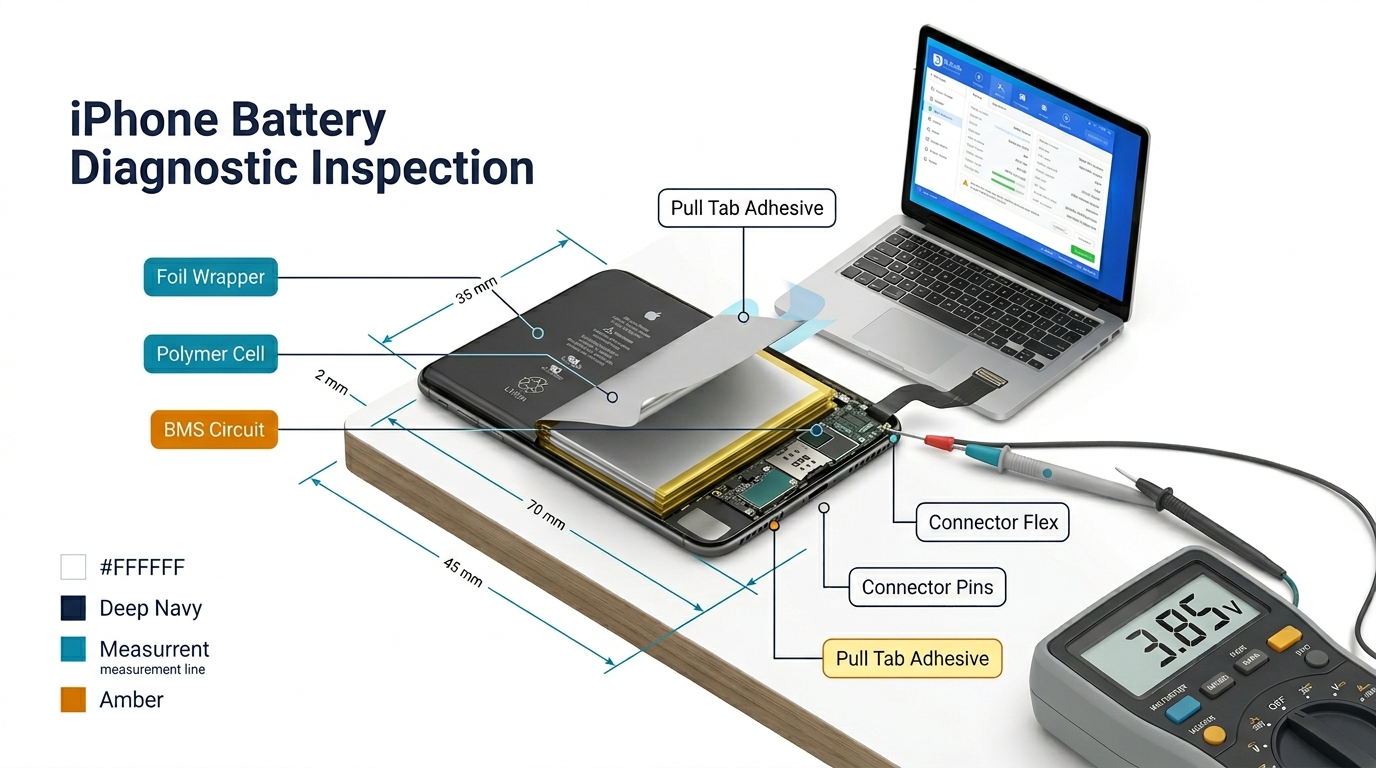
Every iPhone battery includes a Battery Management System (BMS) — a small circuit board on the battery flex cable that controls charging, prevents overcharging/over-discharging, and monitors temperature. The quality of this circuit directly affects safety and longevity.
Budget batteries sometimes use clone BMS circuits that don't communicate properly with iOS. This can cause:
- Inaccurate battery health reporting — iOS shows 100% health immediately after installation but drops rapidly
- Unexpected shutdowns — the BMS reports incorrect voltage, causing iOS to shut down the phone prematurely at 15–20% charge
- Charging issues — slow charging speeds or failure to charge past 80% due to BMS/iOS communication errors
Premium aftermarket batteries use BMS circuits that match Apple's communication protocols more closely, resulting in accurate health reporting and consistent charging behaviour.
Battery Quality Tiers: What to Stock and When to Use Each
Not every customer needs a premium battery. Here's a practical framework for matching battery quality to customer situations.
Budget Tier ($3–$5 wholesale)
Use when:
- Customer explicitly wants the cheapest option
- Phone is 4+ years old and the customer just needs it to last another 6–12 months
- The phone is a secondary/backup device, not a daily driver
- Customer plans to trade in or sell soon and just needs functional battery health
What to tell the customer: "This battery will get your phone working normally for the next 6–12 months. After that, you may notice the battery health dropping faster than the original. For a phone you plan to use for 2+ more years, I'd recommend the standard or premium option."
Shop margin: Parts cost $3–$5, charge $40–$50. Margin: $35–$47 (78–88%).
Mid-Range Tier ($5–$8 wholesale)
Use when:
- Standard offering for most customers
- Phone is 2–3 years old and the customer plans to keep it for at least another year
- Customer wants good battery life without paying premium prices
What to tell the customer: "This is our standard battery. It matches the original capacity and should give you 12–18 months of strong battery life. It's what I'd recommend for most people."
Shop margin: Parts cost $5–$8, charge $55–$70. Margin: $47–$65 (73–85%).
Premium Tier ($8–$12 wholesale)
Use when:
- Customer plans to keep the phone for 2+ more years
- Phone is a primary business device where battery reliability matters
- Customer is battery-health-conscious (checks Settings > Battery regularly)
- Customer has already had a bad experience with a cheap battery replacement
What to tell the customer: "This is our highest quality battery — tested capacity, premium cells, and rated for the same cycle life as Apple's original. It's the closest to what Apple would put in at $89, but at a fraction of the price."
Shop margin: Parts cost $8–$12, charge $65–$89. Margin: $53–$81 (68–81%).
Margin Comparison by Model
| iPhone Model | OEM Capacity | Budget Cost | Mid Cost | Premium Cost | Customer Charge Range |
|---|---|---|---|---|---|
| iPhone 11 | 3,110 mAh | $3–$4 | $5–$6 | $8–$10 | $40–$70 |
| iPhone 12 | 2,815 mAh | $3–$4 | $5–$7 | $8–$10 | $45–$75 |
| iPhone 13 | 3,227 mAh | $4–$5 | $6–$8 | $9–$11 | $45–$80 |
| iPhone 14 | 3,279 mAh | $4–$5 | $6–$8 | $9–$12 | $50–$85 |
| iPhone 15 | 3,349 mAh | $5–$6 | $7–$9 | $10–$12 | $55–$89 |
Apple charges $89 for battery replacement on iPhone 11 through iPhone 15 (out of warranty). Third-party shops should price below Apple but above the "too cheap to trust" threshold. Most shops land at $40–$89 depending on quality tier.
For more on structuring repair prices by quality tier, see our phone screen repair pricing strategy guide — the same tiered pricing approach works for batteries.
The Battery Health Display Problem
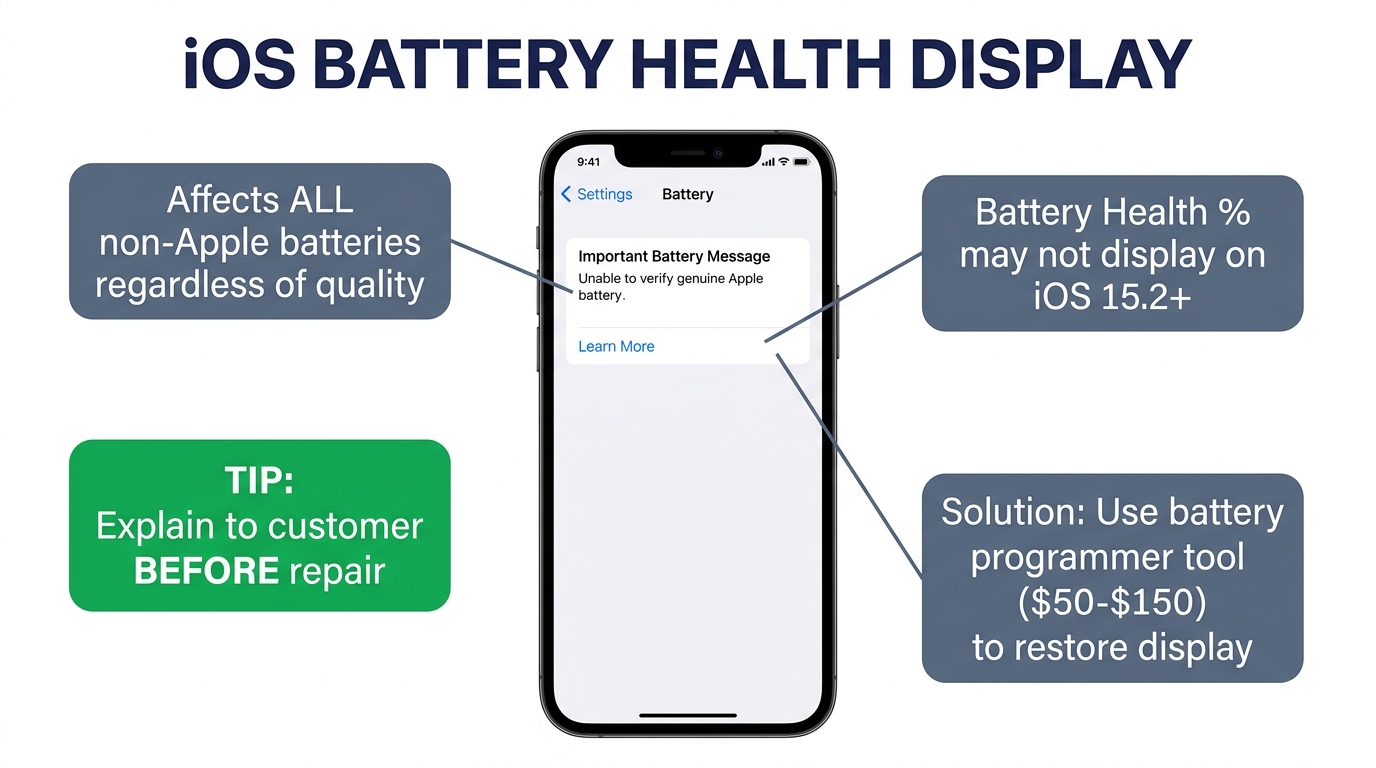
Since iOS 14.5, iPhones show a "non-genuine part" warning after any third-party battery replacement. More importantly, iOS 15.2+ disabled the Battery Health percentage display for phones with non-Apple batteries — the customer sees "Unable to verify this iPhone has a genuine Apple battery" and the health percentage may not display.
This isn't a quality issue — it's Apple's software restriction. It happens with both premium aftermarket batteries and cheap ones. But it causes customer confusion and complaints.
How shops should handle this:
-
Explain before the repair. Tell every customer that iOS will show a non-genuine battery message and that the Battery Health percentage may not display normally. This is standard for any non-Apple battery.
-
Use a battery programmer. Tools like the JC V1S or iCopy Plus can write battery data (cycle count, manufacture date, capacity) to the new battery's BMS, which in some cases restores the health display. These tools cost $50–$150 and pay for themselves quickly.
-
Frame it positively. "The battery itself is tested to match Apple's original capacity and cycle rating. The only difference is iOS can't verify it's an Apple-branded cell, so it shows a message. It doesn't affect how the battery actually performs."
How to Test Battery Quality Before Stocking
Batteries are harder to evaluate than screens because the real quality shows up over time. But there are immediate tests you can run on sample units.
Immediate Tests (Before Stocking)
- Measure actual capacity. Use a battery discharge tester. The measured mAh should be within 95% of the labelled capacity. Below 90% is a rejection.
- Check voltage. A fully charged iPhone battery should read 4.35V (±0.05V). Significantly lower voltage after a full charge indicates aged or low-grade cells.
- Inspect the BMS circuit. Under magnification, look for clean solder joints, proper component placement, and consistent build quality. Sloppy BMS boards correlate with poor cell quality.
- Fit test. Install in the target iPhone model. The battery should fit without bulging or requiring force. Out-of-spec dimensions usually mean the cells inside are from a different production line.
Ongoing Quality Tracking
- Track callback rates by supplier. If a particular supplier's batteries start generating callbacks at 3–6 months, switch suppliers immediately.
- Spot-check battery health on returned phones. When a customer comes in for any repair on a phone you previously replaced the battery on, check the battery health. This gives you real-world data on how your batteries are holding up.
For general supplier evaluation principles, see our how to choose a phone parts supplier guide.
Looking for tested iPhone batteries at wholesale? We supply budget, mid-range, and premium iPhone batteries for iPhone 11 through iPhone 16 series, with measured capacity data on every batch. Request samples and wholesale pricing to compare quality tiers before ordering.
iPhone Battery Replacement as an Upsell Opportunity
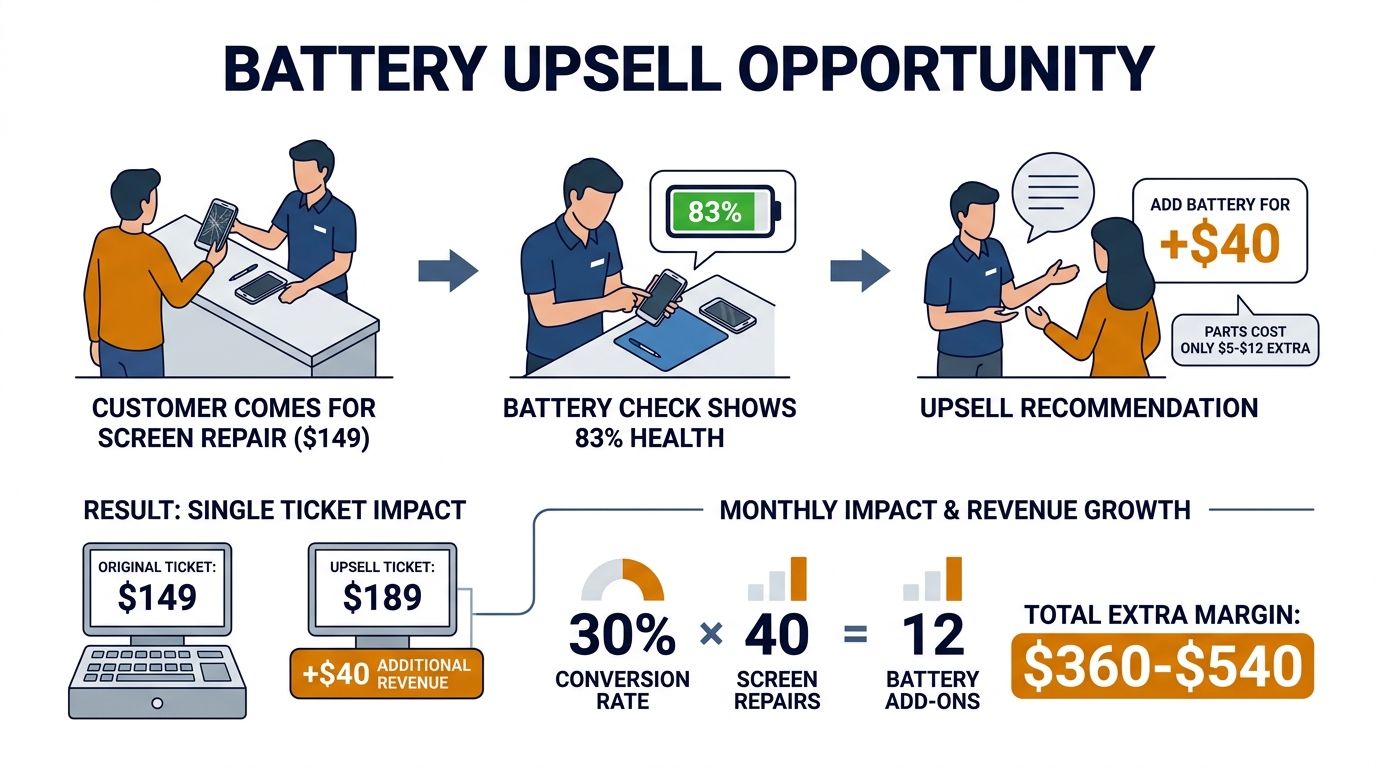
Battery replacement is one of the best upsell opportunities in a repair shop. When a customer comes in for a screen replacement on a 2–3 year old phone, their battery is likely at 80–85% health. Offering a battery replacement at the same time makes sense for both parties:
- For the customer: They're already paying for a repair. Adding a battery replacement while the phone is open costs less than coming back separately (no duplicate disassembly labour).
- For the shop: The incremental labour is 5–10 minutes (the phone is already open). The battery costs $5–$12, and you can charge $30–$50 for the add-on. That's $18–$45 of additional margin for minimal extra work.
How to offer it: When quoting a screen replacement, check the battery health and mention it: "Your battery is at 83% — that means it's lost about 17% of its original capacity. Since we'll have the phone open for the screen repair, I can replace the battery at the same time for an extra $40. If you wait and come back later, it'll be $65 because of the labour to reopen the phone."
This approach is honest, practical, and adds significant revenue per repair ticket. Over the course of a month, even converting 30% of screen repair customers into battery add-ons can add $500–$1,000 in gross margin to a moderately busy shop.
Frequently Asked Questions
How much does iPhone battery replacement cost in 2026?
Apple charges $89 for iPhone 11 through iPhone 15 battery replacement and $99 for iPhone 16 series (out of warranty). Third-party repair shops charge $40–$89 depending on battery quality tier. Budget batteries cost shops $3–$5 and are typically offered at $40–$50. Premium batteries cost $8–$12 and are offered at $65–$89 — still below Apple's price with near-equivalent quality.
How can I tell if an aftermarket iPhone battery is good quality?
Test actual capacity with a battery discharge tester — it should be within 95% of the rated mAh. Check voltage after a full charge (should be 4.35V ±0.05V). Inspect the BMS circuit board for clean solder joints. Install and verify that iOS recognises the battery without errors beyond the standard "non-genuine part" message. Premium batteries from reliable suppliers will consistently pass all these tests.
Will an aftermarket battery show battery health on iPhone?
Since iOS 15.2, third-party batteries may not display the Battery Health percentage — iOS shows a "non-genuine battery" message instead. This happens regardless of battery quality and is Apple's software restriction. Some repair shops use battery programmer tools to write capacity data to the BMS, which can restore the health display on certain iOS versions.
How long should an aftermarket iPhone battery last?
A premium aftermarket battery should maintain above 80% health for 400–500 charge cycles — roughly 18–24 months of normal daily use. Mid-range batteries typically reach 80% after 12–18 months. Budget batteries may drop to 80% in 7–10 months. For comparison, Apple's OEM batteries are rated for approximately 500 cycles to 80% capacity.
Should repair shops offer different battery quality tiers?
Yes. Offering 2–3 tiers lets you serve budget customers (who just need a functional phone for a few more months) and premium customers (who want long-lasting battery life) without turning anyone away. The pricing spread between budget ($40–$50) and premium ($65–$89) is wide enough to create meaningful choice without overwhelming the customer.
Stock Smart, Match Quality to Customer Needs
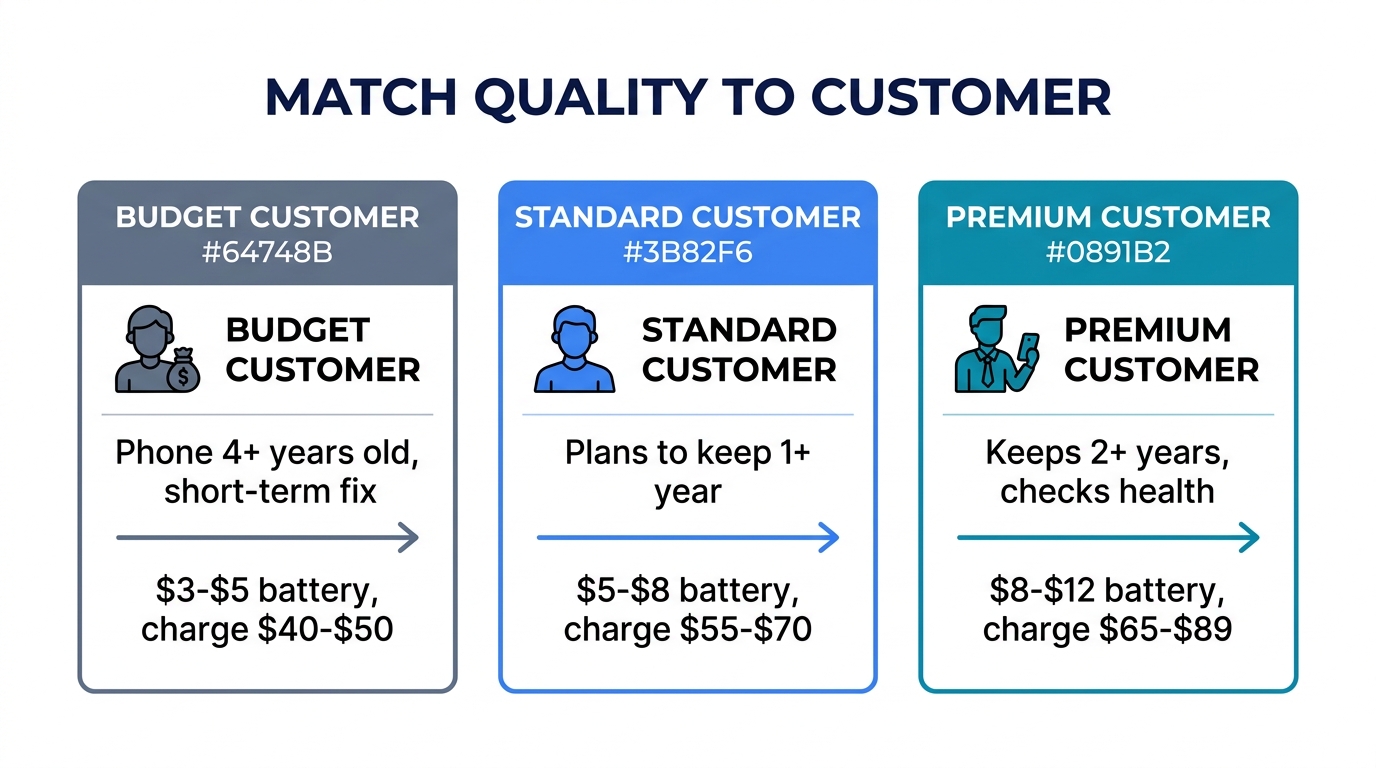
iPhone battery replacement is a high-volume, high-margin repair that every shop should offer. The key to doing it profitably without callbacks is matching battery quality to customer expectations. Budget batteries work for short-term fixes on aging phones. Premium batteries are worth the extra $5–$7 in parts cost for customers who plan to keep their phone — and the reduced callback rate pays for itself.
Stock at least two quality tiers, test every new supplier's batteries before committing to volume, and always explain the iOS battery health display limitation upfront. That combination keeps margins healthy and customers happy.
Ready to compare battery quality tiers? We supply tested iPhone batteries across three quality grades for iPhone 11 through iPhone 16, with measured capacity data and cycle life ratings. Get wholesale pricing and samples.