
DIY Phone Screen Repair vs Professional: Cost, Risk, and Quality Compared
DIY phone screen repair looks like a great deal — screen kits on Amazon cost $30–$80, YouTube tutorials make it look easy, and you save the labor cost of a professional shop. But the real cost of a DIY repair goes beyond the kit price. Factor in the risk of damaging other components, the lower-grade screens that come with most kits, the time investment, and the lack of warranty, and the math changes significantly.
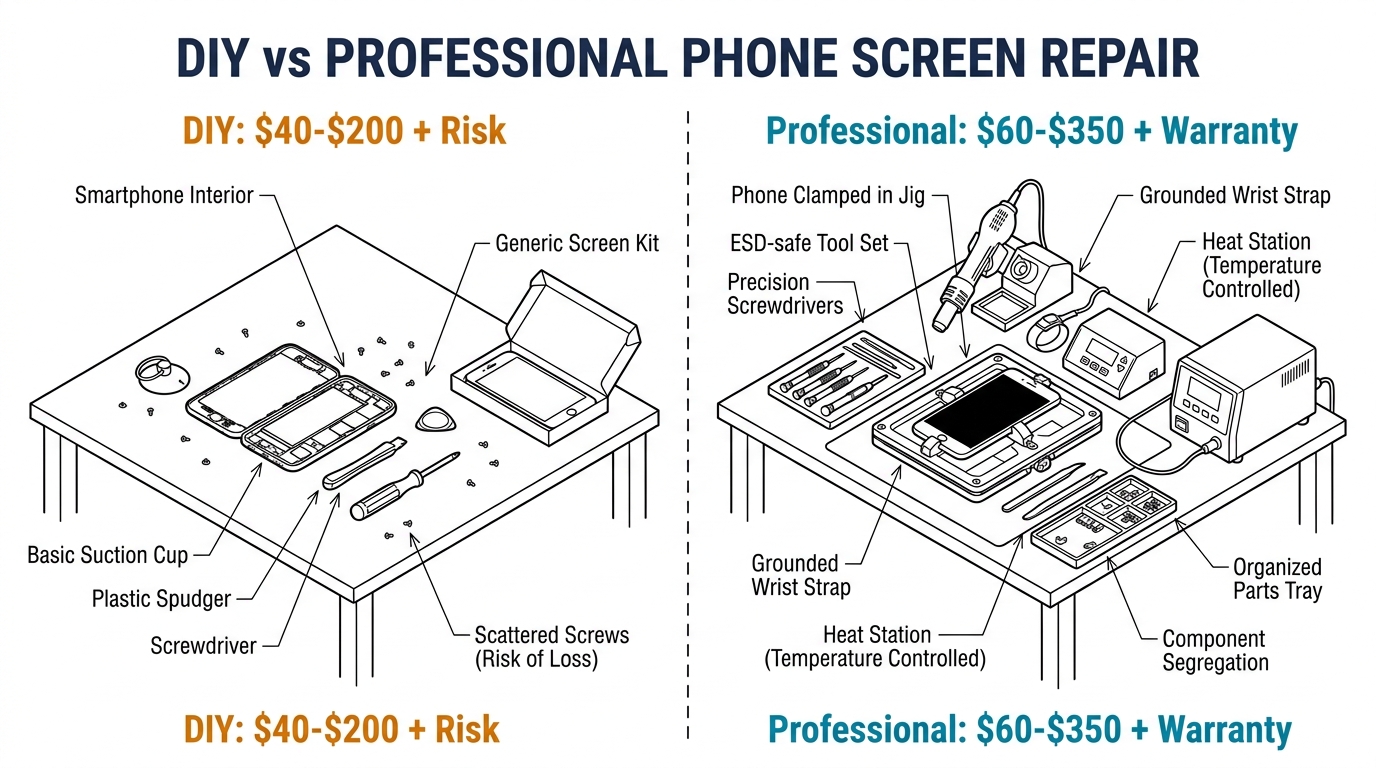
Professional phone screen repair costs more upfront — typically $60–$350 depending on your phone model and screen grade — but includes labor, warranty, higher-quality screen options, and zero risk of making the problem worse. The question isn't simply which is cheaper. It's which gives you the best outcome for your specific situation.
This guide breaks down the real costs, risks, and quality differences between DIY and professional screen repair so you can make the right call.
Sourcing Replacement Screens in Bulk?
Incell / Hard OLED / Soft OLED grades — wholesale pricing, grade comparison on request.
Get Wholesale QuoteThe True Cost of DIY Phone Screen Repair
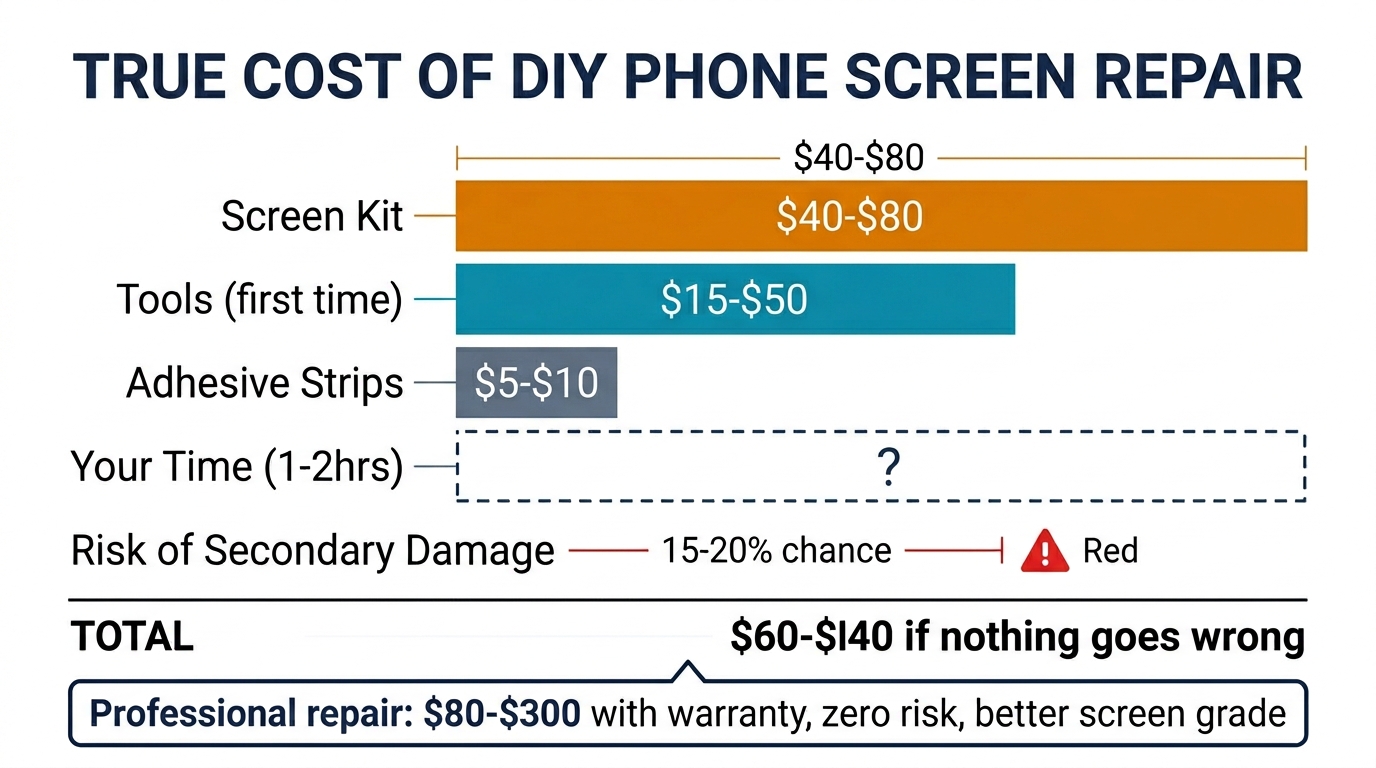
The kit price is only part of the equation. Here's what a DIY screen replacement actually costs when you include everything.
Screen Kit Costs by Phone Model
| Phone Model | Budget Kit (Incell) | Mid-Range Kit (Hard OLED) | Premium Kit (Soft OLED) |
|---|---|---|---|
| iPhone 16 Pro Max | $80–$120 | $130–$170 | $160–$200 |
| iPhone 15 Pro / Pro Max | $70–$100 | $110–$150 | $140–$180 |
| iPhone 14 Pro / Pro Max | $55–$90 | $90–$130 | $120–$160 |
| iPhone 13 / Pro | $40–$70 | $70–$110 | $100–$140 |
| iPhone 12 / Pro | $35–$60 | $60–$100 | $90–$130 |
| iPhone 11 | $30–$50 | N/A (LCD model) | N/A |
| Samsung Galaxy S24 Ultra | $90–$140 | N/A | $180–$250 |
| Samsung Galaxy S23 Ultra | $80–$120 | N/A | $150–$220 |
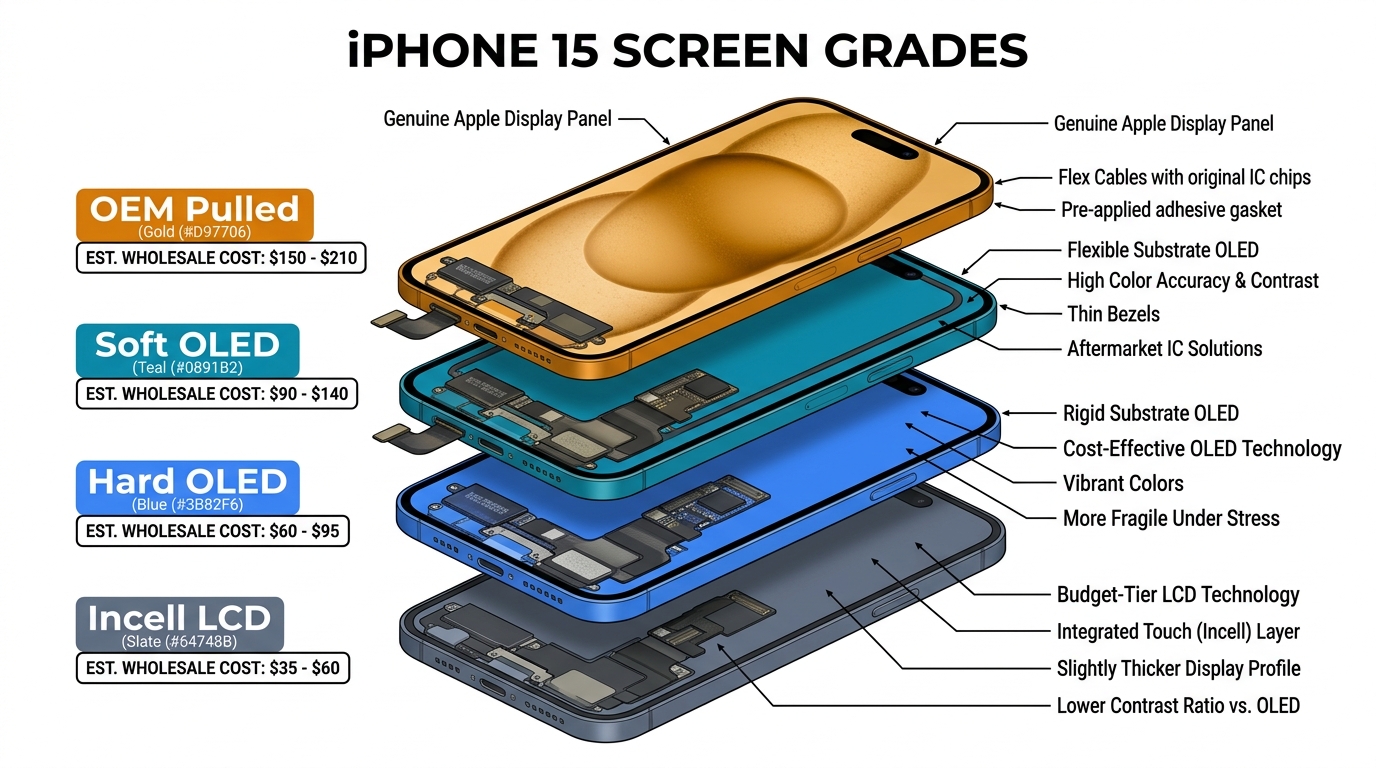
Most kits sold on Amazon and eBay in the $30–$80 range are Incell LCD screens — the lowest quality grade. The product listings rarely state the grade clearly. Terms like "OEM quality" and "premium replacement" on budget listings typically mean Incell, not actual OEM or OLED.
Hidden Costs Most DIY Guides Don't Mention
Tool costs ($15–$50). Basic kits include a plastic spudger and suction cup, but a proper repair needs a pentalobe screwdriver set, a tri-point screwdriver (for iPhone), tweezers, and a heat gun or iOpener. If you don't already own these, they add $15–$50 to your first repair.
Adhesive strips ($5–$10). Many budget kits don't include proper waterproof adhesive gaskets. Without them, your phone loses any remaining water resistance after the repair. Replacement adhesive strips cost $5–$10 per phone model.
Time cost. A first-time DIY screen replacement takes 60–120 minutes. An experienced technician does the same job in 15–30 minutes. If you value your time at any reasonable rate, the "savings" of DIY shrink quickly.
Risk of secondary damage. This is the hidden cost that makes DIY genuinely expensive when it goes wrong. Tearing a flex cable, damaging the Face ID module, cracking the replacement screen during installation, or stripping a screw means buying additional parts or paying a professional to fix what you broke — on top of the original repair cost. Industry data from iFixit's forums suggests that roughly 15–20% of first-time DIY screen repairs result in some form of secondary damage.
No warranty. DIY kits typically have a 30-day return window (if that), which covers dead-on-arrival defects but not issues that develop over weeks. Professional shops offer 90 days to 12 months of warranty on screen replacements.
Realistic DIY Total Cost
| Cost Component | Budget DIY | Mid-Range DIY |
|---|---|---|
| Screen kit | $40–$80 | $90–$160 |
| Tools (first time) | $15–$50 | $15–$50 |
| Adhesive strips | $5–$10 | $5–$10 |
| Your time (1–2 hours) | $0 (if free) | $0 (if free) |
| Risk of secondary damage | ~15–20% chance | ~15–20% chance |
| Total (if nothing goes wrong) | $60–$140 | $110–$220 |
Compare this to a professional repair: $80–$300 with warranty, zero risk, and typically a better screen grade. The savings gap is much smaller than the sticker price suggests.
The True Cost of Professional Phone Screen Repair
Professional repair pricing depends on three things: your phone model, the screen grade used, and the repair channel (independent shop vs franchise vs Apple).
Professional Repair Costs by Channel
| Repair Channel | Typical Cost | Screen Grade | Warranty |
|---|---|---|---|
| Apple (with AppleCare+) | $29 | OEM Original | 90 days |
| Apple (out of warranty) | $199–$379 | OEM Original | 90 days |
| Franchise shop (uBreakiFix, etc.) | $100–$280 | Varies (usually Incell or Hard OLED) | 90 days–1 year |
| Independent repair shop | $60–$350 | Your choice (Incell to Soft OLED) | 90 days–1 year |
| Mail-in service | $70–$250 | Varies | 90 days–6 months |
Independent shops offer the best value for most people because they let you choose the screen grade and price point. A good independent shop gives you options: $80 for Incell, $150 for Hard OLED, $250 for Soft OLED on a typical iPhone 14 Pro. You pick the quality level that matches your budget and expectations.
For a detailed breakdown of what each screen grade looks and performs like, see our guide to OEM vs aftermarket phone screens.
What You're Paying For Beyond the Screen
Professional repair cost includes more than just the display panel:
- Diagnosis — confirming the screen is the actual problem (not the logic board or connector)
- Skilled labor — a trained technician who won't damage flex cables or Face ID modules
- Proper tools — calibrated heat stations, suction jigs, and ESD-safe workstations
- Quality screen — shops source from wholesale suppliers with quality inspection, not random Amazon listings
- Warranty — coverage for defects that appear weeks or months after the repair
- Water resistance — proper adhesive reapplication to maintain the phone's seal
Screen Quality: The Biggest Difference Between DIY and Professional
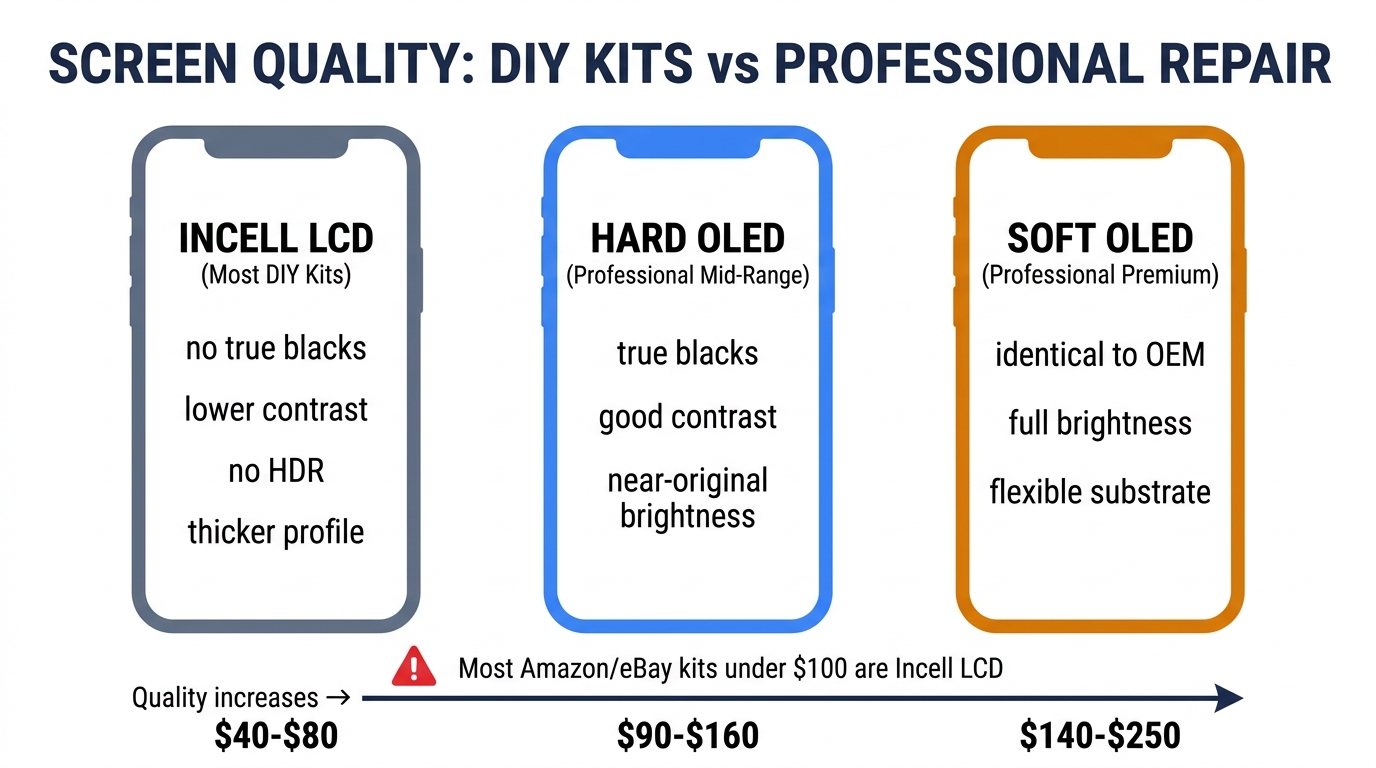
This is the factor that most DIY vs professional comparisons completely ignore — and it's the one that matters most for your long-term satisfaction.
What DIY Kits Actually Contain
The vast majority of DIY screen kits under $100 (for OLED iPhones) use Incell LCD screens. This technology is fundamentally different from the OLED panel your phone originally had:
- No true blacks — the backlight is always on, so blacks appear dark grey
- Lower contrast ratio — images look flatter and less vibrant
- Reduced brightness — harder to read in direct sunlight
- Thicker profile — the screen may sit slightly higher than the original
- No HDR support — video and photo quality is noticeably reduced
- Variable refresh rate issues — on ProMotion models, Incell screens can't smoothly handle 1–120Hz switching, causing visible stutter or ghost touch problems
For phones that originally used LCD screens (iPhone 11, XR, SE), an Incell replacement is perfectly fine — it's essentially the same technology. But for any phone with an original OLED display, the downgrade is visible to everyone, not just tech enthusiasts.
What Professional Shops Can Offer
Professional repair shops source screens from wholesale suppliers in bulk, giving them access to grades that aren't available in consumer DIY kits:
- Hard OLED — true blacks, good color accuracy, strong contrast. Slightly less durable than OEM but visually close. This is the sweet spot for most repairs.
- Soft OLED — virtually identical to the original Apple display. Flexible substrate, excellent color accuracy, full brightness. The premium option.
- OEM Refurbished — genuine Apple displays reclaimed from used phones, tested and refitted with new glass. Preserves True Tone calibration.
A professional shop using Hard OLED delivers a noticeably better result than a DIY kit using Incell — and the price difference is often only $40–$80 when you factor in the true cost of DIY.
Risk Comparison: What Can Go Wrong
DIY Risks
Face ID damage. The iPhone Face ID module is attached to the screen assembly with a delicate flex cable. Tearing it during screen removal disables Face ID permanently — Apple doesn't allow third-party Face ID replacements. This is the single most expensive DIY mistake, turning a $100 screen repair into a phone with permanently disabled Face ID (reducing its resale value by $100–$200).
Flex cable tears. The display ribbon cables are thin and fragile. Pulling at the wrong angle or using too much force tears them, requiring a new screen assembly. This is the most common first-timer mistake and effectively doubles the parts cost.
Stripped screws. iPhone screws are tiny and use pentalobe and tri-point heads. Using the wrong screwdriver size strips them, making reassembly difficult or impossible. Stripped screws require a screw extractor and patience that most people don't have.
Battery puncture. On models where the battery sits directly under the screen (most iPhones), prying the screen too aggressively can puncture the battery. A punctured lithium-ion battery can swell, overheat, or — in extreme cases — catch fire. This is rare but has real safety implications.
Lost water resistance. Even a successful DIY repair typically destroys the phone's IP68 water resistance rating. Without the proper adhesive gaskets and installation technique, the phone is vulnerable to moisture damage. Professional shops use model-specific adhesive kits that restore most of the water sealing.
Professional Repair Risks
Professional repairs aren't risk-free, but the risks are significantly lower and covered by warranty:
- Screen defect — the replacement screen could have a manufacturing defect (dead pixels, color issues). Professional shops cover this under warranty and replace it at no charge.
- Technician error — rare at established shops but possible. Warranty covers the repair if something goes wrong during service.
- Screen grade mismatch — if the shop uses a lower grade than expected. This is preventable by asking upfront which grade they use. Reputable shops specify the grade before starting work.
When DIY Makes Sense (And When It Doesn't)
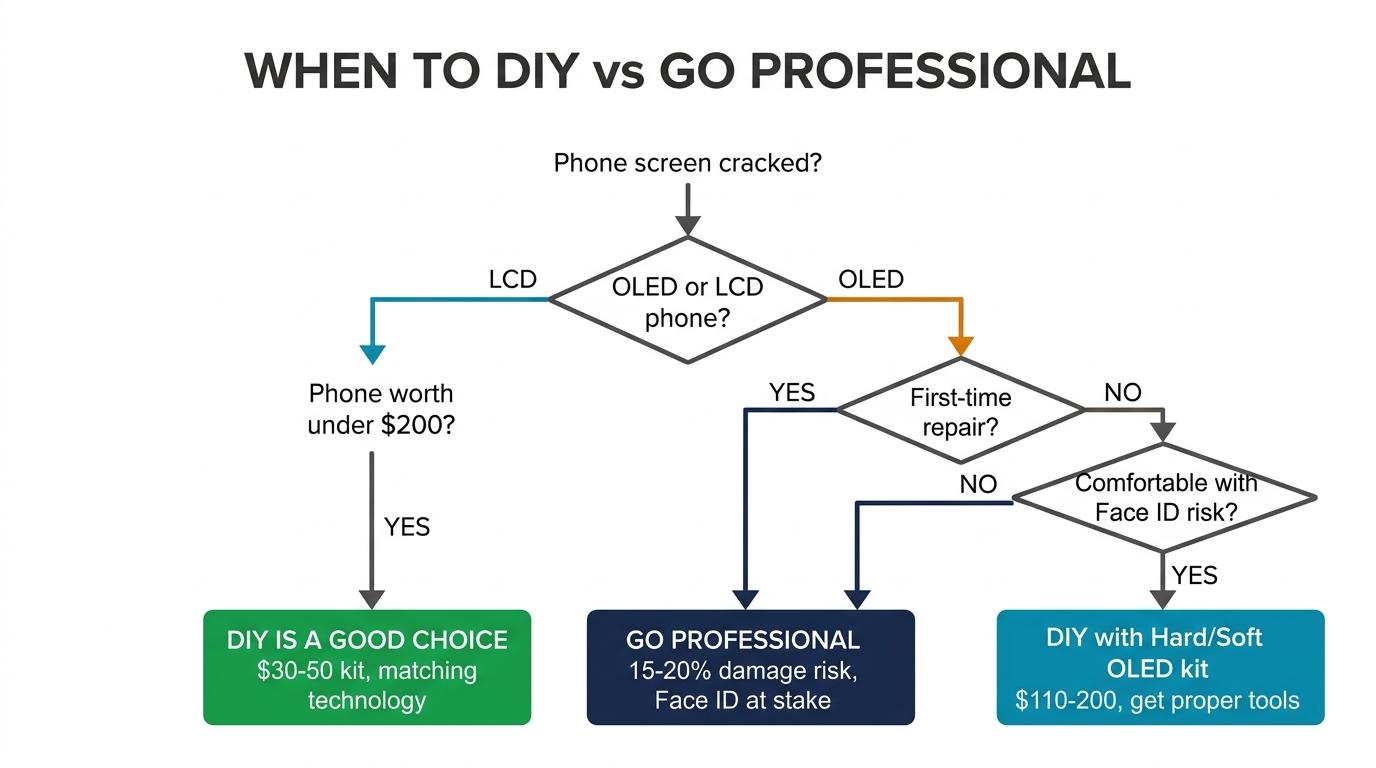
DIY Is a Good Choice When:
- You're repairing an older or budget phone (iPhone 11, SE, or budget Android) where the screen kit costs $30–$50 and the phone uses LCD technology — no OLED downgrade to worry about
- You have repair experience — you've opened phones before and own the tools
- The phone has low resale value — if it's worth less than $200, the risk of minor cosmetic imperfections or lost water resistance matters less
- You enjoy the process — some people genuinely like hands-on repair work and view the time as a hobby, not a cost
Professional Repair Is the Better Choice When:
- Your phone has an OLED display (iPhone 12 and newer, Samsung Galaxy S series) — the screen grade difference between DIY kits and professional options is significant
- Face ID or biometric features matter — one wrong move during DIY disables features worth hundreds of dollars
- You plan to sell or trade in the phone — buyers and trade-in programs detect non-original and low-grade screens, reducing your phone's value
- You've never opened a phone before — the 15–20% risk of secondary damage on a first attempt makes professional repair the safer investment
- You need a warranty — professional shops cover defects for months; DIY kits cover you for days
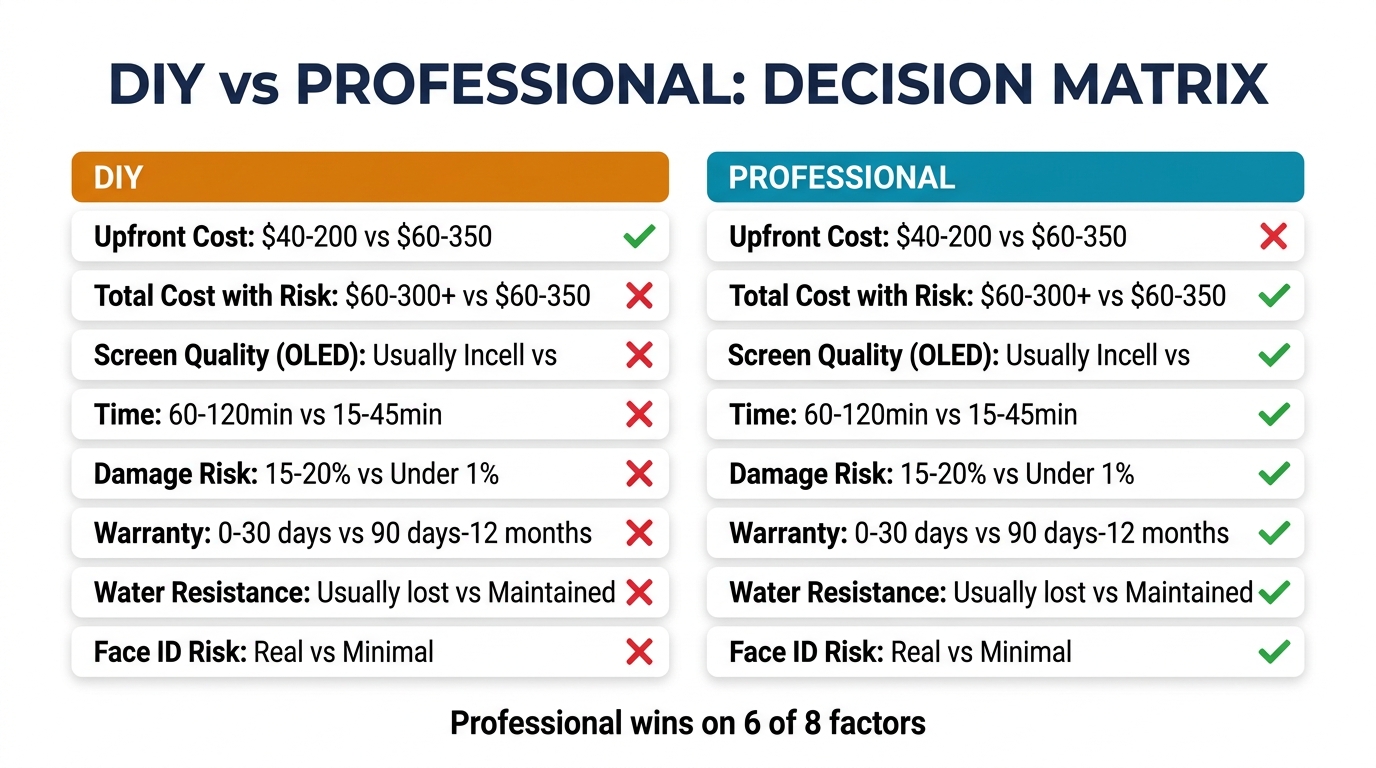
The Decision Matrix
| Factor | DIY | Professional |
|---|---|---|
| Upfront cost | Lower ($40–$200) | Higher ($60–$350) |
| Total cost (including risk) | Similar ($60–$300+) | Predictable ($60–$350) |
| Screen quality (OLED phones) | Usually Incell (lowest) | Choice of grades |
| Time required | 60–120 minutes | 15–45 minutes (plus travel) |
| Risk of secondary damage | 15–20% (first-timers) | Under 1% |
| Warranty | 0–30 days | 90 days–12 months |
| Water resistance after repair | Usually lost | Usually maintained |
| Face ID / biometric risk | Real | Minimal |
How Repair Shops Keep Costs Competitive
Understanding why professional repair can be affordable helps you evaluate whether a shop's pricing is fair.
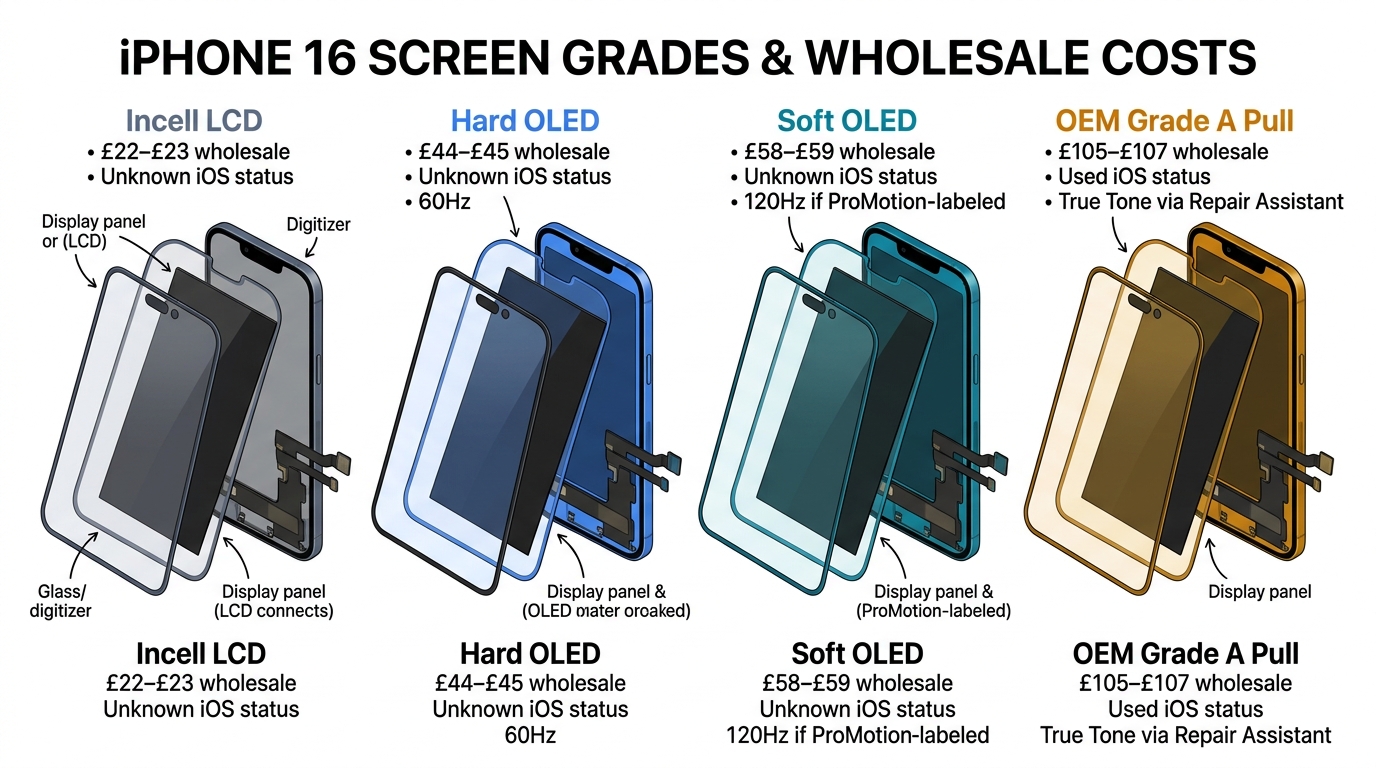
Professional repair shops buy screens at wholesale prices — significantly below what DIY kits cost at retail. A Hard OLED screen that costs you $110 in a DIY kit might cost a shop $35–$45 through their wholesale supplier. This bulk pricing advantage means the shop can charge you $150 for a Hard OLED repair (including labor and warranty) while you'd spend $130+ on a DIY kit alone — with no warranty and lower quality.
Shops that source from established wholesale suppliers with quality inspection pay slightly more per screen but dramatically reduce their defect and callback rates. This efficiency is what allows competitive pricing without cutting corners on quality.
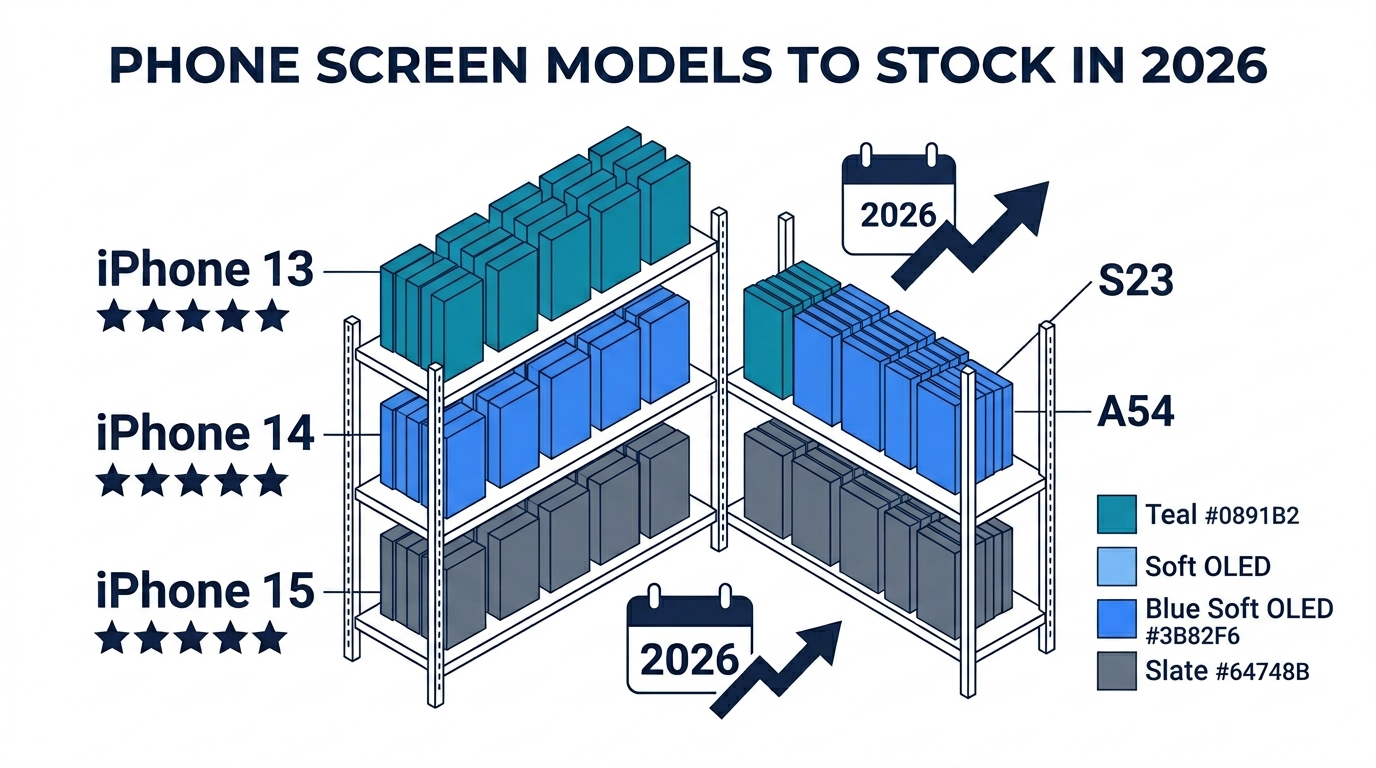
For repair shop owners reading this: your ability to offer better value than DIY depends entirely on your wholesale screen costs and the grades you stock. The shops that lose customers to DIY are usually the ones using the same Incell screens as the kits but charging professional prices. Offering tiered pricing (Incell, Hard OLED, Soft OLED) with transparent grade labeling gives customers a reason to choose your shop over a kit — they're getting a genuinely better screen, not just paying for labor. Understanding the wholesale pricing structure across screen grades shapes this strategy.
Frequently Asked Questions
Is it worth replacing a phone screen yourself?
It depends on the phone. For older LCD models (iPhone 11, SE, budget Android) worth under $200, DIY makes financial sense — the kit costs $30–$50 and the screen technology matches the original. For OLED phones (iPhone 12+, Samsung Galaxy S series), professional repair typically delivers a better outcome because shops have access to higher-grade screens that DIY kits don't include. Factor in the 15–20% risk of secondary damage on your first attempt, and the savings gap narrows significantly.
How much does professional phone screen repair cost?
Professional screen repair costs $60–$350 depending on phone model, screen grade, and repair channel. Apple charges $29 with AppleCare+ or $199–$379 out of warranty. Independent shops typically charge $80–$250 with your choice of screen grade. For a full model-by-model breakdown, see our iPhone screen replacement cost guide.
What's the biggest risk of DIY screen repair?
The biggest risk is damaging the Face ID module (iPhone) or front camera assembly during screen removal. This damage is permanent — Apple doesn't allow third-party replacement of Face ID components. The second biggest risk is tearing the display flex cable, which destroys the new screen before you even finish installing it, effectively doubling your parts cost.
Do DIY screen repair kits come with good screens?
Most kits under $100 for OLED iPhones use Incell LCD screens — the lowest quality aftermarket grade. The listing may say "OEM quality" but the screen technology is fundamentally different from your original OLED display. For a screen that actually matches the original quality, you'd need to buy a Soft OLED kit ($140–$200), which approaches professional repair pricing once you add tools and adhesive.
Can I lose Face ID from a DIY screen repair?
Yes. Face ID uses a dot projector module connected to the display assembly via a thin flex cable. If this cable is torn or the module is damaged during screen removal, Face ID stops working permanently. Apple's security design prevents third-party Face ID replacement. This is the most consequential risk of DIY repair on Face ID-equipped iPhones (iPhone X and newer).
Make the Right Choice for Your Situation
DIY phone screen repair saves money on older LCD phones where the kit quality matches the original screen and the risk is manageable. For modern OLED phones — especially those with Face ID, high resale value, or warranty expectations — professional repair delivers a better result at a cost that's closer to DIY than most people assume.
If you're a repair shop looking to offer better value than DIY kits while maintaining healthy margins, the answer is wholesale screen sourcing at competitive prices. Request a quote — we supply Incell, Hard OLED, and Soft OLED screens for iPhone 11 through 16 series and Samsung Galaxy models, with quality inspection on every batch.