
Air Freight vs Sea Freight for Phone Parts: Cost, Speed, and When to Use Each
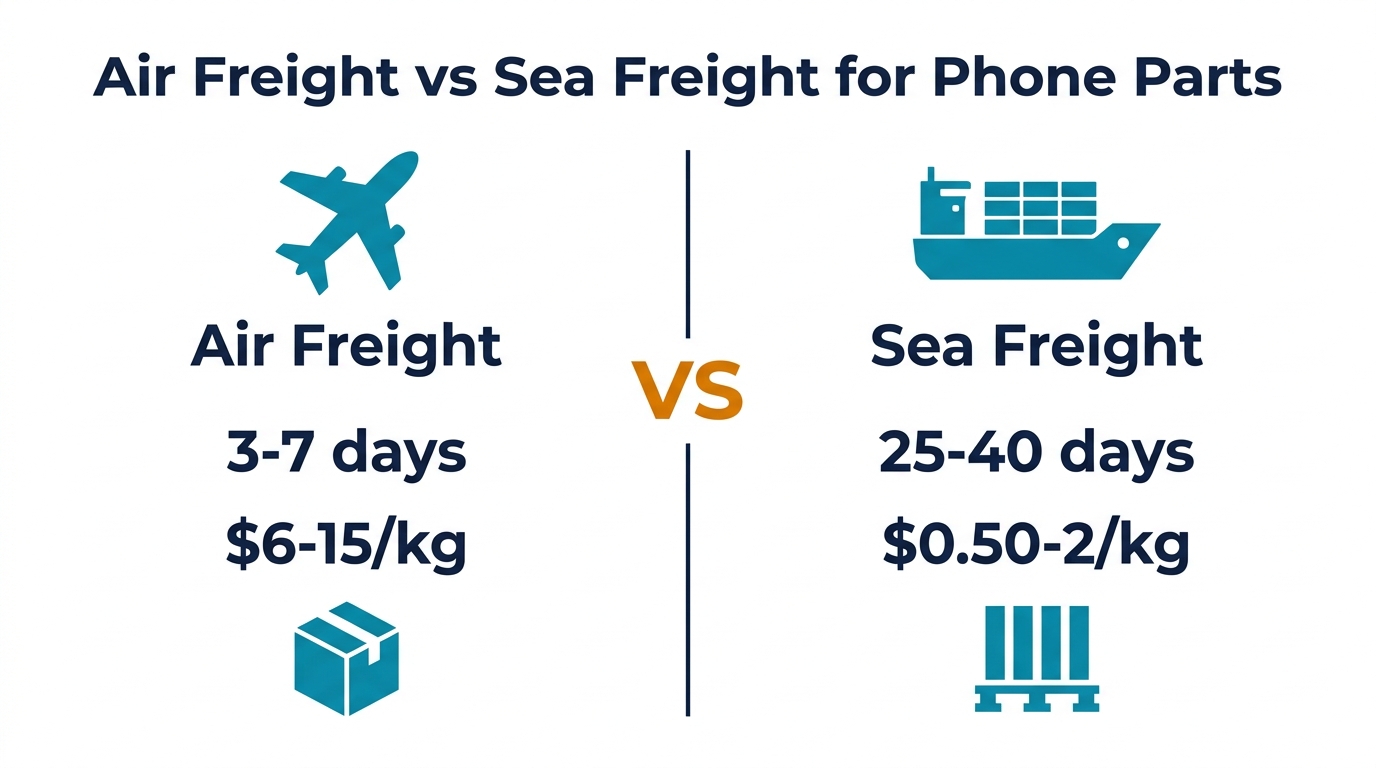
The air freight vs sea freight phone parts decision comes down to a simple trade-off: speed costs money, and saving money costs time. But for phone parts specifically — small, lightweight, high-value items with fast-moving demand — the math works differently than for most imported goods. A single container of phone screens is worth $50,000–200,000 while weighing under 500 kg. That value-to-weight ratio changes which shipping method actually makes financial sense.
Most repair shops importing from China for the first time default to air freight through their supplier's DHL or FedEx account. It's fast, simple, and the cost seems reasonable for small orders. But as order volume grows, that $8–15/kg air freight rate starts eating into your margin — and the question becomes whether sea freight's 60–70% lower cost justifies the 3–5 week delay.
Here's how each option works for phone parts, what the real costs look like, and when to use each method based on your order size and business stage.
Sourcing Replacement Screens in Bulk?
Incell / Hard OLED / Soft OLED grades — wholesale pricing, grade comparison on request.
Get Wholesale QuoteAir Freight vs Sea Freight Phone Parts Comparison: The Key Numbers
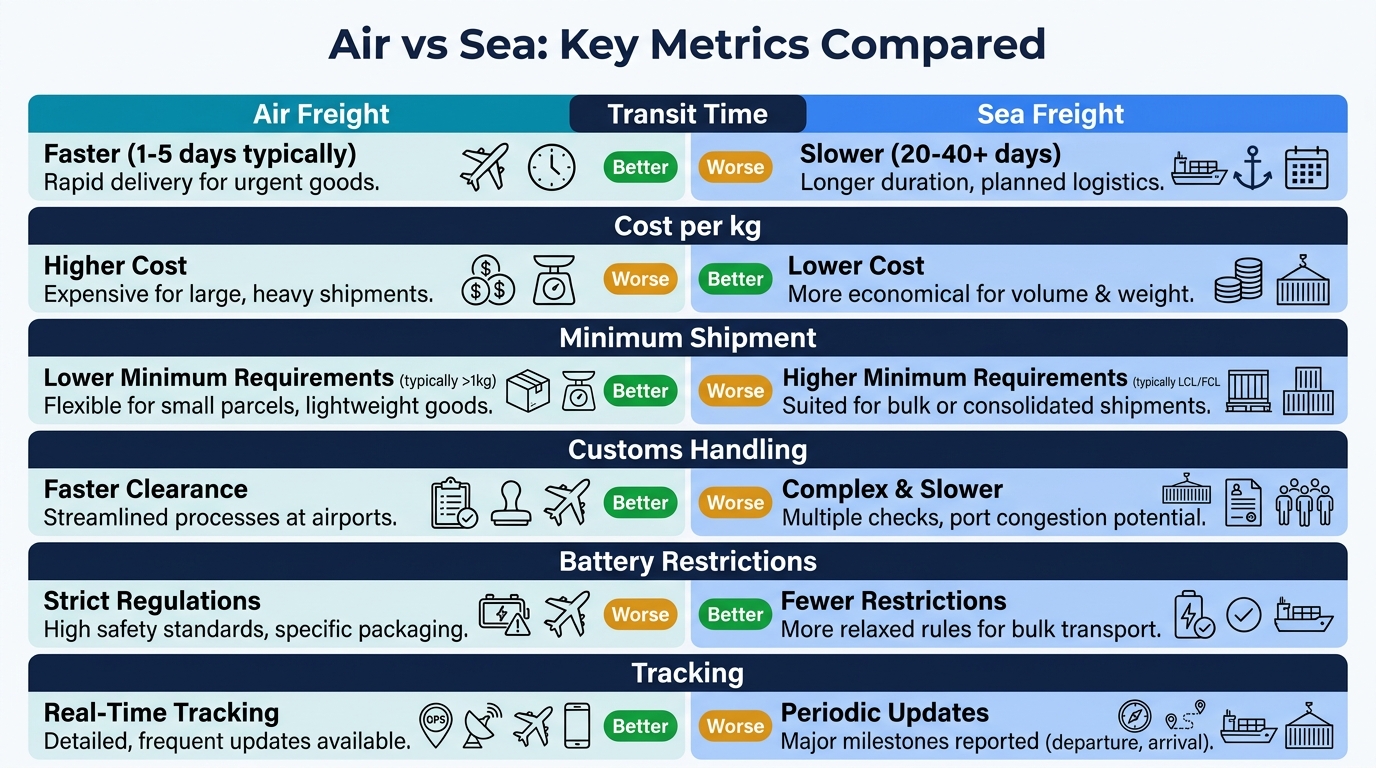
| Factor | Air Freight | Sea Freight |
|---|---|---|
| Transit time (China → US) | 3–7 business days | 25–40 days (port to port) + 5–10 days inland delivery |
| Transit time (China → UK/EU) | 3–5 business days | 30–45 days + customs clearance |
| Cost per kg | $6–15/kg (express courier) or $3–6/kg (air cargo) | $0.50–2/kg (but minimum charges apply) |
| Minimum shipment | No practical minimum (even 1 kg works) | 1 CBM minimum (~100–200 kg for phone parts) |
| Customs handling | Usually handled by courier (DHL, FedEx, UPS) | Requires customs broker or freight forwarder |
| Battery restrictions | Lithium batteries have strict air cargo limits (UN3481) | Fewer restrictions on lithium battery shipment |
| Tracking | Real-time, door-to-door | Limited — port-to-port tracking, less visibility |
| Insurance | Included in most courier shipments | Optional — must arrange separately |
| Best for | Orders under 100 kg, urgent restocks, first orders | Orders over 200 kg, routine restocks, price-sensitive orders |
When Air Freight Makes Sense for Phone Parts
Air freight is the default for most phone parts importers — and for good reason. Phone screens and batteries are lightweight relative to their value, which makes air freight's per-kg pricing less painful than it would be for heavier goods.
Use air freight when:
Your order is under 100 kg (roughly 50–150 screens) At this volume, air freight via DHL/FedEx typically costs $150–600 total shipping. Sea freight's minimum charges ($200–400 for less-than-container load) plus customs broker fees ($100–200) make it barely cheaper — and you wait an extra 3–4 weeks.
You need parts within a week When a popular model is out of stock and customers are waiting, the 25–40 day sea freight timeline isn't viable. Air freight gets parts on your shelf in 3–7 days from order confirmation.
It's your first order with a new supplier Small test orders (10–30 screens) should always go air freight. The speed lets you evaluate quality quickly, and the shipping cost is a minor part of a test order's total expense.
The order contains lithium batteries Air shipping of lithium batteries is possible but has strict IATA regulations (UN3481 for batteries packed with equipment, UN3480 for standalone batteries). Most established suppliers handle this packaging and documentation. Sea freight has fewer restrictions but takes longer — and batteries sitting in a hot container for 5 weeks isn't ideal for cell chemistry.
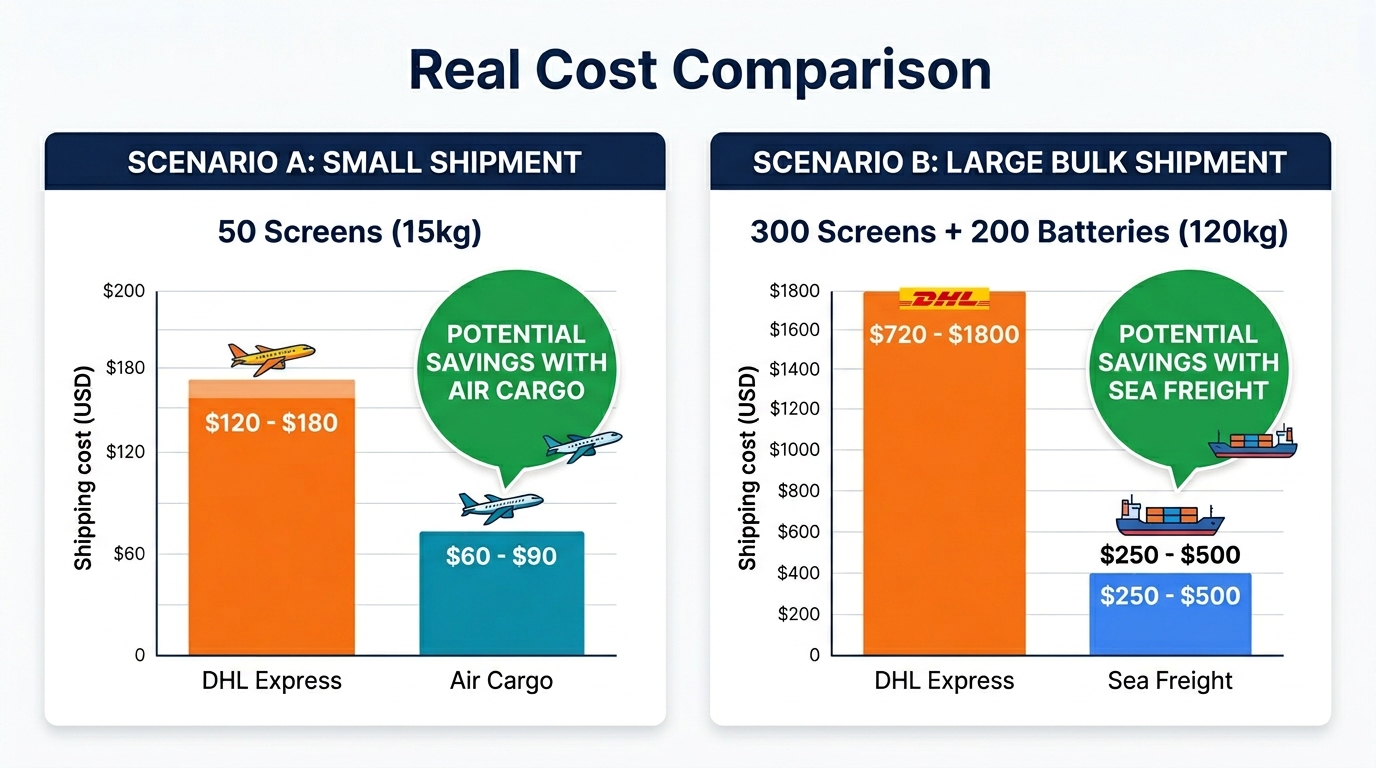
Real cost example: Air freight
Order: 50 iPhone 14 Incell screens (weight: ~15 kg, value: ~$750)
| Shipping Method | Cost | Transit | Total Landed |
|---|---|---|---|
| DHL Express | $120–180 | 4–5 days | $870–930 |
| Air cargo (via forwarder) | $60–90 | 7–10 days | $810–840 |
At this order size, air freight adds $1.20–3.60 per screen to your cost. That's a manageable markup that most shops absorb into their repair pricing.
When Sea Freight Makes Sense for Phone Parts
Sea freight becomes the better option when your order volume is large enough that the per-unit shipping savings outweigh the time cost and complexity.
Use sea freight when:
Your order exceeds 200 kg (roughly 300+ screens or mixed large orders) At 200+ kg, sea freight's per-kg cost advantage becomes significant: $100–400 total shipping vs. $600–3,000 for air. The savings per screen drops to $0.30–1.00 vs. $3–15 for air.
You're placing routine restock orders with predictable demand If you know you'll need 500 screens per month and can plan 5–6 weeks ahead, sea freight saves 40–60% on shipping. The key is having enough existing inventory to cover the longer lead time.
The order includes bulky accessories (cases, tools, packaging) Phone parts mixed with accessories, repair tools, or packaging materials push the total weight up quickly. Sea freight handles mixed cargo more cost-effectively.
You're importing to build initial inventory (not for immediate sale) When opening a new shop or expanding into new models, the initial inventory build doesn't need to arrive fast — it needs to arrive cheap. Sea freight lets you stock up at the lowest possible per-unit cost.
Real cost example: Sea freight
Order: 300 mixed screens + 200 batteries (weight: ~120 kg, value: ~$6,000)
| Shipping Method | Cost | Transit | Total Landed |
|---|---|---|---|
| DHL Express | $720–1,800 | 4–5 days | $6,720–7,800 |
| Sea freight (LCL) | $250–500 | 30–40 days | $6,250–6,500 |
| Sea freight + customs broker | $350–600 | 30–40 days | $6,350–6,600 |
Savings: $370–1,200 per shipment. Over 12 monthly orders, that's $4,400–14,400 per year in shipping cost reduction.
The Hidden Costs Most Buyers Miss
The sticker price for shipping isn't the full cost. These additional expenses affect which method is actually cheaper:
Air freight hidden costs:
- Fuel surcharge: DHL/FedEx add variable fuel surcharges (10–25% of base rate) that fluctuate monthly
- Remote area surcharge: Delivery addresses outside major metro areas incur extra fees ($20–40)
- Customs duties: Couriers handle customs clearance but charge a processing fee ($15–35) on top of actual duties
- Dimensional weight pricing: If your package is large but light, couriers charge by dimensional weight (L × W × H ÷ 5000) instead of actual weight — phone parts in oversized packaging can trigger this
Sea freight hidden costs:
- Customs broker fee: $100–250 per shipment if you don't handle clearance yourself
- Container handling charges: Port fees for loading/unloading ($50–150)
- Inland delivery: Getting the cargo from the port to your shop adds $100–300 depending on distance
- Demurrage: If you don't pick up cargo from the port within the free period (usually 3–5 days), storage fees apply ($30–75/day)
- Insurance: Not automatically included — add 0.5–1% of cargo value for coverage
The cost most people forget: inventory carrying cost
Sea freight saves on shipping but requires you to hold 4–6 weeks more inventory. That means more cash tied up in stock. For a shop with $10,000 in screen inventory, adding 5 weeks of buffer stock means $8,000–12,000 more capital locked up. If you're financing inventory, the interest cost on that extra capital partially offsets the shipping savings.
Not sure which shipping method fits your order? PRSPARES offers both air and sea freight options with transparent pricing — we'll recommend the best method based on your order size and urgency. Get a shipping quote.
The Hybrid Approach: How Established Shops Handle Shipping
The most cost-effective strategy for established repair shops isn't air freight or sea freight — it's both.
Monthly routine restock → Sea freight Place your predictable monthly order (screens you know you'll sell, batteries for popular models) via sea freight 5–6 weeks before you need them. This covers 70–80% of your inventory needs at the lowest per-unit shipping cost.
Urgent restocks and new models → Air freight When a model sells out unexpectedly, or a new iPhone launches and demand spikes, air-freight a smaller emergency order to bridge the gap until your next sea shipment arrives. This covers the 20–30% of demand you couldn't predict.
Test orders and new suppliers → Always air freight Every new supplier relationship starts with a small, air-freighted test order. Speed matters here — you want to evaluate quality quickly, not wait 5 weeks for a sample that might be disappointing.
For the full framework on test orders, see our guide on how to use a test order to evaluate a phone parts supplier. For payment methods that work with both shipping modes, see paying a China phone parts supplier.
Frequently Asked Questions
Can I ship phone batteries by air freight?
Yes, but with restrictions. Lithium-ion batteries are classified as dangerous goods for air transport under IATA regulations. They must be shipped as UN3481 (packed with equipment) or UN3480 (standalone), with proper packaging, labeling, and documentation.
Most established phone parts suppliers handle this compliance automatically — they ship batteries via DHL/FedEx using approved packaging daily. If a supplier says they "can't ship batteries by air," they likely lack the proper dangerous goods certification, which is a concern about their overall logistics capability.
What customs duties apply to phone parts?
Customs duties vary by destination country and product classification. In the US, phone screens and parts are typically classified under HS code 8517 (telephone parts) with duties of 0–3.4%. In the UK/EU, the same products face 0–2.5% duty plus VAT (20% UK, 19–25% EU). Your customs broker or courier will calculate exact duties based on the declared value and product classification. For a detailed breakdown, see our guide on UK & EU import phone parts from China.
At what order size should I switch from air to sea freight?
The breakeven point for phone parts is typically around 150–200 kg (approximately 200–400 screens). Below that, sea freight's minimum charges and customs broker fees make it comparable to air freight in total cost — but much slower. Above 200 kg, sea freight saves 40–60% on shipping per unit. The exact breakeven depends on your route (China to US West Coast is cheaper by sea than China to UK) and your courier rates (negotiated DHL rates are cheaper than published rates).
Should I use my supplier's shipping account or arrange my own?
For orders under 100 kg, use your supplier's DHL/FedEx account — they ship daily and get volume-discounted rates you can't match individually. For sea freight or large air cargo shipments (200+ kg), consider using your own freight forwarder. A forwarder gives you more control over routing, carrier selection, and customs clearance — and their rates for consolidated shipments are often better than your supplier's one-off quotes.
Choose Your Shipping Method by Order Stage
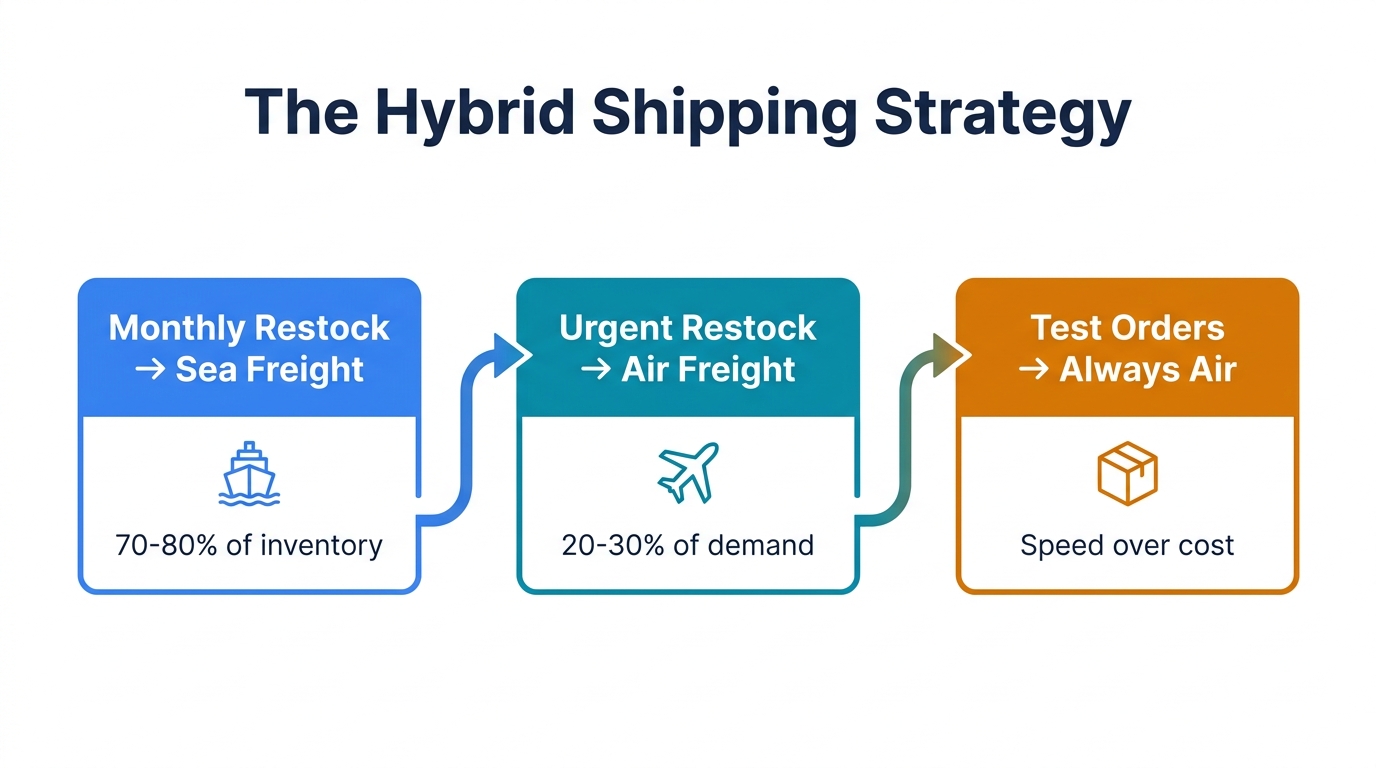
The air freight vs sea freight phone parts decision maps directly to your business stage. Starting out and testing suppliers? Air freight, every time. Running a stable shop with predictable monthly demand? Shift your base inventory to sea freight and use air for exceptions. Scaling aggressively with large monthly orders? A freight forwarder managing both modes gives you the best cost and flexibility.
The mistake is treating shipping as an afterthought. For phone parts imported from China, shipping cost is 5–15% of your landed cost — optimizing it is as valuable as negotiating a $1 better price per screen.
Ready to optimize your shipping costs? PRSPARES offers both air and sea freight with pre-calculated landed costs so you can compare methods before ordering. Get a quote with shipping options.
Related reading: UK & EU Import Phone Parts from China | MOQ, Sample Orders, and Lead Time for Wholesale Phone Parts