
iPhone Charging Port Replacement Cost UK: What Repair Shops Charge (and What Parts Cost Wholesale)
For UK repair shops, iPhone charging port jobs are high-volume and usually straightforward — but the shift from Lightning to USB-C on the iPhone 15 changed the parts economics in ways that catch shops out. The USB-C sub-board costs roughly double a Lightning flex cable at wholesale, the repair takes longer, and shops that haven't updated their pricing are leaving margin on the table.
This guide breaks down what the market currently charges, what parts actually cost at wholesale by grade and connector type, and how to price these jobs profitably — whether you're handling a £45 iPhone 13 clean or a £85 iPhone 15 Pro port swap.
Need Charging Port Flex in Bulk?
Wholesale charging port assemblies for iPhone & Samsung — tested, factory-direct.
Get Wholesale QuoteiPhone Charging Port Repair Prices UK (2026)
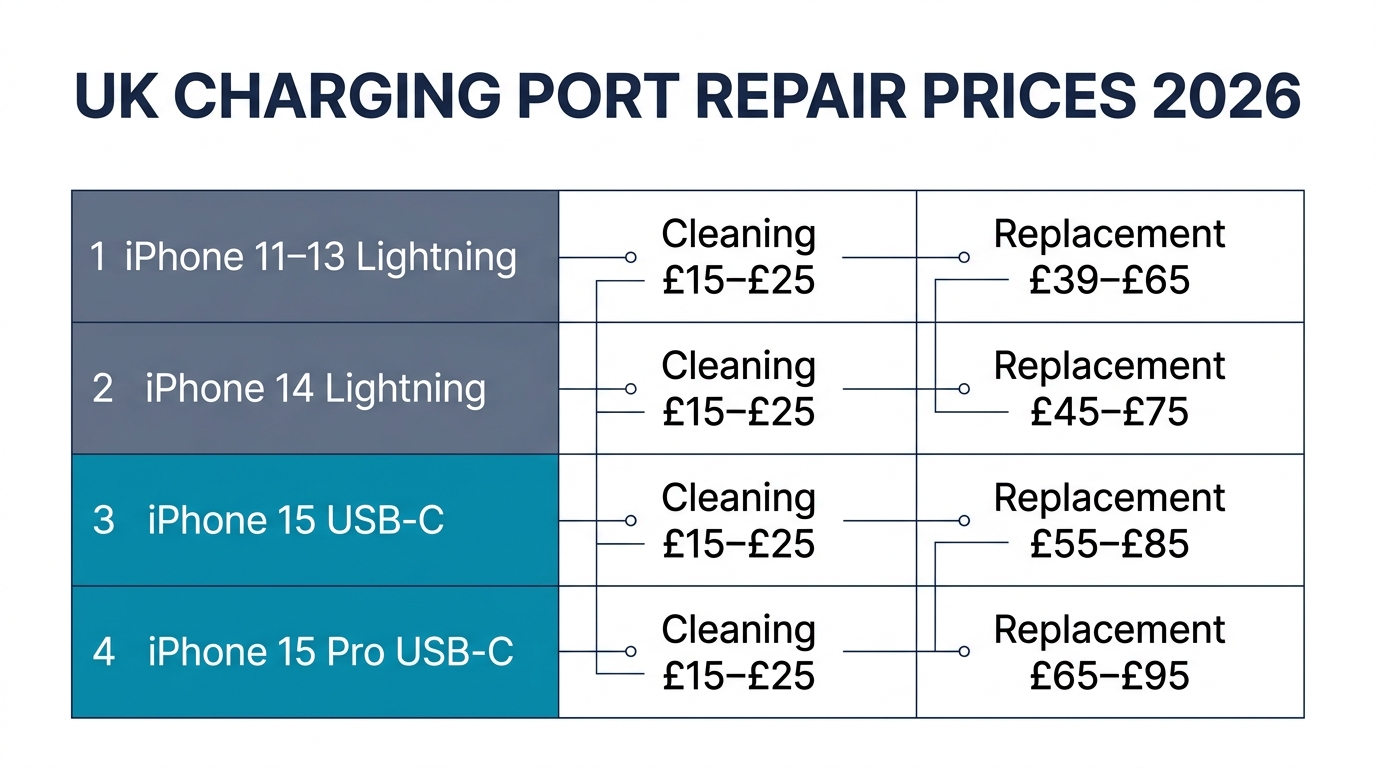
The table below reflects typical independent repair shop pricing across the UK, based on publicly listed prices from multiple shops:
| iPhone Model | Port Type | Cleaning Only | Full Replacement | Apple Store |
|---|---|---|---|---|
| iPhone 11, 12, 13 | Lightning | £15–£25 | £39–£65 | ~£79–£145 |
| iPhone 14, 14 Plus | Lightning | £15–£25 | £45–£75 | ~£95–£145 |
| iPhone 15, 15 Plus | USB-C | £15–£25 | £55–£85 | ~£145–£195 |
| iPhone 15 Pro, Pro Max | USB-C | £15–£25 | £65–£95 | ~£145–£195 |
A few things to note here. First, cleaning is often offered free or at a small fee — many shops use this as a first diagnostic step before committing to a full replacement. Second, the iPhone 15 series is notably more expensive than older Lightning models because the USB-C port assembly is a different component with a higher parts cost. Third, Apple's prices are approximate — Apple UK uses an inspection-based personalised quote system for out-of-warranty repairs rather than a fixed price list, so actual Apple charges may vary. The figures above reflect commonly cited market estimates.
Cleaning vs Replacement: A Margin-Protection SOP
Most iPhone charging port faults are caused by compacted debris, not component failure. Getting this triage right protects your bench time and your reputation — replacing a port that only needed a clean wastes a £10–25 part and 45 minutes; charging for a clean that doesn't fix a dead port loses the customer.
Charge for cleaning only (£15–£25) when you see:
- Visible lint compacted at the back of the port
- Intermittent charging that improves when the cable is wiggled
- Device that worked fine until recently with no drop or liquid exposure
Escalate to full replacement when:
- Bent or broken pins visible under magnification
- Signs of liquid damage or corrosion on the port contacts
- No connection at all regardless of cable, with a clean port interior
- Cleaning had no effect after a thorough attempt
Cleaning takes 5–10 minutes and costs almost nothing in consumables. A Lightning port swap takes 30–60 minutes. A USB-C sub-board on the iPhone 15 is more involved — the assembly is soldered to a sub-board that on some models requires partial disassembly of the rear camera module — and should be priced accordingly.
What Parts Actually Cost: Lightning vs USB-C
Here's what's largely missing from most UK pricing guides: the wholesale cost of the parts themselves. This matters both for repair shops setting prices and for customers understanding why iPhone 15 repairs cost more than iPhone 13 repairs.
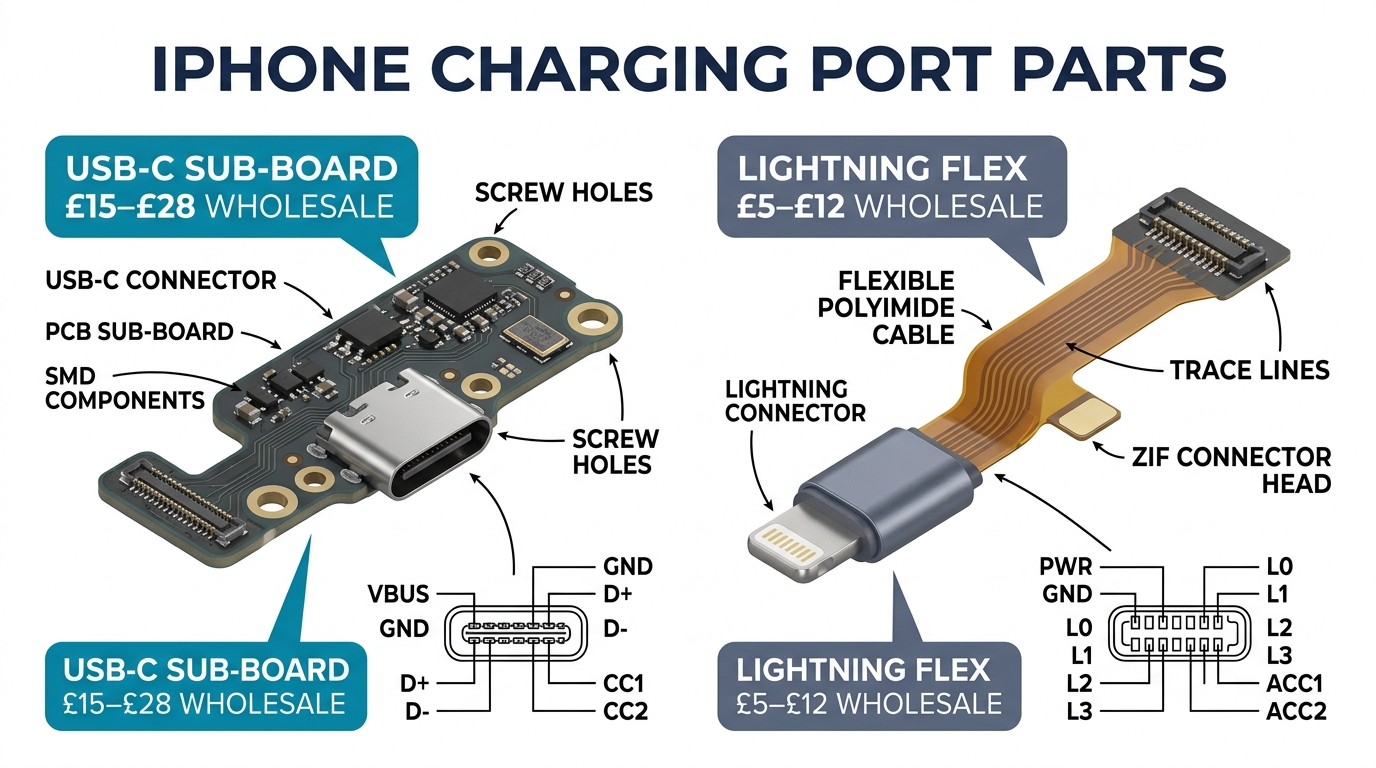
Lightning charging port flex cable (iPhone 11–14):
- Wholesale cost: approximately £5–£12 per unit depending on grade and supplier
- Compatible with iPhone 11, 12, 13, 14 series
- OEM-grade (original pulled): £10–£18
- Aftermarket (compatible): £5–£8
USB-C port sub-board (iPhone 15 series):
- Wholesale cost: approximately £15–£28 per unit
- The USB-C design integrates more components, including the antenna, microphone, and in some models the SIM tray — which is why the part costs more
- OEM-grade: £22–£30
- Aftermarket (compatible): £15–£22
This cost difference explains the £15–£25 premium you typically see on iPhone 15 charging port repairs vs older Lightning models. The part is simply more expensive, and the job often takes longer.
If you're a repair shop buying in volume, the economics shift in your favour. At 50+ units, compatible USB-C sub-boards drop to the lower end of that range, and OEM-pull Lightning cables can be sourced for under £8 with a consistent supplier. A repair shop sourcing parts properly and charging £65–£75 for an iPhone 15 charging port replacement is working with a gross margin of roughly £40–£55 on the part alone — before labour.
For UK repair shops looking to source wholesale phone parts at competitive prices, the key is finding a supplier who separates OEM-pull from compatible parts clearly, rather than labelling everything "original quality."
iPhone 15 and the USB-C Shift: What Changes for Repair Shops
The iPhone 15 was the first standard iPhone to use USB-C, replacing the Lightning connector Apple had used since 2012. For repair shops, this changes a few things worth flagging:
Different SKU, higher cost. Lightning flex cables are model-specific — you already stock separate SKUs for iPhone 11, 12, 13, and 14 variants. iPhone 15 charging port sub-boards are an entirely different part family: more expensive, integrated differently, and the repair procedure varies by model (Pro models in particular require more disassembly).
Cable damage is more common. In the early Lightning era, the most common cause of port failure was lint. With USB-C on iPhones — which now comes in contact with every USB-C cable the customer owns, including third-party cables of varying quality — pin damage from incompatible cables is becoming a more frequent cause. If you're seeing this regularly, our guide to charging port failures after replacement covers how to diagnose whether the problem is the port, the cable, or a board-level fault.
Cleaning procedure is similar. Lint compaction and debris are still the most common culprit — the advice on careful non-metal cleaning tools applies to USB-C just as it did to Lightning.
For Repair Shops: Setting Prices That Make Sense
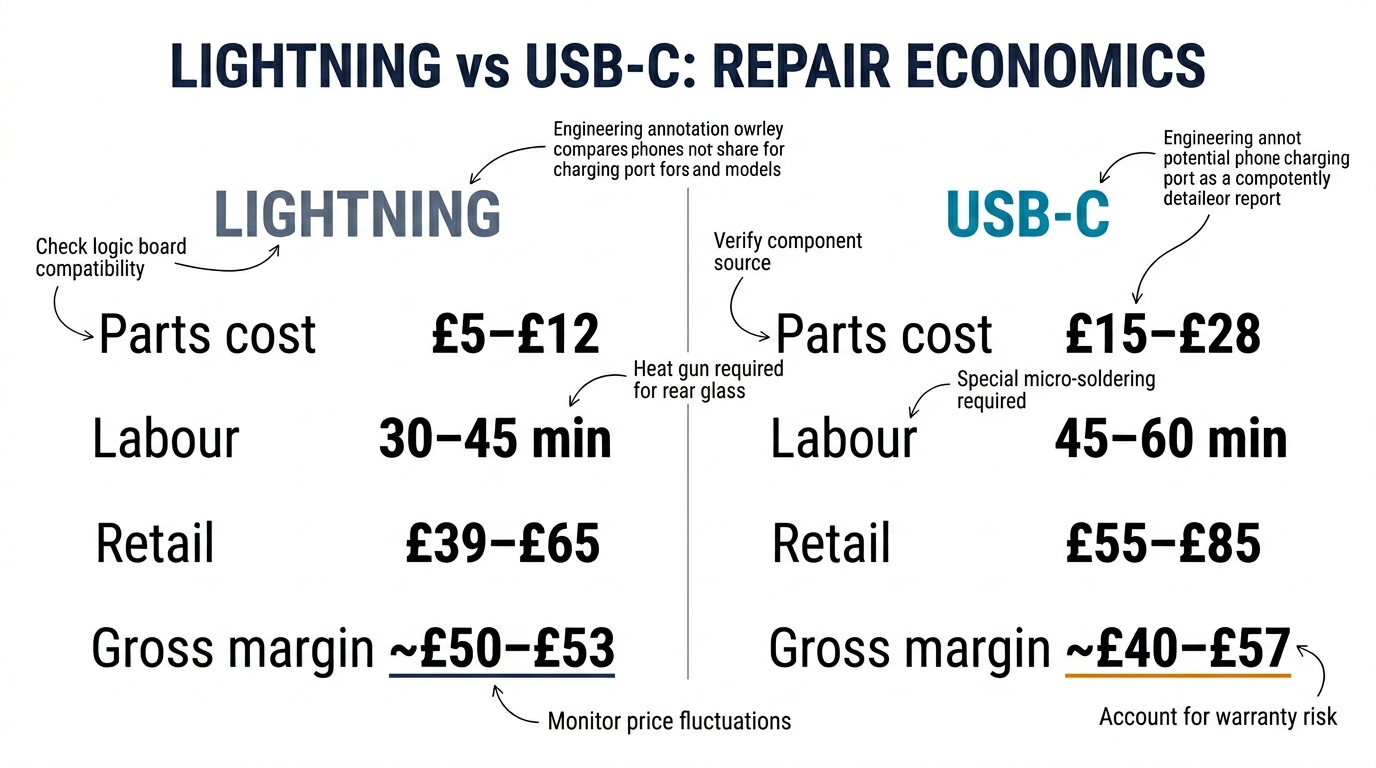
Based on the parts costs above, here's how to think about pricing iPhone charging port repairs profitably:
| Job | Parts cost | Labour (30-60 min) | Suggested retail | Margin |
|---|---|---|---|---|
| Cleaning only | £0–£1 (consumables) | 10 min | £15–£25 | High |
| Lightning replacement (iPhone 11–14) | £5–£12 | 30–45 min | £39–£65 | Strong |
| USB-C replacement (iPhone 15+) | £15–£25 | 45–60 min | £55–£85 | Solid |
A few notes on pricing strategy. Don't compete at the very bottom of the market on this repair — £35 for an iPhone 14 charging port replacement implies you're using the cheapest compatible flex cable available, and the failure rate on those is meaningfully higher. The callback rate is not worth the volume.
On the other hand, charging £90+ for a Lightning replacement on a phone worth £200 at resale needs a justification the customer can understand — if you're using OEM-pull parts, say so explicitly.
If your shop is experiencing higher-than-expected failure rates on charging port repairs — loose connections after replacement, slow charging, or recurring faults — sourcing is the most common root cause. See our guide to diagnosing charging port problems after replacement for how to trace failures back to part quality vs. installation technique.
Frequently Asked Questions
How should I price iPhone 15 USB-C repairs vs older Lightning models? The USB-C sub-board costs roughly £15–£25 at wholesale versus £5–£12 for Lightning flex cables — plus the labour is typically 15–20 minutes longer on the iPhone 15 series due to the integrated sub-board assembly. Most shops charge £10–£20 more for iPhone 15 charging port jobs than equivalent Lightning model repairs to reflect this. If your Lightning and USB-C pricing are currently the same, you're likely leaving margin on the table.
How do I handle charging port callbacks after replacement? The most common post-repair complaint is intermittent disconnection that isn't the port at all — it's the customer's cable. Before assuming a fault, have the customer test with a known-good cable. If the problem persists with a quality cable, check for board-level issues (slow charging, heat during charge, charging only at certain angles). True port failures post-replacement are usually sourcing-related — cheaper compatible flex cables have measurably higher failure rates than OEM-pull parts.
When should I advise a customer to repair vs replace an older iPhone? A useful rule of thumb: if the repair cost exceeds 40–50% of the device's resale value, flag it to the customer before proceeding. On an iPhone 11 or 12, a £45–£55 charging port repair is typically worth it. On an iPhone 7 or 8 worth £40–£60 at resale, the economics often don't stack up. Flagging this proactively protects customer trust and reduces the chance of a complaint after a repair on a device with other underlying faults.
Is offering wireless charging as a bridge solution worth mentioning? Yes — for customers whose port is fully dead while waiting on parts or a booking slot, mentioning Qi (iPhone 8+) or MagSafe (iPhone 12+) as a temporary solution takes minimal time and consistently generates goodwill. Some shops have turned it into a small accessory upsell.
Getting Parts at Wholesale Prices

For UK repair shops looking to source charging port parts — Lightning flex cables, USB-C sub-boards, or mixed-model orders — PRSPARES supplies both OEM-pull and compatible grades with clear labelling.
We ship to UK repair shops with no minimum order requirement on first trial orders. If you're replacing more than 5–10 charging ports per month, buying in small batches (10–20 units) at wholesale cost will meaningfully improve your margins versus sourcing from local distributors.
Browse the wholesale charging ports & small parts catalog, or request a wholesale quote for charging port parts →
Internal links: Wholesale phone parts supplier UK · Charging port failures after replacement · iPhone charging port replacement guide