
Back Glass Replacement iPhone: Cost, Methods, and Best Parts to Use
Back glass replacement iPhone repairs are among the trickiest and most confusing to price shop in the mobile industry. Apple charges $159–$199 for the job. Third-party shops range from $50 to $180. And the DIY route? It depends entirely on whether you have access to a laser machine or plan to swap the entire rear housing assembly.
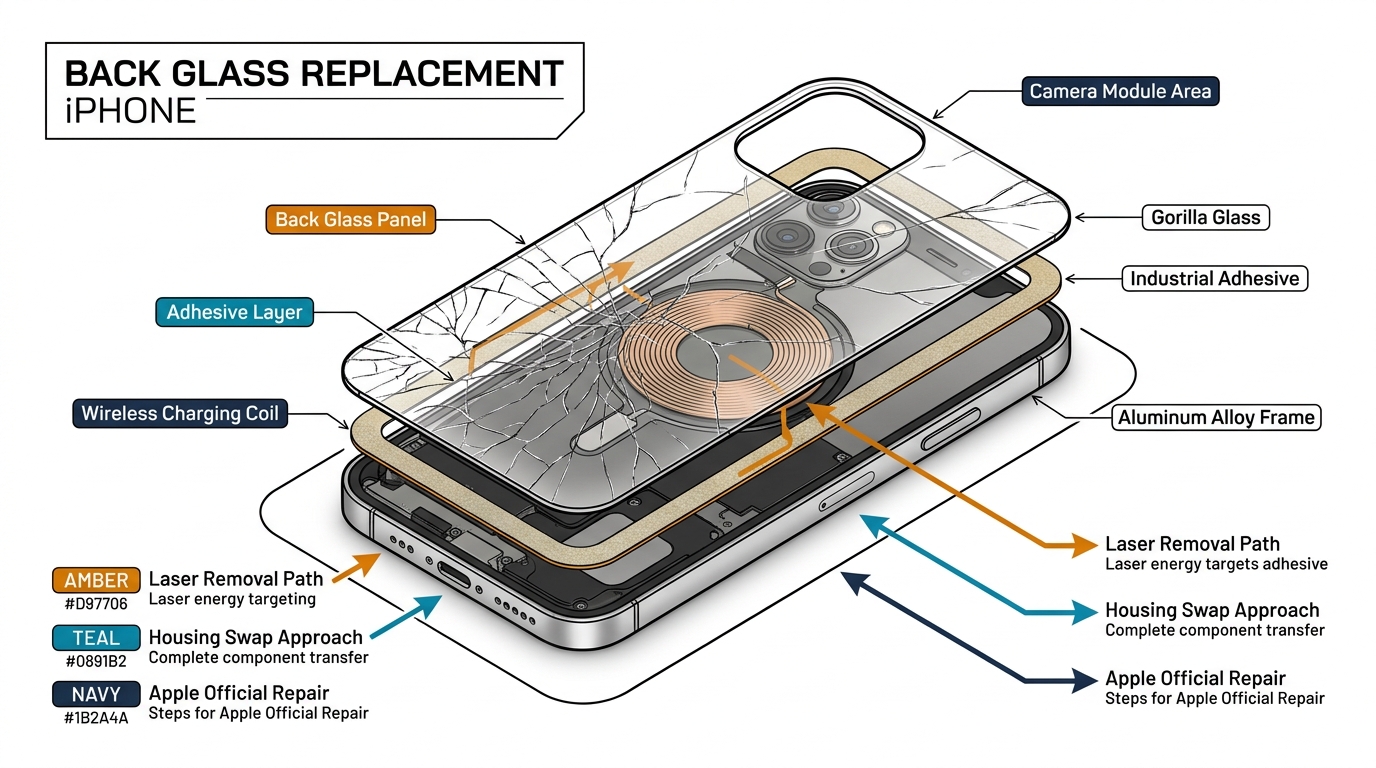
The reason back glass repair is complicated is that Apple bonds the glass directly to the frame with industrial adhesive starting from iPhone 8. There's no clip, no screw, and no easy way to peel it off. That's why three completely different repair methods exist — each with different costs, risks, and outcomes.
This guide covers all three back glass replacement methods for every iPhone model from 8 through 16, with real pricing data, parts cost breakdowns, and practical advice on choosing the right approach for your situation and budget.
Sourcing iPhone Back Glass in Bulk?
Factory-direct back glass for all iPhone models — wholesale pricing, fast lead time.
Get Wholesale QuoteBack Glass Replacement iPhone Cost by Model (2026)
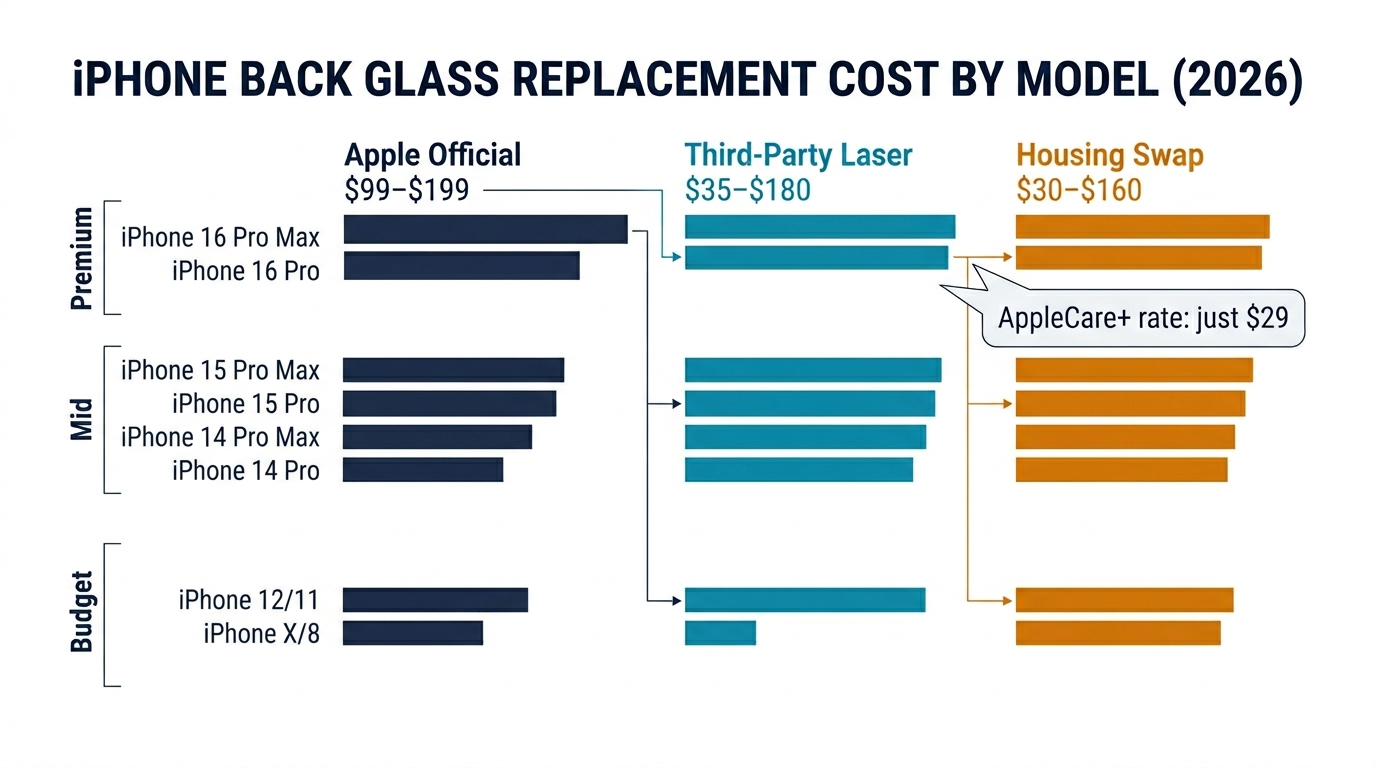
Pricing varies significantly by model, repair method, and where you go. Here's what to expect:
| iPhone Model | Apple Official | Third-Party (Laser) | Third-Party (Housing Swap) |
|---|---|---|---|
| iPhone 16 Pro Max | $199 | $120–$180 | $100–$160 |
| iPhone 16 Pro | $199 | $110–$170 | $90–$150 |
| iPhone 16 / Plus | $169 | $100–$150 | $80–$130 |
| iPhone 15 Pro Max | $199 | $100–$160 | $90–$140 |
| iPhone 15 Pro | $199 | $100–$150 | $80–$130 |
| iPhone 15 / Plus | $169 | $90–$140 | $70–$120 |
| iPhone 14 Pro Max | ~$549* | $90–$140 | $80–$120 |
| iPhone 14 Pro | ~$549* | $80–$130 | $70–$110 |
| iPhone 14 / Plus | $149 | $70–$120 | $60–$100 |
| iPhone 13 Pro Max | $149 | $70–$110 | $60–$100 |
| iPhone 13 / Pro | $149 | $60–$100 | $50–$90 |
| iPhone 12 / Pro / Max | $149 | $60–$100 | $50–$90 |
| iPhone 11 Pro Max | $149 | $50–$90 | $50–$80 |
| iPhone 11 Pro | $149 | $50–$80 | $40–$70 |
| iPhone 11 | $99 | $40–$70 | $40–$60 |
| iPhone X / XS / XR | $99 | $40–$60 | $35–$55 |
| iPhone 8 / 8 Plus | $99 | $35–$55 | $30–$50 |
*Models without a removable back panel — the iPhone 14 Pro / Pro Max and everything from iPhone 13 backward — have no glass-only repair at Apple. Rear glass damage on those models is billed at Apple's "other damage" tier (a full rear system replacement, roughly $349–$599 depending on model), so the lower figures shown for older models apply only where Apple still quotes a back-glass service. Apple's pricing includes genuine parts, full adhesive reapplication, and a 90-day warranty. Third-party laser pricing covers laser glass removal and new glass panel bonding. Housing swap pricing includes a replacement rear housing assembly with all components transferred from your original phone.
iPhone 14 Pro Max Back Glass Replacement: Cost, Method, and Parts
The iPhone 14 Pro Max is one of the most common back glass replacement requests — and, importantly, it is the exception in the modern lineup. Apple's removable rear panel design (two screws plus a battery disconnect) applies to the iPhone 14 and 14 Plus, and to every iPhone 15 and 16 model — but the 14 Pro and 14 Pro Max never received it. Their glass is still bonded directly to the stainless steel chassis, so this model requires laser separation, full disassembly, or a rear housing swap, just like older iPhones.
iPhone 14 Pro Max back glass replacement cost (2026):
| Repair Route | Price |
|---|---|
| Apple Official (billed as "other damage" — no glass-only repair for this model) | ~$549 |
| Third-party laser (glass-only) | $90–$140 |
| Third-party full housing swap | $80–$120 |
For shops with laser equipment, the glass-only route is the better choice on the 14 Pro Max — it preserves the original stainless steel frame, IMEI engraving, and regulatory markings, and the phone stays assembled throughout. Without a laser, the housing swap is the practical route; reserve it also for cases where the frame itself is bent or deeply gouged.
One model-specific caution: the 14 Pro Max uses a stainless steel Pro frame, which reflects laser energy differently than the aluminum frames on standard models. Start with lower laser power and test your settings first — incorrect calibration can leave permanent heat marks that can't be polished out.
Parts cost: a glass-only panel for the 14 Pro Max is only a few dollars at wholesale, while a complete rear housing assembly runs $15–$30 wholesale ($30–$60 retail). Sourcing OEM-quality panels with pre-applied adhesive keeps installation clean and avoids the color mismatch common on cheap Pro-finish housings.
Three Methods for iPhone Back Glass Replacement
Not all back glass repairs are the same. The method used affects cost, durability, and final appearance.
Method 1: Laser Glass Removal
A specialized laser machine heats and separates the bonded glass from the aluminum frame without removing internal components. The broken glass is vaporized layer by layer, the adhesive residue is cleaned off, and a new glass panel is bonded in place.
Pros:
- Preserves the original frame and all markings (IMEI, regulatory text)
- Fastest method — typically 30–60 minutes
- Best cosmetic result when done properly
- No risk to internal components since the phone stays assembled
Cons:
- Requires a $3,000–$15,000 laser machine — not available at every shop
- Operator skill matters: incorrect settings can overheat the frame or damage the wireless charging coil
- New glass panel must be color-matched precisely — slight shade differences between aftermarket panels and original Apple glass exist
Best for: Shops with laser equipment that want to offer premium repairs, and customers who want the cleanest possible result.
Method 2: Full Rear Housing Swap
The phone is completely disassembled, and every component — logic board, battery, cameras, buttons, speakers — is transferred to a new rear housing assembly that comes with back glass pre-installed.
Pros:
- No specialized laser equipment needed — standard repair tools work
- Results in a like-new rear appearance including fresh side rails
- Solves additional issues like dented frames or scratched side rails
Cons:
- Most time-intensive method — 60–120 minutes depending on model
- Higher risk of damage during component transfer, especially to flex cables
- Aftermarket housings vary in quality: cheap ones have poor button fitment, misaligned camera rings, or incorrect color matching
- The phone's water resistance seal is almost impossible to fully restore
Best for: Older models (iPhone 8–12) where laser equipment isn't justified, or situations where the frame is also damaged.
Method 3: Apple Official Repair
Apple replaces the rear system — in many cases, this means replacing the entire back housing plus glass as a single unit. On models with the removable panel design (iPhone 14/14 Plus and all iPhone 15/16), back glass-only replacement is possible without a full housing swap.
Pros:
- Genuine Apple parts with precise color and fit
- Full water resistance restored
- 90-day warranty on the repair
- Preserves remaining AppleCare+ coverage
Cons:
- Most expensive option: $99–$199 without AppleCare+ on models with removable panels, but roughly $349–$599 ("other damage" tier) on iPhone 13 and older and the 14 Pro/Pro Max; $29 with AppleCare+
- Requires appointment, potential wait time
- Turnaround can be 1–5 days for in-store, longer for mail-in
Best for: Phones still under AppleCare+ (where the $29 rate makes it the obvious choice), or newer models where water resistance preservation matters. Also the right choice if you plan to trade in through Apple, as they verify genuine parts during trade-in evaluation.
Which iPhone Models Are Hardest to Repair?
The difficulty of back glass replacement varies dramatically across iPhone generations. This matters for both DIY users and repair shops planning which services to offer.
Easier Models (iPhone 14/14 Plus and All iPhone 15/16)
Starting with the standard iPhone 14 and 14 Plus, Apple changed the internal design to make the back glass removable without full disassembly — a deliberate right-to-repair concession that extended to every iPhone 15 and 16 model. The back panel is secured with adhesive but accessible by removing two screws and disconnecting the battery. Note the exception: the iPhone 14 Pro and 14 Pro Max kept the older bonded design and belong with the moderate-difficulty group below.
For repair shops, this makes laser removal optional — you can heat the adhesive and separate the glass with hand tools, though laser still gives cleaner results. Replacement glass panels for iPhone 14–16 are widely available and relatively affordable.
Moderate Difficulty (iPhone 12–13 Series and 14 Pro/Pro Max)
These models have the glass bonded to a flat-edge frame — aluminum on standard models, stainless steel on the Pros. Laser removal works well but requires careful calibration around the camera module area where the glass is thickest. Housing swaps are straightforward but time-consuming due to the number of components.
Hardest Models (iPhone 8–11 Series)
The curved-edge design on iPhone 8, X, XS, XR, 11, and 11 Pro makes laser removal more challenging — the glass wraps slightly around the edge, and the adhesive bond is exceptionally strong. Many shops default to housing swaps for these models.
The iPhone 11 standard model has an additional complication: the rear camera module sits under the glass, making laser work near the lens area risky. Many experienced technicians prefer housing swaps for the entire iPhone 8–11 range because the time spent carefully lasering curved edges often exceeds the time needed for a full component transfer.
Model-Specific Notes for Repair Shops
iPhone 14/14 Plus and iPhone 15/16 (removable back glass): Apple's redesign means you can offer back glass replacement without a laser at all — heated adhesive separation with hand tools works. This opened the repair to shops that previously couldn't justify a laser machine purchase. The replacement glass panels for these models include pre-applied adhesive strips for clean installation.
iPhone 12/13/14 Pro (stainless steel frame): Be careful with laser settings — the stainless steel frame on these Pro models reflects laser energy differently than aluminum. Incorrect calibration can leave visible heat marks on the frame that are impossible to remove. Start with lower power settings and increase gradually.
iPhone X/XS (glass sandwich design): These were the first iPhones with glass backs, and the glass is thinner than later models. Laser removal has a higher cracking risk on the replacement panel if too much heat is applied. Many shops add a $10–$15 surcharge for these models to cover the higher part wastage rate.
What Back Glass Parts Actually Cost
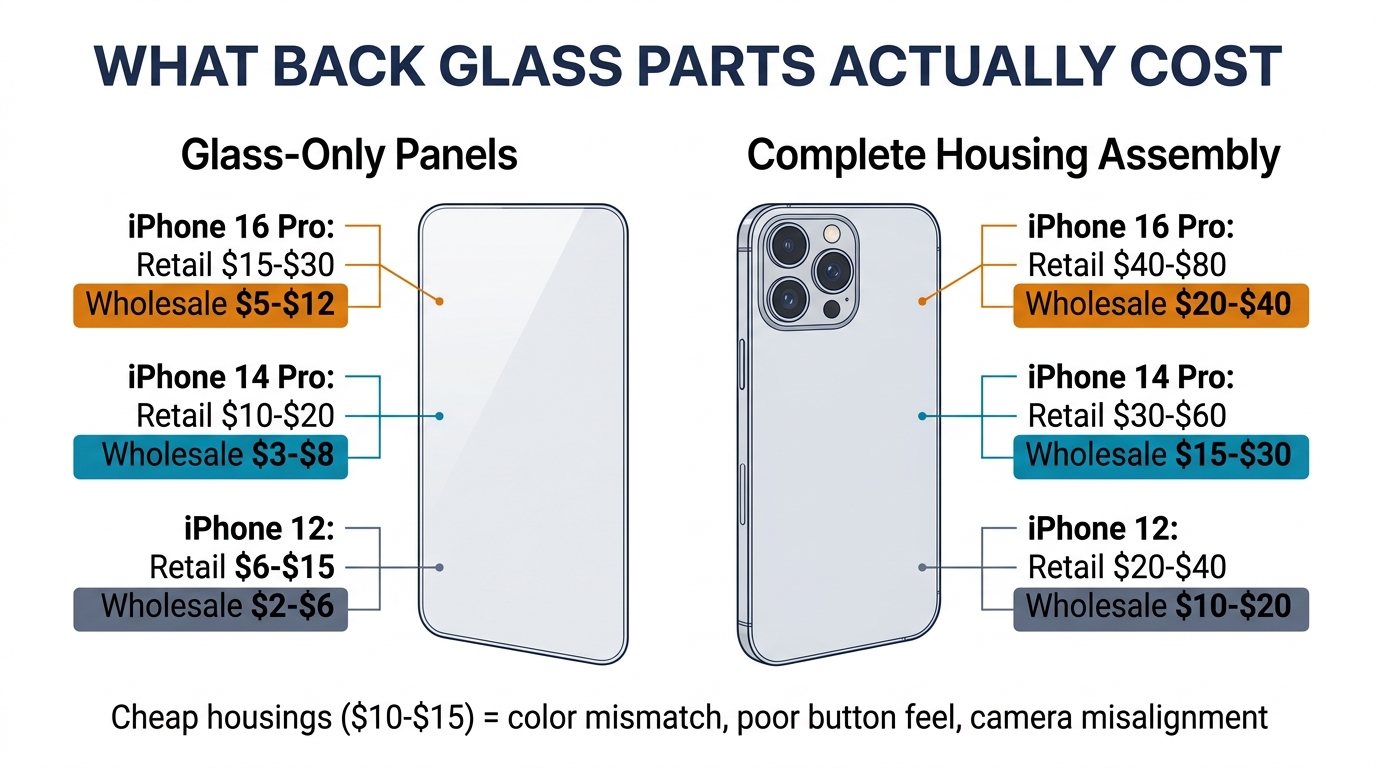
Understanding part costs helps you evaluate whether a repair shop's quote is reasonable — and helps repair shop owners optimize their sourcing.
Aftermarket Glass-Only Panels
These are just the back glass with the logo and text printed on it. They require laser removal of the old glass before installation.
| Model Range | Part Cost (Retail) | Part Cost (Wholesale) |
|---|---|---|
| iPhone 16 Pro / Pro Max | $15–$30 | $5–$12 |
| iPhone 15 Pro / Pro Max | $12–$25 | $4–$10 |
| iPhone 14 Pro / Pro Max | $10–$20 | $3–$8 |
| iPhone 13 Pro / Pro Max | $8–$18 | $3–$7 |
| iPhone 12 series | $6–$15 | $2–$6 |
| iPhone 11 / X series | $5–$12 | $2–$5 |
Complete Rear Housing Assemblies
These include the frame, back glass, buttons, and small parts pre-installed. You transfer the logic board, battery, cameras, and display.
| Model Range | Part Cost (Retail) | Part Cost (Wholesale) |
|---|---|---|
| iPhone 16 Pro / Pro Max | $40–$80 | $20–$40 |
| iPhone 15 Pro / Pro Max | $35–$70 | $18–$35 |
| iPhone 14 Pro / Pro Max | $30–$60 | $15–$30 |
| iPhone 13 Pro / Pro Max | $25–$50 | $12–$25 |
| iPhone 12 series | $20–$40 | $10–$20 |
| iPhone 11 / X series | $15–$35 | $8–$18 |
Quality variation is significant. Cheap aftermarket housings ($10–$15 wholesale) often have:
- Color mismatch with the original Apple finish (especially on Pro models with brushed titanium or stainless steel)
- Poor button tactile feel — buttons stick or feel mushy
- Camera ring misalignment that makes the phone look obviously and poorly repaired
- Missing or incorrect regulatory text printing
Mid-range housings ($20–$35 wholesale) typically solve these issues. For repair shops, spending an extra $10–$15 per unit on better housings dramatically reduces customer complaints and the "it doesn't look right" callbacks.
If you're sourcing back glass panels or housing assemblies in bulk, working with a wholesale supplier that offers quality inspection across its parts inventory ensures consistent results. The same quality grading principles that apply to screens apply to housings — not all aftermarket is equal.
Should You Fix Your Cracked iPhone Back Glass?
The decision depends on three important factors to carefully consider:
1. Is wireless charging affected? A cracked back glass doesn't immediately break wireless charging, but if fragments are missing or the cracks are deep, the charging coil underneath can be exposed to moisture and dust. Over time, this leads to charging failures.
2. What's the phone worth? Compare the repair cost to the phone's trade-in or resale value. For any iPhone 13 or newer, the repair cost is well under 25% of the phone's value — an easy yes. For an iPhone 11 or older, the math gets tighter.
3. Does it affect your case fit? Sharp glass edges from cracks can cut through thin phone cases, and missing glass chunks make the phone sit unevenly in cases. If you're using the phone without a case, the aesthetic and comfort impact is immediate.
For most iPhone 12 and newer models, the answer is yes — repair the back glass. The cost is reasonable, the phone retains significantly more resale value intact, and the exposed internals are a moisture risk.
For iPhone 11 and older, consider whether you plan to keep the phone more than six months before spending $60–$100 on the repair. If you just need protection without the cosmetic fix, a quality phone case covers the cracks and prevents further damage at a fraction of the repair cost.
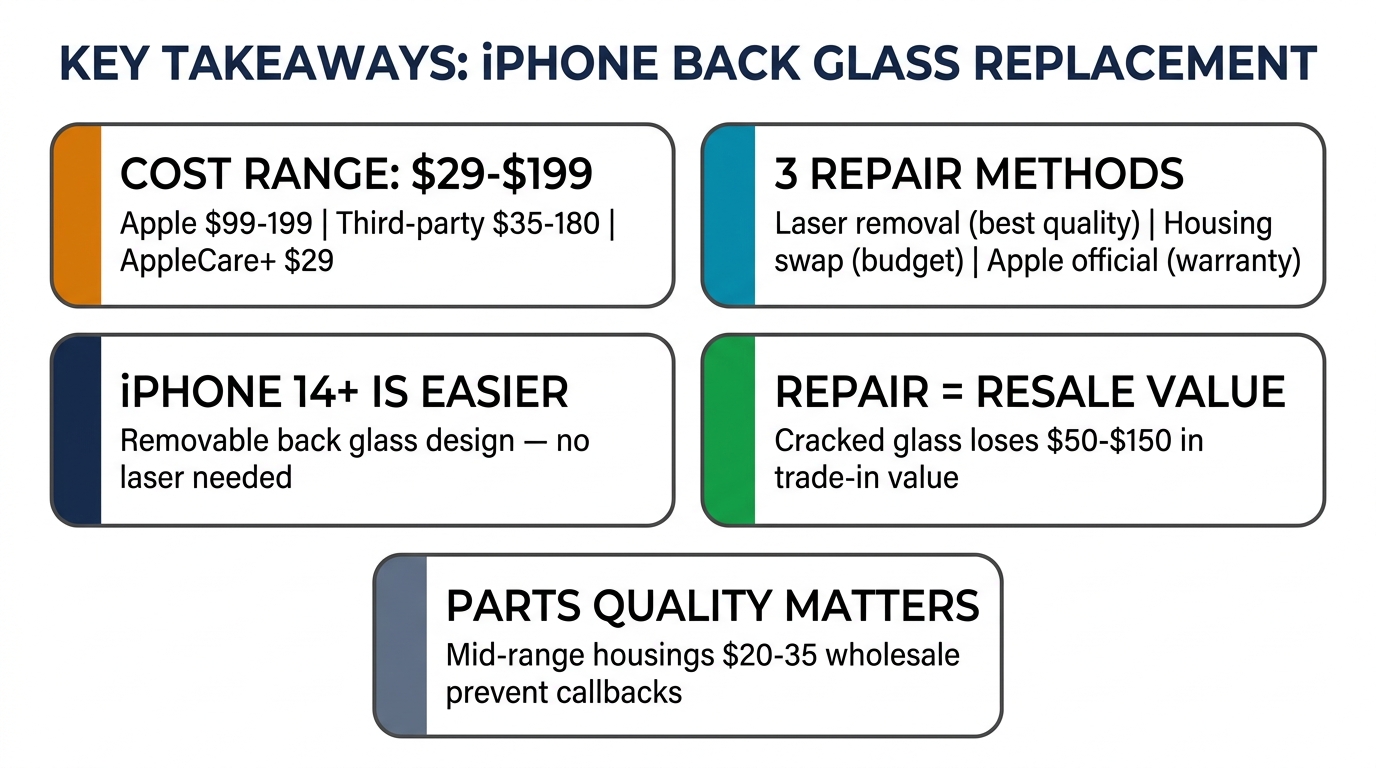
Resale impact: A phone with cracked back glass typically loses $50–$150 in trade-in or resale value compared to one in good condition. Since most back glass repairs cost $50–$150 at third-party shops, the repair essentially pays for itself if you sell or trade in the phone within a year.
Frequently Asked Questions
How much does iPhone back glass replacement cost?
Apple charges $99–$199 depending on the model (or $29 with AppleCare+). Third-party repair shops charge $35–$180 depending on the model and repair method used. Laser glass removal is typically $10–$30 more than a housing swap due to the specialized equipment cost, but delivers a better cosmetic result.
Can I replace iPhone back glass myself?
It's possible but significantly harder than a screen replacement. DIY laser machines are impractical for individuals. The housing swap approach is feasible with patience and a detailed video guide, but takes 90–120 minutes for a first-timer. The main risk is damaging flex cables during component transfer. For iPhone 14 and newer, the simplified back glass design makes DIY more accessible.
Is it worth fixing back glass on an iPhone?
For iPhone 12 and newer, yes. The repair cost ($50–$180) is a fraction of the phone's value, and cracked back glass exposes internal components to moisture and dust. For older models, compare repair cost to the phone's current trade-in value — if repair exceeds 40% of what the phone is worth, a case or skin might be the pragmatic choice.
How long does iPhone back glass replacement take?
Laser removal: 30–60 minutes. Housing swap: 60–120 minutes. Apple official repair: same-day for in-store (with appointment), 3–7 days for mail-in. Most third-party shops offer same-day turnaround for back glass repairs.
Does replacing back glass void my warranty?
Third-party back glass repairs void your Apple warranty. Apple's official repair preserves it. However, if your phone is already out of warranty (which it likely is if you're paying $149+ for back glass), this point is moot. AppleCare+ users should always go through Apple at the $29 rate.
What's the difference between a glass-only repair and a housing swap?
A glass-only repair (usually via laser) removes just the broken back glass and bonds a new panel to your existing frame — your phone keeps its original serial number engravings and regulatory markings. A housing swap transfers all your phone's internals into a completely new rear assembly. Glass-only repair is faster and preserves your original frame markings. Housing swap replaces the entire rear shell, which also fixes frame dents and scratches but takes longer and carries slightly more risk during the component transfer process.
Choosing the Right Back Glass Replacement Approach
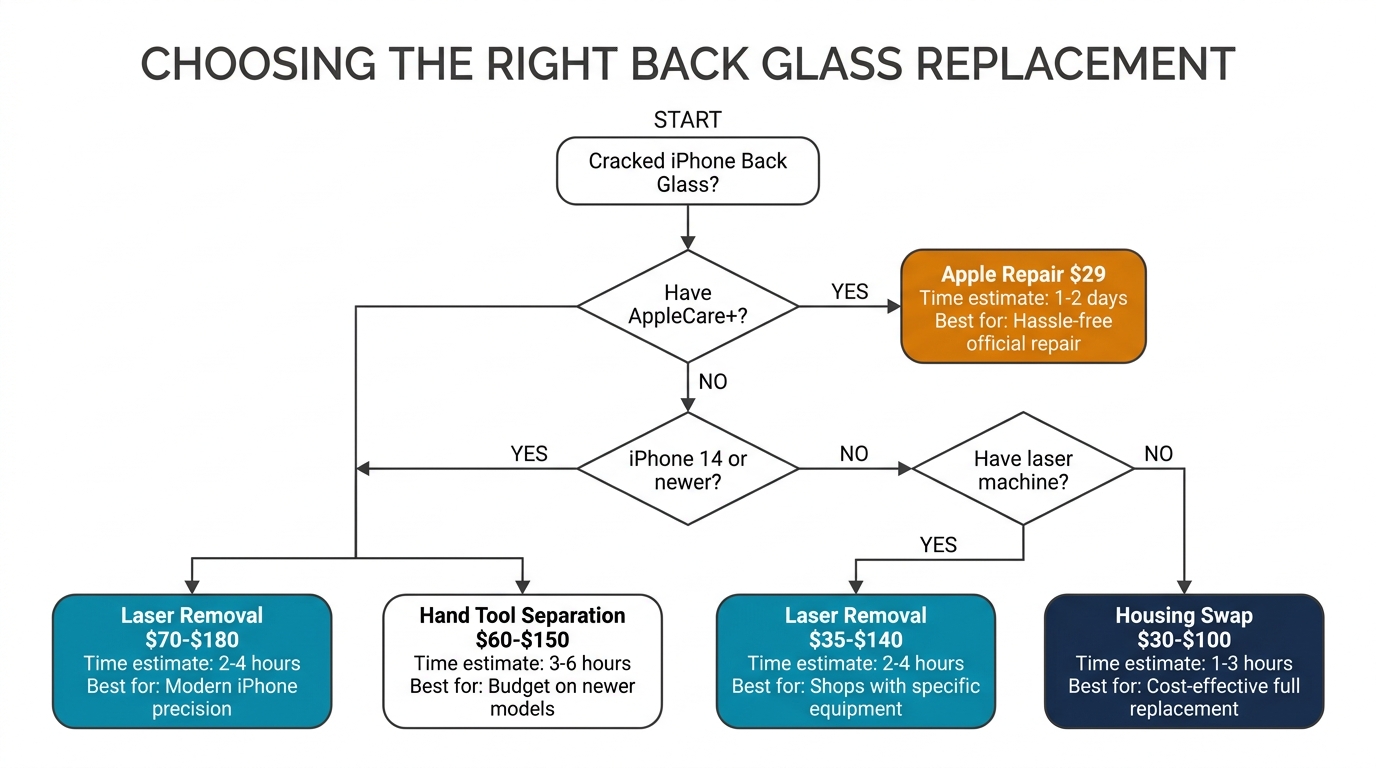
For consumers: if you have AppleCare+, go through Apple at $29 — nothing beats that value. Without AppleCare+, find a local shop with a laser machine for the best cosmetic result on iPhone 12 and newer. For older models, a housing swap delivers good results at a lower price.
For repair shops: laser machines pay for themselves quickly if you handle 10+ back glass repairs per month. The ability to offer a clean, frame-preserving repair at $80–$150 is a strong revenue stream. For shops without a laser, housing swaps remain profitable on older models — just invest in mid-range housings to avoid quality callbacks.
Whether you're sourcing back glass panels, rear housing assemblies, or other cell phone parts wholesale, the quality of your parts directly determines customer satisfaction. Need bulk pricing on iPhone back glass components across all models? Request a quote — we supply glass-only panels and complete housing assemblies with consistent quality grading.