
Phone Screen Warranty and Return Policy: What Wholesale Buyers Should Negotiate Before Bulk Orders

Understanding phone screen warranty wholesale terms matters far more than most first-time buyers realize — until they're sitting on 20 defective screens with no clear path to a replacement or refund.
When you buy a single screen from Amazon, the return process is simple: ship it back, get your money. Wholesale is different. You're buying 50, 100, or 500 screens at a time from a supplier who may be 8,000 miles away. The warranty terms you agree to before you place that order determine whether a bad batch costs you $200 in replacements or $2,000 in dead inventory.
This guide covers what warranty and return terms are standard in the wholesale phone screen trade, what you should negotiate before your first bulk order, and how to handle defects when they inevitably show up.
Sourcing Replacement Screens in Bulk?
Incell / Hard OLED / Soft OLED grades — wholesale pricing, grade comparison on request.
Get Wholesale QuoteWhy Warranty Terms Deserve as Much Attention as Price
Repair shop owners spend hours comparing per-unit prices across suppliers but rarely ask about warranty terms until something goes wrong. That's a costly oversight.
Here's the math: a supplier offering iPhone 14 Incell screens at $17.00 with no warranty versus one charging $19.00 with a 6-month warranty and 2% defect tolerance. If you order 100 screens and hit a 3% defect rate (the industry average for mid-tier aftermarket screens), you lose 3 screens — $51 with the cheap supplier, $0 with the supplier who replaces them.
Over 12 months of monthly orders, warranty coverage on a 3% defect rate saves $600+ per year. That wipes out the per-unit "savings" from the cheaper supplier within two months.
Warranty isn't a bonus feature. It's part of your cost-per-usable-screen calculation.
Standard Phone Screen Warranty Wholesale Terms by Supplier Type
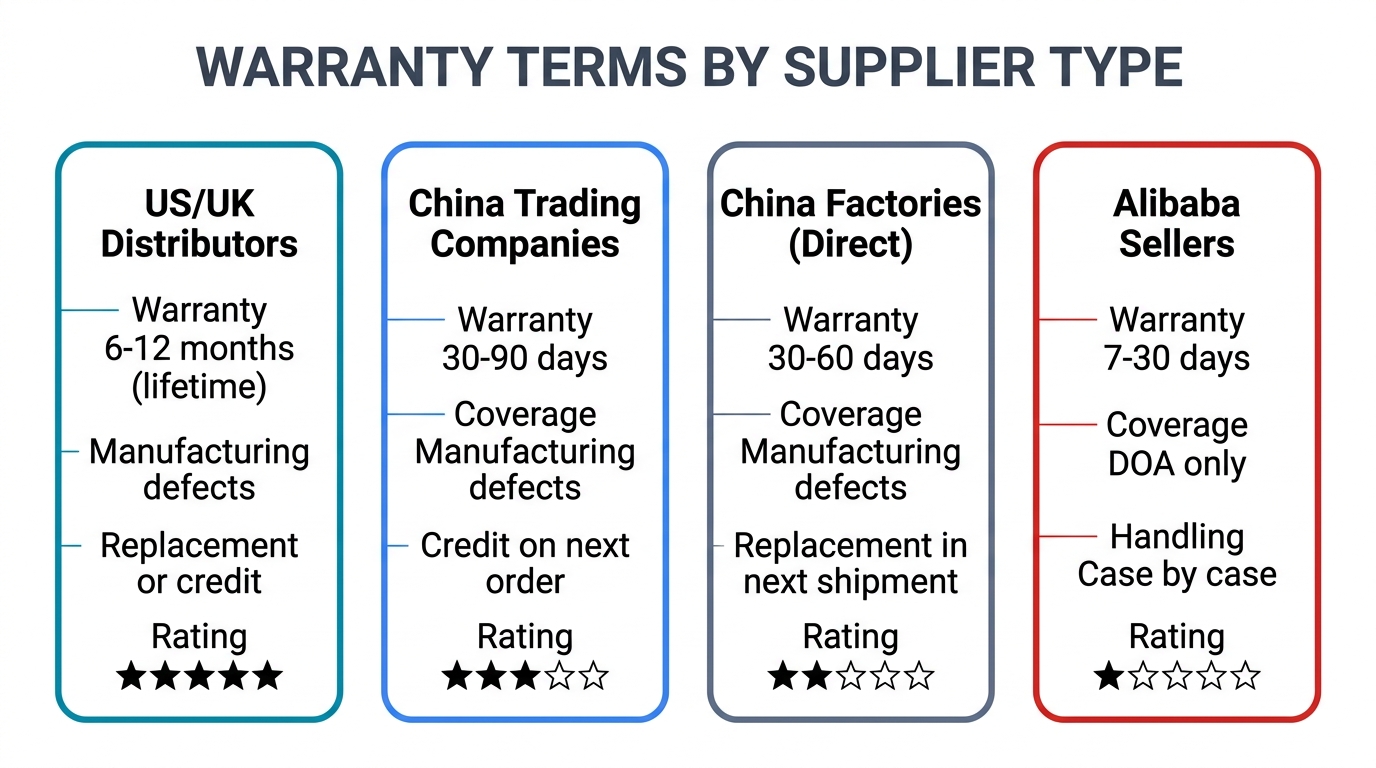
Warranty terms vary widely across the wholesale phone parts industry. Here's what you'll encounter from different supplier types:
| Supplier Type | Typical Warranty Period | What's Covered | What's NOT Covered | Defect Handling |
|---|---|---|---|---|
| US/UK Distributors | 6–12 months, sometimes "lifetime" | Manufacturing defects (dead pixels, touch failure, backlight issues) | Installation damage, physical cracks, liquid damage | Replacement or store credit |
| China-based Trading Companies | 30–90 days | Manufacturing defects | Anything post-installation | Credit on next order |
| China-based Factories (direct) | 30–60 days | Manufacturing defects | Broad exclusions | Replacement in next shipment |
| Alibaba Sellers | 7–30 days | DOA (dead on arrival) only | Everything else | Refund or reship, case by case |
A few critical distinctions:
"Lifetime warranty" isn't what it sounds like. When US distributors like MobileSentrix or Repair Parts USA offer a "lifetime warranty," they mean lifetime of the product against manufacturing defects — not a blanket guarantee that the screen will work forever. If a screen dies because the technician damaged the flex cable during installation, that's not covered. If it develops dead pixels six months after installation with no physical damage, that typically is.
"30-day warranty" from a China supplier is the baseline, not the standard. Suppliers who only offer 30 days are essentially saying "we'll replace DOA screens, but nothing more." This is acceptable for the very cheapest screen grades but below market expectation for mid-tier and premium aftermarket screens.
Warranty on Incell vs. OLED screens may differ. Some suppliers offer longer warranty periods on higher-grade screens (Soft OLED, Original refurbished) because the defect rates are lower and the unit price supports the warranty cost. Ask specifically — don't assume one warranty covers all product lines.
What "Defect" Actually Means — and What It Doesn't
This is where most warranty disputes happen. You and your supplier may have very different definitions of "defect."
Typically Covered Under Phone Screen Warranty
- Dead pixels: Visible non-functioning pixels on the display when powered on. Most suppliers allow 1–3 dead pixels as "within tolerance" — anything beyond that qualifies as defective
- Touch failure: Screen powers on but doesn't respond to touch input, or has dead zones where touch doesn't register
- Backlight issues: Uneven brightness, dark spots, or backlight bleeding that's visible during normal use
- Color shift: Significant deviation in color temperature compared to the sample or specification — common with lower-grade Incell screens
- Flex cable failure: The ribbon cable connecting the screen to the motherboard fails under normal use within the warranty period
- DOA (Dead on Arrival): Screen doesn't power on at all when properly connected
Typically NOT Covered
- Installation damage: Cracked glass during installation, torn flex cables from improper handling, connector pins damaged by misalignment
- Physical damage post-installation: Customer drops the phone, screen cracks — that's the end customer's problem, not a warranty issue
- Liquid damage: Any evidence of liquid contact usually voids warranty
- Software/compatibility issues: Screen works but True Tone doesn't transfer, or Face ID stops working — this often relates to the IC chip or programmer rather than a screen defect
- Cosmetic variance: Minor differences in color temperature or brightness compared to the original OEM screen — aftermarket screens are not OEM, and some variance is expected
The Gray Area: Defects That Appear After Installation
The trickiest warranty scenario is a screen that works perfectly during your initial test but develops issues after being installed in a customer's phone for 2–4 weeks. This could be a latent manufacturing defect or could be caused by the customer's usage.
Most suppliers handle this case-by-case:
- If multiple screens from the same batch develop the same issue, it's almost certainly a batch defect — a strong supplier will replace the full batch
- If a single screen fails out of 100, most suppliers will credit it toward your next order rather than process a formal return
For background on the different screen grades and their quality characteristics, see our guide on OEM vs aftermarket phone screens.
Want warranty terms confirmed before you order? We provide written warranty details on every proforma invoice — including defect tolerance, warranty period by screen grade, and our replacement process. Request a quote with warranty details.
How to Negotiate Phone Screen Warranty Wholesale Terms and Returns
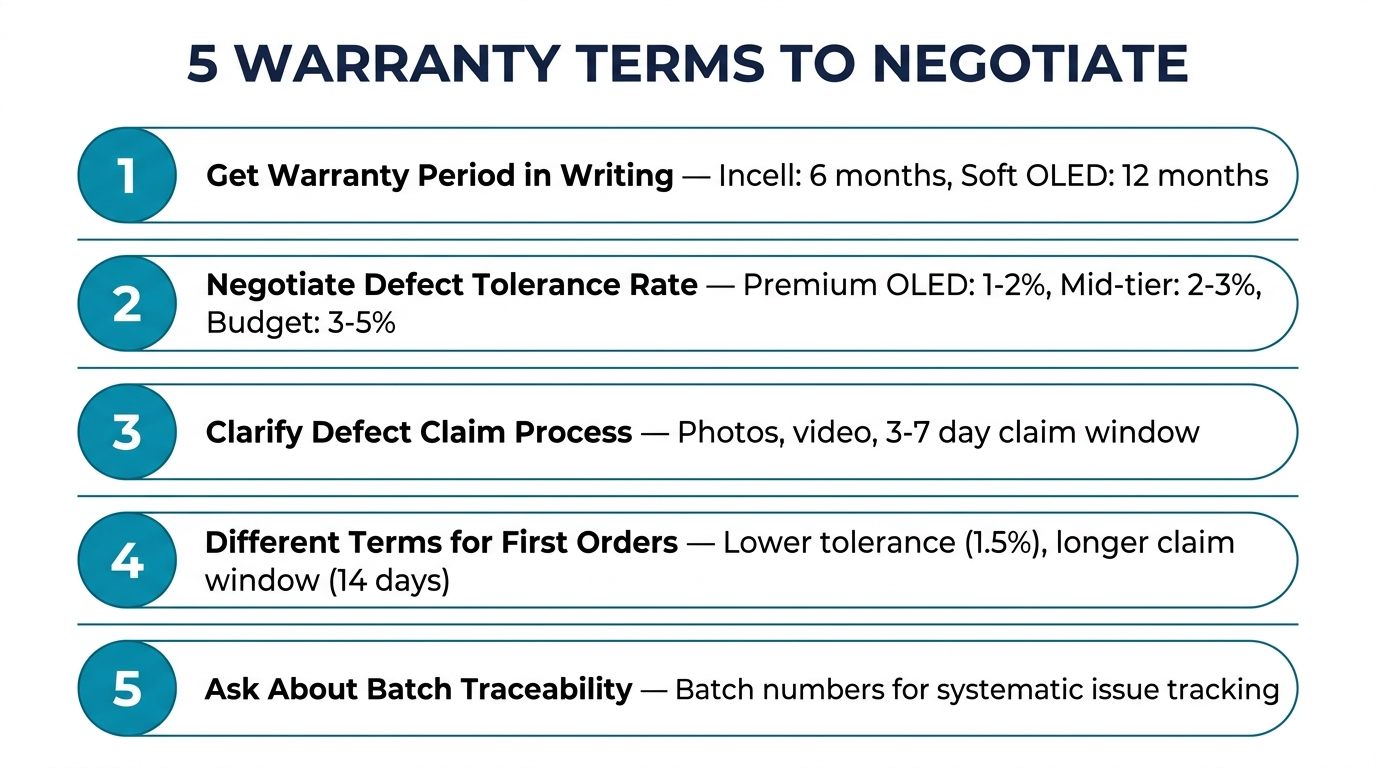
Don't accept the first warranty terms a supplier offers. Here's what to push for — and what's realistic:
1. Get the Warranty Period in Writing
Verbal promises mean nothing in cross-border trade. Before placing your order, confirm these in writing (email, WeChat message, or on the proforma invoice):
- Warranty period for each product grade (e.g., "Incell: 6 months, Soft OLED: 12 months")
- What specific defects are covered
- How the claim process works (who pays return shipping, what documentation is needed)
2. Negotiate a Defect Tolerance Rate
Rather than arguing over individual screens, agree on a defect tolerance percentage upfront. Standard in the industry:
- Premium OLED screens: 1–2% defect tolerance is standard
- Mid-tier Incell/Hard OLED: 2–3% defect tolerance is standard
- Budget Incell screens: 3–5% defect tolerance (higher tolerance priced into the lower cost)
If your defect rate stays within tolerance, there's no claim. If it exceeds the agreed rate, the supplier credits or replaces the excess. This approach eliminates the need to argue over every single screen and keeps the relationship professional.
3. Clarify the Defect Claim Process
Before you need it, understand exactly how to file a warranty claim:
- Documentation required: Most suppliers require clear photos or video of the defect, plus the order number and screen serial/batch number
- Claim window: How many days after discovering the defect do you have to report it? (Typical: 3–7 days from discovery, or within the warranty period)
- Resolution options: Replacement in next order (most common), store credit, or partial refund? Clarify which applies
- Return shipping: Who pays to ship defective screens back? For China suppliers, returning individual screens is rarely practical — most handle it as credits rather than physical returns
4. Negotiate Different Terms for First Orders
For your first order with a new supplier, ask for:
- A lower defect tolerance (e.g., 1.5% instead of 3%) — since you're testing their quality
- A slightly longer claim window (e.g., 14 days instead of 7)
- PayPal payment for the first order so you have platform protection as a backup
A reasonable supplier will agree because they want to prove their quality earns repeat business. For more on payment protection options, see our guide on paying a China phone parts supplier.
5. Ask About Batch Traceability
Good suppliers track production batches. If a defect appears, batch traceability lets both parties identify whether it's an isolated unit or a systematic issue. Ask whether screens are labeled with batch numbers or production dates — this is a sign of a supplier with real quality control.
For more on supplier evaluation criteria, see our guide on how to choose a reliable phone parts supplier.
How to Handle Defective Screens When They Arrive
Even with good warranty terms, you'll occasionally receive defective units. Here's the process that keeps things professional and gets results:
Step 1: Inspect Every Shipment on Arrival
Don't wait until you install a screen in a customer's phone to discover it's defective. Set up a basic incoming inspection process:
- Power-test every screen using a test fixture or a dedicated test phone before shelving it
- Check for visible defects: dead pixels, backlight bleeding, physical damage, loose flex cables
- Record the number of defective units per shipment immediately
We cover the full incoming QC process in detail in our guide on incoming QC for wholesale phone screens.
Step 2: Document Defects Properly
For every defective screen:
- Take clear photos showing the defect (dead pixels, color issues, physical damage)
- Record a short video if the defect is intermittent (touch dead zones, flickering)
- Note the batch number, order number, and the specific model
- Keep the defective screen in its original packaging
Step 3: Contact Your Supplier Within the Claim Window
Send a concise message with:
- Your order number
- The defect count (e.g., "5 out of 100 screens defective = 5% defect rate")
- Photos/video evidence
- Your preferred resolution (replacement in next order, credit, or refund)
Most suppliers respond within 1–2 business days. Approach the conversation as a business partner solving a problem — not as an adversarial complaint. Suppliers who deal in wholesale expect some warranty claims and have processes for handling them.
Step 4: Track Your Defect Rates Over Time
Keep a simple spreadsheet logging each order's defect rate by supplier and screen grade. This data is powerful:
- It tells you which suppliers deliver consistent quality
- It gives you negotiating leverage ("my average defect rate from you over 6 months is 4.2% — can we work on getting this below 3%?")
- It flags quality deterioration early before it costs you money
Red Flags: Warranty Terms That Should Make You Walk Away
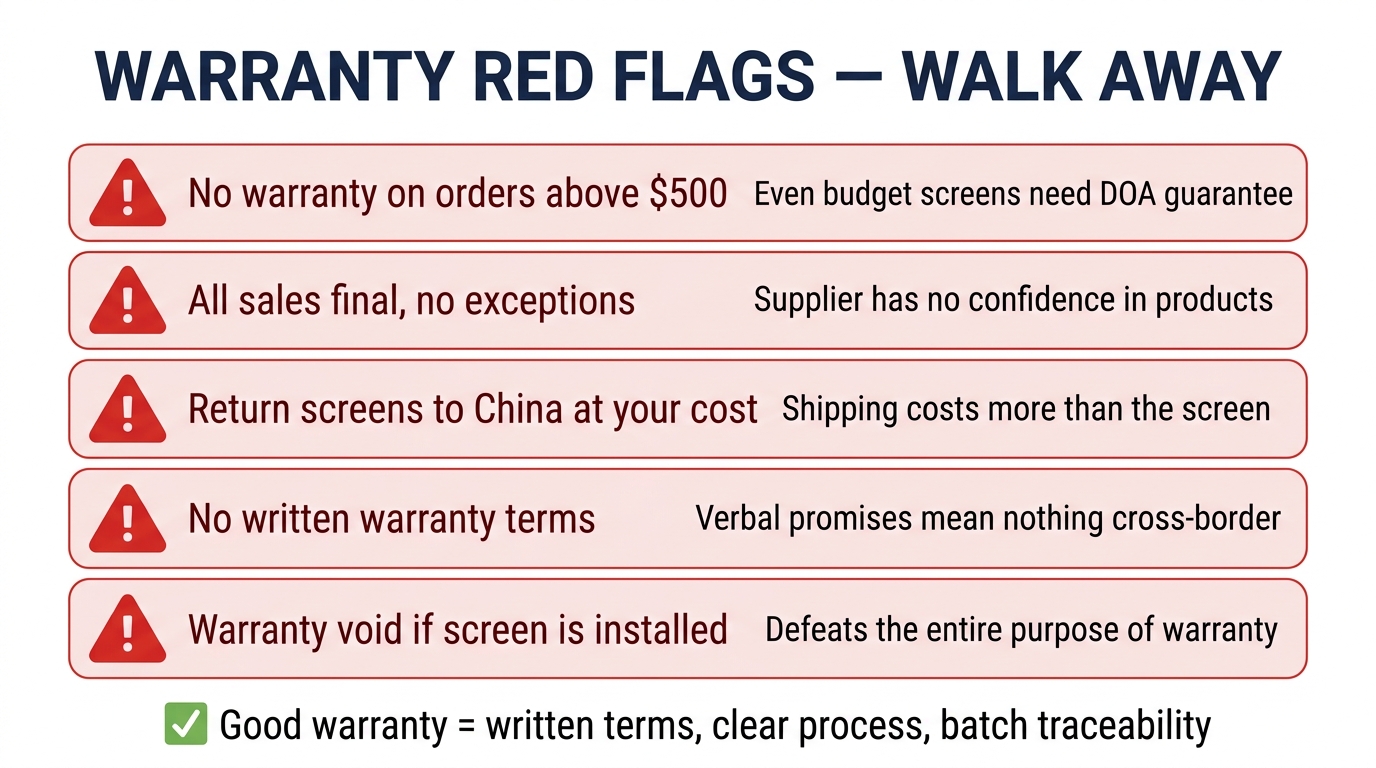
- "No warranty" on any order above $500: Even budget screens should carry a basic DOA guarantee
- "All sales final" with no exceptions: This means the supplier has no confidence in their own products
- Warranty that requires returning screens to China at your cost: Return shipping for a $15 screen costs more than the screen itself — this is effectively a non-warranty
- No written warranty terms: If the supplier won't put warranty details in writing, they won't honor them verbally either
- Warranty void "if screen is installed": This defeats the entire purpose — you can't test a screen's real-world performance without installing it
If you encounter any of these, reconsider the supplier. Our wholesale phone parts sourcing guide covers how to identify reliable suppliers who stand behind their products.
Frequently Asked Questions
What is a standard warranty period for wholesale aftermarket phone screens?
It depends on the supplier type. US/UK distributors typically offer 6–12 months, sometimes lifetime coverage for manufacturing defects. China-based trading companies usually offer 30–90 days. For mid-tier to premium aftermarket screens (Incell, Hard OLED, Soft OLED), aim for at least 90 days. Anything less than 30 days only protects against DOA units.
What defect rate should I expect on wholesale phone screens?
Industry average for mid-tier aftermarket screens (Incell, Hard OLED) is 2–3%. Premium Soft OLED screens typically run 1–2%. Budget screens can hit 3–5%. If your supplier consistently delivers above these ranges, it's a quality issue worth addressing. Track your defect rate per order and use the data to renegotiate terms or switch suppliers.
Do I need to ship defective screens back to China for warranty claims?
Rarely. Most China-based suppliers handle warranty claims as credits on your next order rather than requiring physical returns — shipping individual screens internationally is impractical and costs more than the screen itself. US/UK distributors may accept physical returns with a prepaid label. Clarify the process before placing your first order.
Can I use PayPal buyer protection instead of relying on supplier warranty?
For sample orders and first purchases under $1,000, PayPal's 180-day dispute window provides a useful safety net. For ongoing wholesale orders, relying on PayPal isn't sustainable — the 3–5% surcharge compounds, and frequent disputes can damage your supplier relationship. Negotiated warranty terms with a trusted supplier are a more scalable long-term solution.
What documentation do I need to file a warranty claim?
At minimum: clear photos of the defect, the order number, and the specific screen model and batch number. For intermittent issues (flickering, touch dead zones), include a short video. Most suppliers also want the defect count as a percentage of total order. Keep defective screens in original packaging until the claim is resolved.
Protect Your Margins — Negotiate Before You Order
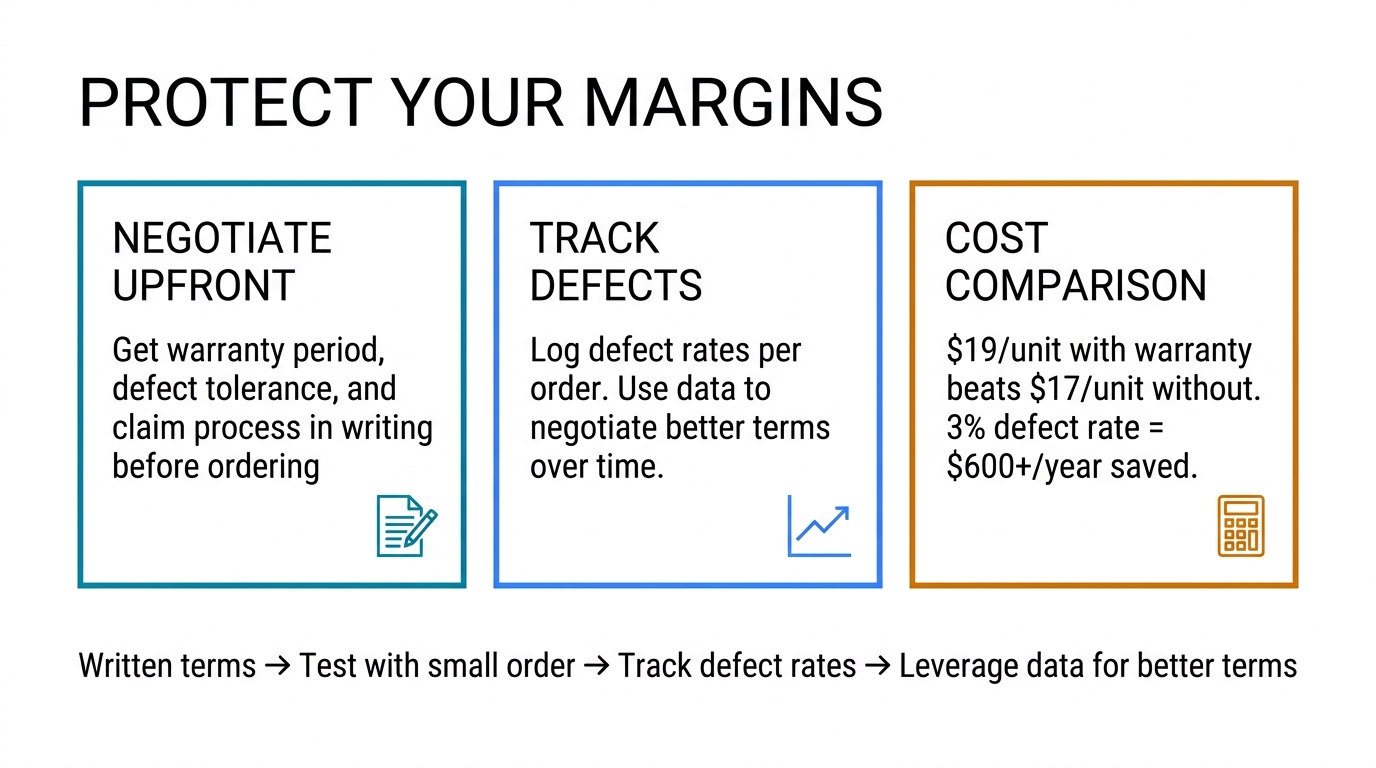
Warranty and return terms aren't an afterthought — they're part of your cost structure. A supplier with slightly higher prices but strong warranty coverage, clear defect handling, and batch traceability will save you more money over 12 months than the cheapest no-warranty option.
Before your next order, review the warranty terms on your current supplier's invoice. If they're vague or missing, now is the time to clarify.
Need a supplier with transparent warranty terms? Request a wholesale quote — every order includes written warranty coverage, defect tolerance by grade, and a clear claim process. No surprises when something needs replacing.