
Which Small Phone Parts Create the Most Repeat Demand for Repair Shops
Screens and batteries get all the attention. They dominate wholesale order lists, they fill up your repair counter, and they account for the bulk of your revenue. But if you only track those two categories, you are missing the small phone parts repeat demand that drives a significant piece of your business.
Small phone parts — earpiece speakers, loudspeakers, camera lens glass, button flex cables, sensor assemblies, vibrator motors — generate a steady, predictable stream of repair jobs that most shop owners underestimate. These components fail frequently, cost little to stock, and deliver some of the highest profit margins in the repair business.
This article ranks the small parts that create the most repeat demand, explains why they fail so often, and gives you a stocking strategy based on what we see from thousands of repair shop orders processed through our Shenzhen warehouse every month. If you want the broader picture covering screens, batteries, and ports alongside small parts, see our guide on which replacement parts bring the most repeat orders.
Looking for a Reliable Wholesale Parts Supplier?
Factory-direct from Shenzhen — transparent grades, invoices & 12-month warranty.
Get Wholesale QuoteWhy Small Parts Deserve Their Own Strategy
Small parts account for roughly 15–25% of total repair jobs in a typical independent shop. But they punch above their weight in three ways:
Higher margin percentage. A loudspeaker replacement that costs you $0.80 wholesale and you charge $15–25 for the repair delivers a margin that no screen swap can match on a percentage basis.
Lower inventory risk. A single loudspeaker unit ties up less than a dollar. A single OLED screen ties up $30–80. If a small part sits on your shelf for three months, it costs you almost nothing. If a screen sits that long, your cash flow feels it.
Customer relationship builder. When a customer walks in for a quick speaker fix and you finish it in 20 minutes, they remember you for the bigger jobs later. Small repairs build trust and repeat business.
For a detailed look at quality grades across these components, check our small repair parts quality guide covering earpieces, speakers, camera lenses, and flex cables.
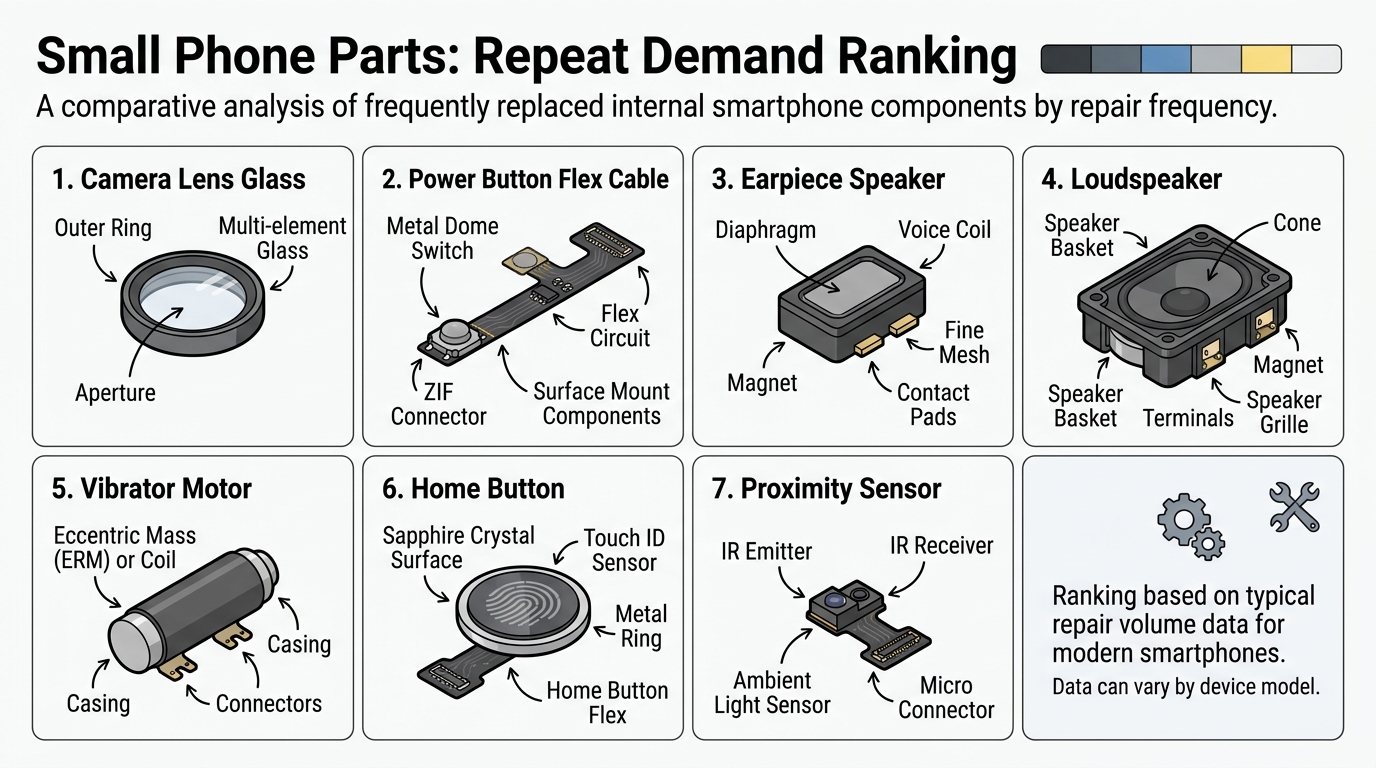
Small Parts Ranked by Repeat Demand
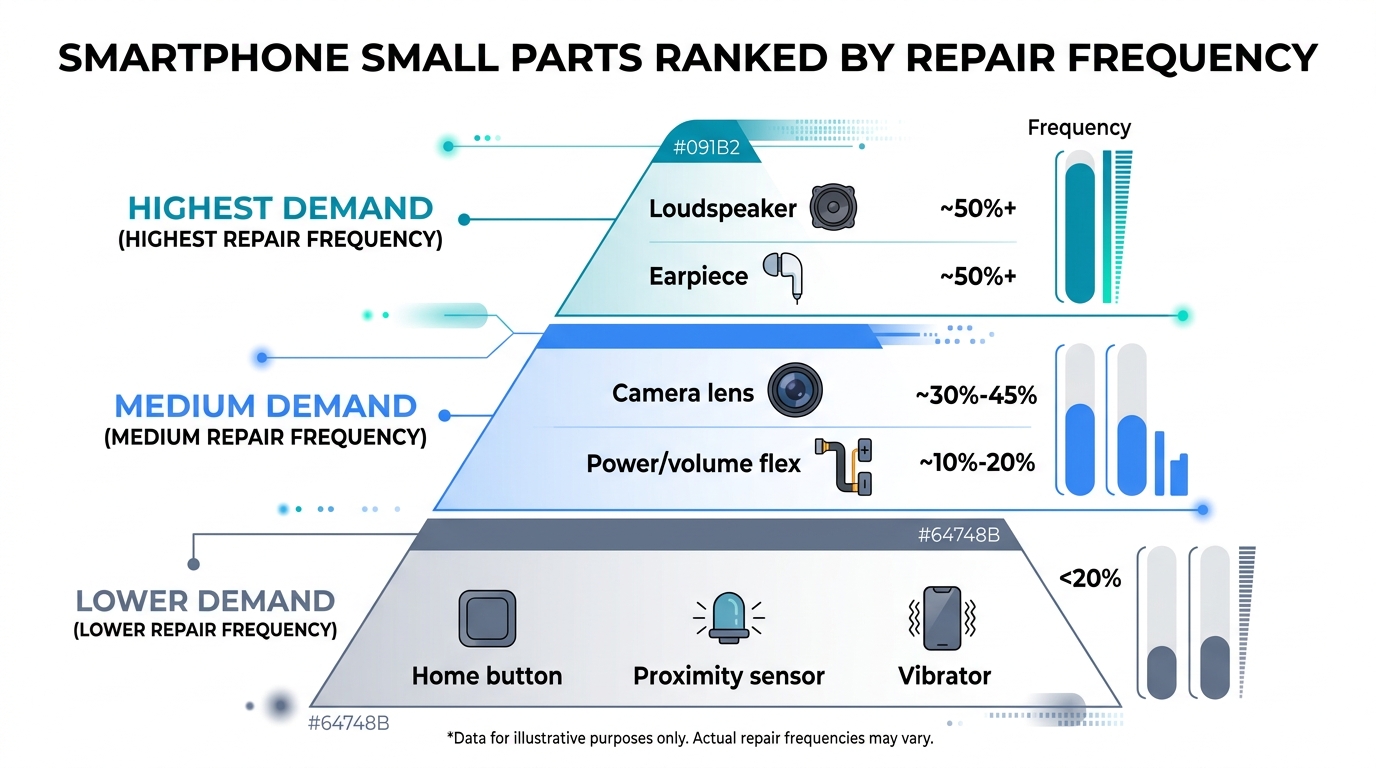
The following ranking is based on order frequency data from PRSPARES wholesale accounts and feedback from repair shop owners across the UK, Africa, Latin America, and Southeast Asia.
| Rank | Small Part | Repeat Order Frequency | Avg. Wholesale Cost (USD) | Typical Repair Charge (USD) | Margin % |
|---|---|---|---|---|---|
| 1 | Charging port flex cable | Very High (weekly restock) | $0.60–2.50 | $20–40 | 85–95% |
| 2 | Loudspeaker | High (bi-weekly) | $0.40–1.20 | $15–25 | 90–95% |
| 3 | Earpiece speaker | High (bi-weekly) | $0.30–1.00 | $12–20 | 90–96% |
| 4 | Camera lens glass | High (bi-weekly) | $0.50–2.00 | $15–35 | 88–94% |
| 5 | Power/volume button flex | Moderate-High (monthly) | $0.50–1.80 | $15–30 | 88–94% |
| 6 | Home button / Touch ID flex | Moderate (monthly) | $1.00–4.00 | $20–45 | 85–92% |
| 7 | Proximity/ambient light sensor flex | Moderate (monthly) | $0.80–2.50 | $15–30 | 85–92% |
| 8 | Vibrator motor (taptic engine) | Low-Moderate (every 6–8 weeks) | $0.50–2.00 | $12–25 | 88–93% |
| 9 | SIM tray / card reader | Low (as-needed) | $0.15–0.80 | $8–15 | 90–95% |
Let us break each one down.
1. Charging Port Flex Cables — The Small Part King
Charging ports sit at the top of every small parts demand list. We cover them in dedicated depth in our guide on how to choose charging ports for bulk repair orders, but they deserve mention here for context.
Failure causes are straightforward: daily plug-unplug cycles, lint buildup, liquid exposure, and cheap third-party cables that damage the port over time. For iPhone models, the Lightning/USB-C port flex also carries the microphone and headphone jack signals, so a single failed component affects multiple functions.
Restock frequency: Weekly for busy shops. This is the one small part you never want to run out of.
2. Loudspeakers — The Water Damage Survivor
Loudspeakers (bottom speakers) rank second because they fail from two dominant causes: water/liquid exposure and physical impact. Even phones rated IP68 develop loudspeaker issues after minor liquid contact — the speaker membrane degrades before any other component shows damage.
The demand pattern is consistent across all markets. A shop doing 8–12 repairs per day will typically see 3–5 loudspeaker jobs per week. Newer phones with stereo speaker setups (iPhone 12 and later, Samsung S21 and later) have increased per-device demand because customers notice audio quality loss more on stereo systems.
Key stocking note: iPhone loudspeakers are model-specific. Samsung Galaxy A-series loudspeakers have more cross-compatibility between generations but still require model matching. Always stock by specific model, not generic.
3. Earpiece Speakers — Quiet Failures, Steady Demand
Earpiece speakers fail differently from loudspeakers. The most common complaint is "I can't hear the other person on calls" or "call audio is muffled." These failures build up gradually — dust accumulation in the mesh, adhesive degradation from heat cycling, and membrane fatigue.
What makes earpiece demand especially steady is that customers often delay the repair for weeks before it becomes unbearable. This means your earpiece repairs arrive at a constant trickle rather than in bursts.
Regional note: In markets where voice calls remain the primary phone use (parts of Africa, South Asia), earpiece speaker demand is proportionally higher than in markets dominated by messaging apps.
4. Camera Lens Glass — The Rising Star
Camera lens glass replacement has grown faster than any other small part category over the past three years. The reason is simple: phone manufacturers keep adding larger, more protruding camera modules.
The iPhone 15/16 series, Samsung S24/S25 series, and most mid-range phones from Xiaomi and OPPO all feature camera bumps that are the first point of contact in a face-down drop. Cracked camera lens glass now accounts for roughly 8–12% of all walk-in repairs at shops in the UK and Europe.
Margin opportunity: Camera lens glass is one of the most profitable small parts to stock. A lens that costs $0.80 wholesale supports a $20–35 repair charge because customers perceive camera damage as serious. The repair itself takes 10–15 minutes with proper adhesive.
Stocking tip: Prioritize lenses for the latest 2–3 generations of iPhone and Samsung flagships. These models drive 70% of camera lens repair demand.
5. Power/Volume Button Flex Cables
Power and volume buttons fail from mechanical fatigue. After 2–3 years of daily use, the flex cable contact points degrade. Customers report buttons that feel "mushy," require extra pressure, or stop responding intermittently.
Demand is moderate but highly predictable. Phones in the 2–4 year age range produce a constant stream of button flex repairs. In markets where phone replacement cycles are longer (Africa, Latin America, parts of Southeast Asia), this demand is significantly higher.
Compatibility warning: Many power/volume flex cables are model-specific and generation-specific. iPhone power flex cables often integrate the flash LED and microphone, making correct model matching critical. Check our stock guide for small repair shops in 2026 for model-specific recommendations.
6. Home Button / Touch ID Flex
Home button repairs are a declining but still substantial category. iPhone 6s through iPhone 8 remain widely used in Africa, Latin America, the Middle East, and parts of Southeast Asia. In these markets, home button and Touch ID flex cables still generate 2–4 repairs per week for an active shop.
Critical quality note: Touch ID functionality is paired to the device logic board. If the original home button is damaged beyond repair, a replacement button will provide the "click" function but not fingerprint recognition. This is a fact you must communicate to customers upfront. Third-party solutions that restore partial Touch ID function exist but vary in reliability.
In the UK and Europe, home button demand has dropped below one repair per week for most shops as iPhone SE (3rd gen) is the last model with this component.
7. Proximity/Ambient Light Sensor Flex
Proximity sensor failures cause a specific, annoying problem: the screen stays black during calls (or fails to turn off, causing accidental face touches). Ambient light sensor failures break auto-brightness. Both send customers to repair shops.
Demand for these parts is moderate but consistent. The repair is often bundled with screen replacements — when a technician swaps a screen and reuses the original sensor flex, damage during transfer creates a new repair need. This means your own shop workflow generates some of your own sensor flex demand.
iPhone-specific note: On iPhone X and later, the proximity sensor integrates with the Face ID module and earpiece speaker in a single flex assembly. This makes it more expensive ($2–5 wholesale) but also a higher-value repair ($25–40 charge).
8. Vibrator Motor (Taptic Engine)
Vibrator motor repairs are less frequent but deliver solid margins. Customers notice vibration failure when they miss calls and notifications. The repair is quick (10–15 minutes) and parts are inexpensive.
Demand pattern: Irregular. You might see two vibrator repairs in one week and then none for three weeks. This makes it a "stock a few, reorder as needed" category rather than a bulk-buy priority.
9. SIM Tray and Card Reader
SIM trays are the lowest-demand item on this list but worth stocking because they cost almost nothing and the repair charge relative to part cost is excellent. Customers break SIM trays by forcing them in wrong, using bent ejector tools, or water corrosion in the tray mechanism.
In dual-SIM markets (India, Southeast Asia, Africa), SIM tray demand is higher because users swap SIMs more frequently.
Profit Margin Analysis: Why Small Parts Outperform
Here is the math that every repair shop owner should internalize:
| Repair Type | Part Cost | Labor Time | Repair Charge | Net Margin |
|---|---|---|---|---|
| Screen replacement (iPhone 15) | $25–45 | 30–45 min | $80–120 | 55–70% |
| Battery replacement (iPhone 14) | $6–10 | 20–30 min | $35–50 | 75–85% |
| Loudspeaker replacement | $0.60–1.20 | 15–20 min | $15–25 | 90–95% |
| Camera lens glass | $0.80–2.00 | 10–15 min | $20–35 | 90–94% |
| Power button flex | $0.50–1.80 | 20–30 min | $15–30 | 88–94% |
The takeaway: screen repairs generate more absolute dollars per job, but small part repairs generate more profit per minute of labor. A shop that maximizes small part throughput alongside screen and battery work is optimizing total profitability.
Stocking Strategy: Always on Shelf vs. Order Per Job
Not every small part deserves permanent shelf space. Here is how to prioritize:
Always on Shelf (Stock 10–20 Units Per Top Model)
- Charging port flex cables (top 5 models you repair most)
- Loudspeakers (top 5 models)
- Earpiece speakers (top 5 models)
- Camera lens glass (top 3 flagship models)
Stock Light (3–5 Units Per Model)
- Power/volume button flex (top 3 models)
- Proximity sensor flex (top 3 iPhone models)
- Home button flex (iPhone 6s, 7, 8 only — if your market demands it)
Order as Needed
- Vibrator motors
- SIM trays
- Niche model-specific parts
For a complete stocking framework including screens and batteries, see our guide on which parts a small shop should stock in 2026. And if you are building your very first wholesale order, our sample order templates include a dedicated small parts section.
Regional Demand Differences
Small parts demand varies significantly by market. Understanding your region's pattern prevents overstocking the wrong items.
Africa and Latin America
- Higher demand: Home button flex (iPhone 6s/7/8 still widely used), power/volume flex (older phones with mechanical wear), earpiece speakers (voice-call-heavy usage)
- Lower demand: Camera lens glass (fewer flagship devices in circulation)
- Phone age profile: Average phone age 3–5 years. Mechanical wear parts dominate.
UK and Europe
- Higher demand: Camera lens glass (flagship-heavy market), proximity sensor flex (iPhone X+ models), loudspeakers (water damage from weather)
- Lower demand: Home button flex (older iPhones largely retired)
- Phone age profile: Average phone age 2–3 years. Camera and sensor parts dominate.
Southeast Asia
- Higher demand: Charging ports (humidity and dust exposure), loudspeakers (water damage), SIM tray components (dual-SIM usage)
- Lower demand: Home button flex (rapid adoption of newer models in urban centers)
- Phone age profile: Mixed. Urban areas mirror Europe; rural areas mirror Africa.
Understanding these patterns lets you adjust wholesale orders by region. For comprehensive sourcing strategies tailored to your market, see our complete cell phone parts wholesale sourcing guide.
Why These Parts Keep Failing: The Demand Engine
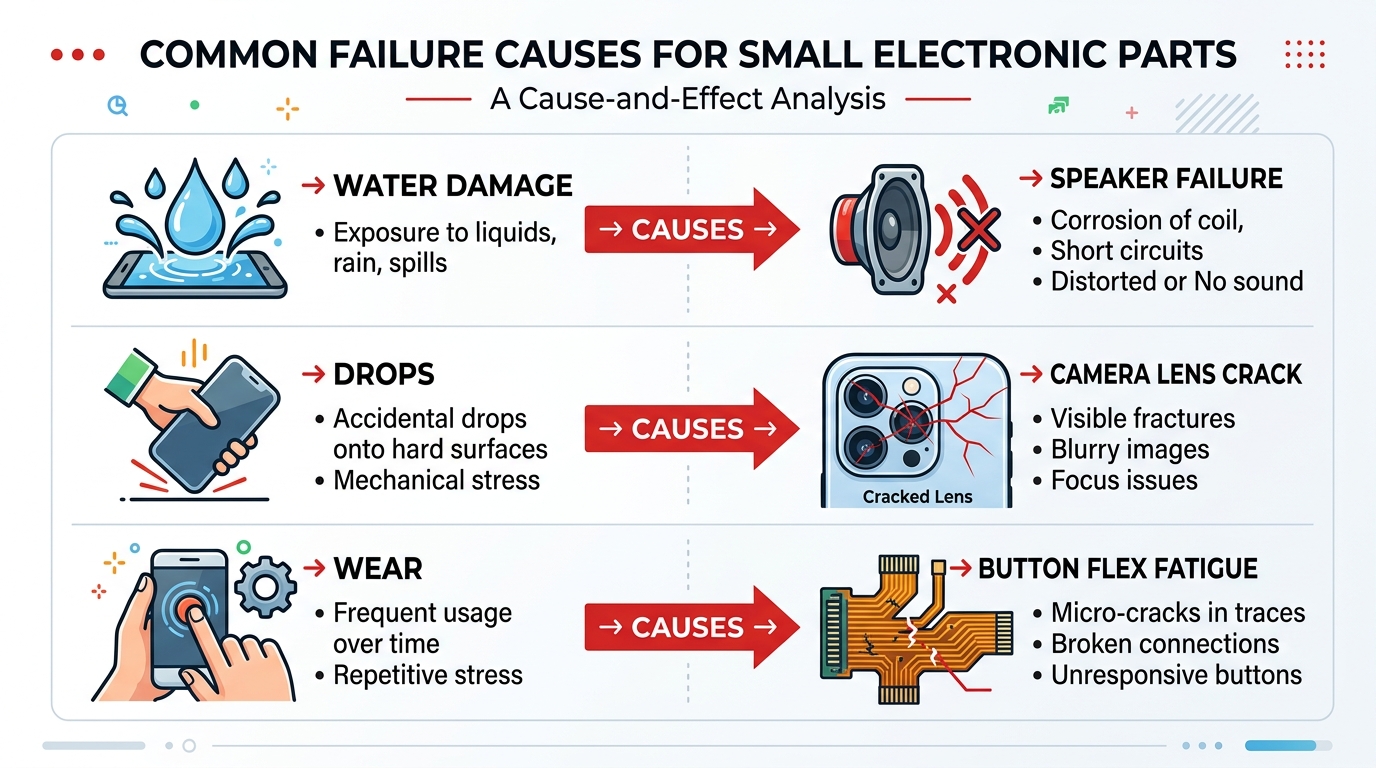
Three forces guarantee that small parts will always generate repeat demand for your shop:
1. Mechanical wear is unavoidable. Buttons get pressed thousands of times. Charging ports endure daily insertion cycles. Speakers vibrate continuously. No amount of build quality eliminates mechanical fatigue over a 3–4 year phone lifespan.
2. Environmental exposure compounds failure. Humidity, dust, pocket lint, sweat, rain, and accidental splashes all accelerate component degradation. Markets with tropical climates see 20–30% higher small parts failure rates than temperate regions.
3. Phone design trends increase vulnerability. Larger camera bumps crack more often. Thinner phones flex more, stressing internal flex cables. Removing headphone jacks pushed more signal routing through the charging port flex, increasing that component's failure rate. Every generation of phone design creates new small-part failure modes.
Frequently Asked Questions
Which small phone part has the highest profit margin for repair shops?
Earpiece speakers and loudspeakers offer the highest margin percentage, often exceeding 90–95%. The wholesale cost is typically under $1.00 while repair charges range from $12–25. Camera lens glass is a close second, with the added advantage of a higher absolute dollar margin per repair.
How many SKUs of small parts should a small repair shop stock?
Focus on the top 5 phone models you repair most frequently and stock charging ports, loudspeakers, earpiece speakers, and camera lenses for each. This gives you approximately 20 SKUs of high-demand small parts. Add power/volume flex and sensor flex for your top 3 models for another 6 SKUs. Total: 25–30 small part SKUs cover the vast majority of walk-in demand.
Are small parts quality differences significant between grades?
Yes. Loudspeakers and earpieces have noticeable audio quality differences between low-grade and high-grade replacements. Camera lens glass varies in clarity and oleophobic coating. Flex cables differ in contact point durability — low-grade flex cables may fail again within 3–6 months. We recommend mid-grade or higher for all small parts to avoid warranty returns. Our small repair parts quality guide covers grade differences in detail.
Should I buy small parts from the same supplier as my screens and batteries?
Consolidating with one supplier reduces shipping costs and simplifies order management. A mixed order combining screens, batteries, and small parts in a single shipment from Shenzhen saves 15–25% on per-unit shipping compared to ordering categories separately. Most wholesale suppliers, including PRSPARES, offer mixed-category orders specifically for this reason.
How often should I reorder small parts?
For high-demand items (charging ports, loudspeakers, earpiece speakers), reorder when stock drops below 5 units per model. For moderate-demand items (flex cables, sensors), reorder when stock drops below 2 units. Set a monthly review cycle where you audit small parts inventory alongside your screen and battery stock. This prevents stockouts without overcommitting cash.
Build Your Small Parts Order

Small parts are the backbone of consistent, high-margin repair shop revenue. They require minimal capital investment, carry almost zero inventory risk, and keep customers walking through your door between major repairs.
The ranking in this article gives you a clear priority list: start with charging ports and speakers, build out to camera lenses and flex cables, and add niche parts as your repair volume grows.
Ready to stock up? Request a mixed small parts order from PRSPARES — we ship from our Shenzhen warehouse with MOQs designed for independent repair shops and small wholesale buyers. Tell us your top 5 models and your market region, and we will put together a recommended small parts package with current pricing.