
Which Cell Phone Repair Parts Bring the Most Repeat Orders for Repair Shops?
Every repair shop has limited cash and limited shelf space. The parts you choose to stock determine how many customers you can serve same-day, how much capital sits idle on shelves, and which repairs you have to turn away or delay. Stocking the wrong cell phone repair parts means either tying up money in slow-moving inventory or losing walk-in customers to the shop down the street that had the part ready.
The question isn't just "what parts exist" — it's which parts generate consistent, repeat business month after month. Some categories bring customers in weekly. Others sit on your shelf for months waiting for the right phone to walk through the door. This guide ranks the major phone repair parts categories by repair volume, profit margin, reorder frequency, and customer retention impact — so you can stock what actually moves.
Need Wholesale Phone Repair Parts?
Factory-direct pricing from Shenzhen — OEM-quality screens, batteries & small parts.
Get Wholesale QuoteThe 5 Cell Phone Repair Parts Categories, Ranked
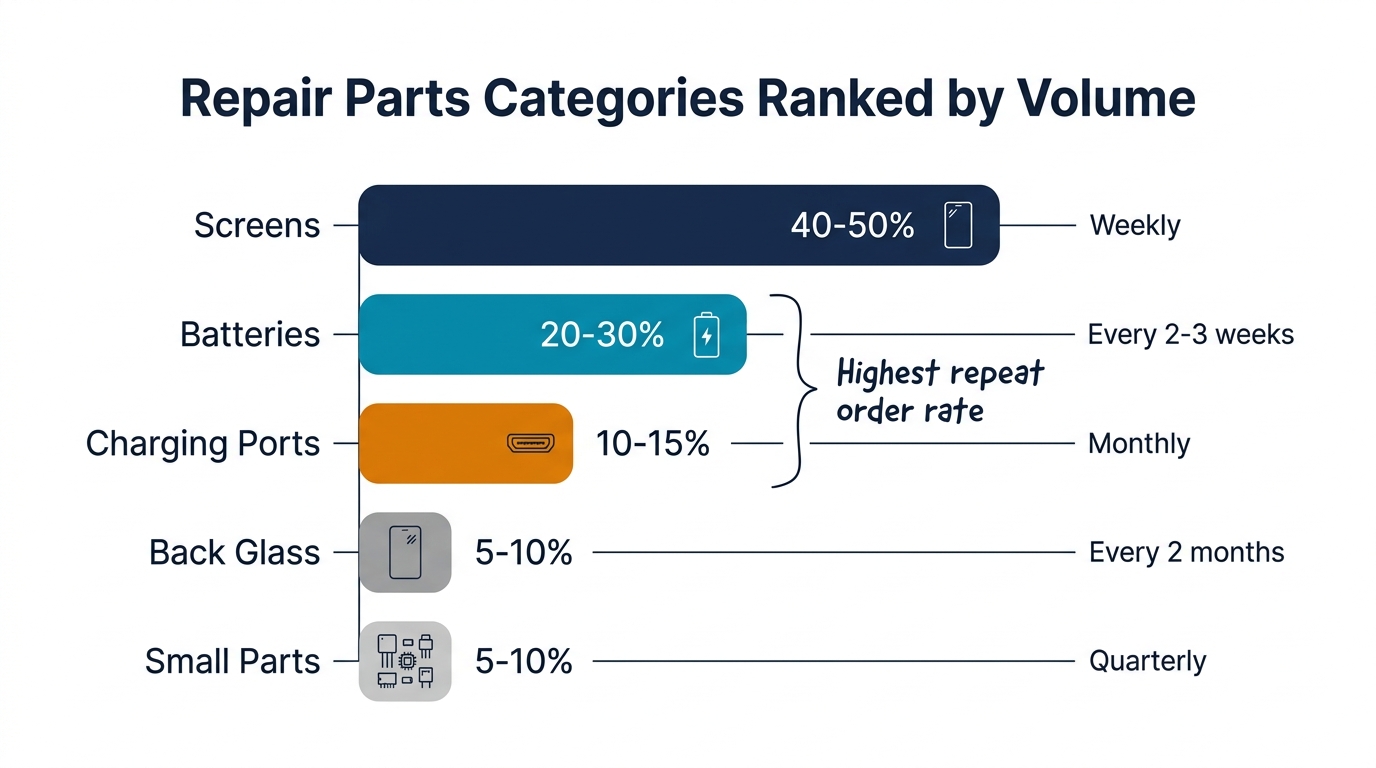
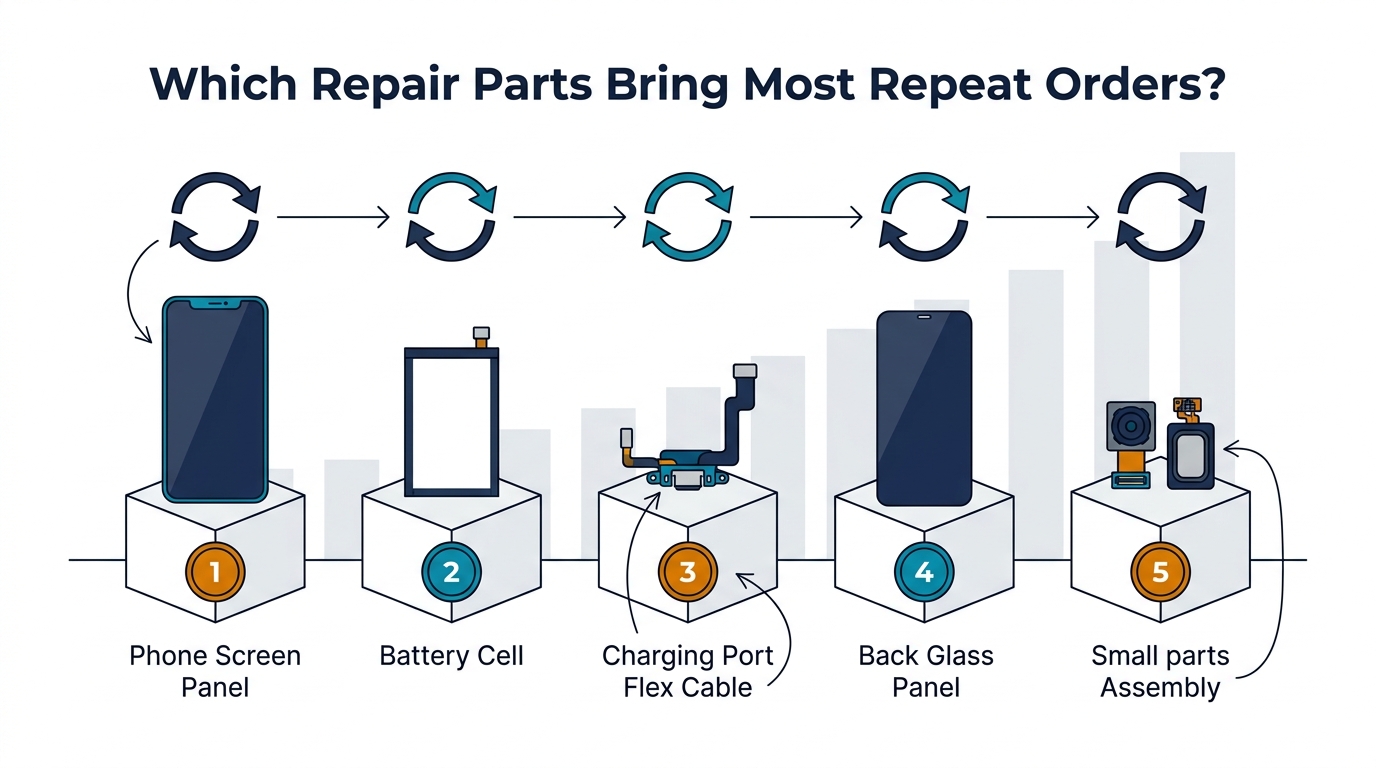
Based on repair volume data across hundreds of independent repair shops, here's how the major parts categories stack up:
| Rank | Parts Category | % of Total Repairs | Avg. Margin | Reorder Frequency | Customer Retention Impact |
|---|---|---|---|---|---|
| 1 | Screens | 40-50% | 70-85% | Every 1-2 weeks | High — most visible repair |
| 2 | Batteries | 20-30% | 80-90% | Every 2-3 weeks | Very High — repeat customers |
| 3 | Charging Ports | 10-15% | 85-92% | Every 3-4 weeks | High — solves daily frustration |
| 4 | Back Glass/Housing | 5-10% | 75-85% | Monthly | Moderate |
| 5 | Small Parts (cameras, speakers, buttons) | 5-10% | 80-90% | Monthly+ | Low-Moderate |
The key insight: Screens dominate volume, but batteries and charging ports dominate repeat orders and customer lifetime value. A customer who gets a screen replaced might not need another repair for 2 years. A customer who gets a battery replaced often comes back for a screen, a charging port, or refers friends — because they trust you.
1. Screens: Your Volume Driver
Screen replacements are the bread and butter of phone repair. They account for 40-50% of all repair jobs and are what most customers think of when they hear "phone repair."
Why Screens Generate the Most Revenue
- Highest ticket price: Screen repairs range from $45 (Incell LCD) to $180 (OEM Original), depending on grade
- Constant demand: People crack screens year-round, rain or shine
- Multiple price tiers: Offering Incell, Hard OLED, and Soft OLED lets customers self-select based on budget
The Challenge With Screens
- Highest inventory cost: You need to stock multiple grades × multiple models × multiple colors
- Quality complaints are visible: A bad screen is immediately obvious to the customer
- Fast-changing model mix: New iPhone/Samsung models shift demand every September
What to Stock
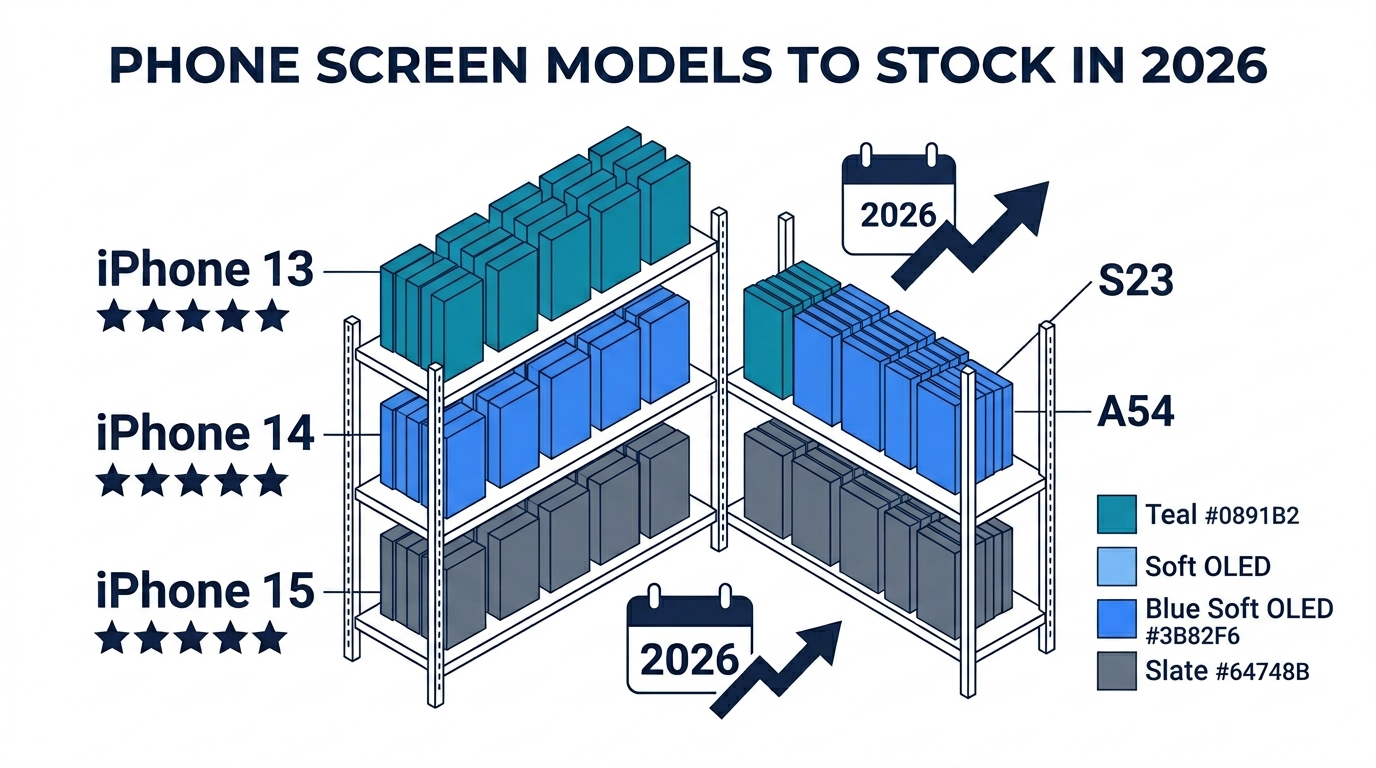
Focus 80% of your screen inventory on the top 5-6 models that represent your highest repair volume. For most shops in 2026, that means iPhone 12, 13, and 14 series screens in both Hard OLED and Soft OLED grades.
For detailed guidance on screen grades, see our Hard OLED vs Soft OLED vs LCD comparison. For wholesale pricing and MOQs, check our iPhone screens wholesale guide.
2. Batteries: Your Repeat Order Engine
Battery replacements are the most underrated profit center in phone repair. They're the second most common repair, but they're first in generating repeat customers and referrals.
Why Batteries Drive Repeat Business
- Predictable replacement cycle: Every iPhone battery degrades after 2-3 years. You can almost predict when a customer's phone will need one
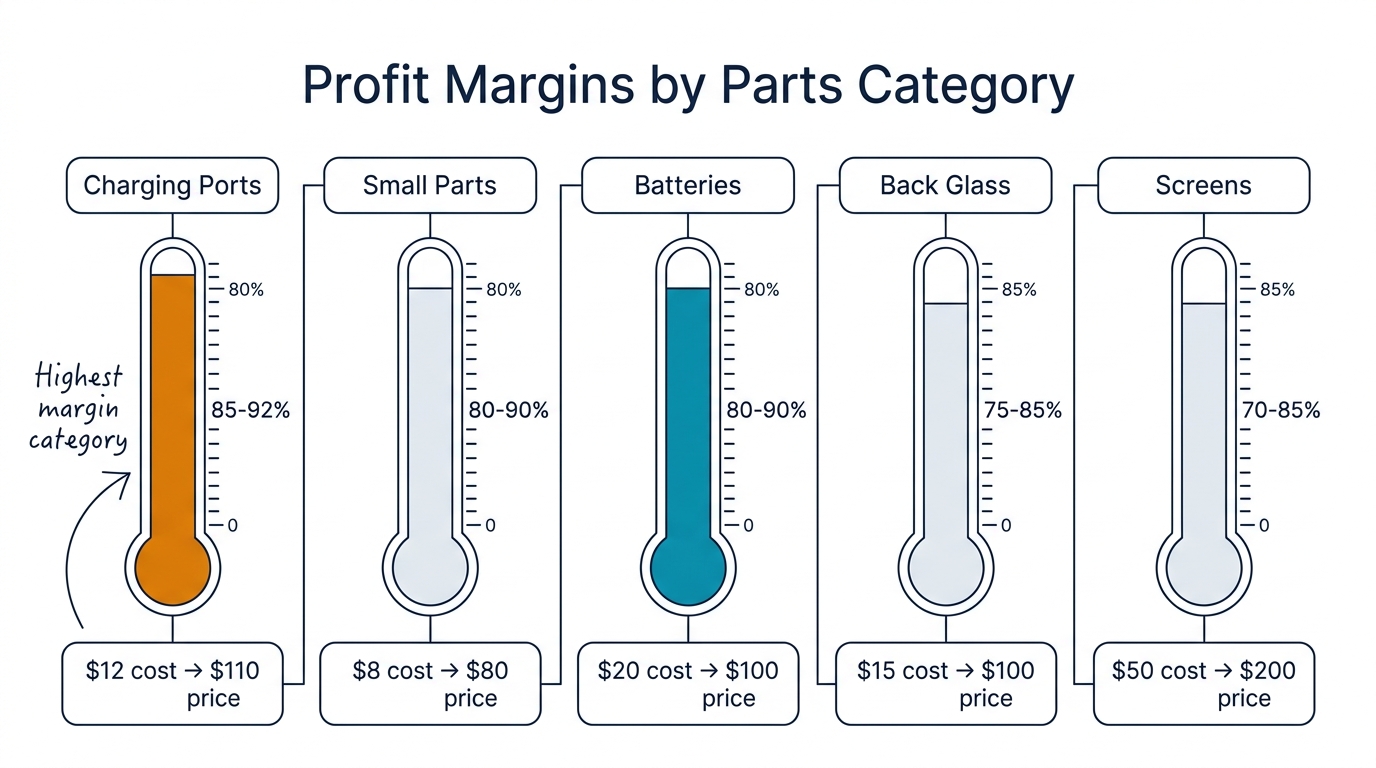
- Low parts cost, high margin: Wholesale batteries cost $2-7, repair charges $35-65 — that's 80-90% margin
- Trust builder: A customer who pays $45 for a battery replacement and gets 12+ months of better battery life becomes a loyal customer
- Referral generator: "My phone lasts all day again" is something people tell friends about
The Reorder Math
A mid-size repair shop doing 50-70 battery replacements per month reorders every 2-3 weeks. iPhone 11 and 12 series batteries are the highest-volume models in 2026. At 50+ units per order, wholesale prices drop to $3.50-5 per unit for premium grade.
What to Stock
Prioritize iPhone 11, 12, and 13 series batteries — these three families represent 60%+ of battery replacement demand. Keep iPhone SE and XR in smaller quantities for budget-market customers.
For our complete battery buying checklist, see the aftermarket iPhone battery bulk buying guide. For understanding how battery quality affects your customer retention, check our iPhone battery quality guide for repair shops.
3. Charging Ports: High Margin, Steady Demand
Charging port repairs are the sleeper hit of phone repair — lower volume than screens or batteries, but with the highest margins and the most grateful customers.
Why Charging Ports Are So Profitable
- Lowest parts cost: Charging port flex cables cost $3-12 at wholesale
- High perceived value: A phone that won't charge is a phone that doesn't work — customers pay $55-110 for the fix
- Consistent margins above 85%: The gap between parts cost and repair price is enormous
- Quick repair time: 15-30 minutes per phone means high throughput
The Hidden Complexity
The charging port flex cable assembly includes the primary microphone, Taptic Engine connector, and speaker contacts. Cheap parts that charge fine but have bad microphones create expensive callbacks. Quality control matters more here than most shops realize.
What to Stock
iPhone 11 through 13 series are your highest-volume charging port repairs. Stock all color variants for your top 3 models. Keep quantities modest (20-30 per model per order) since volume is lower than screens or batteries.
See our charging port bulk buying guide for detailed quality criteria and pricing.
4. Back Glass and Housing: Growing Category
Back glass replacement has grown significantly since Apple started using glass backs on all iPhone models from iPhone 8 onward. It's not as high-volume as screens, but it's a solid secondary revenue stream.
Why Back Glass Is Worth Stocking
- Cosmetic repairs are quick: Back glass replacement takes 10-20 minutes with a laser machine, longer with manual methods
- Good margins: Wholesale back glass costs $3-8, repair charges $30-60
- Growing demand: As more phones age past warranty, back glass cracks that were cosmetic become repair priorities
The Limitation
Back glass is primarily cosmetic — a cracked back doesn't affect phone function. This means fewer customers feel urgency about the repair compared to screens, batteries, or charging ports. Demand is real but less consistent.
What to Stock
Stock back glass for iPhone 11 through 14 series in the most popular colors (black, white, and one additional color per model). Don't over-invest — order 10-15 units per model and reorder as needed.
5. Small Parts: Low Volume, High Value Per Repair
Small parts — front cameras, rear cameras, ear speakers, loudspeakers, power buttons, and volume flex cables — individually account for low volume, but collectively they add up and often carry very high margins.
Why Small Parts Matter
- Diagnostic differentiator: A shop that can replace a front camera or ear speaker same-day handles repairs that competitors turn away
- Very high margins: A front camera module costs $3-8 at wholesale and the repair charges $40-70
- Customer lock-in: If you're the only shop in town that stocks iPhone 13 Pro rear camera modules, those customers have nowhere else to go
The Challenge
- Wide SKU range: There are dozens of small parts across dozens of phone models
- Low individual demand: You might only replace 2-3 ear speakers per month
- Risk of dead inventory: Stocking 20 units of a part you use 3 times per month ties up cash for 6+ months
How to Stock Smart
Don't try to stock every small part for every model. Instead:
- Track which small parts repairs you get asked for most often
- Stock 5-10 units of your top 3 most-requested small parts per model
- For rare repairs, order on-demand from a supplier with fast shipping
Building Your Ideal Parts Mix
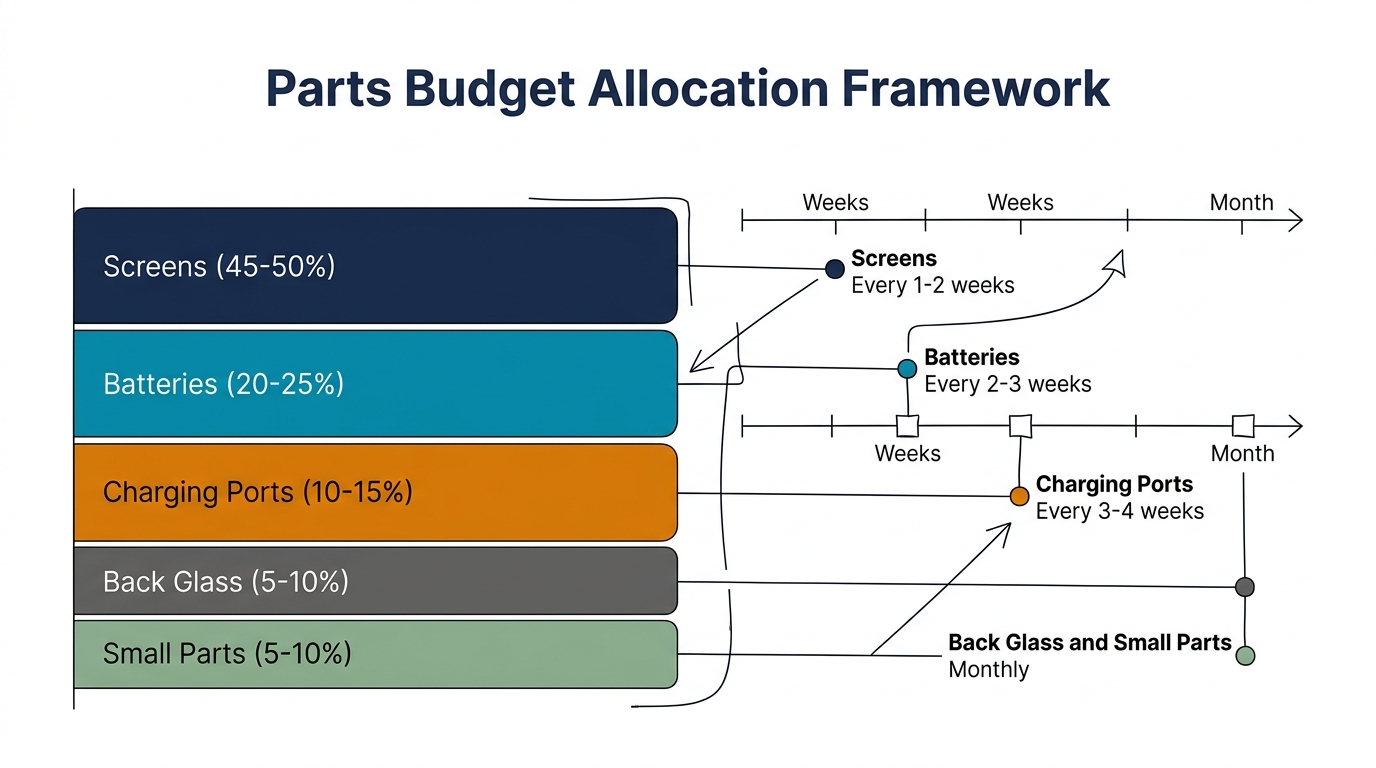
Here's a practical framework for allocating your parts budget across categories:
| Category | % of Parts Budget | Why |
|---|---|---|
| Screens | 45-50% | Highest volume, highest revenue per repair |
| Batteries | 20-25% | High volume, best margins, drives repeat business |
| Charging Ports | 10-15% | Excellent margins, steady demand |
| Back Glass | 5-10% | Growing category, good secondary revenue |
| Small Parts | 5-10% | Low volume but differentiates your shop |
The Reorder Cycle That Works
Most successful repair shops follow this pattern:
- Screens: Reorder weekly or bi-weekly — demand is too high to let stock run out
- Batteries: Reorder every 2-3 weeks in quantities of 50-100 across your top models
- Charging ports: Reorder monthly in quantities of 20-50 across top models
- Back glass and small parts: Reorder monthly or as-needed, keep minimum stock levels
For a complete guide on stocking strategy for new and small shops, see our which parts to stock in 2026 guide.
Why Mixed-Model Orders Matter
Here's a common problem: a supplier offers great pricing at 100 units per SKU, but you only need 20 iPhone 12 batteries, 30 iPhone 13 batteries, and 15 iPhone 11 batteries this month. Buying 100 of each ties up cash in inventory you won't use for 3-5 months.
The solution is working with suppliers who support mixed-model orders — letting you combine different models and even different parts categories into a single order that meets the minimum order quantity.
A practical mixed order might look like:
- 20 × iPhone 12 screens (Hard OLED)
- 15 × iPhone 13 screens (Soft OLED)
- 30 × iPhone 11 batteries
- 30 × iPhone 12 batteries
- 20 × iPhone 13 batteries
- 10 × iPhone 12 charging ports (mixed colors)
- 10 × iPhone 13 charging ports (mixed colors)
Total: 135 units across multiple categories — enough to hit MOQ pricing while stocking exactly what your shop needs. For more on how MOQs work and how to optimize order sizes, see our MOQ and lead time guide.
FAQ
What are the most profitable phone repairs?
Charging port repairs and battery replacements offer the highest margins — typically 85-92% and 80-90% respectively. While screen replacements generate more revenue per job, the parts cost is higher, bringing margins down to 70-85%. The most profitable strategy is offering all three services: screens for volume, batteries for repeat business, and charging ports for high-margin steady work.
How many phone repairs does a typical shop do per month?
A mid-size independent repair shop typically handles 150-300 repairs per month. The breakdown is roughly 40-50% screen replacements, 20-30% battery replacements, 10-15% charging port repairs, and the remainder split between back glass, cameras, and other small parts. Shops in high-traffic locations or those offering same-day service can exceed 400+ repairs monthly.
What phone repair parts should a new shop stock first?
Start with screens and batteries for the top 5 most popular phone models in your market — for most shops, that means iPhone 11, 12, 13, and Samsung Galaxy S/A series. Add charging ports for your top 3 iPhone models. Keep initial quantities small (10-20 per SKU) until you understand your actual demand. Scale up based on 30 days of real repair data.
How much inventory should a repair shop carry?
Carry 2-3 weeks of inventory for high-volume parts (screens, batteries) and 4-6 weeks for lower-volume parts (charging ports, small parts). This balances having parts available for same-day repairs against tying up too much cash. Track your actual usage by model and adjust quantities every month based on real data, not estimates.
Do repair shops make more money from parts or labor?
The majority of repair shop revenue comes from the margin on parts, not labor charges. Most shops don't charge labor separately — the repair price includes both parts and labor. With wholesale parts costing $3-40 and repair charges ranging from $35-180, the built-in margin on parts is where the profit sits. This is why sourcing quality parts at good wholesale prices directly impacts your bottom line.
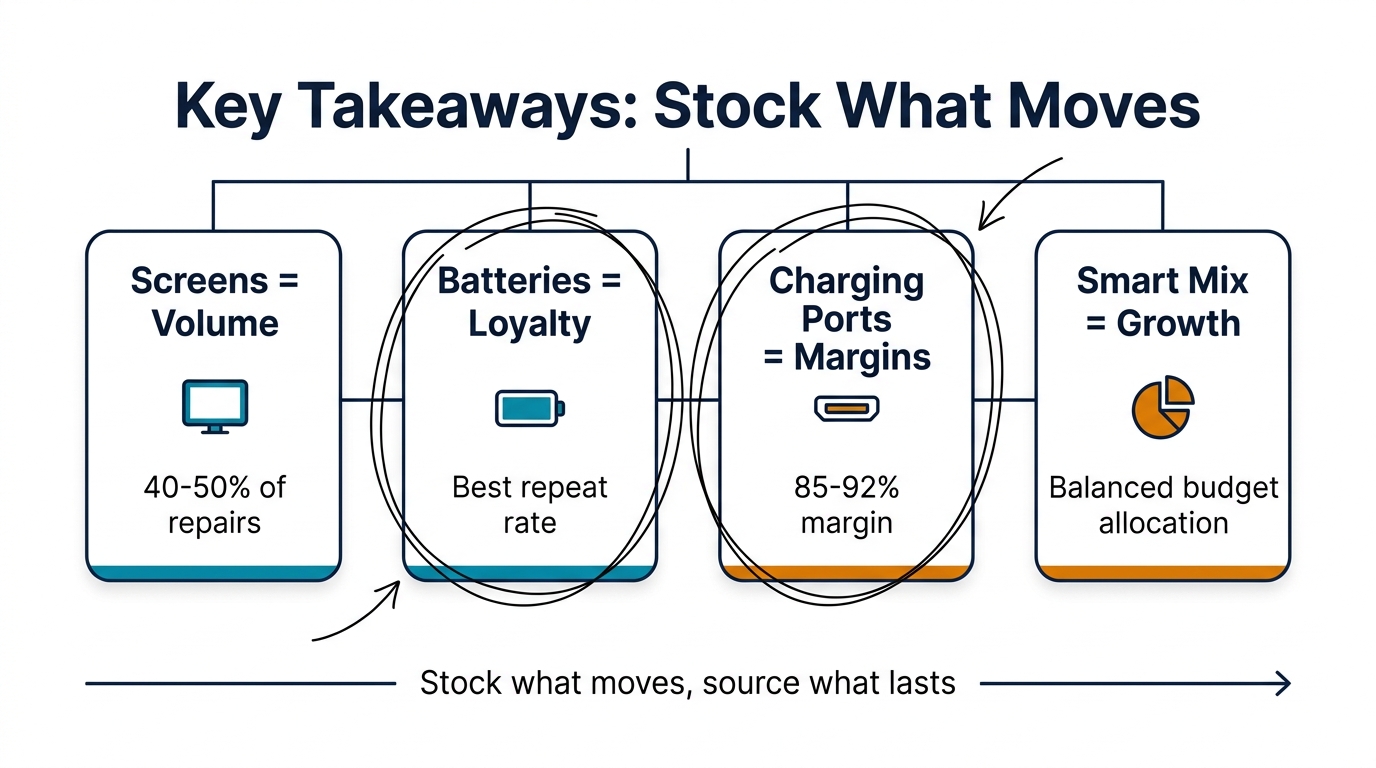
Stock What Moves, Source What Lasts
The repair shops that grow consistently aren't the ones with the most parts on their shelves — they're the ones with the right parts. Screens for volume and revenue, batteries for repeat business and referrals, charging ports for high margins, and select small parts to handle repairs competitors can't.
Every parts category has its role in your business. The key is matching your inventory investment to your actual repair volume and working with a supplier who lets you order the mix you need — not the minimum they want to ship.
We supply screens, batteries, charging ports, and small parts for all major iPhone and Samsung models. Mixed-model orders start at 10 units, so you can stock exactly what your shop needs without over-committing on any single SKU.