
How to Choose iPhone Charging Port Replacement Parts for Bulk Repair Orders
Charging port repairs are the second or third most common job in most phone repair shops — right behind screen replacements and often neck-and-neck with battery swaps. Yet most repair shops put far less thought into sourcing their iPhone charging port replacement parts than they do screens or batteries. They order whatever's cheapest, assume all flex cables are the same, and only discover the quality difference when a customer comes back because their microphone stopped working after a "charging port repair."
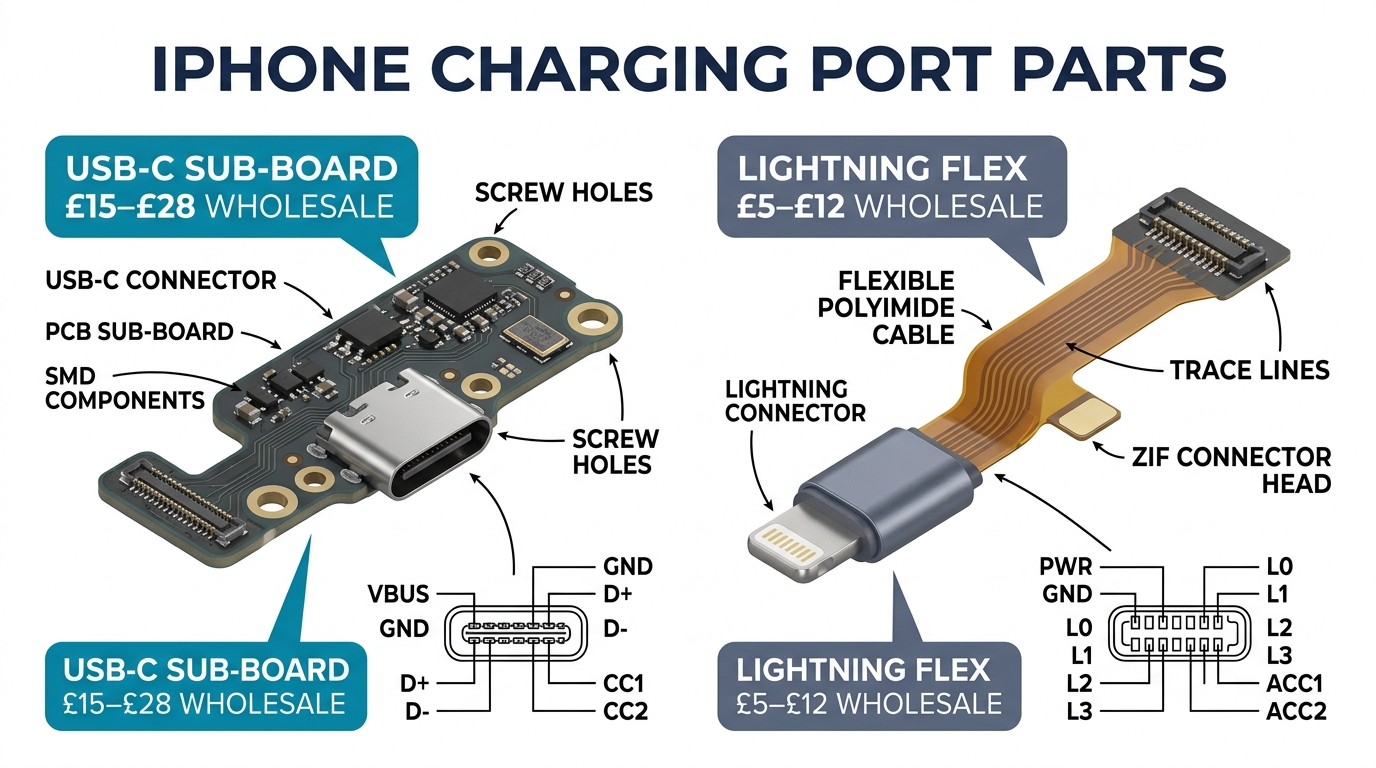
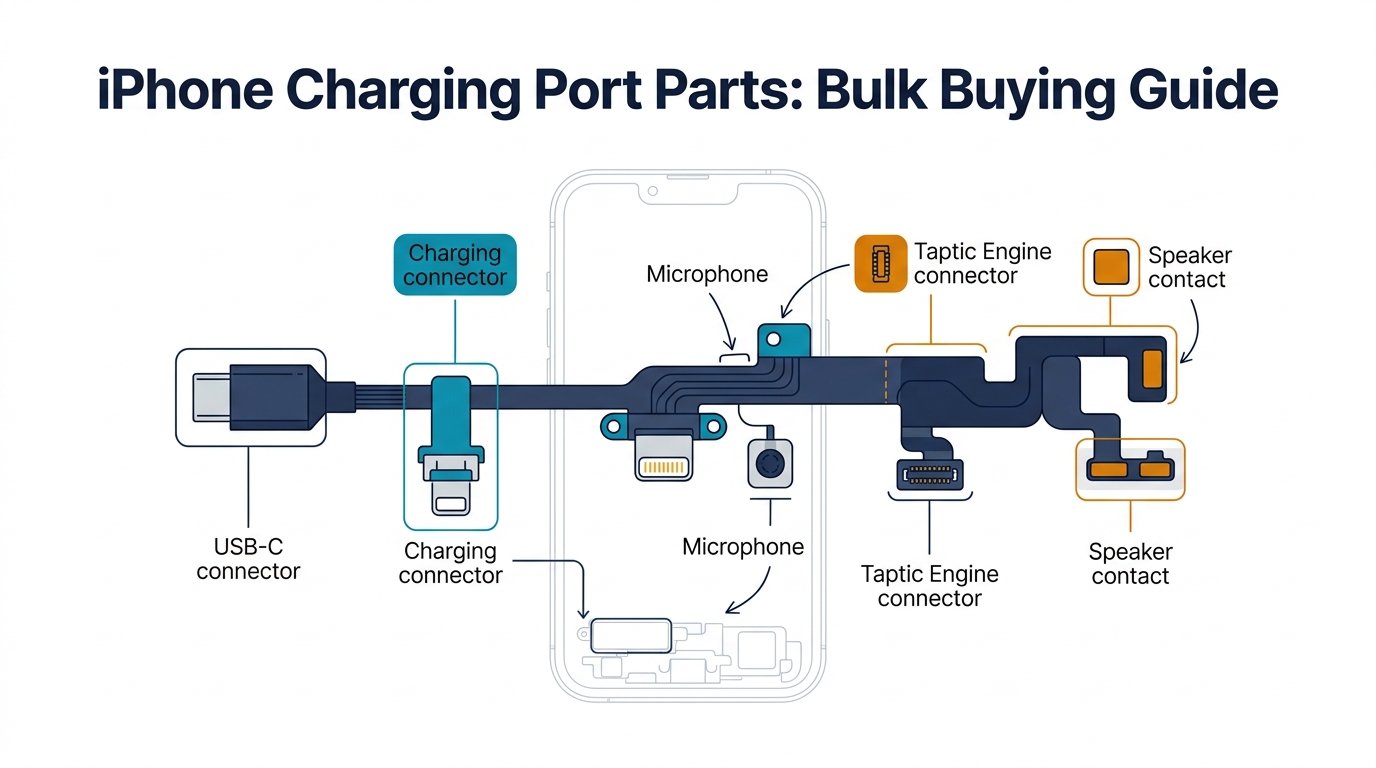
The problem is that an iPhone charging port isn't just a port. It's a flex cable assembly that includes the Lightning or USB-C connector, the primary microphone, the Taptic Engine connector, and other components that vary by model. A bad charging port flex doesn't just mean slow charging — it can mean muffled calls, no vibration, or speaker issues that the customer blames on your repair work.
This guide covers what you're actually buying when you order charging port parts, what quality factors matter most, how pricing works at wholesale, and which models you should prioritize stocking.
Need Charging Port Flex in Bulk?
Wholesale charging port assemblies for iPhone & Samsung — tested, factory-direct.
Get Wholesale QuoteWhat's Actually Inside a Charging Port Flex Cable Assembly?
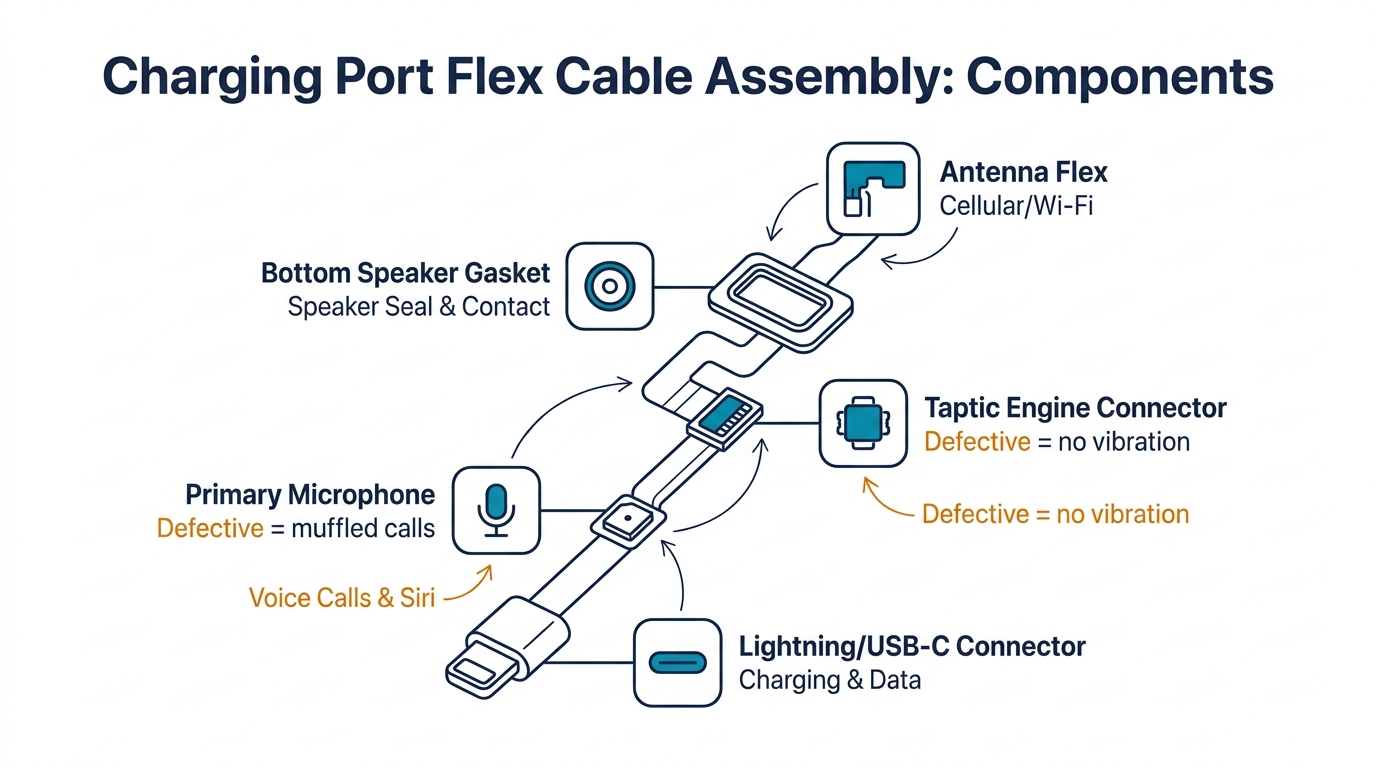
When suppliers list "iPhone charging port flex cable," they're selling a complete sub-assembly — not just the USB connector. Understanding what's on this flex cable explains why quality matters so much and why a $2 part can cause $50 worth of callbacks.
Here's what a typical iPhone charging port assembly includes:
| Component | Function | What Happens If It's Defective |
|---|---|---|
| Lightning/USB-C connector | Charging and data transfer | Loose connection, intermittent charging, "accessory not supported" errors |
| Primary microphone | Voice calls, voice memos, Siri | Muffled audio on calls, "Can't hear you" complaints |
| Taptic Engine connector | Links to haptic feedback motor | No vibration for notifications, no haptic touch feedback |
| Bottom speaker gasket/contact | Seals and connects to bottom speaker | Reduced speaker volume, distorted audio |
| Antenna flex (some models) | Cellular/Wi-Fi antenna connection | Weak signal, dropped calls |
This is why cheap charging port parts cause so many problems. A supplier can use a decent USB-C connector but cheap microphone components, and you won't discover the issue until the customer calls you saying people can't hear them on phone calls. By then, you've already installed 30 units from that batch.
Lightning vs USB-C: What Repair Shops Need to Know
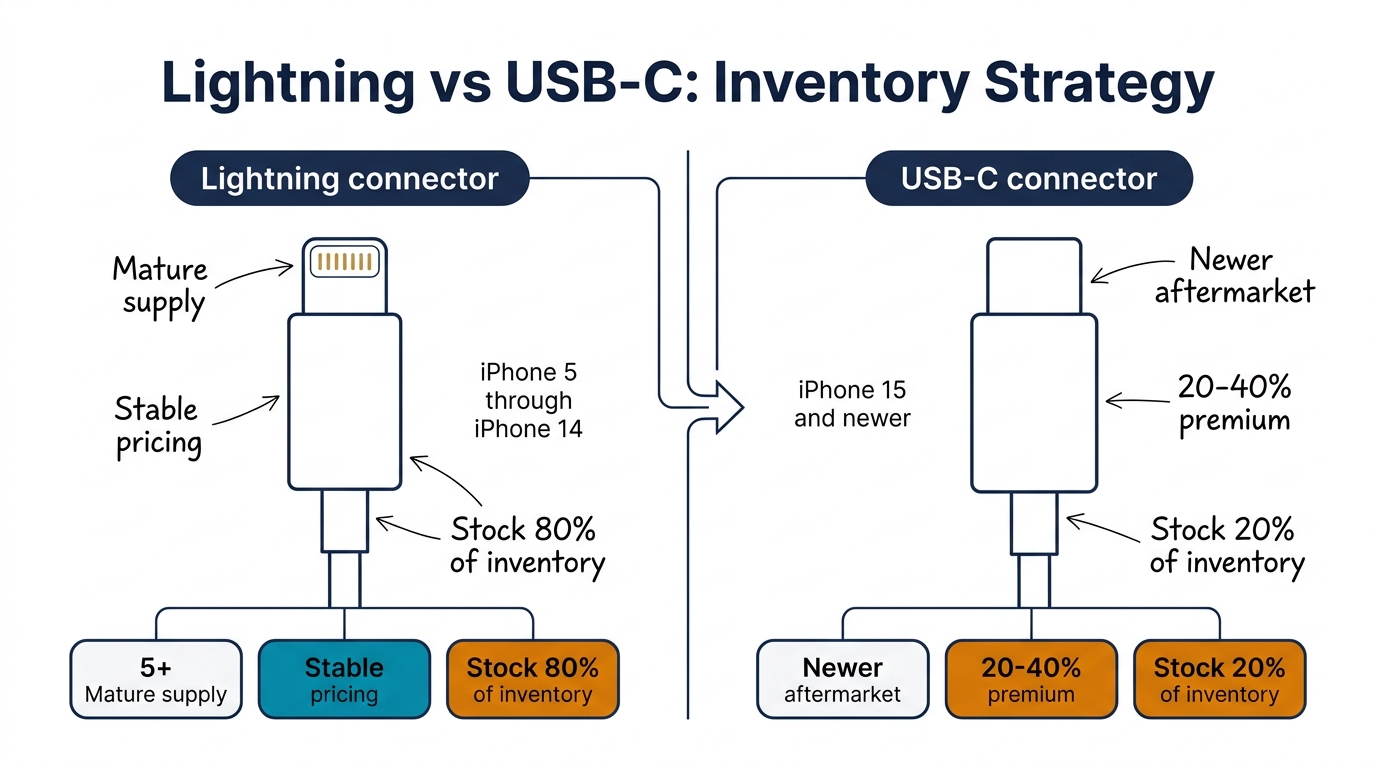
The iPhone 15 series (released September 2023) was Apple's switch from Lightning to USB-C. This means repair shops now need to stock two different connector types, and the transition affects your inventory strategy.
Lightning Models (iPhone 5 through iPhone 14)
Lightning charging port assemblies have been on the market for over a decade. Supply is abundant, quality is generally consistent among established suppliers, and prices are at their lowest point. Most of your current charging port repair volume likely comes from Lightning models — particularly iPhone 11, 12, and 13 series.
Stocking note: Lightning parts are mature and stable. You won't see sudden price fluctuations or supply shortages. Stock 2-3 months of inventory for your high-volume models.
USB-C Models (iPhone 15 and newer)
USB-C charging port assemblies are newer to the aftermarket. Quality consistency is still developing — some early aftermarket USB-C parts had issues with data transfer speeds and fast charging compatibility. The USB-C connector also has tighter tolerances than Lightning, meaning manufacturing quality matters more.
Stocking note: Order smaller quantities of USB-C parts until you've verified quality with your supplier. The aftermarket for iPhone 15/16 charging ports is still maturing. Expect to pay 20-40% more per unit compared to equivalent Lightning parts.
The Transition Period Strategy
For the next 2-3 years, you'll be servicing both connector types. Here's how to manage inventory:
- 80% of your charging port stock: Lightning models (iPhone 11-14 series) — this is where your volume is
- 20% of your charging port stock: USB-C models (iPhone 15-16) — growing but still lower volume
- Phase out gradually: iPhone X and older Lightning parts — demand is declining, only stock if you regularly service these models
Quality Factors That Actually Matter
Not every charging port flex cable is the same quality. Here's what separates a reliable part from one that generates callbacks:
1. Connector Fit and Retention
The charging connector needs to hold the cable firmly. A loose Lightning or USB-C port is the fastest way to lose a customer's trust. When testing sample parts:
- Insert and remove a charging cable 10 times. The click should be consistent and firm.
- The cable should not wobble or disconnect with slight movement.
- For USB-C parts, test with multiple cable brands — some cheap connectors only work reliably with specific cables.
2. Microphone Quality
Since the primary microphone sits on the charging port flex cable, this is the component most often compromised in budget parts. Test by:
- Making a phone call after installation — ask someone on the other end if you sound clear
- Recording a voice memo and playing it back
- Testing Siri voice recognition
Red flag: If your supplier's charging port parts consistently produce muffled call audio, the microphone component is substandard. This is the #1 quality issue we see with budget charging port assemblies.
3. Color Matching
iPhone charging port assemblies come in model-specific colors (black, white, blue, red, green, gold, etc.). The visible part of the charging port — the connector housing you can see at the bottom of the phone — should match the phone's color.
This seems cosmetic, but mismatched colors look unprofessional. A customer with a blue iPhone 13 who gets a black charging port assembly will notice. Always order the correct color variant for each model you service.
4. Flex Cable Durability
The flex cable connects all components on the assembly. Cheap flex cables use thinner copper traces that can crack during installation or after repeated phone flexing. Signs of poor flex cable quality:
- Visible thinness compared to OEM parts
- Components that work during testing but fail within days of installation
- Intermittent issues that come and go (often a cracked trace making inconsistent contact)
5. Screw Holes and Bracket Alignment
The charging port assembly is secured with specific screws and brackets. If the screw holes don't align perfectly with the phone's frame, you're either forcing screws (risk of stripping) or leaving the assembly loosely secured. Test samples in the actual phone model before committing to a bulk order.
Wholesale Pricing by iPhone Model
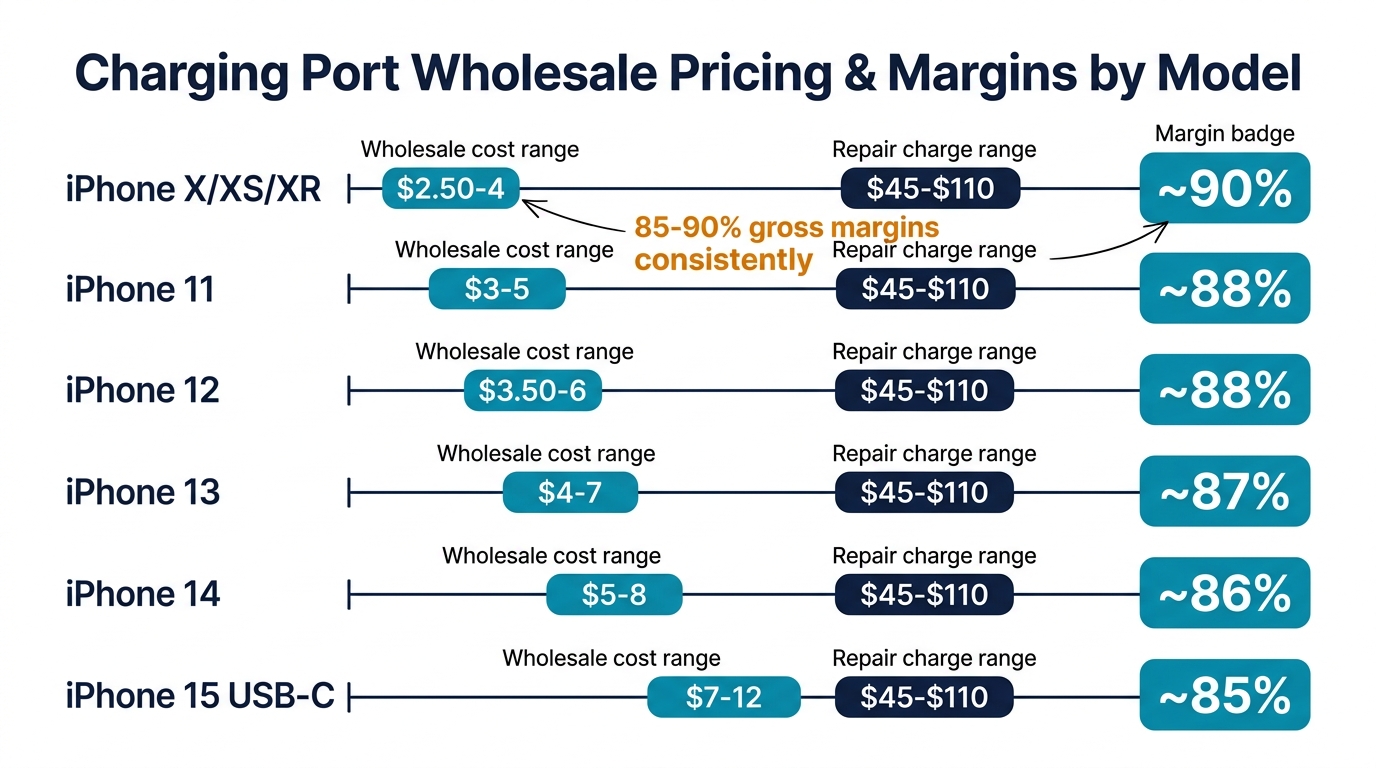
Charging port flex cable assemblies are significantly cheaper than screens or batteries. This makes them a high-margin repair — but only if the parts are reliable. Here's what wholesale pricing looks like in 2026:
| iPhone Model | Wholesale Price (per unit) | Typical Repair Charge | Gross Margin |
|---|---|---|---|
| iPhone X / XS / XR | $2.50-4.00 | $45-65 | $41-61 (~90%) |
| iPhone 11 series | $3.00-5.00 | $50-70 | $47-65 (~88%) |
| iPhone 12 series | $3.50-6.00 | $55-75 | $51-69 (~88%) |
| iPhone 13 series | $4.00-7.00 | $60-85 | $56-78 (~87%) |
| iPhone 14 series | $5.00-8.00 | $65-90 | $60-82 (~86%) |
| iPhone 15 series (USB-C) | $7.00-12.00 | $80-110 | $73-98 (~85%) |
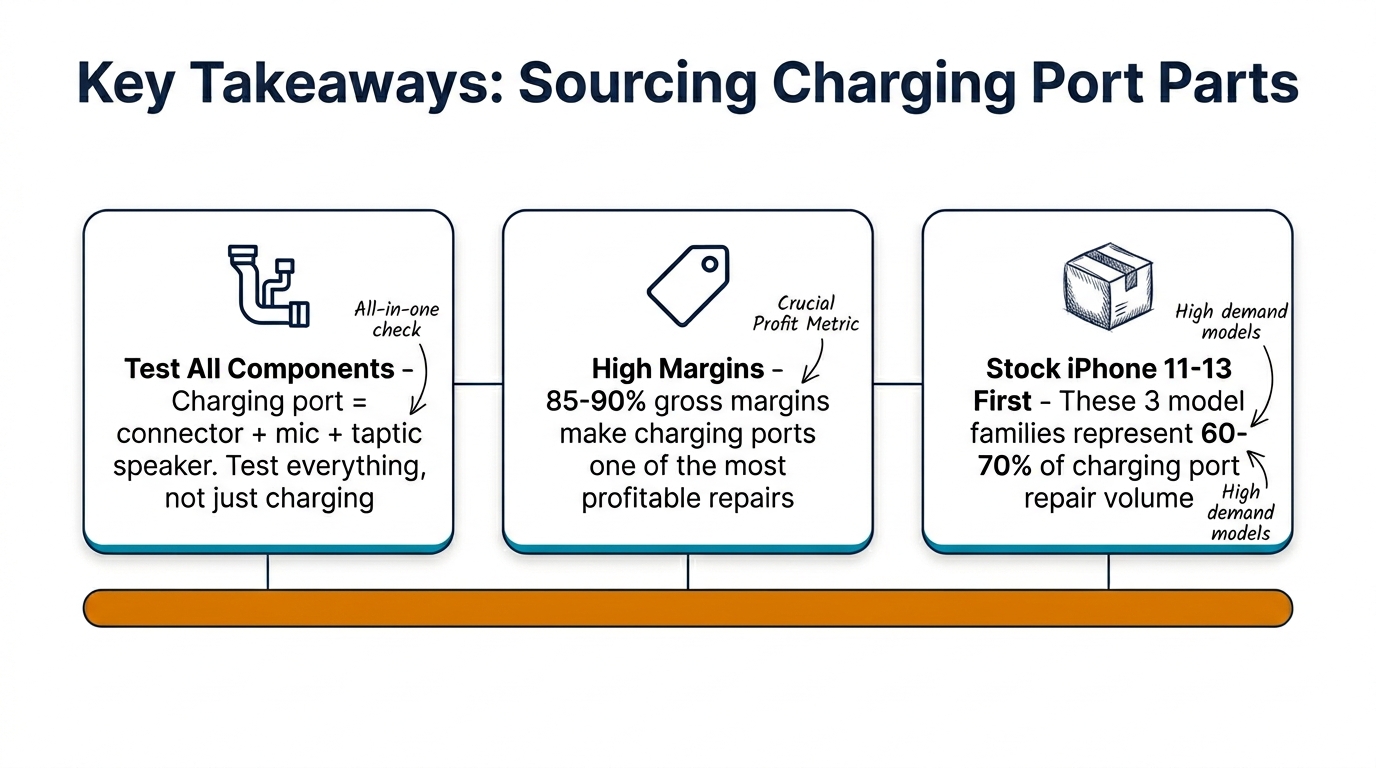
Key insight: Charging port repairs consistently deliver 85-90% gross margins — higher than screen replacements. The parts cost is low, the repair is straightforward (15-30 minutes depending on model), and demand is steady. This makes charging ports one of the most profitable repair services you can offer.
For a complete picture of how parts costs affect your repair pricing strategy, see our guide on iPhone battery replacement cost breakdown — the margin analysis approach applies equally to charging port repairs.
Which Models to Stock First
Focus your bulk charging port orders on models with the highest repair demand:
| Priority | Models | Why |
|---|---|---|
| High | iPhone 11 / 11 Pro / 11 Pro Max | 5+ years old, heavy daily use = worn charging ports. Huge install base |
| High | iPhone 12 / 12 Pro | 4+ years old, entering peak charging port failure window |
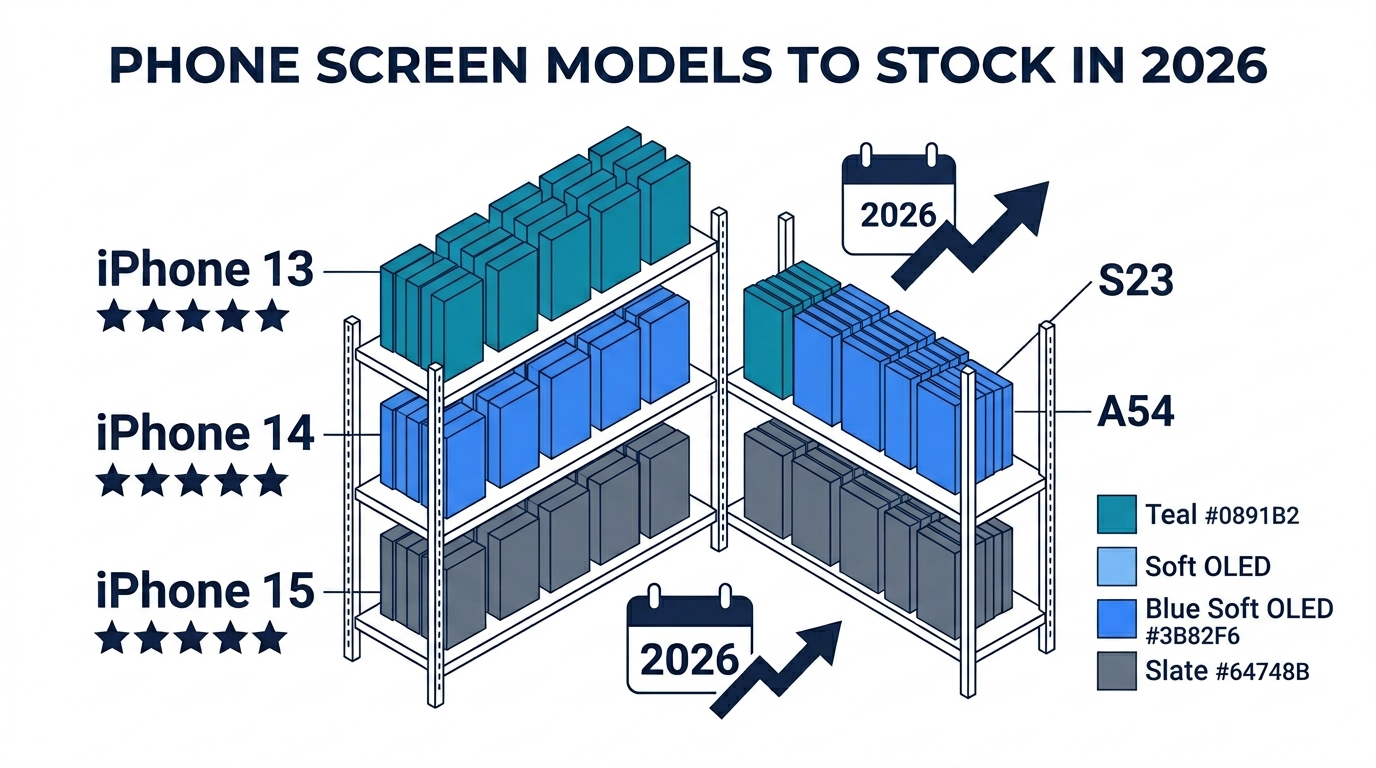
| High | iPhone 13 / 13 Pro / 13 Pro Max | 3+ years old, growing repair volume |
| Medium | iPhone XR / XS | Still serviced but declining — stock small quantities |
| Medium | iPhone 14 / 14 Pro | Newer, but some early failures appearing |
| Low (growing) | iPhone 15 / 15 Pro (USB-C) | Still under warranty for many, but aftermarket demand is building |
Practical stocking tip: For your first bulk order, focus on iPhone 11 through 13 series. These three model families probably represent 60-70% of your charging port repair work. Add iPhone 14 as secondary stock. Keep iPhone 15 USB-C parts in small quantities — order 10-20 units to have on hand, not 100.
For broader inventory planning across all repair categories, see our guide on which repair parts a small shop should stock in 2026.
Common Mistakes When Sourcing Charging Ports
Mistake 1: Treating All Suppliers as Equal
Two charging port assemblies at the same price can have dramatically different microphone quality, connector retention, and longevity. Always test 5-10 sample units before committing to a bulk order. Install them in actual phones and check all functions — not just charging.
Mistake 2: Ordering Only the Connector
Some suppliers sell the charging port connector separately from the full flex cable assembly. For most repairs, you need the complete flex cable assembly that includes the microphone, Taptic Engine connector, and all associated components. Ordering just the connector saves money but requires micro-soldering skills to install — impractical for most repair shops doing volume work.
Mistake 3: Ignoring Color Variants
Ordering "iPhone 13 charging port" without specifying the color means you might receive all black units when 40% of your iPhone 13 repairs are on blue or pink models. Check your repair records to see which colors you service most and order accordingly. Most good suppliers offer mixed-color orders.
Mistake 4: Not Testing the Microphone
This is the most costly mistake. A charging port that charges perfectly but has a bad microphone will result in a callback that costs you 30 minutes of labor plus a replacement part. Always make a test call after every charging port installation — it takes 30 seconds and catches the #1 quality issue.
Mistake 5: Over-Ordering Older Models
iPhone X and XS charging port parts are cheap, but if you only replace 3-5 per month, a 100-unit order gives you 20-30 months of inventory for a declining model. Calculate your monthly volume per model and order 2-3 months of stock at a time. For guidance on order sizing and MOQs, see our MOQ and lead time guide.
How to Evaluate a Charging Port Supplier
Beyond testing the parts themselves, evaluate your supplier's practices:
- Do they stock color-specific variants? A serious supplier carries all color options for each model, not just black.
- Can they provide mixed-model orders? You need 20 × iPhone 12 + 15 × iPhone 13 + 10 × iPhone 11 in one shipment — not 100 units of one model.
- What's their defect handling? Do they replace faulty units in the next order, or make you ship parts back internationally?
- Do they test microphone function? This is the critical question. Budget suppliers test for charging function only. Quality suppliers test all components on the flex assembly — charging, microphone, vibration motor connection, and speaker contact.
- Can they provide model-specific photos? If a supplier shows you one generic photo for all iPhone charging ports, they may not actually stock model-specific parts.
For a more detailed framework on choosing wholesale suppliers, see our complete supplier selection guide.
FAQ
How much does an iPhone charging port replacement cost at a repair shop?
Most independent repair shops charge $45-110 for an iPhone charging port replacement depending on the model. Older models (iPhone X, 11) typically cost $45-70. Newer models (iPhone 14, 15) cost $80-110. With wholesale parts costing $3-12 per unit, charging port repairs deliver some of the highest margins in phone repair — consistently above 85%.
Is it worth replacing an iPhone charging port or should customers buy a new phone?
For any iPhone newer than the XS, charging port replacement is almost always worth it. The repair costs $50-100 and takes 15-30 minutes, while a new iPhone costs $600-1,200. Even for older models, the repair cost is low enough that it makes financial sense unless the phone has multiple other issues.
What's the difference between a charging port connector and a charging port flex cable?
The connector is just the physical Lightning or USB-C socket. The flex cable assembly is the complete part that includes the connector plus the primary microphone, Taptic Engine connector, speaker contacts, and antenna connections. Most repairs require the full flex cable assembly — replacing just the connector requires micro-soldering equipment and skills that most repair shops don't use for routine work.
How long does an iPhone charging port last?
Original iPhone charging ports typically last 3-5 years with daily charging. Heavy users (multiple charges per day, frequent cable swapping) may see wear sooner. The most common failure point is the connector itself becoming loose, followed by lint accumulation that prevents proper cable seating. Quality aftermarket replacement parts should last 2-3 years minimum.
Do aftermarket charging ports affect iPhone water resistance?
The charging port assembly includes gaskets and seals that contribute to the iPhone's water resistance rating. Quality aftermarket parts include these gaskets, but the water resistance may not match the original factory seal. Most repair shops advise customers that water resistance cannot be guaranteed after any repair involving the charging port area — this is standard practice across the industry.
Stock Smart, Repair Profitably
Charging port repairs are a high-margin, steady-volume service that every repair shop should optimize. The key is sourcing parts where all components on the flex cable work reliably — not just the charging connector. Test every new supplier's parts for microphone quality, connector retention, and color accuracy before committing to bulk orders.
If you're sourcing iPhone charging port replacement parts for your repair business, we supply complete flex cable assemblies for all iPhone models from iPhone 8 through iPhone 16. Every batch is tested for charging, microphone, and vibration function. We support mixed-model and mixed-color orders starting at 10 units.