
How Phone Parts Buying Differs by Market: Budget Phone Markets vs Premium Phone Markets

A repair shop in Lagos and a repair shop in London both need phone parts. But what they order, how they order, and what they spend per unit look completely different.
Understanding how phone parts buying by market works isn't academic — it directly affects how you should build your wholesale orders, which grades to choose, and how to allocate your budget. A buyer in a premium phone market who stocks Samsung A05 LCD screens is wasting money on parts nobody needs. A buyer in a budget phone market who orders iPhone 14 Soft OLED is tying up capital in parts too expensive for local repair pricing.
This guide maps out the key differences between budget and premium phone markets, so you can match your sourcing strategy to the market you actually serve.
Looking for a Reliable Wholesale Parts Supplier?
Factory-direct from Shenzhen — transparent grades, invoices & 12-month warranty.
Get Wholesale QuoteWhat Defines a "Budget" vs "Premium" Phone Market
The distinction isn't about country wealth — it's about which phone models dominate the installed base and what customers are willing to pay for repairs.
Budget Phone Markets
- Dominant models: Samsung A-Series (A05, A06, A14, A15), Xiaomi Redmi series, Tecno, Infinix, Oppo A-series
- Screen technology: Primarily LCD. AMOLED only on mid-range Samsung (A34, A54)
- Average screen repair price: $15-35 retail
- Customer priority: Lowest price that gets the phone working. Grade tolerance is high — customers accept visible quality differences if the price is right
- Typical regions: Sub-Saharan Africa, South Asia, Southeast Asia, parts of Latin America, Central Asia
Premium Phone Markets
- Dominant models: iPhone 11-15 series, Samsung S/Z series, Google Pixel
- Screen technology: OLED dominant (Incell, Hard OLED, Soft OLED). LCD only on older/budget models
- Average screen repair price: $50-120 retail
- Customer priority: Quality that matches the original screen. Customers notice color differences, touch responsiveness, and brightness. Grade tolerance is lower
- Typical regions: Western Europe (UK, Germany, France), North America, Australia, Japan, South Korea, Gulf states (UAE, Saudi Arabia)
Mixed Markets
Many markets fall between these two extremes. Eastern Europe, Turkey, Brazil, Mexico, and urban areas in India and China have significant volume in both budget and premium devices. If you operate in a mixed market, your sourcing needs to cover both segments — which makes order planning more complex but also gives you a wider customer base.
How Product Mix Differs Between Markets
Screens: The Biggest Divergence
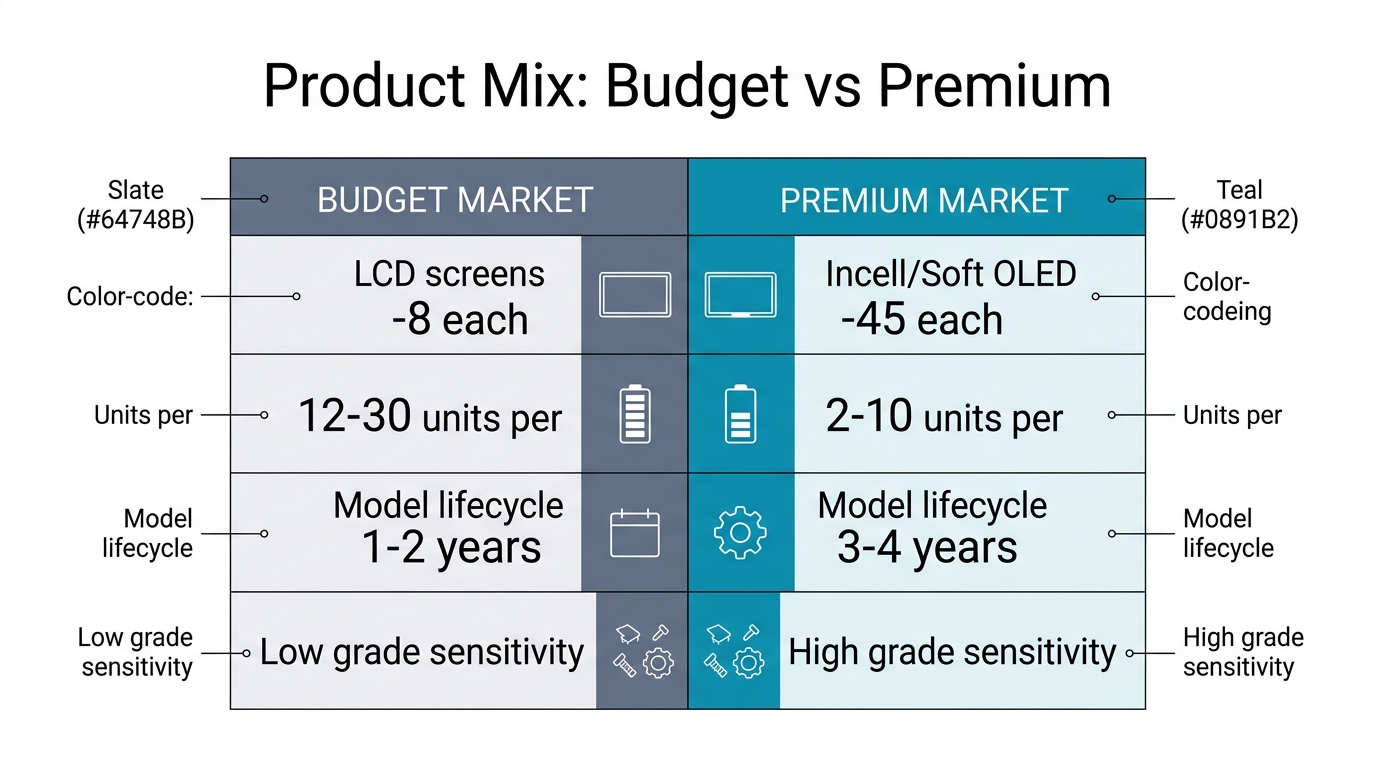
In budget markets, your screen inventory is dominated by LCD panels costing $3-8 each. You stock high quantities because unit cost is low and turnover is fast. The top models shift frequently as Samsung and Chinese brands release new budget phones every 6-12 months.
In premium markets, your screen inventory centers on Incell and OLED panels costing $9-45 each. You stock fewer units because each screen ties up more capital. But model lifecycles are longer — iPhone 12 screens will still be in demand in 2027.
| Factor | Budget Market | Premium Market |
|---|---|---|
| Most-stocked screen type | LCD | Incell / Soft OLED |
| Cost per screen | $3-8 | $9-45 |
| Units stocked per $100 | 12-30+ | 2-10 |
| Model lifecycle | 1-2 years | 3-4 years |
| Grade sensitivity | Low | High |
Batteries: Similar Demand, Different Models
Battery replacement demand is universal — every market has aging phones with degraded batteries. The difference is which models:
- Budget markets: Samsung A14/A15 batteries, Xiaomi Redmi batteries, Tecno/Infinix batteries. Unit cost: $1.50-3.00
- Premium markets: iPhone 11/12/13/14 batteries, Samsung S-series batteries. Unit cost: $3.00-5.00
Battery margins are high in both segments. This is often the most profitable repair category regardless of market.
Small Parts: Higher Value in Budget Markets
Here's a non-obvious insight: small parts like charging ports and earpieces are proportionally more important in budget phone markets.
Why? Because in budget markets, a phone might only cost $80-150 new. A $25 screen repair represents 15-30% of the phone's value — the customer is willing to pay. But a $50 Soft OLED screen repair on a $100 phone doesn't make economic sense. So budget market repairs skew toward smaller, cheaper fixes: charging port replacements, speaker swaps, battery changes.
In premium markets, customers are more likely to invest in screen repairs because the phone is worth $600-1,200. Small parts are still profitable but represent a smaller share of total repair revenue.
How Order Strategy Differs
Budget Market Ordering Strategy
Order frequently, smaller quantities per model, broader model range.
Budget phone models turn over quickly. Samsung releases new A-Series models annually, and Chinese brands update even faster. You need to track which models are currently selling in your local market and adjust your orders every 1-2 months.
Practical approach:
- Order every 3-4 weeks
- Stock 5-8 screen models at 5-10 units each
- Keep battery stock for 6-8 models
- Heavy small parts inventory (charging ports, speakers, flex cables)
- Total order: $200-400 per cycle
Biggest risk: Overstocking a model that's being replaced. Don't buy 50 Samsung A13 screens because they're cheap if A14 and A15 are already dominant in your market.
Premium Market Ordering Strategy
Order less frequently, higher value per order, fewer models with deeper stock.
iPhone models stay in the repair queue for 3-4 years. You can safely stock iPhone 11, 12, and 13 screens knowing they'll sell. The model range is narrower but the value per unit is higher.
Practical approach:
- Order every 4-6 weeks
- Stock 3-5 screen models at 10-20 units each
- Focus battery stock on top 3-4 iPhone models
- Moderate small parts (charging ports, back glass for newer iPhones)
- Total order: $400-800 per cycle
Biggest risk: Stocking premium grades (Soft OLED) that don't match local demand. Not every premium market customer wants the $100+ repair — many are happy with Incell at $50. Know your customer price sensitivity before loading up on expensive inventory.
For detailed first-order guidance, see our wholesale order templates by shop size.
Grade Preferences by Market

Quality grades mean different things to different markets.
Budget Markets: Price-Driven Grade Selection
Most customers in budget markets choose the cheapest grade that works. They're not comparing their replacement screen to the original — they're comparing it to the cost of buying a new phone.
- Standard/B-grade LCD screens are perfectly acceptable and move faster than premium grades
- Battery grade matters less — customers want the phone to last a full day, not match original specifications exactly
- Small parts quality: Basic functionality is the standard. Premium flex cables or gold-plated connectors don't command a price premium
For wholesale buyers: Stock mostly standard grades. Keep a small quantity of premium grade for customers who ask, but don't over-invest.
Premium Markets: Quality-Driven Grade Selection
Customers in premium markets notice quality differences. A screen with slightly off color temperature, visible edge bleeding, or slower touch response will generate complaints or returns.
- Incell is the minimum acceptable grade for most iPhone screen repairs in premium markets. Below that, customers complain
- Soft OLED commands a real price premium — customers will pay $30-50 more for a screen that matches original quality
- Battery capacity accuracy matters — repair shops in premium markets test batteries and reject units that underperform claimed capacity
For wholesale buyers: Invest more in A-grade and premium grades. The per-unit cost is higher, but the customer expectation justifies the price. Cutting corners on grade to save $2 per screen loses you customers who go to a shop with better parts.
For more on screen grades and how to evaluate them, see our OEM vs aftermarket phone screens guide.
Shipping and Logistics Differences
Market location also affects how you order.
Shipping to Africa and South Asia
- Air freight is typically the best option for phone parts (lightweight, high value-to-weight ratio)
- Delivery time from China: 5-10 days by air
- Customs and import duties vary significantly by country — check local regulations before ordering
- Some buyers in these markets consolidate orders with neighboring shops to meet MOQ and split shipping costs
Shipping to Europe and North America
- Air freight and express (DHL, FedEx) are common for urgent orders
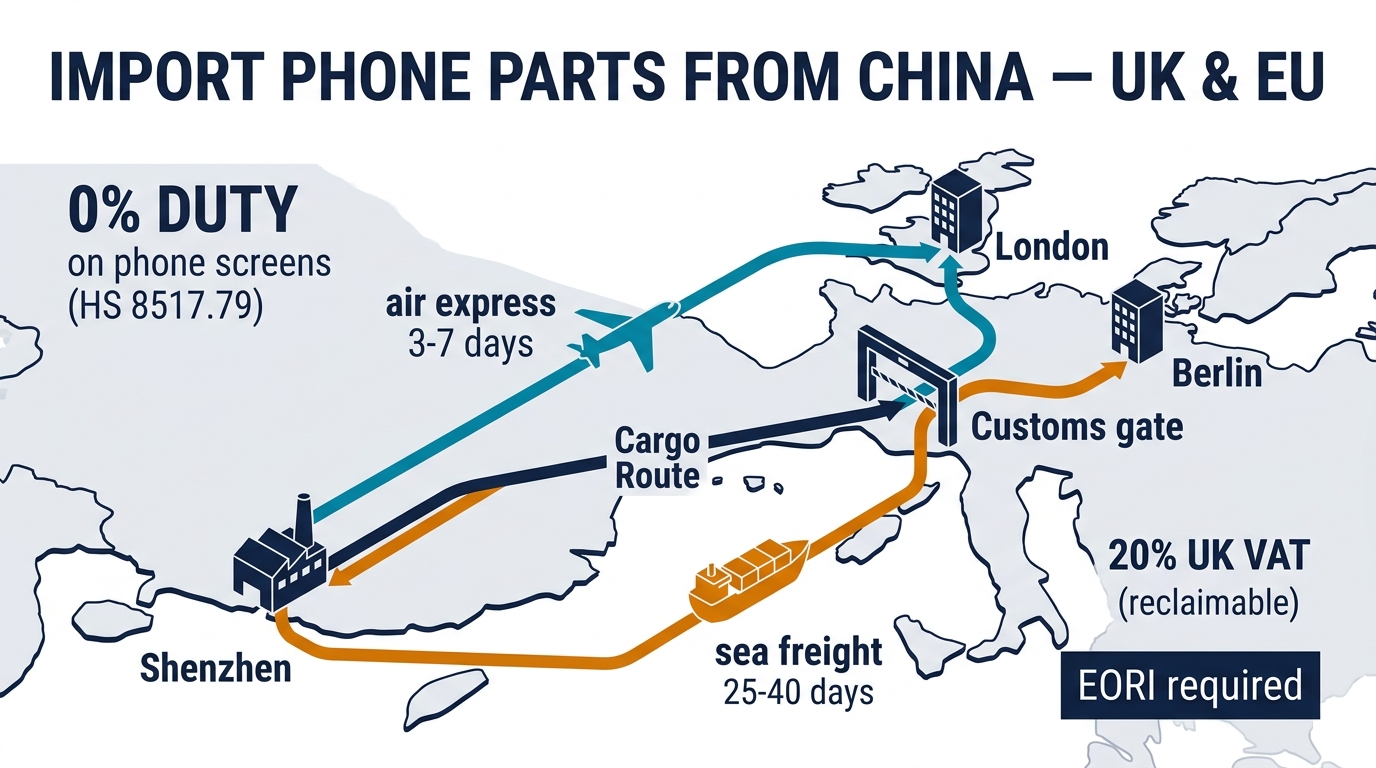
- Delivery time from China: 3-7 days express, 5-12 days standard air
- EU import regulations require CE marking and WEEE compliance for certain electronic components — your supplier should know these requirements
- VAT/import tax adds 15-25% to landed cost in most European countries. Factor this into your pricing
For more on importing from China, see our UK & EU import guide.
Frequently Asked Questions
I serve a mixed market — how do I split my order?
Track your repairs for 30 days and calculate the Samsung-to-iPhone ratio. If it's 60/40 either direction, allocate your budget accordingly. A $500 order in a mixed market might look like: $200 on iPhone Incell screens, $120 on Samsung A-Series LCD screens, $100 on batteries for both brands, $80 on small parts. See our Samsung vs iPhone stocking guide for detailed allocation frameworks.
Are aftermarket phone parts quality different for budget vs premium phones?
The manufacturing process differs. Budget phone LCD screens are simpler to produce and have fewer quality variables. Premium phone OLED screens have more complexity — panel type, touch IC, backlight — which means more quality variation between suppliers. This is why supplier evaluation matters more for premium phone parts than for budget phone parts.
Should I use different suppliers for budget and premium markets?
Not necessarily. A good wholesale supplier stocks parts across both segments. Using one supplier for everything simplifies your ordering, shipping, and quality management. Just make sure the supplier has genuine experience with both Samsung A-Series and iPhone parts — some suppliers specialize in one segment and their other product lines are weaker.
How does repair pricing work in budget markets where customers are very price-sensitive?
Volume compensates for lower per-repair margin. A shop in a budget market might charge $20 for a screen repair but do 15-20 repairs per day. A shop in a premium market charges $60 but does 8-12 per day. Daily revenue can be similar — the difference is in parts cost structure and how many units you move through inventory each month.
Match Your Sourcing to Your Market

The worst parts-buying mistake is sourcing as if your market were different from what it actually is. Premium grades in a budget market sit on the shelf. Budget grades in a premium market generate complaints.
Know your market. Track what walks through your door. Build your orders around the models and grades your customers actually need — not what's cheapest or what other markets buy.
If you're not sure which grades and models match your market, send us your location and top repair models. We ship to repair shops in 60+ countries and can recommend a product mix based on what works in your region.
Related reading: