
What Should a Phone Parts DOA Policy Include? A Repair Shop Buyer's Checklist
A DOA parts policy phone repair shops can rely on is the difference between a minor inconvenience and a real financial hit. When a screen arrives dead on arrival — no display, no touch, dead pixels visible on first power-on — you lose the part cost, the labor time spent installing it, and potentially the customer's trust if the repair gets delayed.
Every wholesale phone parts supplier has some form of DOA policy. But "we'll replace defective parts" means wildly different things depending on what's actually in the fine print: the claim window, what counts as DOA vs. damage, who pays return shipping, and whether you get a replacement or a credit. These details matter more than the policy's existence.
Here's the complete checklist of what a DOA policy should include — and the specific terms to negotiate before you commit to a supplier.
Sourcing Replacement Screens in Bulk?
Incell / Hard OLED / Soft OLED grades — wholesale pricing, grade comparison on request.
Get Wholesale Quote7 Elements a DOA Parts Policy in Phone Repair Must Cover
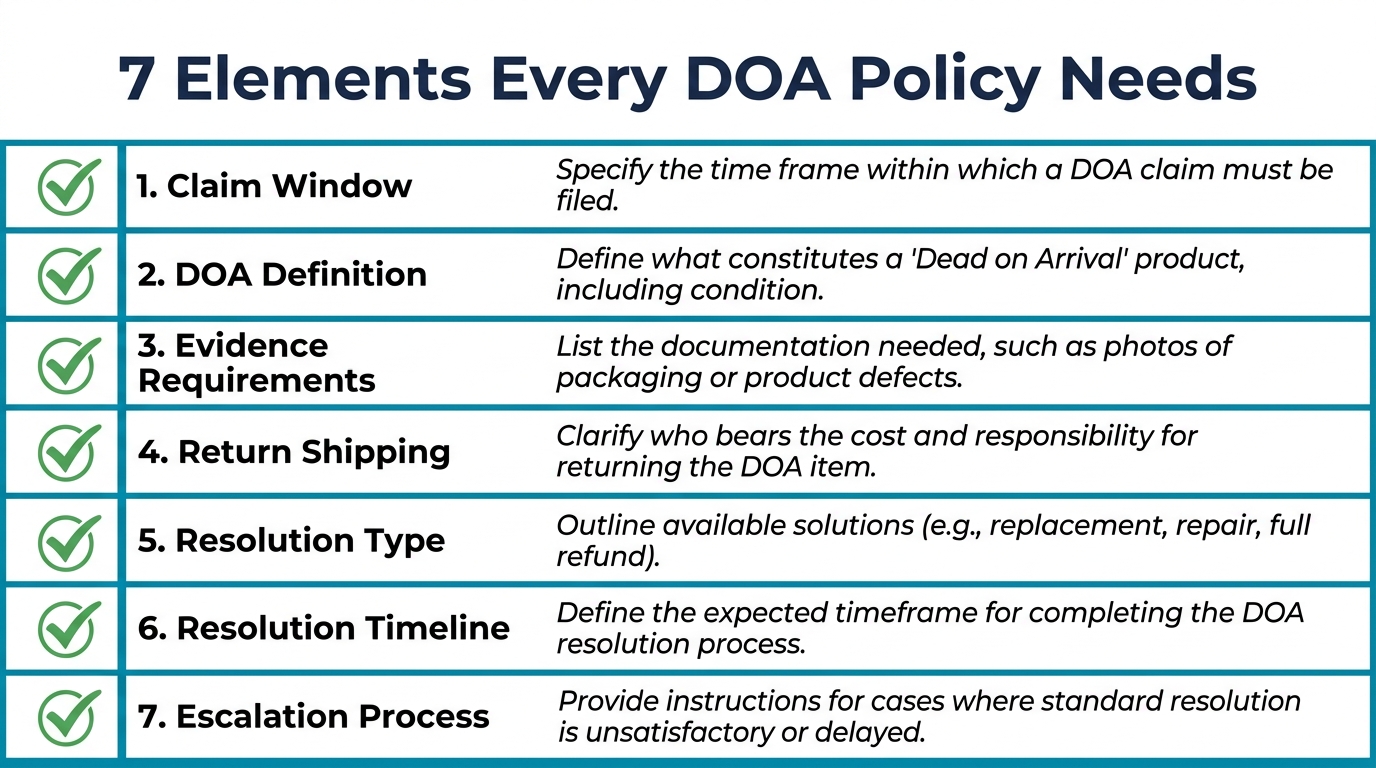
Not all DOA policies are written with the same level of detail. Some suppliers have a full written policy; others handle it informally over WhatsApp. Either way, these seven elements need to be clearly defined — in writing — before you place a bulk order.
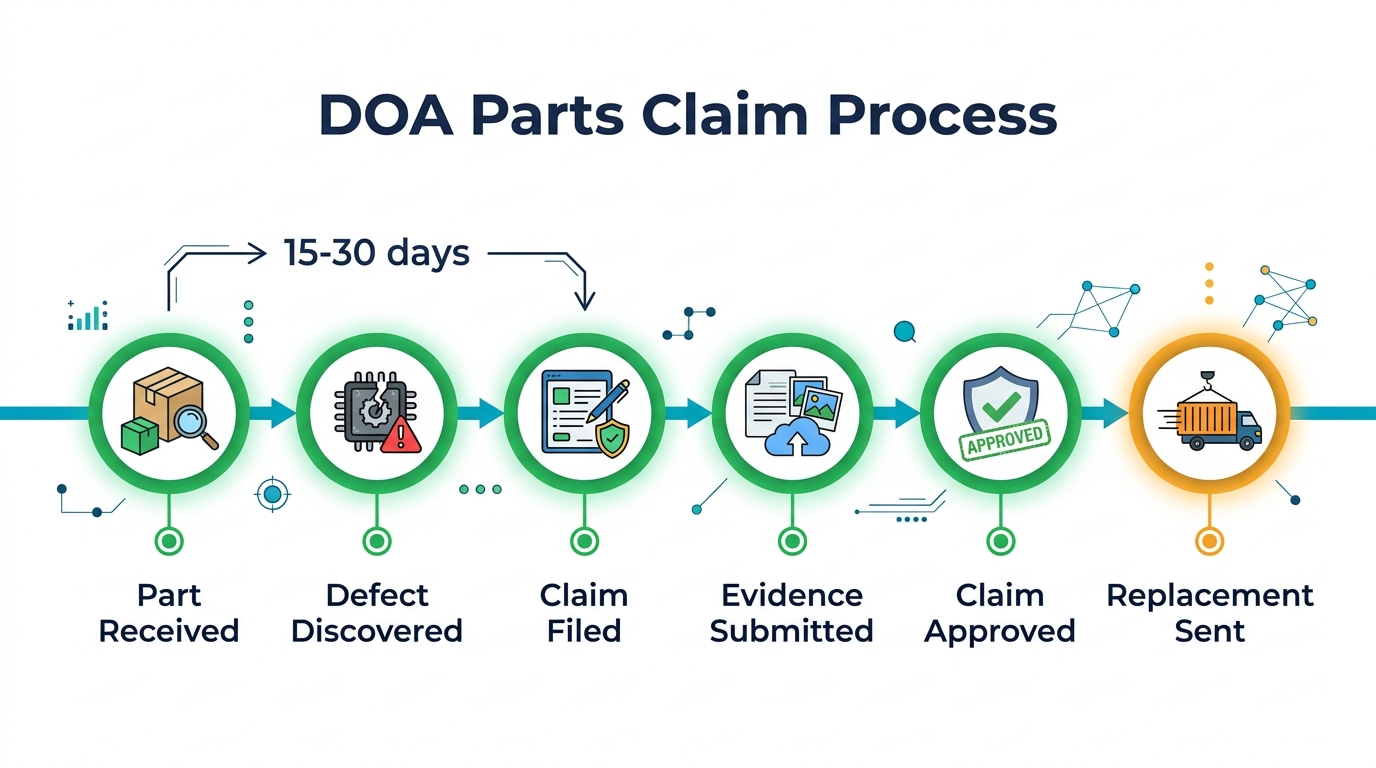
1. Claim Window (How Long You Have to Report)
The claim window defines how many days after receiving the parts you have to report a DOA issue. This is the single most negotiated DOA policy term.
| Window Length | What It Means for You | Common With |
|---|---|---|
| 7 days | Very tight — you must test every part within a week of arrival | Budget suppliers, Alibaba sellers |
| 15 days | Reasonable for shops that test on arrival and install within 1–2 weeks | Mid-range suppliers |
| 30 days | Comfortable — covers parts that sit in inventory before first install | Quality-focused suppliers |
| 90 days | Rare but best — covers defects that only appear after installation | Premium suppliers, long-term partnerships |
What to negotiate: Push for at least 15 days on screens and 30 days on batteries. If a supplier only offers 7 days, ask: "What happens if I install a screen on day 10 and it's dead?" If the answer is "that's outside the claim window," you're absorbing all DOA risk after the first week.
2. DOA Definition (What Counts as Dead on Arrival)
This is where most disputes happen. A clear DOA definition should cover:
Clearly DOA (should be accepted by any supplier):
- Screen doesn't power on at all
- Touch completely non-responsive
- Dead pixel clusters visible on first power-on (not single pixels)
- Battery doesn't hold charge or shows 0% immediately
- Charging port doesn't establish connection
Gray area (needs to be explicitly addressed in the policy):
- Screen powers on but has backlight bleed or uneven brightness
- Touch works but has dead zones in specific areas
- Battery charges but capacity is 20%+ below rated spec
- Screen works but shows "Unknown Part" warning (is this a defect or expected behavior?)
Not DOA (typically excluded):
- Physical damage from installation (cracked flex cable, bent pins)
- Defects that appear after customer use (not present on first power-on)
- Cosmetic issues on the frame or housing (scratches, color mismatch)
What to negotiate: Get the gray area items addressed explicitly. The most important: Does the policy cover screens with touch dead zones? Does it cover batteries that charge but underperform? If these aren't in the policy, you'll fight about them every time.
3. Evidence Requirements (How to Document a Claim)
Suppliers need proof that the part is genuinely DOA and wasn't damaged during installation. Standard evidence requirements:
- Photo of the defect: Clear photo showing the issue (dead pixels, no display, etc.)
- Video of the defect: Short video showing the screen connected to a test board or installed in a phone, demonstrating the failure
- Part serial/batch number: To identify which shipment the part came from
- Test method: Brief description of how you tested (test board vs. phone installation)
Best practice: Film a 15-second video every time you first test a new screen from a shipment. If it passes, delete the video. If it fails, you already have your evidence. This takes almost no extra time and eliminates "prove it was DOA, not installation damage" disputes.
4. Return Shipping (Who Pays)
For international suppliers (China → US/UK/EU), return shipping can cost more than the part itself. A $15 screen with $20 return shipping is a net loss even with a replacement.
Three common arrangements:
- Supplier pays return shipping: Best for you, rare with international suppliers
- Replacement sent with next order, defective part kept by buyer: Most practical. You photograph the defect, supplier credits or ships replacement with your next order. No return shipping needed.
- Buyer pays return shipping: Worst arrangement. Only acceptable if the supplier offers batch returns (you accumulate DOA parts and return them together quarterly)
What to negotiate: Push for "credit or replace with next order" — this is the industry standard for international phone parts suppliers and avoids the return shipping problem entirely.
5. Resolution Type (Replacement, Credit, or Refund)
What you get when a DOA claim is approved:
- Replacement: Supplier sends an identical part. Best if you need the part for a pending repair.
- Store credit: Applied to your next order. Practical for ongoing relationships.
- Refund: Money back. Rare for established relationships — more common for first orders or dispute resolution.
What to negotiate: Accept credit for routine DOA claims (1–2 parts per order). Push for replacement or refund for batch-level issues (5%+ of an order is DOA — that's a batch quality problem, not individual part failure).
6. Resolution Timeline (How Fast You Get Made Whole)
A DOA claim that takes 3 weeks to resolve defeats the purpose. Define timelines:
- Acknowledgment: Supplier confirms receipt of your claim within 24–48 hours
- Decision: Claim approved or questioned within 3–5 business days
- Resolution: Replacement shipped or credit applied within 5–7 business days of approval
Red flag: If a supplier consistently takes 2+ weeks to respond to DOA claims, they're either overwhelmed or hoping you'll give up. Neither is acceptable for a business relationship.
7. Escalation Process (When Things Don't Get Resolved)
What happens when the standard process fails? Establish:
- Who do you contact if your account rep doesn't resolve the claim? (Manager, quality team)
- Is there a formal dispute process or is everything handled ad hoc?
- At what point does unresolved DOA volume trigger a larger conversation about batch quality?
DOA Rates: What's Normal and What's a Red Flag

Not every DOA part means your supplier is bad. Some baseline failure rate is normal in wholesale electronics. Here's what to expect:
| Part Type | Normal DOA Rate | Concerning Rate | Action Threshold |
|---|---|---|---|
| Screens (all types) | 1–3% | 3–5% | 5%+ → full batch review |
| Batteries | 0.5–2% | 2–4% | 4%+ → switch supplier or grade |
| Charging ports | 1–3% | 3–5% | 5%+ → test every unit pre-install |
| Small parts (speakers, cameras) | 0.5–1% | 1–3% | 3%+ → verify sourcing |
Track your DOA rate per supplier per part type per month. A simple spreadsheet with columns for: date, supplier, part type, model, order quantity, DOA count, claim status, resolution. After 3 months, this data tells you more about a supplier's real quality than any marketing claim.
Looking for a supplier with a transparent DOA policy? PRSPARES offers 30-day DOA coverage on all screens and batteries with credit-on-next-order resolution. Ask about our DOA terms.
How to Set Up Your DOA Claim Process
A fast, documented DOA process protects both you and your supplier relationship. Here's the workflow:
When you receive a shipment:
- Unbox and count — verify quantity matches invoice
- Visual inspect 100% of screens (check for obvious damage, wrapper condition, flex cable integrity)
- Power-test 10–15% on a test board (full QC sample per our incoming screen QC guide)
- Log results immediately — date, batch number, pass/fail per unit
When you find a DOA part:
- Photograph the defect (screen connected to test board showing the failure)
- Film a 15-second video demonstrating the issue
- Note the part's position in the batch (was it the only failure or one of several?)
- Send claim to supplier within 24 hours with: photo, video, batch number, order number
When the claim is resolved:
- Log the resolution (credit, replacement, refund) and how long it took
- Update your DOA rate tracking for that supplier
- If resolution was slow or disputed, note it — patterns matter for supplier evaluation
For the full framework on tracking supplier quality over repeat orders, see our guide on what to check before placing a repeat order.
Frequently Asked Questions
What if the supplier says my installation caused the defect?
This is the most common DOA dispute. Protect yourself by always testing screens on a test board before installing in a customer's phone. A test board demonstration video proves the part was defective before installation. If you only discover the defect after installation, the supplier may argue installation damage — and without pre-install evidence, the claim becomes your word against theirs. A $20 test board eliminates this dispute entirely.
Should I accept a supplier with no written DOA policy?
For small test orders, an informal policy communicated via WhatsApp or email is acceptable — just screenshot the conversation where they confirm DOA terms. For bulk orders ($500+), insist on a written policy or at least a documented email confirming the 7 key elements above. If a supplier won't put their DOA terms in writing, their policy is effectively "we'll decide case by case" — which means you have no guaranteed protection.
How do I handle DOA parts that I've already installed in a customer's phone?
This is the most expensive DOA scenario: you've already spent labor installing it, and now you need to remove it, install a replacement, and claim the defective part. Your DOA policy should ideally cover "defects discovered within X days of installation" (not just "within X days of delivery"). If it doesn't, you absorb the labor cost. Minimize this risk by power-testing every screen before installation — the 30-second test catches 90%+ of DOA parts before they reach a customer's phone.
Is a 1% DOA rate worth switching suppliers over?
No — 1% is within normal range for aftermarket phone parts. At 100 screens per month, 1% means 1 DOA screen — a minor cost absorbed by the DOA policy. Start evaluating alternatives when DOA rate consistently exceeds 3% or when the supplier's claim process becomes slow or adversarial. The DOA rate matters less than how the supplier handles the claims — a supplier with 2% DOA and fast, fair resolution is better than a supplier with 1% DOA who fights every claim.
Your DOA Policy Is Part of Your Supplier Evaluation

A strong DOA parts policy phone repair shops can depend on isn't a bonus — it's a baseline requirement for any wholesale parts supplier. Before placing your first bulk order, confirm all 7 elements in writing. Track your DOA rates from the first shipment. And treat how a supplier handles DOA claims as one of the strongest signals of whether they're worth a long-term relationship.
The best suppliers don't just have a DOA policy — they make it easy to use, because they know that fast, fair claim resolution is what keeps buyers reordering.
Want to see our DOA policy before placing an order? PRSPARES provides full DOA terms upfront — 30-day window, photo/video claim process, credit-on-next-order resolution. Request our terms and a quote.
Related reading: Phone Screen Warranty and Return Policy for Wholesale Buyers | How to Use a Test Order to Evaluate a Phone Parts Supplier