
iPhone Battery Specs That Actually Matter When Buying Wholesale: Capacity, IC Chips, and What to Test

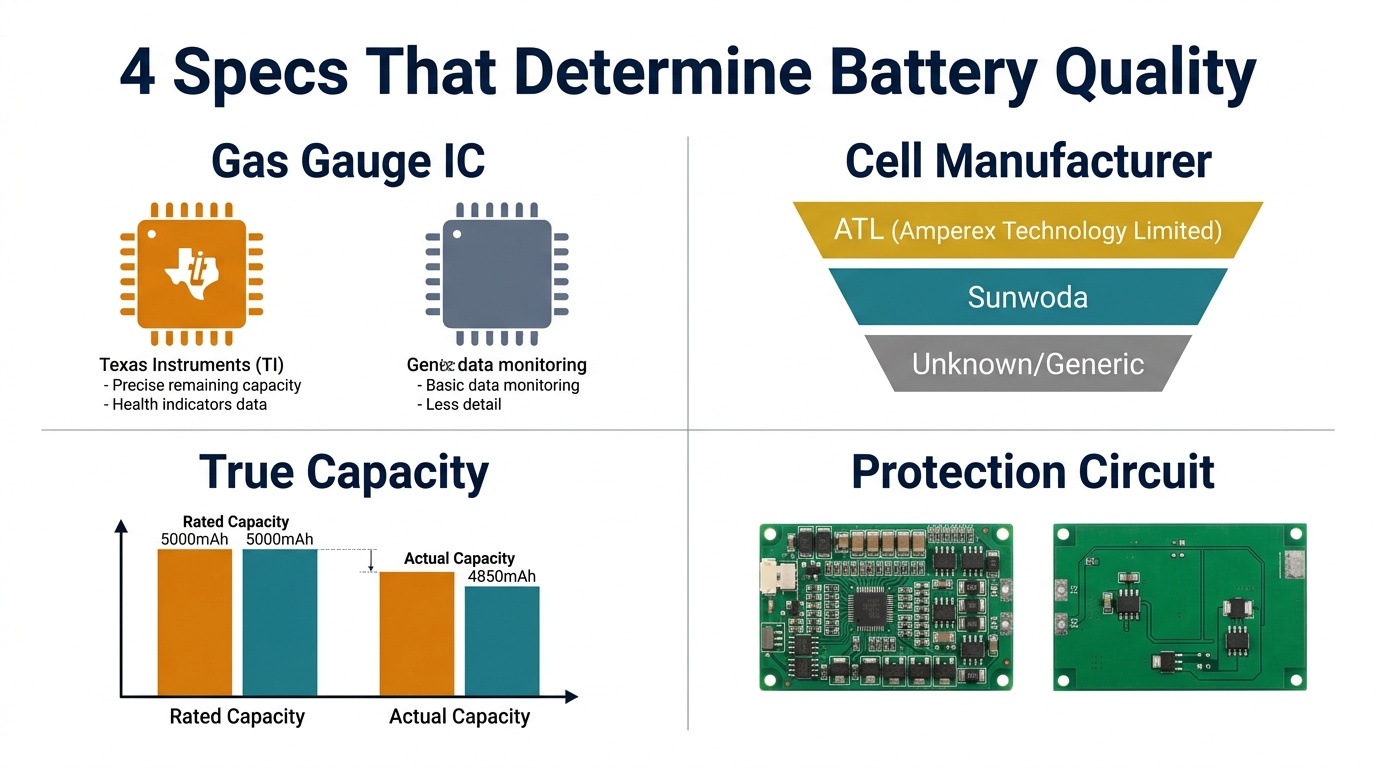
Most wholesale iPhone battery listings show two specs: model compatibility and mAh capacity. That's roughly as useful as choosing a car by knowing it has four wheels and an engine. The iPhone battery wholesale specs that actually determine whether a battery performs well — and keeps performing for 12+ months — are buried deeper: the gas gauge IC chip, the cell manufacturer, the protection circuit design, and the gap between advertised capacity and what the battery actually delivers under load.
A $3 battery and a $6 battery for the same iPhone model can look identical in the listing. The difference is inside — in the IC chip that talks to iOS, the cell chemistry that determines capacity retention, and the protection board that prevents overcharge failures. Understanding these specs saves you from callbacks, customer complaints about rapid battery drain, and the worst outcome: swelling batteries that damage the customer's phone.
Here's what to check, what to test, and what to ask your supplier before ordering batteries in bulk.
Buying Phone Batteries Wholesale?
OEM-cell batteries with safety packaging — iPhone, Samsung & more, factory-direct.
Get Wholesale QuoteThe 4 iPhone Battery Wholesale Specs That Determine Quality
1. Gas Gauge IC Chip: TI vs. Chipsea vs. Others
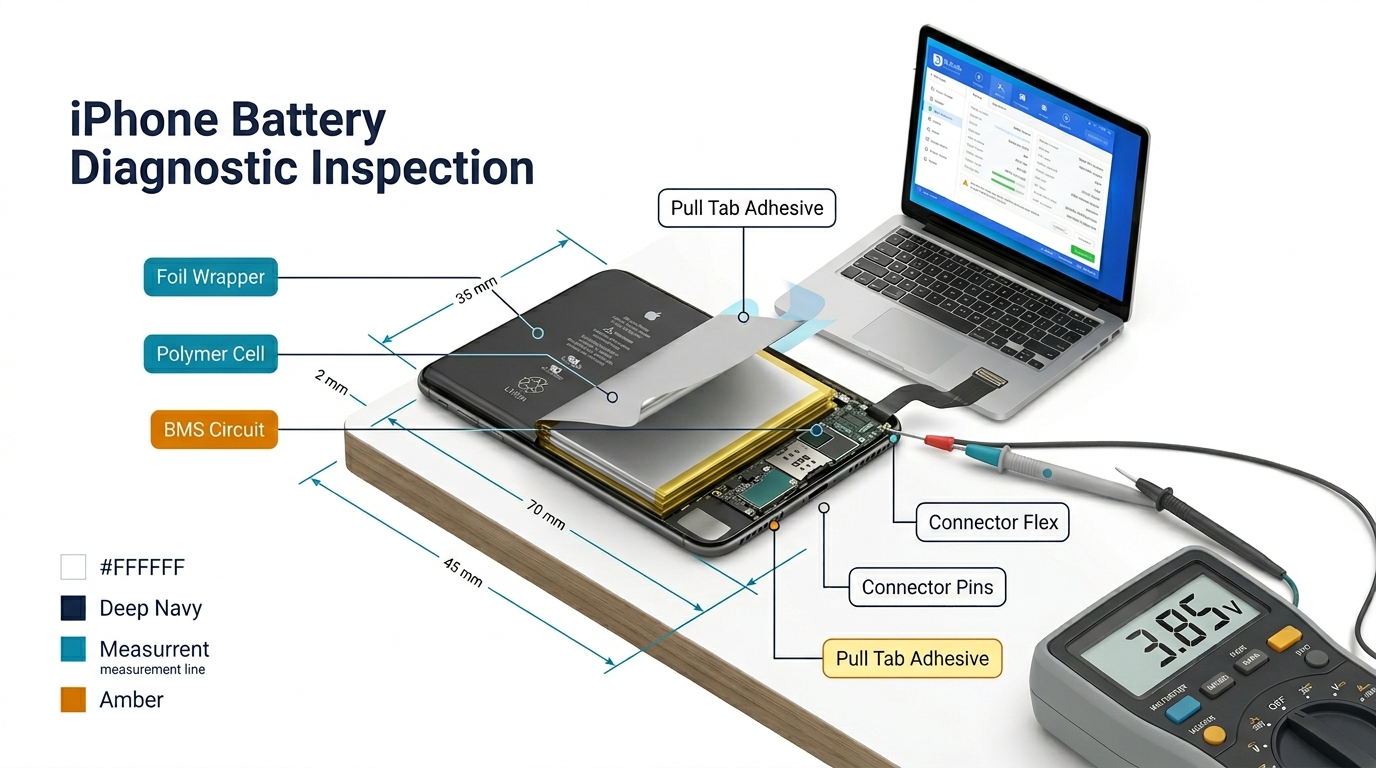
The gas gauge IC is the small chip on the battery's protection circuit board (PCB) that communicates with iOS. It reports cycle count, current capacity, voltage, and temperature to the iPhone's power management system. This chip is the most important spec differentiator between battery grades.
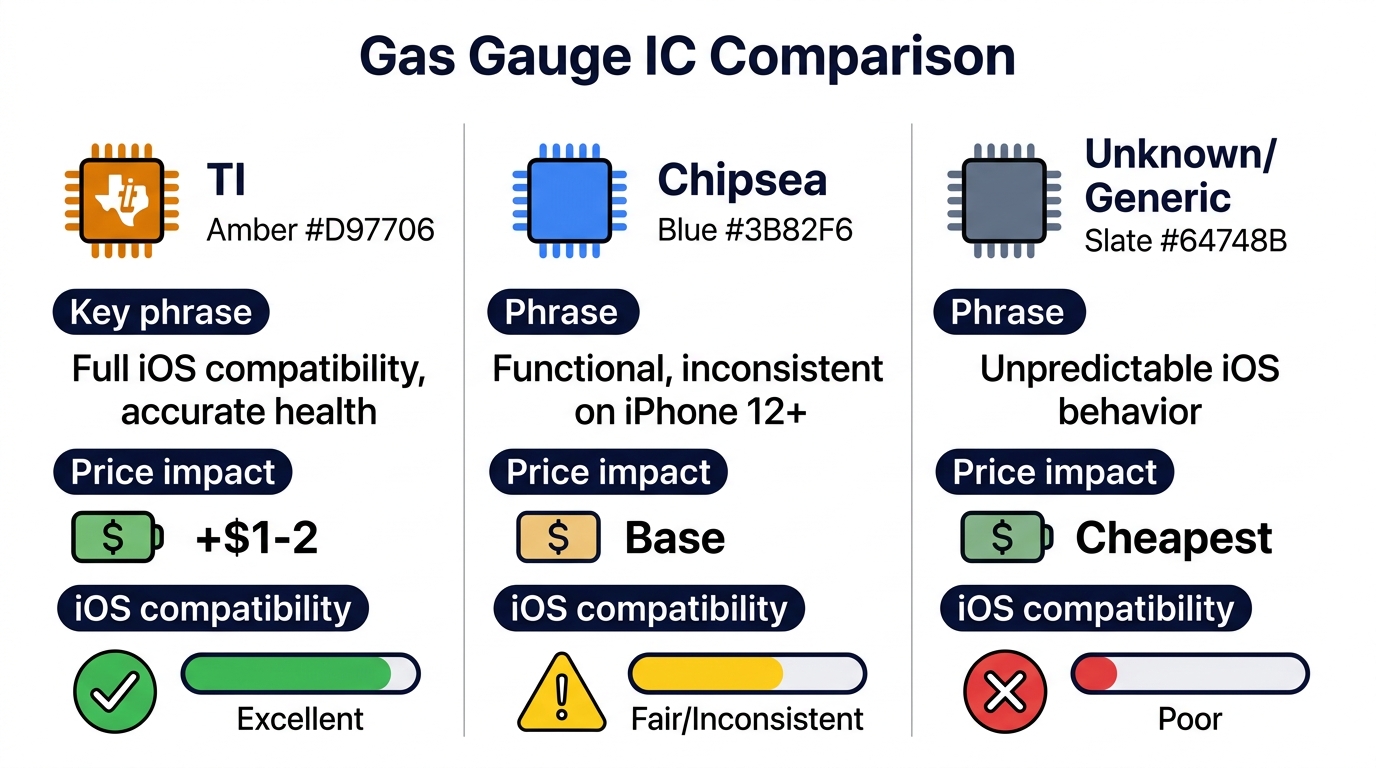
| IC Chip Brand | What It Means | iOS Compatibility | Price Impact |
|---|---|---|---|
| Texas Instruments (TI) | Same chip Apple uses on OEM batteries. Full iOS data communication, accurate health reporting. | Excellent — no warnings, accurate Battery Health | +$1–2 per unit |
| Chipsea | Chinese IC manufacturer. Functional but less precise capacity reporting. Some models trigger iOS warnings. | Good on older models (iPhone 8–11), inconsistent on iPhone 12+ | Base price |
| Unknown/unmarked | Generic ICs with no traceable manufacturer. Unpredictable iOS communication. | Inconsistent — may show wrong health %, trigger warnings | Cheapest |
Why it matters: On iPhone 12 and newer, iOS performs more aggressive battery validation. Batteries with non-TI gas gauge ICs may:
- Show inaccurate Battery Health percentage (jumping between values)
- Trigger "Service" or "Unknown Part" warnings
- Report incorrect cycle count data
- Cause unexpected shutdown behavior under heavy load
What to ask your supplier: "What gas gauge IC does this battery use? Is it TI?" If they can't answer, they probably don't know what they're selling.
2. Cell Manufacturer: ATL, Sunwoda, and the Quality Hierarchy
The cell is the actual lithium-polymer pouch that stores energy. Different cell manufacturers produce cells with very different quality levels.
| Cell Manufacturer | Quality Tier | Typical Capacity Retention (after 500 cycles) | Common In |
|---|---|---|---|
| ATL (Amperex Technology Limited) | Premium — Apple's OEM supplier | 85–90% | OEM batteries, premium aftermarket |
| Sunwoda | Upper-mid — major Chinese battery manufacturer | 80–85% | Quality aftermarket, some OEM refurbished |
| BYD / EVE / CATL | Mid — large manufacturers, variable quality | 75–85% | Mid-range aftermarket |
| Unknown / unbranded cells | Budget — no traceability | 60–75% | Cheapest aftermarket |
Practical impact: A battery with an ATL cell will hold 85%+ of its original capacity after a year of normal use. A battery with an unknown cell may drop to 70% capacity in 6 months — which is when your customer calls to say "the battery you put in is already dying."
How to verify: Quality aftermarket battery manufacturers print or laser-etch the cell manufacturer name on the cell pouch (visible under the battery wrapper). If the cell has no manufacturer identification, it's unbranded — and unbranded cells have the widest quality variance.
3. True Capacity vs. Advertised Capacity
Every battery listing shows a capacity in mAh. But advertised capacity and actual deliverable capacity are often different — sometimes significantly.
Why the gap exists:
- Manufacturers may test capacity at ideal lab conditions (25°C, 0.2C discharge rate) that don't match real phone usage
- Some list the cell's rated capacity before protection circuit losses
- "High capacity" batteries advertise more mAh than the OEM spec, but the extra capacity may come from pushing the cell voltage higher — which reduces lifespan
What to look for:
| iPhone Model | OEM Rated Capacity | Acceptable Aftermarket Range | Red Flag |
|---|---|---|---|
| iPhone 12 | 2,815 mAh | 2,670–2,815 mAh (95–100%) | Below 2,530 mAh (90%) |
| iPhone 13 | 3,227 mAh | 3,066–3,227 mAh | Below 2,905 mAh |
| iPhone 14 | 3,279 mAh | 3,115–3,279 mAh | Below 2,951 mAh |
| iPhone 14 Pro Max | 4,323 mAh | 4,107–4,323 mAh | Below 3,891 mAh |
| iPhone 15 | 3,349 mAh | 3,182–3,349 mAh | Below 3,014 mAh |
| iPhone 15 Pro Max | 4,422 mAh | 4,201–4,422 mAh | Below 3,980 mAh |
How to verify: Use a battery capacity tester (YZXStudio ZY1280 or similar) to fully discharge the battery from 100% to cutoff voltage. The measured mAh is the true capacity. Test 3–5 batteries from each new batch. For the detailed testing process, see our guide on battery reset scams and verification methods.
4. Protection Circuit Board (PCB) Quality
The PCB sits between the cell and the connector, managing charge/discharge protection, temperature monitoring, and communication with the phone. A quality PCB includes:
- Overcharge protection: Cuts off charging above 4.35V (or the cell's rated max voltage)
- Over-discharge protection: Prevents the cell from discharging below 2.8V
- Short circuit protection: Disconnects if a short is detected
- Temperature monitoring: Reduces charge rate or cuts off if temperature exceeds safe limits
What fails on cheap PCBs: Inadequate temperature monitoring is the most dangerous. A battery without proper thermal cutoff can continue charging at high temperatures, leading to cell swelling — the battery puffs up, potentially damaging the phone's screen from internal pressure.
How to spot cheap PCBs: Compare the PCB component count against a known-quality battery. Quality PCBs have 8–12 visible components (resistors, capacitors, MOSFETs, IC). Budget PCBs may have 4–6 components with empty solder pads where protection components should be.
How to Evaluate Battery Specs Before Ordering in Bulk
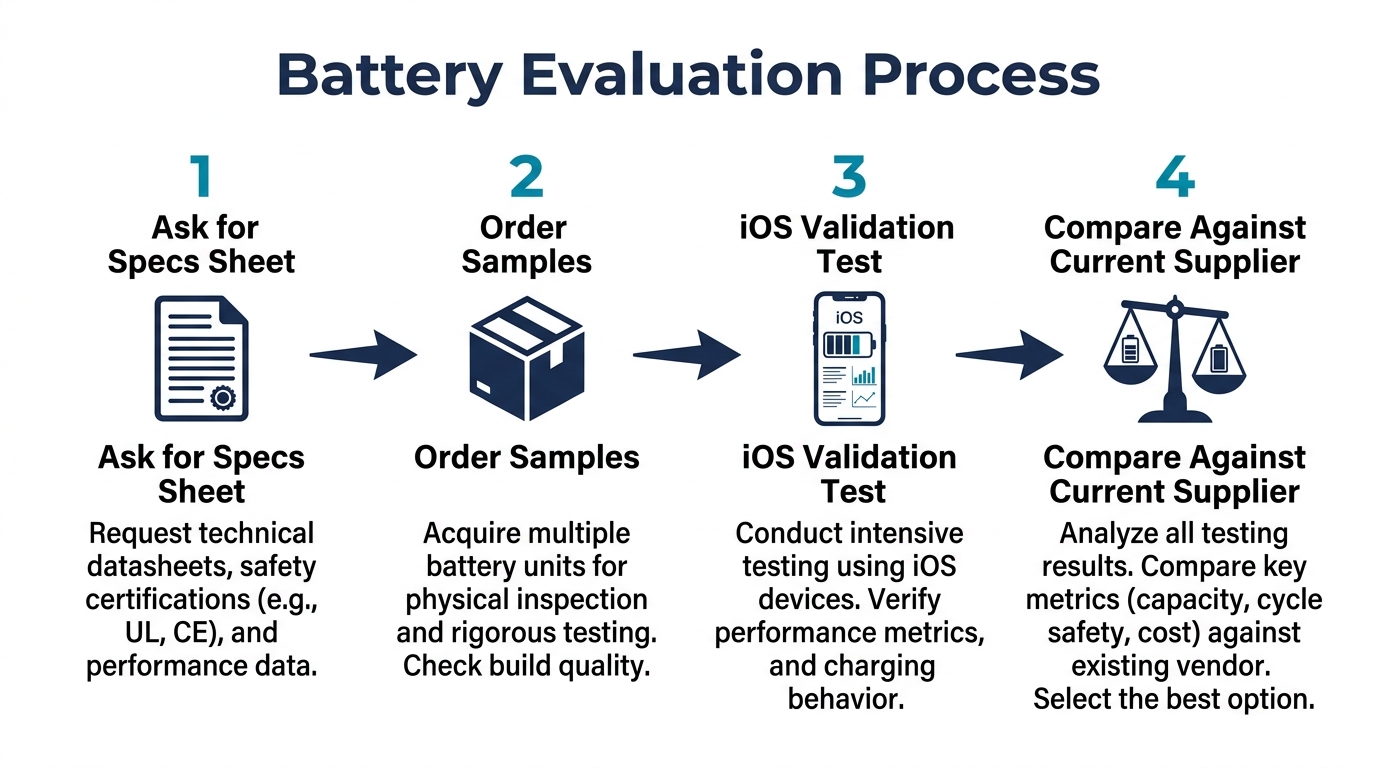
A practical pre-order evaluation process that takes 30 minutes:
Step 1 — Ask for specs sheet (before ordering): Request the IC chip brand, cell manufacturer, and rated capacity for each model. Suppliers who provide this information readily are more likely to know and control their product quality.
Step 2 — Order samples (5–10 units): Test samples before committing to bulk. Focus on:
- Visual inspection: cell manufacturer marking, PCB component count, wrapper quality
- Capacity test: Full discharge on 3 batteries, compare against rated spec
- Internal resistance: Should be 40–70 mΩ for new cells (measured with battery tester or programmer)
Step 3 — iOS validation test (install in phone): Install 2–3 sample batteries in test phones and check:
- Does Battery Health show 100%? (Should for new batteries with proper IC)
- Does the "Unknown Part" warning appear? (On iPhone 12+, depends on IC pairing)
- Is charge/discharge behavior normal? (No unexpected shutdowns, accurate percentage reporting)
Step 4 — Compare against your current supplier: Run the same tests on batteries from your existing supplier. Side-by-side comparison eliminates guesswork — you'll see exactly where the new batteries are better, worse, or equivalent.
Want batteries with documented specs? PRSPARES provides TI IC chip, cell manufacturer, and tested capacity data for every battery model we ship. Request battery samples with spec sheets.
"High Capacity" Batteries: Worth It or Marketing Hype?
Some suppliers offer "high capacity" batteries that advertise 10–20% more mAh than the OEM spec. These are real — they use physically larger cells or higher-density chemistry to store more energy in the same form factor.
When they're worth it:
- The cell manufacturer is identifiable (ATL, Sunwoda, or major brands)
- The IC is properly calibrated to report the correct higher capacity to iOS
- The battery passes full discharge testing at the advertised capacity
- The price premium is reasonable ($1–2 more per unit)
When they're not:
- The capacity increase is unverified (listing says 3,500 mAh but tests at 3,100 mAh)
- The IC still reports OEM capacity (3,227 mAh) despite the cell being "3,500 mAh" — the extra capacity is invisible to the user
- The higher capacity comes from pushing voltage limits — this reduces the total cycle life
- The battery is physically thicker or slightly different in dimension, causing fit issues in the phone
Bottom line: A reliable OEM-capacity battery with a TI IC and quality cell is a safer stock choice than a "high capacity" battery with unknown specs. High capacity works as a premium upsell when you've verified the product — not as your default inventory.
Frequently Asked Questions
Does the gas gauge IC affect whether iOS shows "Unknown Part"?
On iPhone 11 and earlier, the IC has minimal impact on warnings — most aftermarket batteries work without triggering alerts. On iPhone 12 and newer, the gas gauge IC communicates serial data with iOS. Batteries without properly paired TI ICs may show "Unknown Part" in Settings > About. This is separate from the battery health reading — the battery can show "Unknown Part" while still displaying 100% health and functioning normally. The warning is cosmetic but affects customer perception.
Can I use a battery programmer to fix bad IC data?
Yes — battery programmers (JC, i2C, JCID) can read and write gas gauge IC data, including cycle count, full charge capacity, and serial pairing information. This is useful for resetting accurate data on OEM pull batteries or for pairing aftermarket batteries with TI ICs. However, programmers cannot fix a fundamentally bad IC — if the chip is a low-quality generic that doesn't communicate properly with iOS, reprogramming won't solve compatibility issues. The IC hardware itself matters.
How do I know if a "high capacity" claim is real?
The only reliable verification is a full discharge capacity test. Charge the battery to 100% using a calibrated charger, then discharge through a capacity tester at 0.5C rate until cutoff voltage. The measured mAh is the true capacity. If a battery advertises 3,500 mAh but measures at 3,100 mAh, the "high capacity" claim is inflated. Test 3 batteries from the same batch — consistent results indicate the manufacturer is at least producing reliably, even if the advertised number is optimistic.
Which iPhone models are most sensitive to battery IC quality?
iPhone 14 and newer models perform the most aggressive battery validation. These models are most likely to show warnings, report inaccurate health data, or exhibit unexpected behavior with non-TI ICs. For iPhone 11 and older, IC quality matters less for iOS compatibility (though it still affects capacity reporting accuracy). If you need to prioritize where to spend more on battery quality, invest in TI-IC batteries for iPhone 12 and newer, and use standard aftermarket for older models where the callback risk is lower.
Spec the Battery Before You Price the Battery
The iPhone battery wholesale specs that matter aren't on the listing — they're inside the battery. A TI gas gauge IC, a branded cell from ATL or Sunwoda, verified capacity within 95% of OEM, and a properly populated protection circuit board are what separate a battery that lasts from one that generates callbacks in 3 months.
Ask for specs before you order. Test samples before you commit. And track your callback rate per battery supplier per model — because the true cost of a cheap battery isn't the purchase price, it's the re-do labor and customer trust you lose when it underperforms.
Looking for batteries with verified specs and IC documentation? PRSPARES provides gas gauge IC type, cell manufacturer, and tested capacity data with every battery order. Browse the wholesale battery catalog, or get a quote with full spec sheets.
Related reading: Battery Reset Scams: How Wholesale Buyers Check If a Battery Is Really New | Buying iPhone Batteries in Bulk for Your Repair Business