
What to Check Before Buying iPhone Batteries in Bulk for Repair Business

A bad batch of aftermarket iPhone batteries doesn't just cost you parts — it costs you customers. Every aftermarket iPhone battery looks the same on the outside, but the quality gap between suppliers is enormous. Swollen cells, rapid capacity loss, and "Service" warnings showing up two weeks after installation are the fastest way to destroy a repair shop's reputation. And unlike screens, where a customer might tolerate slight color differences, a failing battery feels dangerous.
The problem is that wholesale iPhone batteries look identical on the outside. Two batteries sitting side by side — one from a reliable factory, one from a corner-cutting operation — have the same label, the same connector, and the same claimed capacity. The differences are inside: cell quality, protection circuit design, and actual vs. advertised capacity.
This guide is the pre-purchase checklist we wish every repair shop would use before placing a bulk battery order. It covers what to verify, what to test, and what red flags to walk away from.
Buying Phone Batteries Wholesale?
OEM-cell batteries with safety packaging — iPhone, Samsung & more, factory-direct.
Get Wholesale QuoteAftermarket iPhone Battery Grades: What You're Actually Buying
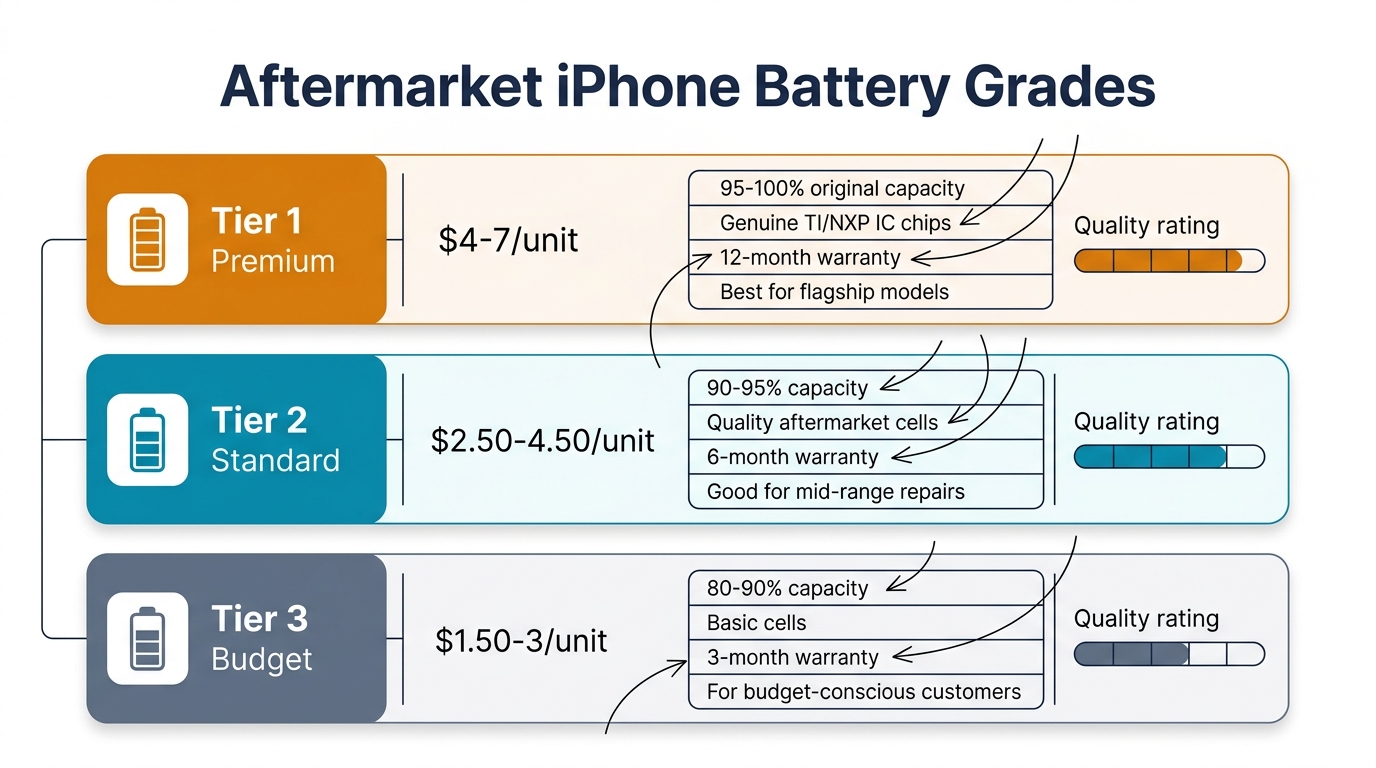
Not all aftermarket iPhone batteries are the same grade. The market has three distinct tiers, and understanding them prevents you from overpaying — or underpaying and regretting it.
Tier 1: Premium Aftermarket
These use new A-grade lithium polymer cells (often from ATL, Sunwoda, or Desay), a properly designed PCM (Protection Circuit Module) board, and accurate capacity ratings. They match or come within 95-100% of the original battery's rated capacity. Cycle life typically reaches 500+ full charge cycles before dropping below 80% health.
Wholesale price range: $4-7 per unit depending on model and order volume.
Tier 2: Standard Aftermarket
Standard grade batteries use B-grade or mixed cells with acceptable but lower consistency. Capacity is typically 85-95% of the rated specification. The PCM board is functional but uses cheaper components. These batteries work fine for 6-12 months but degrade faster than Tier 1.
Wholesale price range: $2.50-4.50 per unit.
Tier 3: Budget / Ungraded
The cheapest option on the market. These often use recycled cells, have inflated capacity ratings (a battery labeled 3,227 mAh might actually deliver 2,600 mAh), and cut corners on the protection circuit. Failure rates are significantly higher — expect 5-15% of units to show issues within 90 days.
Wholesale price range: $1.50-3 per unit.
The math that matters: A Tier 3 battery saves you $2-3 per unit upfront. But if 10% come back as warranty claims, each callback costs you 20-30 minutes of labor plus a replacement battery. On a 100-unit order, that's 10 callbacks × 30 minutes = 5 hours of unpaid labor. The "savings" disappear fast.
The 8-Point Pre-Purchase Checklist
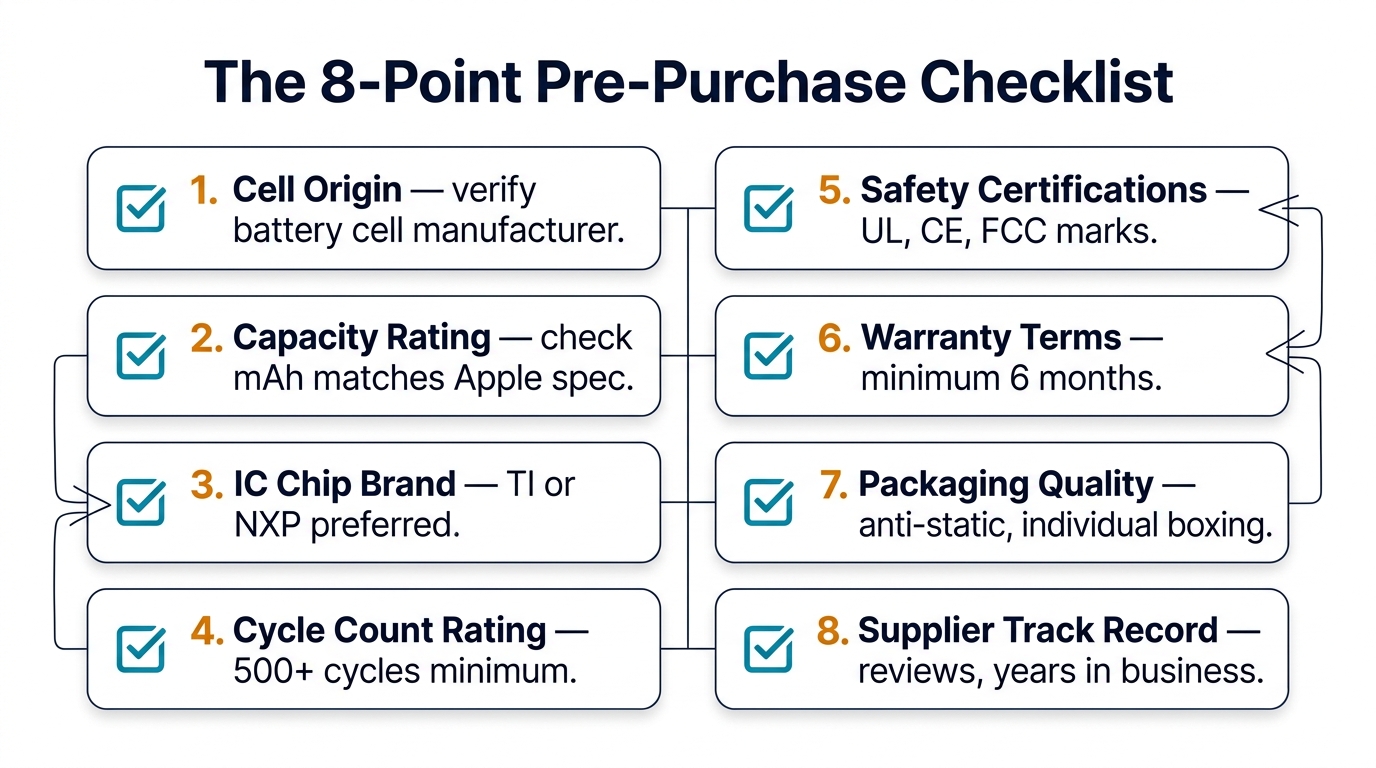
Before you commit to a bulk iPhone battery order — especially from a new supplier — verify these eight points. Skip any of them and you're gambling.
1. Actual Capacity vs. Labeled Capacity
This is the single most common area where cheap batteries cheat. The label says 3,227 mAh (iPhone 13's original spec), but the actual cell delivers 2,800 mAh.
How to verify: Ask the supplier for third-party capacity test reports. Better yet, order a 10-unit sample and test them yourself using a battery analyzer (tools like YZXStudio USB meters or dedicated cell testers work). A legitimate battery should deliver at least 95% of its labeled capacity on the first full charge cycle.
Red flag: If a supplier won't provide test data or discourages sample orders, walk away.
2. Cell Manufacturer and Origin
The cell inside the battery is what determines longevity. Reputable cell manufacturers include ATL (Amperex Technology Limited, Apple's own supplier), Sunwoda, Desay, and BYD. These companies produce cells with consistent quality and documented specifications.
How to verify: Ask for the cell brand and grade classification. "A-grade ATL cells" is a specific, verifiable claim. "High-quality lithium cells" is marketing — it tells you nothing.
3. Protection Circuit Module (PCM) Quality
The PCM board is the battery's safety system. It prevents overcharging, over-discharging, short circuits, and overheating. A well-designed PCM uses a dedicated battery management IC (like those from Texas Instruments or Seiko) and includes temperature monitoring.
What to check: Does the PCM have temperature protection (NTC thermistor)? Does it cut off charging above 4.35V and discharging below 2.8V? Cheap PCM boards skip the temperature sensor — this is a safety risk, not just a quality issue.
4. Physical Fit and Connector Match
An aftermarket iPhone battery needs to fit the exact housing dimensions and use the correct flex cable connector. Even a 0.5mm difference in thickness can cause the battery to press against the screen from behind, leading to display issues or swelling concerns.
How to verify: Install sample batteries in the actual phone models. Check that the connector seats without force, the adhesive tab aligns with the pull-tab channel, and the battery sits flat without bulging.
5. iOS Compatibility and "Service" Warnings
Starting with iOS 14.5, iPhones display a "Service" message in Battery Health settings when a non-original battery is detected. While this doesn't affect battery function, it concerns customers.
What to ask your supplier: Does the battery trigger the "Service" warning? Some premium aftermarket batteries include reprogrammed battery data (sometimes called "pop-up removal" or "no warning") that avoids this message. This feature typically adds $0.50-1.00 per unit to the wholesale cost but significantly reduces customer complaints.
6. Certifications and Safety Testing
Legitimate battery manufacturers carry certifications that indicate their products have been independently tested for safety:
| Certification | What It Covers | Why It Matters |
|---|---|---|
| UN38.3 | Transportation safety testing for lithium batteries | Required for international shipping; proves the battery passed altitude, thermal, vibration, and short-circuit tests |
| UL 2054 | Household and commercial battery safety | Industry-standard safety certification; indicates proper overcharge and short-circuit protection |
| CE | European Conformity | Required for selling in EU/UK markets |
| MSDS | Material Safety Data Sheet | Documents the chemical composition and safe handling procedures |
| RoHS | Restriction of hazardous substances | Confirms no lead, mercury, or other banned substances |
Minimum requirement: UN38.3 and MSDS are non-negotiable for any battery you plan to import. Without UN38.3, your shipment can be refused by freight forwarders or seized at customs.
7. Cycle Life and Warranty Terms
A battery's cycle life tells you how long it will serve your customer before degrading noticeably. Original iPhone batteries are rated for 500 cycles to 80% capacity retention. Good aftermarket batteries should match this.
What to ask: What is the rated cycle life? What's the warranty period — and what does it actually cover? A "12-month warranty" that only covers dead-on-arrival units is very different from one that covers capacity degradation below 80%.
Industry standard: Reputable wholesale suppliers offer 12-month warranties that cover both DOA and premature capacity loss. If a supplier only offers 30-day or 90-day coverage, their confidence in their own product is telling.
8. Batch Consistency
One good sample doesn't guarantee 500 good units. Batch-to-batch consistency is what separates professional suppliers from traders who source from whoever has the cheapest stock this week.
How to verify: Order from the same supplier three times, from three different batches. Test 2-3 units from each batch. If capacity and performance are consistent across batches, you've found a reliable source. If quality swings wildly, that supplier doesn't control their supply chain.
Which iPhone Models Move the Most Batteries?
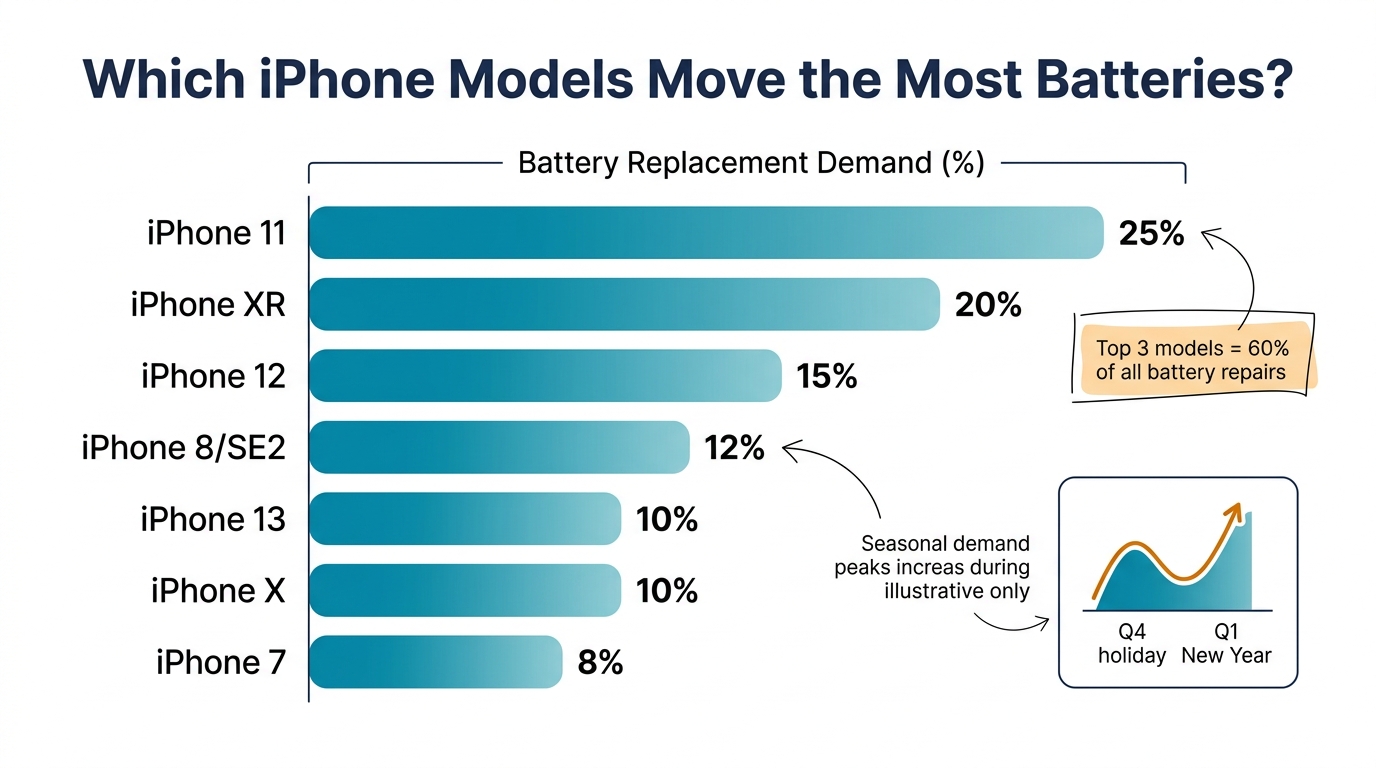
Not every iPhone model is worth stocking batteries for. Focus your bulk orders on models with the highest repair volume:
| Model Group | Battery Demand | Why |
|---|---|---|
| iPhone 11 / 11 Pro / 11 Pro Max | Very High | 4+ years old, batteries degrading en masse. Huge install base |
| iPhone 12 / 12 Pro / 12 Mini | High | Hitting the 3-year mark where battery health drops below 80% |
| iPhone 13 / 13 Pro | Growing | Entering the replacement cycle, volume increasing monthly |
| iPhone XR / XS / XS Max | Moderate | Still common in budget-conscious markets, but declining |
| iPhone 14 / 14 Pro | Low (growing) | Too new for most organic battery replacements, but some demand |
| iPhone SE (2nd/3rd gen) | Moderate | Smaller battery degrades faster, common in business/fleet use |
Stocking tip: For your first bulk battery order, focus on iPhone 11 and 12 series. These two model families likely represent 50-60% of your battery replacement volume. Add iPhone 13 and XR/XS as secondary stock. Don't over-invest in iPhone 14+ batteries yet — the demand isn't there.
If you want to understand the full cost picture for battery replacements, our iPhone battery replacement cost breakdown covers what customers expect to pay and how your parts cost affects margin at each price point.
For a broader view of which parts to prioritize across all categories, see our guide on which repair parts a small shop should stock in 2026.
Common Traps in Wholesale Battery Sourcing
After years of supplying batteries to repair shops worldwide, these are the traps we see buyers fall into repeatedly:
Trap 1: Chasing the lowest price per unit. A $1.80 battery that fails 12% of the time costs more than a $4.50 battery that fails 1% of the time. Always calculate total cost including callbacks, not just purchase price.
Trap 2: Ordering 500+ units from an untested supplier. No matter how good the price or how professional the website looks, never commit to a large order before testing samples. Start with 20-50 units across your top 3 models. If the quality checks out over 30 days of installs, scale up.
Trap 3: Ignoring shipping and customs requirements. Lithium batteries are classified as dangerous goods for air freight. Your supplier must provide proper UN38.3 documentation and ship through DG-certified channels. Cutting corners on shipping to save $50 can result in your entire shipment being held at customs or returned.
Trap 4: Not testing for iOS warnings. A technically perfect battery that triggers Apple's "Service" message will generate customer complaints. Always confirm whether the battery triggers warnings before ordering in bulk. This one issue accounts for more return requests than any actual quality defect.
Trap 5: Assuming "original capacity" means original quality. Many suppliers advertise "original capacity" — meaning the mAh rating matches the original battery. But capacity is just one specification. Cell quality, PCM design, and cycle life matter just as much. A battery with original capacity but B-grade cells will hit 80% health in 200 cycles instead of 500.
Trap 6: Not comparing across order sizes. The per-unit price difference between ordering 20 and ordering 100 can be 15-25%. But buying 100 units of a model you only replace 5 times per month ties up cash for 20 months. Calculate your monthly volume per model and order 2-3 months of stock at a time — this balances price breaks against cash flow. For more on how MOQ and order sizing works, see our MOQ and lead time guide.
How to Evaluate a Battery Supplier
Beyond testing the batteries themselves, evaluate the supplier's business practices:
- Can they provide UN38.3 test reports specific to the models you're ordering? Generic certificates that don't match the actual product are worthless.
- Do they offer mixed-model orders? A supplier willing to let you order 20 × iPhone 11 + 20 × iPhone 12 + 10 × iPhone 13 in a single order is more practical for repair shops than one requiring 100 units per model.
- What's their defect handling process? Do they replace defective units from the next order, or do they require you to ship failed batteries back internationally at your cost?
- How do they handle batch traceability? Good suppliers track which factory batch each order comes from. If a quality issue appears, they can identify and isolate the affected units.
For more detailed guidance on evaluating parts suppliers, see our complete supplier selection guide and iPhone battery quality guide for repair shops.
FAQ
How much do aftermarket iPhone batteries cost wholesale?
Wholesale prices range from $1.50 to $7 per unit depending on the quality tier, iPhone model, and order volume. Premium aftermarket batteries (A-grade cells, full certifications) for popular models like iPhone 12 and 13 typically cost $4-6 per unit at quantities of 50+. Budget batteries below $2.50 per unit often come with significantly higher failure rates.
Are aftermarket iPhone batteries safe?
Yes, when they're properly manufactured with quality cells, a functioning protection circuit module, and proper certifications (UN38.3, UL). The risk comes from ungraded batteries that skip safety components — particularly the temperature protection sensor on the PCM board. Always verify that your supplier's batteries carry UN38.3 certification at minimum.
What is the warranty on wholesale iPhone batteries?
Industry standard is 12 months covering both dead-on-arrival units and premature capacity loss. Some budget suppliers only offer 30-90 day warranties. The warranty terms are a useful signal of the supplier's confidence in their product — if they won't stand behind the battery for a year, the cells probably aren't A-grade.
How many battery replacements do repair shops do per month?
A mid-size repair shop typically does 40-80 battery replacements per month, with iPhone 11 and 12 series being the highest volume. Shops in high-traffic locations or those offering same-day service can exceed 100+ per month. Battery replacements are the second most common phone repair after screen replacements.
Do aftermarket batteries trigger Apple's "Service" warning?
Most standard aftermarket batteries will trigger a "Service" or "Unknown Part" message in iOS Battery Health settings. This doesn't affect battery function or phone performance, but it concerns customers. Premium aftermarket batteries with reprogrammed battery data can avoid this warning — they cost $0.50-1 more per unit but reduce customer complaints significantly.
Start With the Right Battery Supplier
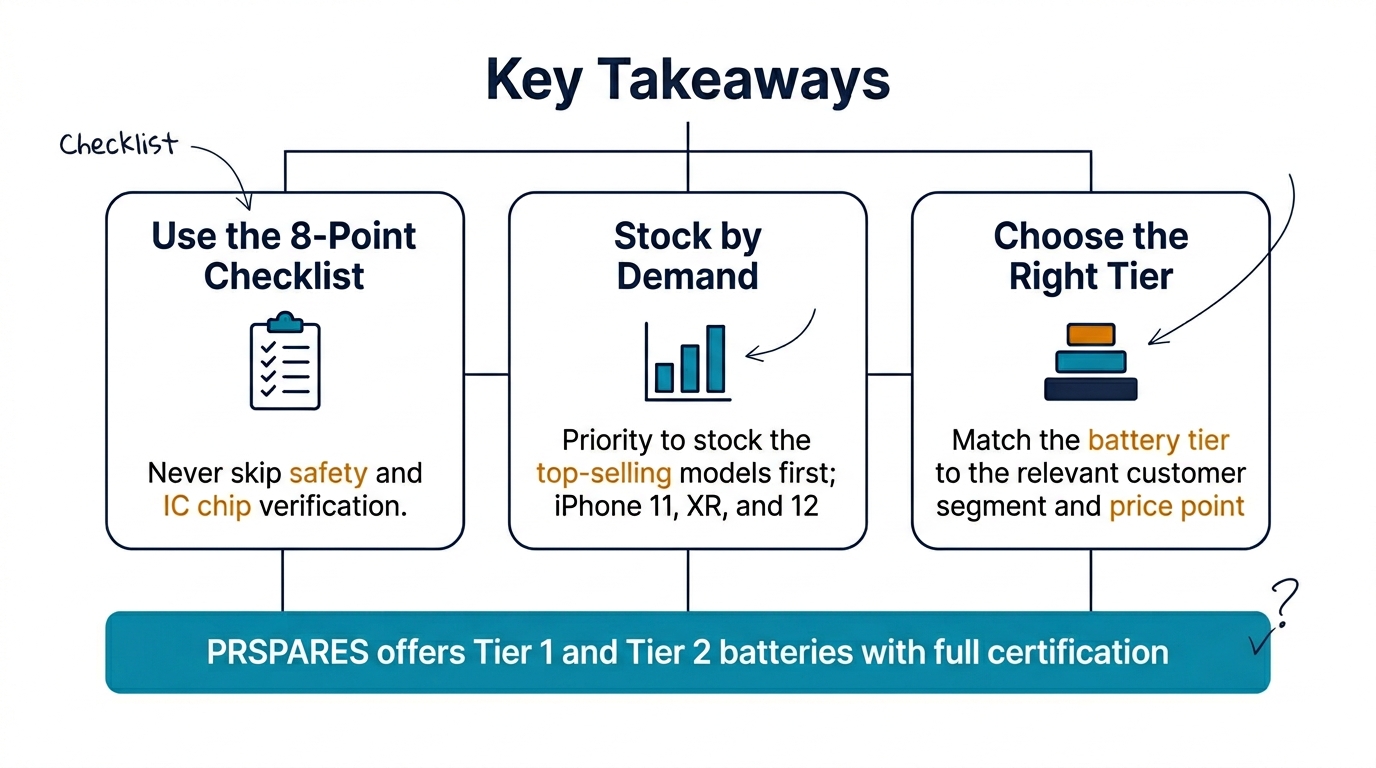
Buying iPhone batteries in bulk comes down to three things: verified cell quality, proper safety certifications, and a supplier who maintains consistency across batches. Get these right and battery replacements become one of your most reliable profit centers. Get them wrong and you're spending more time handling complaints than doing repairs.
If you're sourcing aftermarket iPhone batteries for your repair business, we supply premium-grade batteries (A-grade cells, UN38.3 certified, 12-month warranty) for all iPhone models from SE through iPhone 15. Minimum order starts at 10 units, and we support mixed-model orders so you can stock exactly what your shop needs.