
How Repair Shops Should Prepare a Mixed Order List Before Contacting a Supplier

A mixed order list is a single structured document that itemizes every phone part you want to buy by category, model, grade, and quantity before you contact a supplier. It is the difference between a same-day itemized quote and a week of back-and-forth. The fastest way to get a slow, unhelpful response from a wholesale supplier is to send a message that says: "Hi, I'm interested in buying phone parts. What are your prices?"
That message tells the supplier nothing. They don't know what models you need, what grades you want, how many units, or whether you're a first-time buyer or a regular customer. The result: either a generic price list that doesn't match your needs, or a series of back-and-forth messages that waste a week before you get a real quote.
A well-prepared mixed order list — phone parts organized by category, model, grade, and quantity — changes the entire interaction. For example, it tells the supplier exactly what you need, gets you an accurate quote in hours instead of days, and positions you as a serious buyer worth investing time in. In our experience, organized inquiries are quoted roughly 80% of the time on the same business day, because suppliers move easy-to-process orders to the top of the queue.
This article shows you how to prepare that list, what to include, what mistakes to avoid, and provides a ready-to-use template you can fill in and send today.
Looking for a Reliable Wholesale Parts Supplier?
Factory-direct from Shenzhen — transparent grades, invoices & 12-month warranty.
Get Wholesale QuoteWhat Suppliers Need to Quote You Accurately
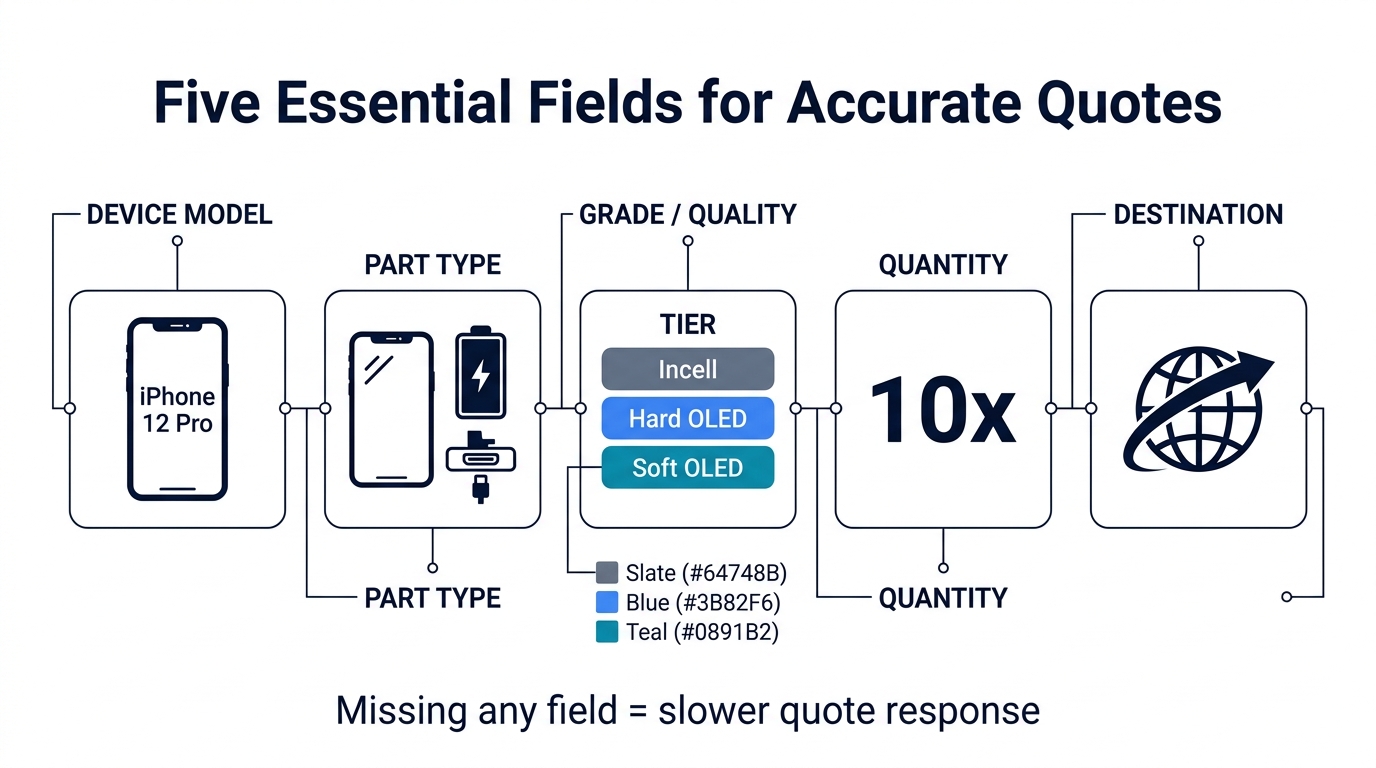
Every wholesale supplier — whether in Shenzhen, Guangzhou, or anywhere else — needs the same core information to give you a real quote. Missing any of these forces them to guess or ask follow-up questions, which slows everything down.
The Five Essential Fields
-
Device Model — Be specific. "iPhone 12" and "iPhone 12 Pro" may use different screens. "Samsung A15" has regional variants. Include the exact model identifier.
-
Part Type — Screen, battery, charging port, earpiece, back glass, etc. Don't assume the supplier knows which part you mean for a given model.
-
Grade / Quality Tier — For screens: Incell, Hard OLED, Soft OLED, or Original. For batteries: Standard, Premium, or OEM-equivalent. If you're not sure which grade you need, say so — a good supplier will explain the options. For help understanding grades, see OEM vs aftermarket phone screens.
-
Quantity — Per model, per grade. "10x iPhone 12 Incell" is clear. "Some iPhone screens" is not. Even approximate quantities help — "about 10-15" is better than nothing.
-
Destination Country — Shipping costs and methods vary dramatically by destination. A supplier needs this to quote accurate landed cost. It also helps them flag any import requirements specific to your country.
Helpful but Optional Fields
These aren't required but make the interaction smoother:
- Your shop size / monthly volume — Helps the supplier recommend appropriate quantities and possibly offer volume pricing
- Preferred shipping method — Air express (DHL/FedEx), standard air freight, or sea freight
- Budget range — If you have a budget cap, stating it upfront helps the supplier suggest the best product mix within your range
- Timeline — When do you need the parts? Urgent orders ship differently than planned restocks
The Mixed Order List Template
Here's a template you can copy, fill in, and send to any supplier:
REPAIR SHOP ORDER INQUIRY

Shop Name: _______________
Location/Country: _______________
Monthly Repair Volume: ___ repairs/month (approximate)
This Is My: [ ] First Order  [ ] Repeat Order

ORDER LIST:

SCREENS:
| # | Model           | Grade    | Qty | Notes          |
|---|-----------------|----------|-----|----------------|
| 1 | iPhone 12       | Incell   | 10  |                |
| 2 | iPhone 13       | Incell   | 8   |                |
| 3 | iPhone 13 Pro   | Soft OLED| 3   |                |
| 4 | Samsung A15     | LCD      | 10  |                |
| 5 |                 |          |     |                |

BATTERIES:
| # | Model           | Grade    | Qty | Notes          |
|---|-----------------|----------|-----|----------------|
| 1 | iPhone 12       | Standard | 15  |                |
| 2 | iPhone 13       | Standard | 10  |                |
| 3 | Samsung A14     | Standard | 10  |                |
| 4 |                 |          |     |                |

SMALL PARTS:
| # | Model           | Part Type      | Qty | Notes    |
|---|-----------------|----------------|-----|----------|
| 1 | iPhone 11       | Charging Port  | 5   |          |
| 2 | iPhone 12       | Charging Port  | 5   |          |
| 3 | iPhone 12       | Earpiece       | 5   |          |
| 4 |                 |                |     |          |

SHIPPING PREFERENCE: [ ] Express  [ ] Standard Air  [ ] Sea Freight
BUDGET RANGE: $_____ (optional)
NOTES: _______________________________________________
Fill in what you know. Leave blank what you don't. Even a partially completed template is far more useful than a vague inquiry message.
Common Mistakes That Slow Down Your Order

Mistake 1: Asking for "a Price List"
Suppliers with 500+ SKUs across multiple brands, grades, and models can't send you a meaningful price list. Prices change weekly based on supply, batch, and volume. A full catalog isn't useful — it's overwhelming and probably outdated.
Instead, list your specific models and quantities. You'll get accurate, current pricing for exactly what you need.
Mistake 2: Not Specifying Grades
"I need 20 iPhone 13 screens" is incomplete. There are at least three grades for that model — Incell ($11-15), Hard OLED ($18-25), and Soft OLED ($30-45). Without specifying, the supplier either asks which grade (adding a day to the process) or quotes the grade they want to sell you (which may not be what you want).
If you're unsure about grades, say: "Please quote both Incell and Soft OLED for iPhone 13." That way you can compare and decide.
Mistake 3: Mixing Models and Parts Randomly in a Message
A message that reads: "I need some iPhone 12 screens and batteries and also Samsung A15 screens and maybe some charging ports for iPhone 11 and 13, also do you have earpieces?" is hard to process.
Structure your list by category (screens, batteries, small parts) with one line per item. The template above handles this — use it or something similar.
Mistake 4: Not Including Destination
A supplier can't quote shipping without knowing where the parts are going. Shipping to the UK costs differently than shipping to Nigeria. Import duties and documentation requirements also vary. Include your country in every inquiry.
Mistake 5: Sending the Same Inquiry to 10 Suppliers Simultaneously
It's fine to compare 2-3 suppliers. But mass-sending the same inquiry to many suppliers often results in lower-quality responses. Experienced suppliers can tell when they're in a mass bidding situation and may not invest time in a detailed quote.
Pick 2-3 suppliers based on reputation or recommendation, send them your organized list, and compare the responses on quality of communication as much as on price. How a supplier responds to your first inquiry predicts how they'll handle problems later. For guidance on choosing the right supplier, we have a detailed evaluation framework.
What a Good Supplier Response Looks Like
When you send a well-organized inquiry, a good supplier should respond with:
- Itemized pricing matching your order list — price per unit for each model, grade, and quantity
- Stock availability — which items are in stock now, which need production time
- Grade clarification if you didn't specify — explaining what options are available and the quality/price difference
- Shipping quote — estimated cost and delivery time to your destination
- MOQ notes — whether your quantities meet minimum order requirements, or suggestions to adjust if they don't
- Payment options — accepted payment methods and terms for your order size
Red flag responses:
- A single flat price with no breakdown ("iPhone screens $12 each" without specifying which model or grade)
- No mention of shipping or delivery time
- Pressure to order immediately or claims of limited stock (unless it's a specific model they've flagged)
- No response to specific questions you asked
How Your Order List Affects Pricing
Here's something most buyers don't realize: how you present your order actually influences the price you get.
Volume Signaling
A well-organized order list with 15-20 line items and realistic quantities signals to the supplier that you're a regular buyer, not a one-time shopper. Suppliers offer better per-unit pricing to buyers they expect to reorder — because the lifetime value justifies a thinner margin on each transaction.
Specificity Reduces Risk for the Supplier
When you specify exact models, grades, and quantities, the supplier can check their actual inventory and costs. Vague inquiries force suppliers to quote conservatively (higher prices) to cover uncertainty. Specific inquiries let them quote tighter because they know exactly what they're pulling from stock.
Mixed Orders Often Get Better Total Pricing
A supplier makes more profit on a $600 mixed order (screens + batteries + small parts) than on a $600 screen-only order, because different categories have different margins. This means they can afford to be more competitive on individual items when the total order covers multiple categories. For more on this approach, see how small shops build mixed orders.
From Order List to Ongoing Relationship
Your first well-organized inquiry sets the tone for the entire supplier relationship. It shows that you:
- Know what you need (professional buyer, not a casual shopper)
- Respect the supplier's time (organized list, not a vague question)
- Are ready to buy (specific quantities, not "just looking")
After your first order, keep the same template updated with your current model list and quantities. Each subsequent inquiry becomes faster — the supplier already knows your preferences, and you can simply say "same as last month, but add 5x iPhone 14 Incell."
Over 3-4 orders, this evolves into a standing order pattern where the supplier practically prepares your shipment before you ask. That's the efficiency you're building toward — and it starts with getting the first inquiry right.
Frequently Asked Questions
Should I include my budget in the inquiry?
A budget line is an optional but powerful detail that lets the supplier shape the order around your number. First, for example, if you say "My budget is around $500 for this order," the supplier can suggest quantity adjustments to fit within 1-2 messages. Second, if you leave it out, you'll get a quote for exactly what you listed — which might be 20% over or under your target, forcing another round of revision. In our experience, buyers who name a budget close their first order roughly 30% faster.
How detailed should my first inquiry be?
A first inquiry is a complete itemized list of every model and part you need, each with a quantity and grade. First, it is far better to send one full list of 5-10 line items and let the supplier adjust than to drip-feed requests one at a time over several days. Second, for example, even if you're unsure about some quantities, include your best estimate with a note like "flexible on quantity." In our experience, a complete inquiry earns a same-day itemized quote about 80% of the time, while a vague one can stretch the process to a week.
What if I don't know which grade I need?
A grade comparison request is the right move when you don't know which grade you need. First, for example, write "Not sure between Incell and Soft OLED for iPhone 13 — please quote both so I can compare," and any good supplier will provide guidance. Second, never guess a grade and order blind: in practice, a wrong-grade screen can be a $200 customer loss in returns and 1-star reviews.
Can I negotiate prices from the initial quote?
Price negotiation is a normal part of wholesale, but it works only when you give the supplier a reason. First, a vague "Can you do better on price?" rarely moves anything. Second, for example, a specific offer like "If I increase the iPhone 12 Incell quantity from 10 to 20, can you reduce the per-unit price by 8-10%?" works much better, because it hands the supplier a volume reason. In practice, the strongest levers are higher volume, a commitment to monthly orders, or combining categories into one shipment — together they can shave $50-100 off a mid-size order.
Send an Organized Inquiry, Get an Organized Response

The quality of the quote you receive is directly proportional to the quality of the inquiry you send. Ten minutes spent organizing your order list saves days of back-and-forth and gets you better pricing.
Use the template above, fill in your models and quantities, and send it to us. We'll respond with itemized pricing, stock availability, and a shipping quote — typically within the same business day for complete inquiries.
Related reading: