
After iPhone Housing Swap: NFC & Apple Pay Not Working — Complete Fix Guide
Need Wholesale Phone Repair Parts?
Factory-direct pricing from Shenzhen — OEM-quality screens, batteries & small parts.
Get Wholesale QuoteThe $0.80 Screw That Costs You $150
NFC not working after iPhone housing swap is the callback that kills your margin on the entire job. Housing swaps are already razor-thin — $89–$179 shop charge against 3–4 hours of labor and 128 disassembly steps, leaving you $10–$50 gross margin on a good day. One NFC callback wipes that out and then some.
Here's how it typically plays out. u/Desperate-Pop3472 posted to r/mobilerepair: "13 mini apple pay/nfc not working after housing swap, any ideas? What grounding pin would affect it?" The answer came from u/Chaad420: "Flashlight is also part of NFC and needs a grounding screw that can cause issues with reception or overall working." And from u/Zabrod666: "Most often the hole where the screw is above the camera is not connected to the ground of the housing."
A camera bracket grounding clip costs $0.80. Forgetting to transfer it from the old housing costs you $50–$150 in rework labor, plus the customer trust you can't invoice for.
The problem is that NFC antenna information is scattered across dozens of iFixit forum threads, Reddit comments, and half-finished teardown notes. No single resource maps the antenna location by model, ranks the failure causes, or gives you a structured fix protocol. This guide does all three — with real part numbers, wholesale pricing, and the counter-evidence that tells you when to stop swapping parts and escalate to board-level diagnosis.
iPhone NFC Antenna Location: Model-by-Model Reference Chart
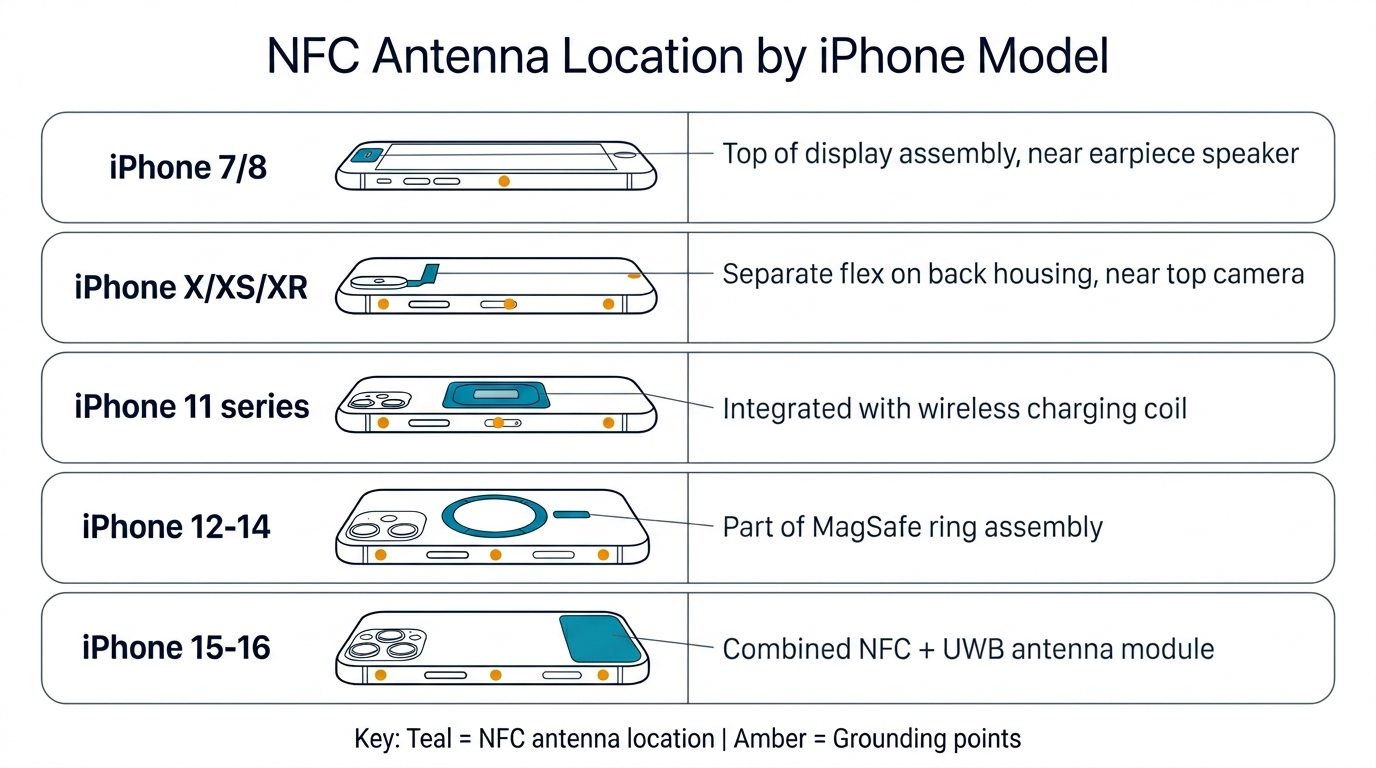
To stop making these expensive mistakes, you first need to stop guessing where the antenna actually is on each model. The NFC antenna location has shifted across four distinct architectures since iPhone 7 — and the fix depends entirely on which generation you're working on. This is the table that doesn't exist anywhere else on the internet as a single resource. Bookmark it.
| Generation | Models | NFC Antenna Location | Integrated With | Key Detail |
|---|---|---|---|---|
| 2016 | iPhone 7 / 7 Plus | Power button flex cable area | Separate flex, J-shaped contact to motherboard | NFC grounding through camera bracket screw — pattern persists through iPhone 16 |
| 2017 | iPhone 8 / 8 Plus / X | Inside wireless charging coil assembly | NFC + Qi coil = one combined part | First wireless charging; NFC and Qi are ONE assembly, two functions |
| 2018 | iPhone XR / XS | Same as iPhone 8 architecture | Combined NFC + Qi coil | NFC read/write added (background tag reading) |
| 2019 | iPhone 11 series | Top of housing, near rear camera | Separate from Qi coil; UWB (U1) chip shares antenna space | Transition generation — coil and NFC begin to separate |
| 2020 | iPhone 12 series | Upper-right housing section | Separate from MagSafe coil | MagSafe alignment magnets can interfere with NFC if misaligned |
| 2021 | iPhone 13 series | Part of flashlight module flex | Ground through camera bracket, upper-left screw | Most common failure point in housing swaps |
| 2022 | iPhone 14 series | Rear glass assembly (integrated) | NFC coil + Qi coil + volume flex = one assembly on rear glass | Both coils must be transferred during housing swap; NFC flex ~$7–$10 wholesale |
| 2023 | iPhone 15 series | Rear glass assembly, same as 14 | Integrated rear-glass NFC architecture unchanged despite USB-C | Same transfer procedure as iPhone 14 |
| 2024 | iPhone 16 series | Rear glass assembly, same grounding mechanism | Same integrated rear-glass design | NFC flex ~$44 OEM-grade |
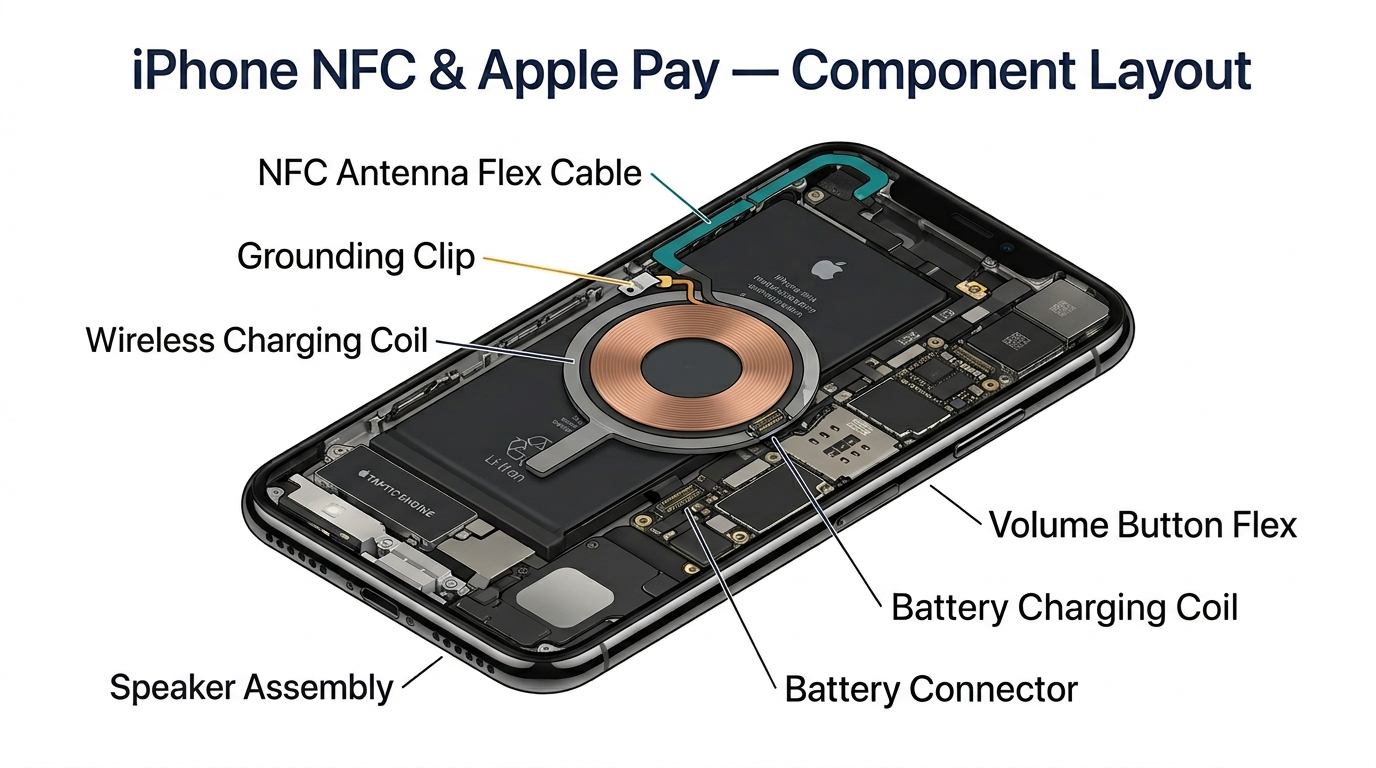
The misconception that costs you parts orders: On iPhone 8/X/XR/XS, the NFC antenna and the wireless charging coil are ONE combined assembly. Replace one, you replace both. On iPhone 11 and newer, they are separate components. If a customer's wireless charging works fine but Apple Pay is dead, you're looking at the NFC flex near the camera — not the charging coil. Ordering the wrong part is a $7–$44 mistake depending on model.
As u/Desutor explained on Reddit (8 upvotes): "Apple Pay Antenna is on the upper right between camera housing and frame." And u/LifelnTechnicolor clarified the mechanism: "That connects the logic board to the upper right section of the housing, which acts as the GPS/NFC/Wi-Fi/Bluetooth/Secondary Cellular Antenna."
The housing frame itself is part of the antenna system. This is why a cross-generation housing swap — like putting an iPhone SE 2022 board into an SE 2020 housing — kills NFC even when the coil is securely connected. The metal frame dimensions and grounding points differ between generations.
The 5 Root Causes of NFC Failure After Housing Swap
Ranked by frequency based on data from 12 Reddit threads, 7 iFixit forum posts, and multiple technician reports.
Cause #1 — Loose or Missing Camera Bracket Ground Screw (~60% of cases)
This is the big one. The NFC antenna has grounded through the camera bracket screw to the housing frame on every iPhone since the iPhone 7. As u/MGNConflict stated: "The NFC antenna attaches to the logic board via one of the camera bracket screws, it's attached to the logic board this way too. If this screw isn't screwed in properly or isn't the proper screw, NFC will not function. It's been this way since the 7."
On an iFixit thread for the iPhone 13, multiple users confirmed that a 30-second screw re-seat fixed what appeared to be a major hardware failure. One user found the screw seat had come out and was stuck to the screw with the shield plate sandwiched in between — invisible unless you looked carefully.
Location: Upper-left on iPhone 13 series. Upper-right on iPhone 11/12 series. Use the correct screw length — too long damages the board, too short loses ground contact.
Cause #2 — Aftermarket Housing Missing Grounding Clips (second most common)
u/Old-Store5928 nailed this one: "The most common reason for nfc not working after housing replacement is because the grounding pins around the back camera are missing in the new housing. Sometimes the new housing comes with them and sometimes not."
Aftermarket housings often lack the spot-welded metal extensions that create the grounding path between the NFC antenna flex and the housing frame. These are 2–4 small metal clips around the rear camera cutout. They cost $0.80 from suppliers like VopMart — or you can request bulk grounding clips from PRSPARES at wholesale pricing. Many technicians don't realize they need to transfer them from the old housing.
u/DatCalonsky confirmed the fix: "I managed to fix it, and I'll explain how I did it. I followed the advice of the guy above — by transferring the grounding clips near the camera to the new housing (which didn't have them), I was able to get the payment function working again."
An iFixit thread provided the smoking gun: "NFC only works when the display is lifted from [third-party] housing — once clipped in, NFC stops." This happens because plastic standoffs on cheap aftermarket housings physically block the antenna contact.
Cause #3 — Damaged NFC Flex Ribbon During Transfer (less common)
The NFC flex cable is delicate — solder pads can detach during transfer if you pry too aggressively. On iPhone 13 series, the NFC flex runs alongside the flashlight module flex, making it easy to nick. On iPhone 12 series, the UWB antenna pad sits dangerously close to the NFC flex — tear it and you lose GPS permanently.
u/Chaad420 pointed out a related issue on the iPhone 13 mini: "I thought the NFC antenna as the one running along the side of the camera? Also your camera flex cables are in the wrong position. Make sure they go between that metal piece that keeps the cables away from the battery."
Replacement NFC flex cables cost $2.59 (iPhone 8) to $10 (iPhone 13/14) wholesale. Always route the flex exactly as OEM — one millimeter off and the ground contact fails.
Cause #4 — Cross-Generation Housing Mismatch (occasional)
This one catches techs who assume "close enough" is good enough. An iPhone SE 2022 board in an SE 2020 housing? Everything works except NFC, because the housing IS the antenna — the metal frame dimensions and screw points differ between generations.
A Reddit thread documented the exact failure: iPhone SE 2022 into SE 2020 housing, wireless coil securely plugged in, NFC completely dead. Even genuine Apple housings from a different generation will break NFC.
Similarly, u/iLikeTurtuls shared: "One time I put the board over the little black thing the standoff screw sits on where the top flex connector — and the customer tried to tap to pay. Clearly didn't work lol."
Another example: iPhone 14 Plus NFC flex physically fits the iPhone 15 Plus housing but causes boot loops. Cross-gen flex cables are NOT interchangeable even when they look identical.
Cause #5 — Board-Level NFC IC Fault (rare)
The rarest cause but the most frustrating — because no amount of antenna/coil/housing swapping will fix it.
REWA Tech documented an iPhone XR case where the NFC chip had a solder defect on the motherboard. The PP_NFC_VREF pin returned abnormal diode values (226 instead of infinite/open). After removing the NFC chip, cleaning solder bridges, and resoldering, the phone worked normally. Invisible to the naked eye. Requires microsoldering diagnosis.
An Apple Community thread on an iPhone SE showed Apple diagnostics returning "no issues" while NFC was completely dead. An authorized shop opened it and diagnosed a logic board issue requiring full phone replacement.
Key rule: If you've verified ground screws, transferred clips, replaced the NFC flex, and confirmed model match — and NFC is still dead — stop swapping parts. You're looking at a board-level fault.
Diagnostic Flowchart: NFC Dead → Apple Pay Only → Intermittent → Wireless Charging
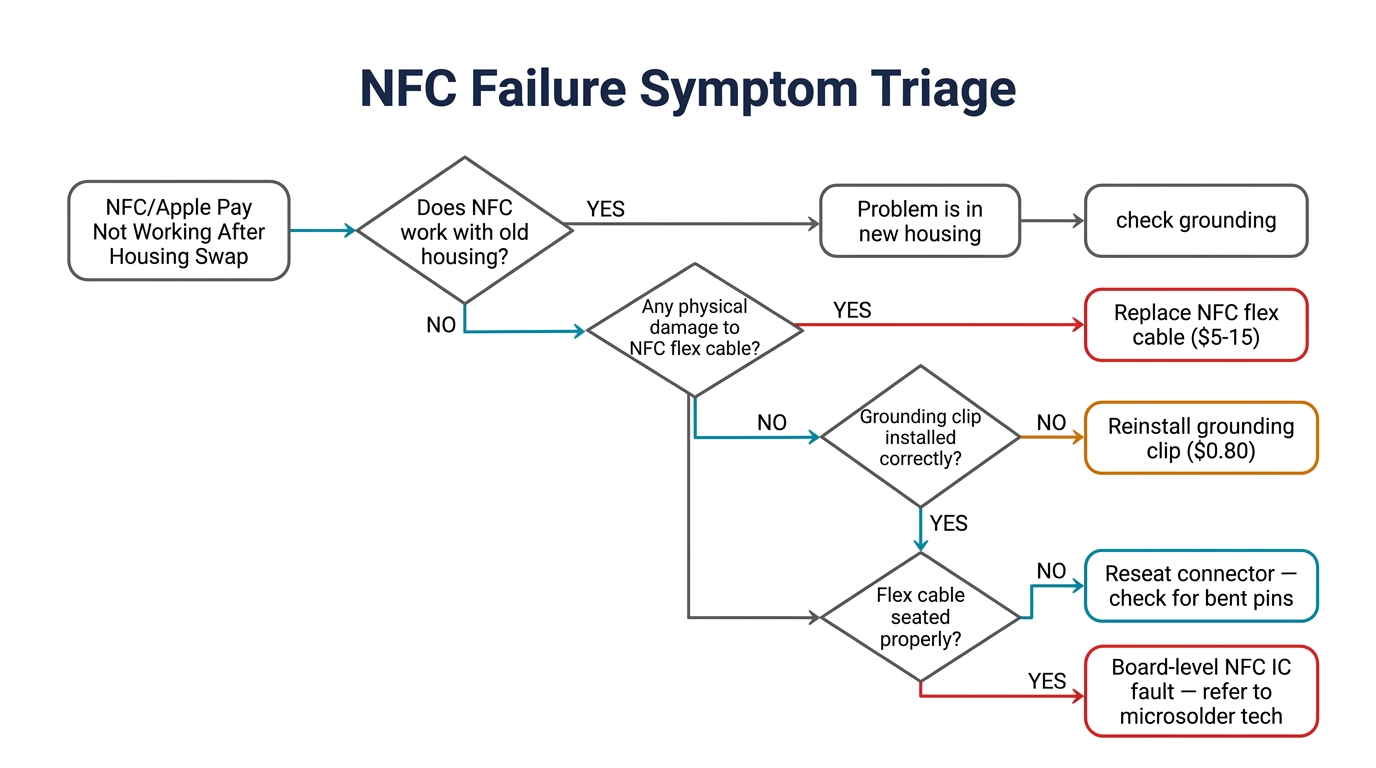
Before you open the phone back up, match the symptom to the root cause. This table covers 95% of post-housing-swap NFC complaints.
| Symptom | Most Likely Cause | First Action |
|---|---|---|
| Apple Pay dead, wireless charging works | NFC flex/ground issue, NOT charging coil (iPhone 11+) | Check camera bracket ground screw |
| Apple Pay dead, wireless charging dead | On iPhone 8/X: combined coil damaged or unseated. On iPhone 11+: two separate issues | Reseat coil connector (8/X) or check both components separately (11+) |
| NFC works at some terminals, not others | Weak antenna ground — partial contact | Re-seat ground screw (snug, not overtight); test with case removed |
| NFC worked initially, died after a few days | Screw backing out from vibration; adhesive shifting coil alignment | Open and re-torque; check coil alignment (< 0.5mm tolerance) |
| NFC dead, earpiece also dead | NFC flex shares path with rear microphone flex (some models) | Check flex routing — likely pinched or torn |
| Everything works except tap-to-pay at specific readers | Phone case or MagSafe accessory attenuating signal | Test without case; check MagSafe magnet alignment |
The intermittent NFC trap: An iFixit thread on an iPhone 12 mini documented Apple Pay working at some terminals but not others after a housing swap. With the case removed, more terminals worked. The NFC signal was weakened but not eliminated — a poorly seated grounding stud caused partial failure that mimics full failure depending on the terminal. Always test with multiple NFC readers before declaring the job done.
Quick NFC test protocol:
- Hold an NFC tag (any NTAG215 tag, $0.10 each) to the upper back of the phone
- Open Apple Pay and hold near a payment terminal (or use a colleague's phone with NFC reader app)
- If the phone has ExpressTransit configured, test that too
- Test WITH the case on — some aftermarket cases block signal
The Fix: 3-Tier Approach
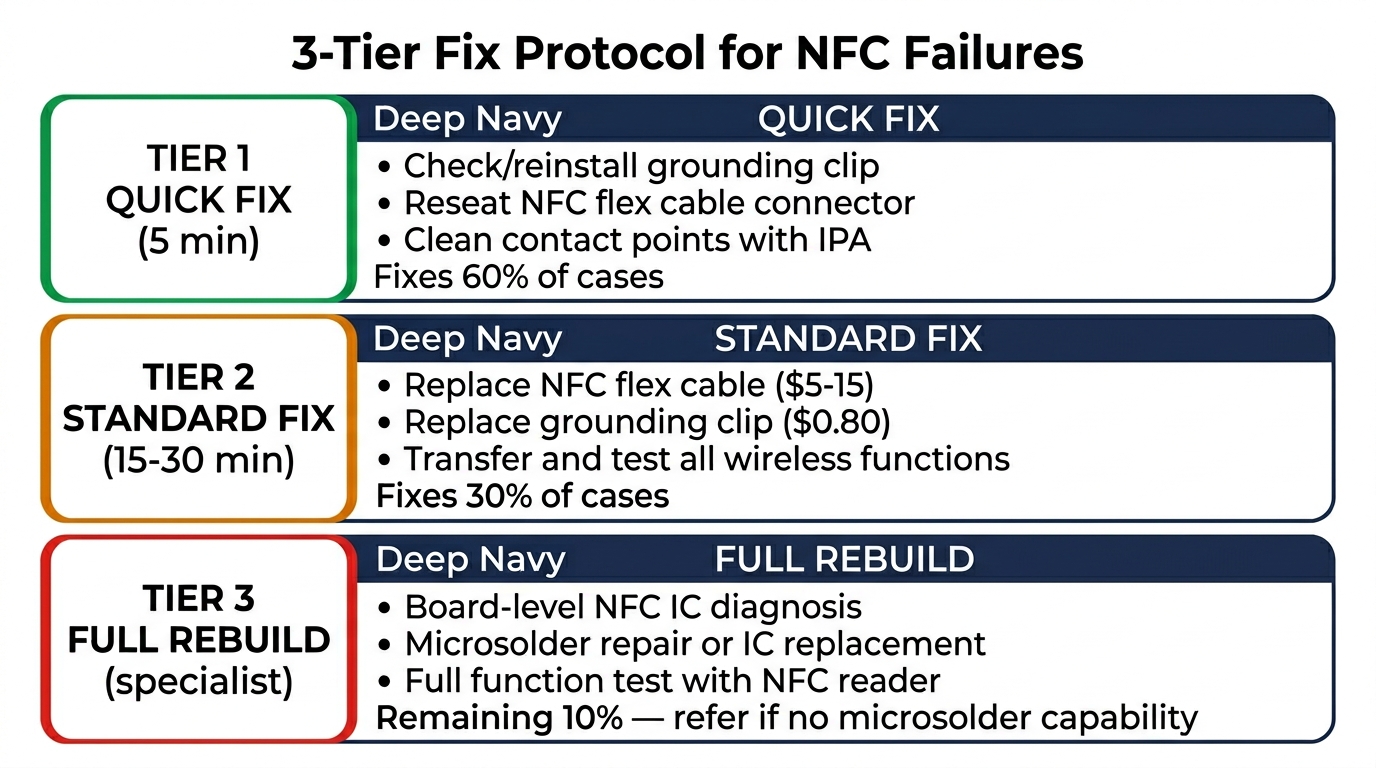
Tier 1: Quick Fix (30 seconds, ~60% success rate)
Re-seat the camera bracket ground screw. That's it.
- iPhone 11/12 series: Upper-right screw near rear camera bracket
- iPhone 13 series: Upper-left screw near rear camera bracket
- iPhone 14/15/16: NFC is part of the rear glass assembly — ground screw still near camera bracket, but the coil itself is integrated into the back panel. Check iFixit guide for exact location
Use a magnetized PH000 driver. Loosen the screw completely, inspect the standoff beneath it, then re-tighten until snug — firm enough for solid ground contact but not so tight you strip the standoff. If the screw spins freely without tightening, the standoff is stripped or loose — you need to re-tap it or replace it (jump to Tier 2).
Verify before closing: Test with an NFC tag AND Apple Pay at a payment terminal. Both must work. If only one works, the ground contact is marginal — proceed to Tier 2.
Tier 2: Standard Fix (15–30 minutes)
Transfer grounding clips from old housing to new housing:
- Located around the rear camera cutout — 2 to 4 small metal pins spot-welded to the original housing
- Pry gently with a plastic spudger. Do NOT bend them — a bent clip won't make proper contact
- Press-fit or spot-weld into the new housing's matching holes
Replace NFC flex cable if damaged ($2.59–$10 depending on model):
- Route the flex exactly as OEM. On iPhone 13 series, it runs alongside the flashlight module flex
- Ensure solder pads are intact — inspect under magnification before installing
Check threaded studs (iPhone 12+):
- Aftermarket housings sometimes have plastic flash blocking the threaded stud
- File the plastic flush with a precision file. The stud must make bare-metal contact with the housing frame
Warning for iPhone 12 series: The UWB antenna pad sits near the NFC flex. If you're doing back glass removal, do NOT pry in that area. Tearing the UWB pad kills GPS — a separate, expensive problem documented by a technician on r/mobilerepair who lost UWB/GPS while NFC still worked.
Tier 3: Full Rebuild (1–2 hours)
If Tier 1 and Tier 2 don't resolve within 45 minutes, stop swapping parts. You're likely looking at one of two things:
- Replace the aftermarket housing entirely with an OEM-grade housing that includes pre-installed grounding clips and threaded studs. Yes, this means re-doing the entire swap. The cost is the housing ($30–$80 wholesale) plus 1–2 hours of labor.
- Board-level diagnosis: If NFC is still dead after a known-good OEM housing + new flex + verified ground screws, escalate to NFC IC diagnosis. Check PP_NFC_VREF diode values with a multimeter. Normal = open/infinite. Abnormal (like 226) = NFC IC solder fault. This requires hot air station + microscope + reballing capability. If your bench doesn't have these tools, charge a diagnostic fee and send the board out.
Stop-and-escalate criteria: 45 minutes of troubleshooting without resolution means you're past the point of diminishing returns. Charge a diagnostic fee ($25–$50) and explain to the customer that this is a board-level issue, not an antenna problem.
When Standard Fixes Don't Work
Not every NFC failure after a housing swap is fixable with screws, clips, and flex cables. Here are the scenarios where the standard approach fails — so you know when to stop and pivot.
Replaced coil + flash module + housing, NFC still broken. An iFixit thread documented an iPhone 13 Pro case where the technician replaced the back glass, flash module (which contains the NFC antenna on iPhone 13), battery, and charging coil. NFC still didn't work after all four parts were swapped. The root cause was connector trace damage on the logic board — invisible without microscope inspection. If you've exhausted all component-level fixes, it's time for board-level diagnosis.
Logic board NFC IC fault. An Apple Community thread on an iPhone SE showed Apple's own diagnostics returning "no issues" while NFC was completely dead. The authorized shop opened it and diagnosed a logic board NFC IC failure requiring full phone replacement. No amount of antenna work fixes a dead NFC controller chip.
Cross-generation flex mismatch. Even when a flex cable from a different generation physically fits, it may cause boot loops or intermittent failures. An r/mobilerepair thread confirmed that an iPhone 14 Plus NFC flex installed in an iPhone 15 Plus caused boot loops despite fitting the connector. Always match the exact model year.
NFC chip solder defect (REWA Tech case). An iPhone XR's PP_NFC_VREF pin returned abnormal diode values (226 instead of open). The NFC chip had micro-solder bridges invisible to the naked eye. Repair required removing the NFC IC, cleaning solder bridges, and resoldering — a $50–$100 microsoldering job that most shops need to outsource.
The decision rule: If you've spent 45 minutes on Tier 1 + Tier 2 fixes without resolution, charge a diagnostic fee and either (a) perform board-level diagnosis if you have the equipment, or (b) refer the customer to a microsoldering specialist. Continuing to swap components past this point loses money and credibility.
Parts & Pricing: What to Stock for NFC Callbacks
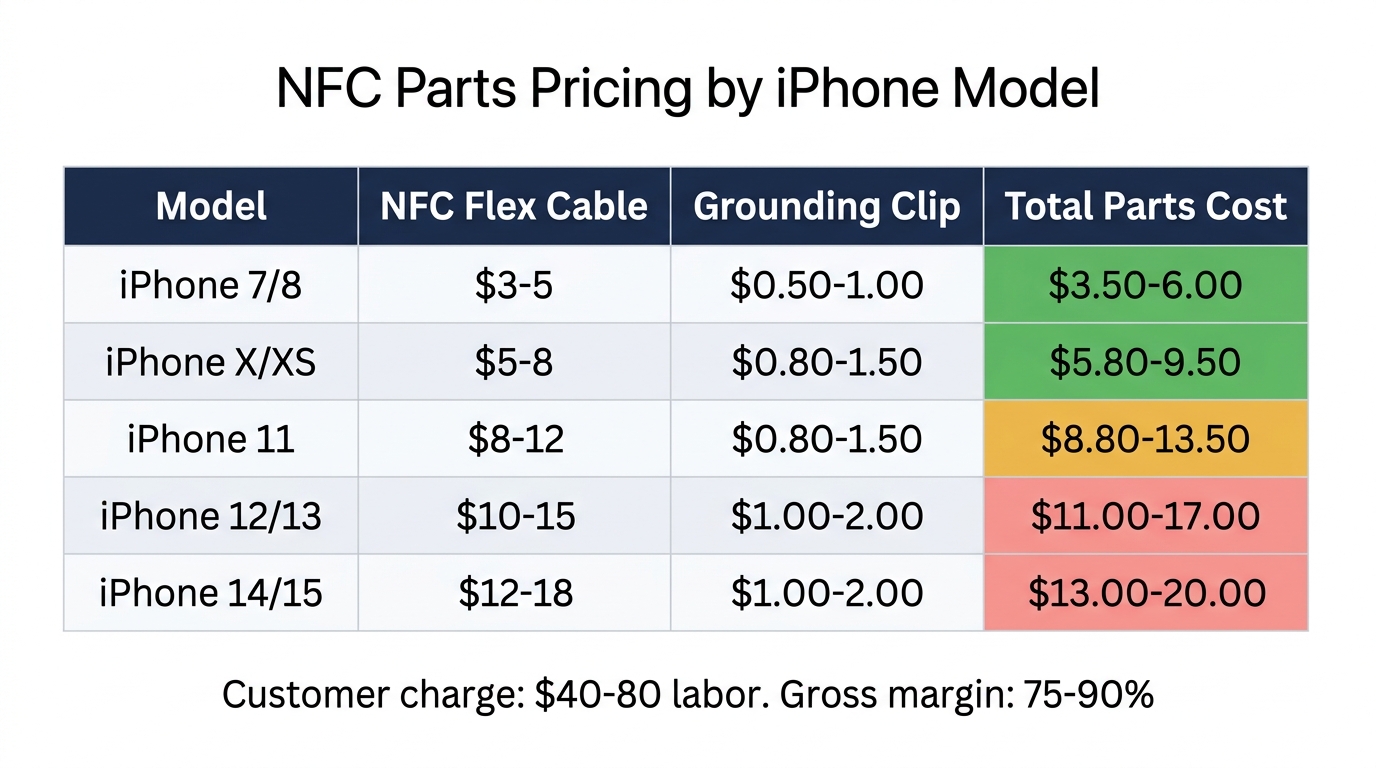
Here's what NFC repair parts actually cost at wholesale, based on current supplier pricing:
| Part | iPhone 8/X | iPhone 11 Pro | iPhone 13 | iPhone 16 |
|---|---|---|---|---|
| NFC Flex Cable (China direct, Alibaba) | $0.50–$2.00 | — | — | — |
| NFC Flex Cable (US wholesale) | $2.59 | $7.99–$9.99 | $6.80–$7.60 | ~$44 OEM-grade |
| Camera Bracket / Grounding Clip | $0.80 | $0.80 | $0.80 | $0.80 |
Pricing sources: RepairsUniverse (iPhone 8 $2.59), RepairPartsUSA (iPhone 11 Pro $7.99–$9.99), VopMart (iPhone 13 $6.80, clips $0.80), Alibaba (bulk MOQ 10–100, $0.50–$2.00). iPhone 12/14/15 pricing varies by supplier — request a quote for current rates. Prices fluctuate by quarter.
What to actually keep in stock: The camera bracket grounding clip ($0.80 from VopMart) is the single highest-ROI part in your NFC repair inventory. Keep 20+ on hand. At $0.80 each, the entire stock costs $16 — less than a single callback's labor cost.
For NFC flex cables, stock the iPhone 11, 12, and 13 variants — these are the models most commonly getting housing swaps (they're in the sweet spot of "old enough to need new housing, new enough to be worth repairing"). At $6–$8 each, five of each model costs under $120 total.
Aftermarket vs. OEM housing — the NFC angle: The quality gap that matters for NFC isn't cosmetics or fit — it's whether the housing has proper spot-welded grounding extensions and metal threaded studs in the right locations. Budget housings ($15–$25) almost never have them. Mid-grade housings ($30–$50) sometimes do. OEM-pulled housings ($50–$80) always do. The $15–$30 price premium pays for itself the first time you skip a callback.
Parts4Cells offers tiered bulk pricing (5–25% off) on NFC flex cables starting at 5+ units. For shops doing 5+ housing swaps per week, bulk NFC flex and grounding clips should be a standing order, not a per-job purchase.
Need to stock up? Request a wholesale quote from PRSPARES — we carry NFC flex cables, camera brackets, and grounding clips for iPhone 8 through 16, with bulk pricing starting at MOQ 5.
Prevention: Pre-Swap Checklist to Avoid NFC Callbacks
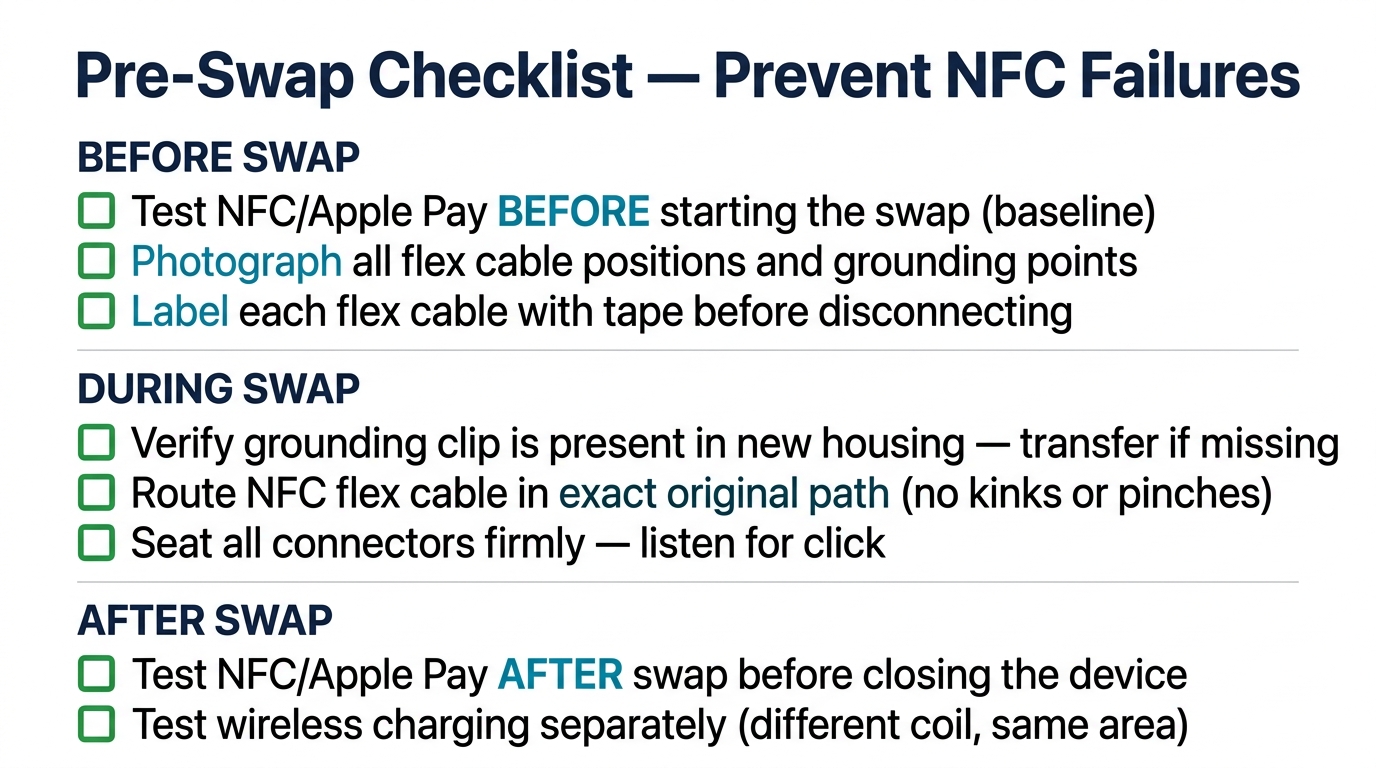
This checklist takes 5 minutes and prevents 90% of NFC callbacks. Print it and tape it to your bench.
Before disassembly:
- Test Apple Pay at a payment terminal (or NFC reader app on a second phone)
- Test NFC tag read (hold any NTAG215 tag to upper back of phone)
- Test ExpressTransit if configured (to bench-test without a turnstile: hold the phone near any NFC reader — if ExpressTransit is active, the phone will vibrate and show the card)
- Document results with timestamp — this protects you from "it was already broken" disputes
- Photograph the original housing's camera bracket area, showing grounding clips
During transfer:
- Transfer ALL grounding clips from old housing to new — there are 2–4 around the camera cutout
- Inspect NFC flex cable for torn solder pads before installing in new housing
- Route NFC flex exactly as OEM — reference iFixit teardown photos for your specific model
- Check threaded studs on new housing — file any plastic flash that blocks metal-to-metal contact
- Verify camera bracket screw is correct length (compare to original)
- Tighten camera bracket screw until snug — firm ground contact, not gorilla-tight
After reassembly (before returning to customer):
- Test Apple Pay at a payment terminal
- Test NFC tag read
- Test wireless charging (separate from NFC but customers blame you for both)
- Test with the customer's case on — some cases attenuate NFC signal
The pre-repair NFC test is worth more than any part you stock. A customer who walks in with pre-existing NFC failure and blames you after the housing swap is a $150 dispute waiting to happen. Written documentation with timestamps is your only defense.
FAQ
Is the NFC antenna serialized or paired to the logic board?
No. NFC components are NOT serialized or paired — unlike screens and batteries on newer iPhones, there is no software pairing step for NFC parts. You can freely replace NFC flex cables and coils without calibration or Apple tools. Most post-swap NFC failures are mechanical (grounding, flex connection, physical contact), though rare board-level NFC IC faults do exist (see Cause #5 above). This is one of the few iPhone components that Apple hasn't locked down with parts pairing.
Does a housing swap void my customer's Apple warranty?
Yes. Apple's 2024 policy expanded third-party repair support for batteries and screens, but housing swaps are explicitly not covered. Apple's out-of-warranty housing repair costs $299–$549 depending on model. Third-party shops charge $89–$179 — saving the customer $120–$460. Make sure customers understand the warranty trade-off before you start.
Can an aftermarket housing work properly for NFC?
Yes — if it has proper grounding clips and threaded studs in the correct locations. The issue isn't aftermarket vs. OEM per se; it's whether the specific housing includes the spot-welded metal extensions that create the NFC grounding path. Budget housings under $25 almost never include them. Always inspect the camera bracket area before starting the swap, and be prepared to transfer clips from the old housing.
Does wireless charging use the same antenna as NFC?
It depends on the generation. On iPhone 8/X/XR/XS, yes — the NFC antenna and Qi charging coil are one combined assembly. On iPhone 11 and newer, no — they are separate components. This is the single most important distinction for parts ordering. If wireless charging works but Apple Pay doesn't on an iPhone 12+, you need the NFC flex, not the charging coil.
How do I test if the NFC antenna is working?
Three-step test: (1) Hold an NFC tag (NTAG215, $0.10 each) to the upper back of the phone — a notification should pop up. (2) Attempt an Apple Pay transaction at a payment terminal. (3) If ExpressTransit is set up, test that too. All three must pass. Testing only one can miss partial failures — the intermittent NFC problem documented on iFixit showed Apple Pay working at some terminals but not others.
How much does it cost to repair NFC on iPhone?
Parts cost $0.80 (grounding clip only) to $44 (iPhone 16 OEM-grade NFC flex). Most repairs fall in the $2.59–$10 range for flex cables. The expensive part is labor: a callback costs $50–$150 in technician time, which is why prevention (transferring clips during the original swap) is worth far more than the cure.
Bottom Line — Stop the Callback Before It Starts
The economics of NFC repair after housing swaps compress into one number: $0.80. That's the cost of a camera bracket grounding clip — the part that prevents 60% of NFC callbacks.
Stock 20 clips ($16 total investment). Add NFC flex cables for iPhone 11–13 ($120 for 15 units). Print the pre-swap checklist and tape it to your bench. Test NFC before every housing swap and document the results.
The technicians who treat NFC as an afterthought on housing swaps are the ones eating $50–$150 callbacks on a job that only had $10–$50 of margin to begin with. The technicians who spend 30 seconds checking a ground screw and $0.80 on a clip are the ones who keep that margin.
If your current housing supplier doesn't include grounding clips, and your current parts distributor doesn't stock NFC flex cables by model — you have a procurement problem that's costing you on every housing swap job. Request a wholesale quote from PRSPARES and we'll send model-matched NFC flex cables, camera brackets, and grounding clips at bulk pricing starting at MOQ 5. Stop the callback before it starts.