
Phone LCD Parts Wholesale: Quality Grades, Pricing & Supplier Guide
Phone LCD parts wholesale is the bulk sourcing of replacement screens—aftermarket INCELL, aftermarket OLED, and four grades of original panels—at unit prices that run 20% to 100% of an Apple service part. In practice, the catch is that price and quality almost never line up the way the labels promise.
Every repair shop owner has experienced this nightmare: a batch of "premium" screens arrives, and within weeks, 15% are back on your bench with dead pixels, ghost touches, or colors so washed out your customers think you installed a knockoff. You thought you were saving money. Instead, you're hemorrhaging it—on replacements, on labor, on reputation.
Here's the uncomfortable truth about phone LCD parts wholesale: the terminology is deliberately confusing, pricing varies wildly for seemingly identical products, and too many suppliers are counting on your ignorance to pad their margins. According to Statista's 2023 repair industry report, U.S. repair shop owners lose up to $3,000 per month from faulty parts alone. That's not a rounding error—that's your profit walking out the door.
This guide cuts through the marketing nonsense. I'll decode quality grades, reveal what you should actually pay, and show you how to evaluate suppliers like someone who's been burned before. Because if you're sourcing phone LCD parts wholesale without this knowledge, you're not saving money—you're gambling with it.
Sourcing Replacement Screens in Bulk?
Incell / Hard OLED / Soft OLED grades — wholesale pricing, grade comparison on request.
Get Wholesale QuoteUnderstanding Phone LCD Quality Grades: The Complete Breakdown
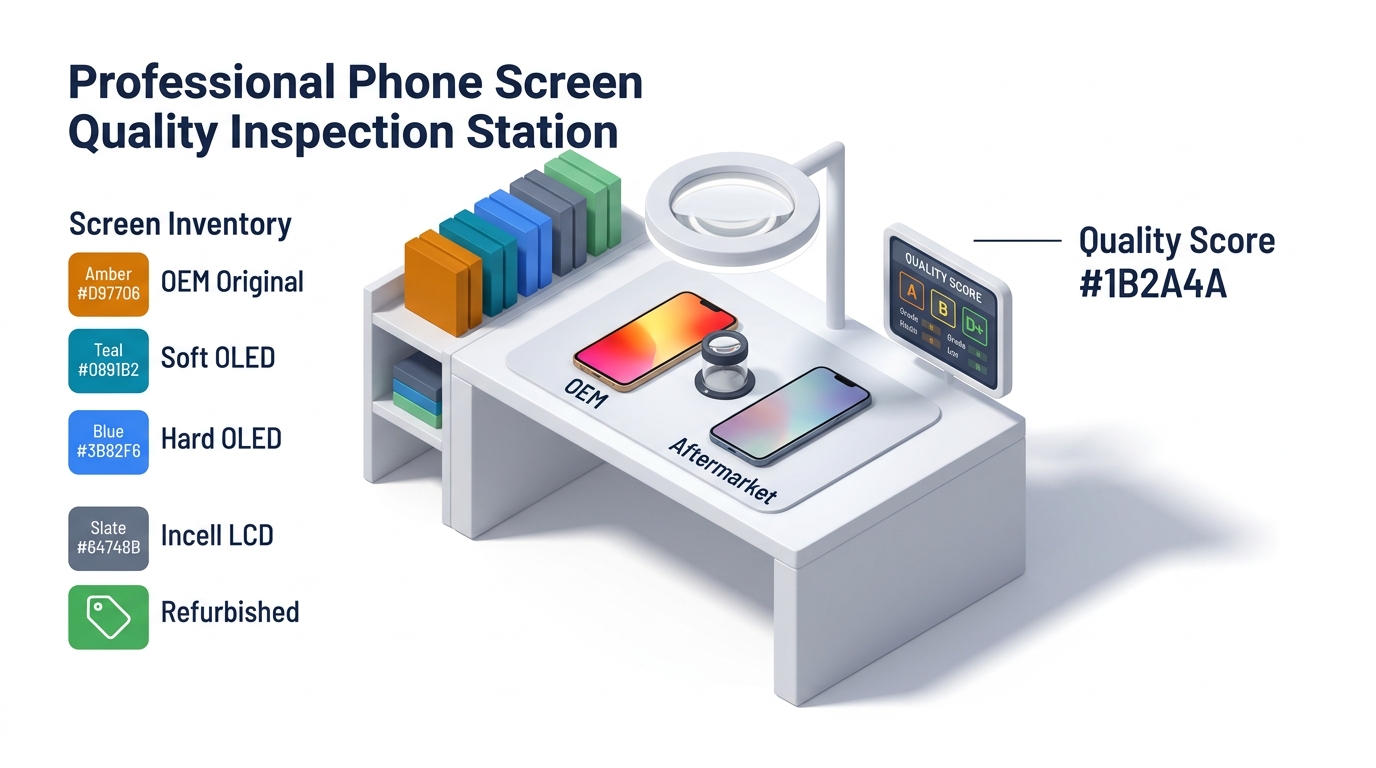
A phone LCD quality grade is a defined tier of display that sets a measurable color accuracy, brightness, and failure rate at a specific price band. There are two completely separate grading worlds—aftermarket and original—and confusing them is what costs repair shops money. First, aftermarket covers INCELL and OLED clones running 20-70% of original price with 3-12% failure rates. Second, original covers four sub-grades (OEM, refurbished, pulled, new) running 55-100% of price. For example, an "OEM" label and a "premium aftermarket" label can sit on near-identical screens that differ 40% in price.
The Aftermarket Universe
The aftermarket universe is the set of third-party panels built to replicate OEM specifications, spanning a 70-95% color-accuracy range. In practice, they run from budget options that'll make your customers squint to premium alternatives that even technicians struggle to distinguish from originals. For example, a $20 HD INCELL and an $80 soft OLED are both "aftermarket," yet they are not remotely the same product.
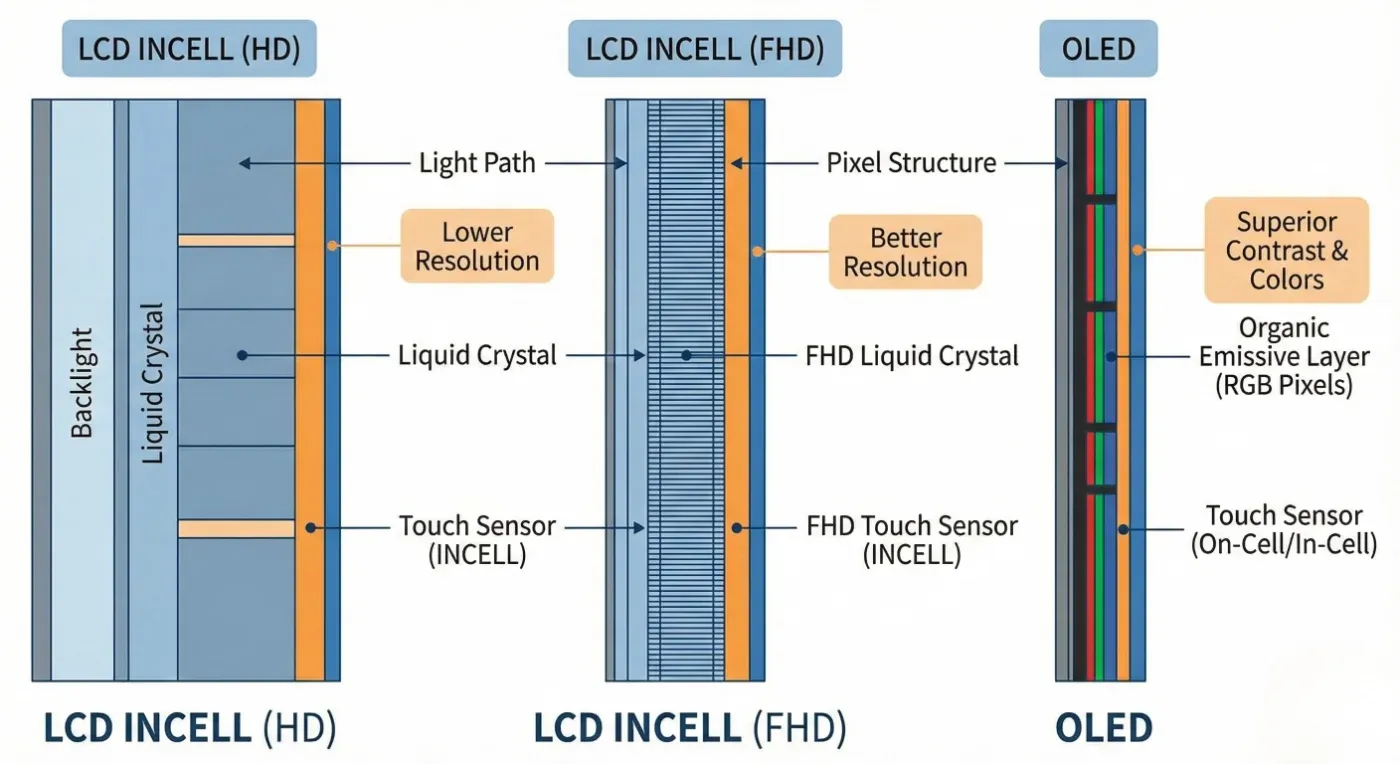
INCELL Displays (LCD Technology)
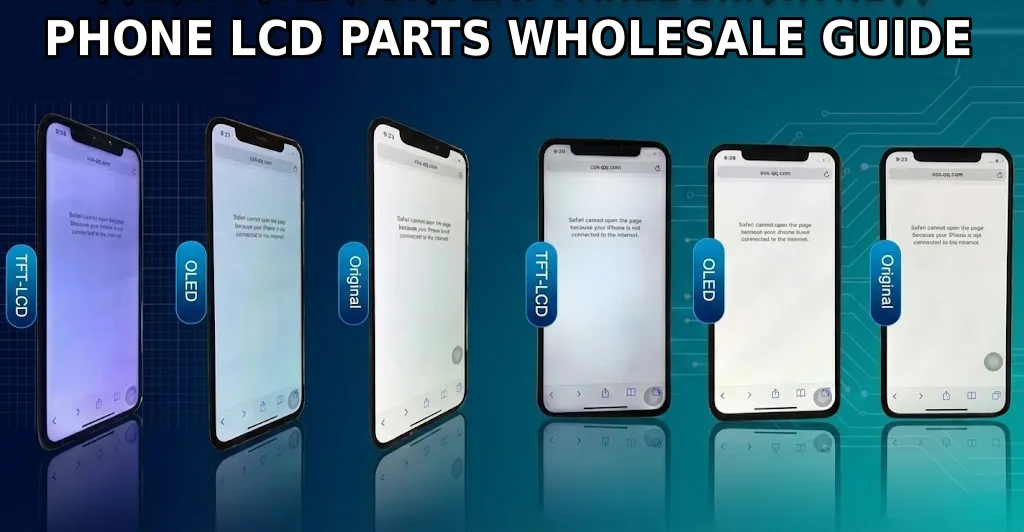
INCELL is an LCD technology that integrates the touch sensor directly into the panel, reducing thickness and improving clarity at 20-40% of original price. But here's what suppliers won't volunteer: INCELL comes in two very different flavors. For example, HD and FHD INCELL look identical on a spec sheet yet differ 15 points in color accuracy.
-
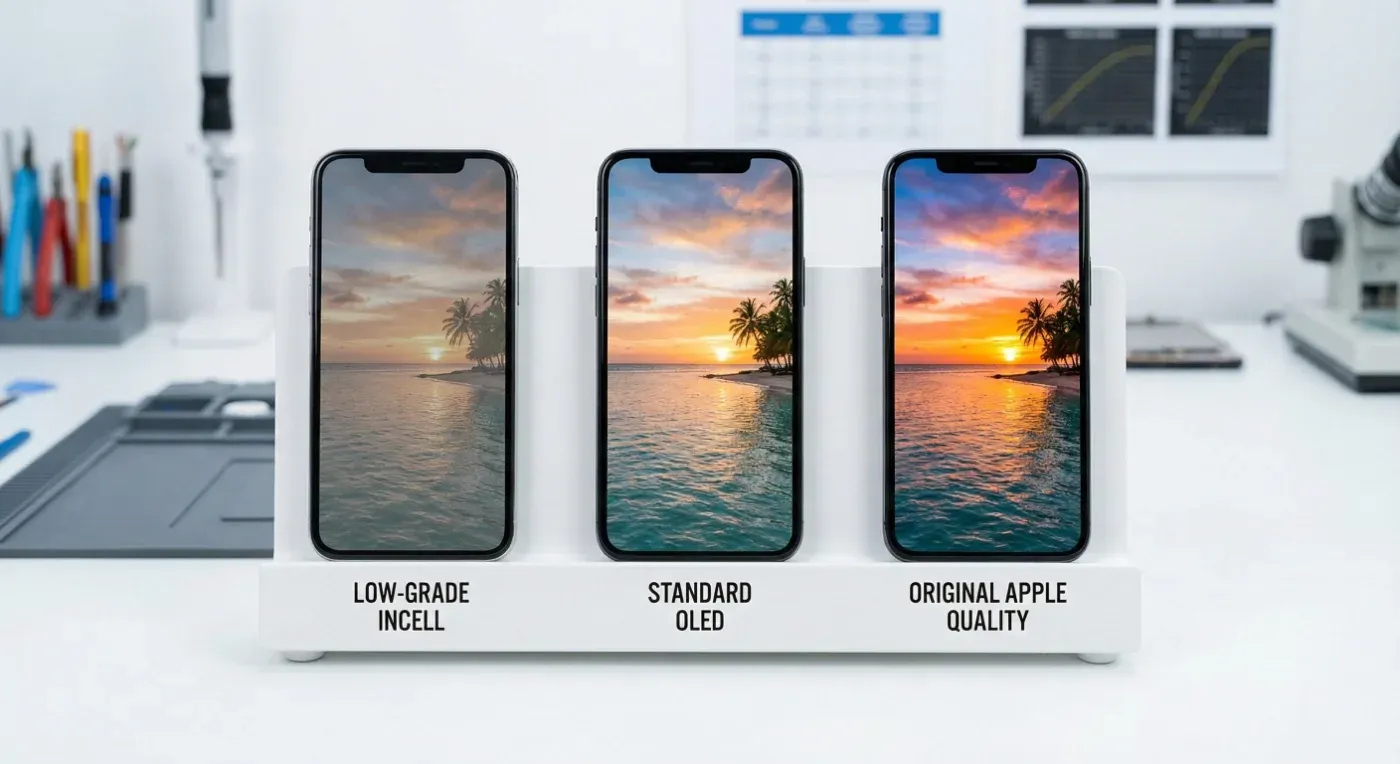
HD INCELL (Moshi, KD brands): These hit 720p effective resolution regardless of what's marketed. Color accuracy? 70-80% of original. Brightness? 400-500 nits. And the failure rate? 7-12% according to repair shop reports. That's 1 in 10 screens coming back to haunt you.
-
FHD INCELL (RJ, JK brands): True native resolution, 85-90% color accuracy, 500-650 nits brightness. Failure rates drop to 3-7%. Still not perfect, but manageable.
OLED and Soft OLED
Aftermarket OLED is a self-emissive panel for OLED-equipped phones (iPhone X onwards, Samsung flagships), delivering 85-95% color accuracy at 40-70% of original price. In practice, fitting INCELL to one of these phones is a technology downgrade your customer will see. For example, your two real options are standard aftermarket OLED and soft OLED:
-
Standard Aftermarket OLED: 85-92% color accuracy, decent contrast, but often with color shifting at angles. Expect 80-90% of original brightness.
-
Soft OLED: More flexible panels similar to Samsung's manufacturing approach. 90-95% color accuracy, better viewing angles, improved touch response. This is as close as aftermarket gets to original.
The Original Screen Categories
"Original" doesn't mean what you think it means. There are four distinct categories, and confusing them will cost you.
| Type | What It Actually Is | Quality Level | Typical Price |
|---|---|---|---|
| OEM | Original materials, third-party assembly | 95-100% | 55-75% of new |
| Original Refurbished | Genuine screens professionally restored | 95-100% display quality | 70-90% of new |
| Original Pulled | Removed from functioning devices | 100% original tech | 65-80% of new |
| Original New | Genuine Apple/Samsung service parts | 100% | Baseline (100%) |
The catch with Original Pulled? OLED screens may have burn-in. Refurbished quality varies wildly between factories. And "OEM" is the most abused term in the industry—verify, or you're buying expensive aftermarket with a fancy label.
Aftermarket LCD Screens: What You're Really Getting
An aftermarket LCD screen is a third-party panel built to replicate OEM specifications, delivering roughly 70-95% of original color accuracy at 20-70% of the original price. In practice, the grade you actually receive rarely matches the grade on the label. I've seen too many shop owners fall into the same trap: they order "premium aftermarket" screens, receive something labeled with impressive-sounding grades, and only discover the truth when customers start complaining. According to IDC's Q1 2024 mobile parts report, 38% of the cheapest aftermarket parts failed within six months versus 7% for mid-tier suppliers—so the grade definition matters more than the marketing word.
The INCELL Reality Check
The INCELL reality check is a simple rule: INCELL is fine for older LCD-equipped iPhones (8, 8 Plus, XR, 11) and budget customers, but it trades away 20-30% of color accuracy. In practice, you need to understand exactly what you are trading before you stock it. For example, an HD INCELL screen at $20 saves money up front yet generates the complaints a $35 FHD unit avoids.
HD INCELL is for emergencies only. When a customer says "I just need it to work until my upgrade," HD INCELL makes sense. For anyone who actually looks at their phone? The washed-out colors and reduced brightness are immediately noticeable. One repair shop owner I know calls these "relationship enders"—customers never come back.
FHD INCELL is your workhorse. For everyday users who prioritize function over perfection, FHD INCELL delivers acceptable performance at reasonable cost. The 85-90% color accuracy won't win awards, but it won't generate complaints either.
The Aftermarket OLED Gamble
Here's what IDC's Q1 2024 mobile parts report found: over 38% of extremely low-priced aftermarket parts failed within six months of installation—compared to just 7% for mid-tier suppliers. That's not a quality difference; that's a business model difference.
The ultra-cheap OLED screens flooding the market often use:
- Recycled panels from damaged devices
- Cloned IC chips that degrade under heat cycles
- Third-rate polarizers that yellow within months
Soft OLED is worth the premium. At 50-70% of original price, Soft OLED screens deliver 90-95% of original quality. For customers who care about their display—photographers, designers, anyone under 40—this is the minimum acceptable standard.
Insider Warning: 混货 (Mixed Quality Batches)
混货 (hùn huò) is a Shenzhen-market term for mixed goods. It is a batch where a supplier pads a premium order with lower-grade screens, betting you won't test every unit. In practice, the only solution is random sampling. First, test 10% minimum from every batch. Second, if you find a single dud, test the whole shipment. For example, one $50 dud hidden in a 100-unit order can cost you $200 in returns and a lost customer.
Original Screen Options: OEM, Refurbished, Pulled & New
An original screen is a display built on a genuine Apple or Samsung panel, sold in four distinct grades—OEM, refurbished, pulled, and new—that run 55-100% of an Apple service part. In practice, "original" is the most abused word in the trade, so each grade carries a different trade-off you need to verify. First, OEM uses original-grade panels without final calibration. Second, refurbished bonds genuine panels to new glass. Third, pulled comes from working devices. Fourth, new is the authorized service part. For example, a $90 "OEM" iPhone 13 screen and a $110 refurbished one can both be genuine yet fail at very different rates.
OEM Screens: The Verification Challenge
An OEM screen is an original-grade panel and component set that may lack final Apple programming or calibration, delivering 95-100% of original quality at 55-75% of the price. In practice, the challenge is verification, because "OEM" is the single most misused label in the trade. For example, without component-origin documentation you may be paying an OEM price for premium aftermarket.
The problem? "OEM" is the most misused label in the industry. Without verification, you might be paying OEM prices for premium aftermarket. Always request:
- Component origin documentation
- Batch testing results
- Clear return policies for quality disputes
Original Refurbished: Quality Varies Wildly
An original refurbished screen is a genuine Apple or Samsung panel recovered from a damaged device, separated from broken glass, and bonded to new components at 70-90% of new price. In practice, the quality depends entirely on the refurbishment facility, so it varies wildly. For example, a basic refurb with minimal testing and an ultra-premium refurb with full calibration can both be called "refurbished" yet differ 15% in price and far more in reliability.
| Refurbishment Grade | Process | Price Point |
|---|---|---|
| Basic | Original panel + new glass, minimal testing | 70-75% of new |
| Premium | OCA bonding, extensive functionality testing | 75-85% of new |
| Ultra-Premium | Premium glass, full calibration testing | 80-90% of new |
For repair businesses, premium refurbished often represents the sweet spot: original display quality at 20-25% savings versus new.
Original Pulled: Proceed with Caution
An original pulled screen is a 100%-original display removed from a functioning device—trade-ins, buybacks, recycling programs—priced at 65-80% of new. In practice, the technology is genuine, but the screen carries used-device risk. For example, three issues recur:
- OLED burn-in is real. Check for image retention, especially on status bar and keyboard areas.
- Previous repairs may have compromised water resistance.
- Cosmetic wear may be visible to discerning customers.
Pricing at 65-80% of new makes pulled screens attractive, but only if you're testing thoroughly and setting appropriate customer expectations.
Original New: The Access Problem
An original new screen is a genuine Apple or Samsung service part sold at 100% of baseline price, roughly $120-150 for an iPhone 13. In practice, access is the problem, because authorized-program restrictions limit its use for most independent shops. For example, unless you are an Apple Authorized Service Provider, original new screens are reserved for specific repair scenarios, not everyday inventory.
Wholesale Pricing Guide: What You Should Actually Pay
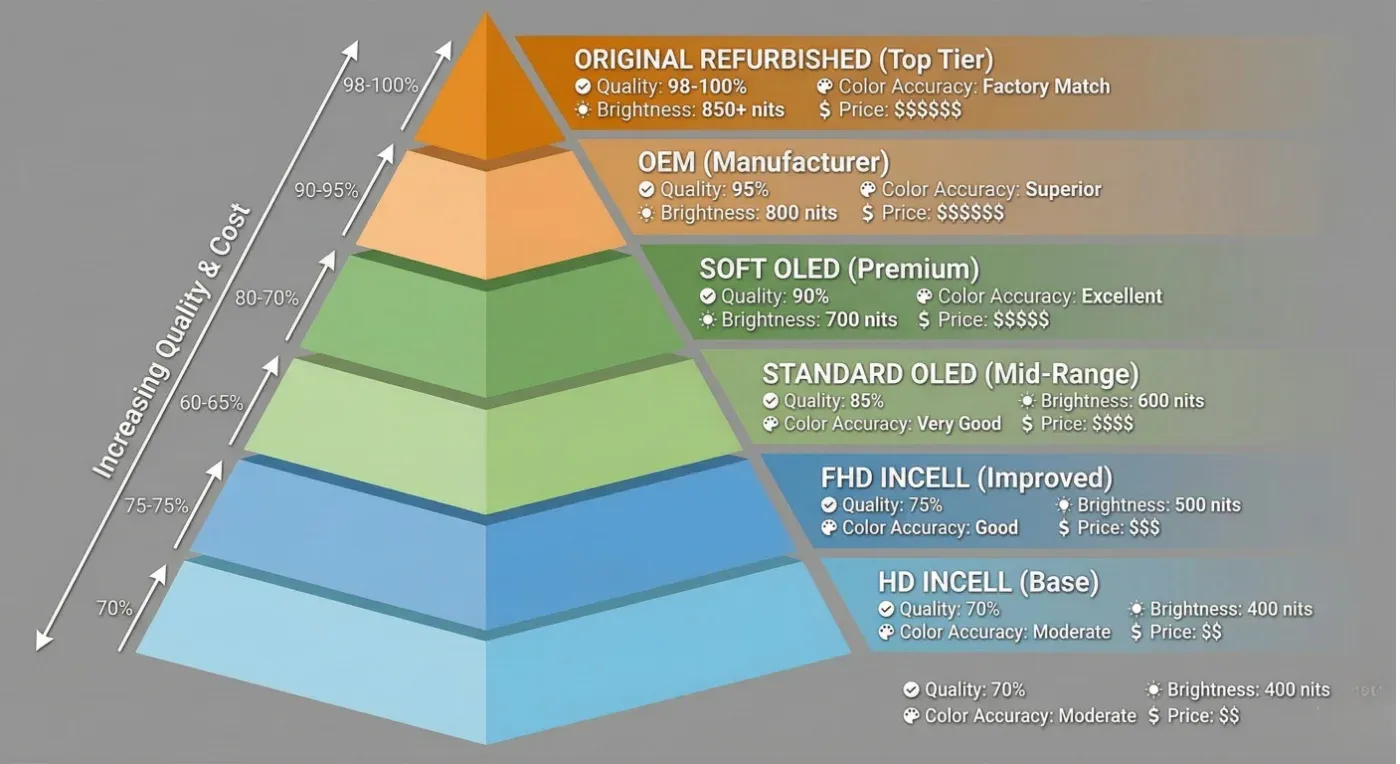
Wholesale LCD pricing is the per-unit cost of a screen grade expressed as a percentage of the Apple service-part price, ranging from 20% for HD INCELL to 100% for original new. In practice, most buyers get it wrong because they compare unit prices without calculating Total Cost of Ownership (TCO). For example, a $15 screen isn't cheap if 10% come back defective—the replacement, labor, and lost-customer costs push its real cost above a $22 screen. According to IDC's 2024 data, 37% of global screen returns came from unverified supplier chains.
Price Benchmarks by Quality Grade
A price benchmark is the typical wholesale range for a screen grade, expressed both as a percentage of the original new price and as a dollar figure for a reference model. For example, on an iPhone 13 the grades run from 20% ($18-28 HD INCELL) to 100% ($120-150 original new):
| Screen Type | % of Original New Price | Typical Wholesale Range (iPhone 13) |
|---|---|---|
| HD INCELL | 20-30% | $18-28 |
| FHD INCELL | 30-40% | $28-40 |
| Standard OLED | 40-50% | $45-60 |
| Soft OLED | 50-70% | $60-85 |
| OEM | 55-75% | $65-90 |
| Original Refurbished | 70-90% | $85-110 |
| Original Pulled | 65-80% | $80-100 |
| Original New | 100% | $120-150 |
Prices vary by model, supplier, and order volume. These represent typical 2024 wholesale ranges.
The TCO Calculation You're Probably Skipping
Let's do the math that separates profitable shops from struggling ones:
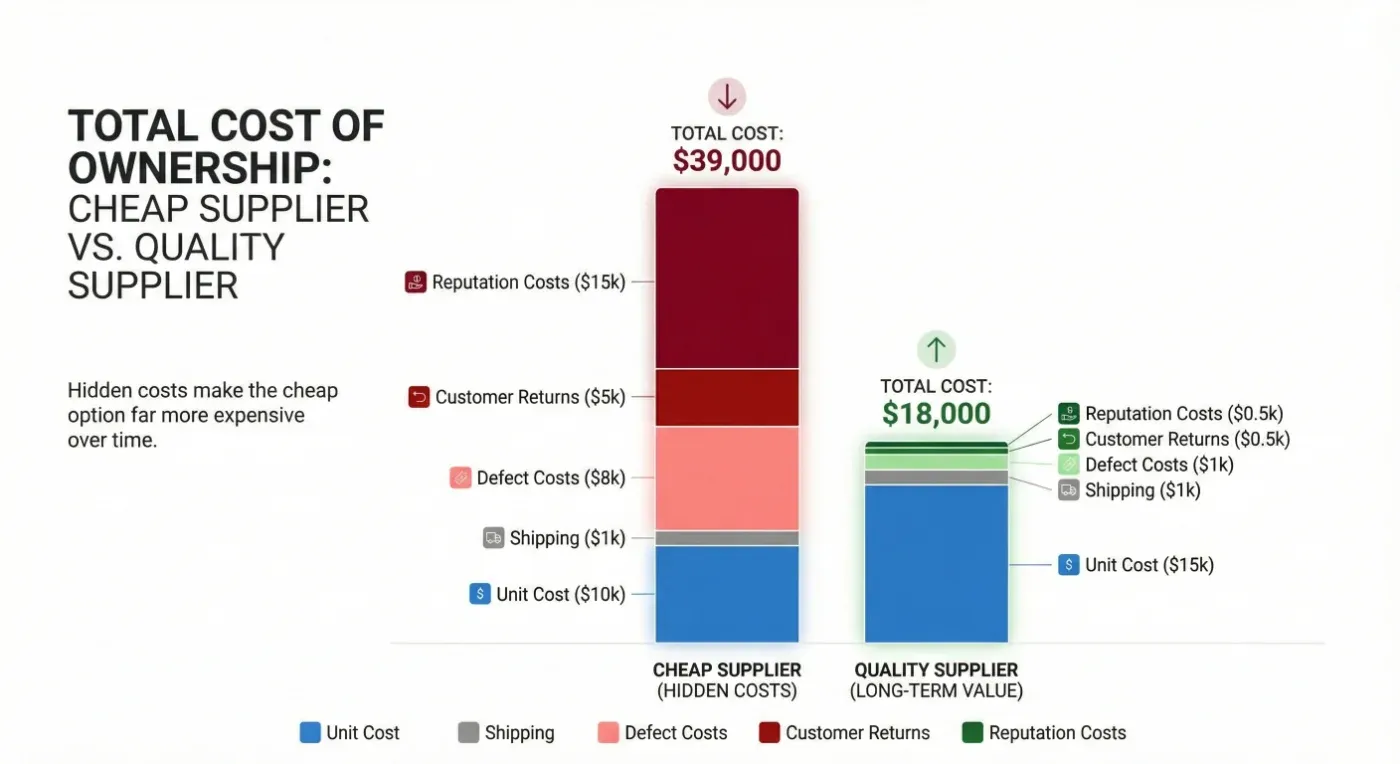
| Cost Factor | Cheap Supplier ($15/unit) | Quality Supplier ($22/unit) |
|---|---|---|
| Unit price | $15.00 | $22.00 |
| Shipping (per unit) | $1.50 | $1.50 |
| Defect rate | 10% | 3% |
| Defect cost (replacement + labor) | $1.50 | $0.66 |
| Customer return processing | $2.00 | $0.50 |
| Reputation cost (lost customers) | $3.00 | $0.50 |
| Actual cost per unit | $23.00 | $25.16 |
See that? The "cheap" supplier saves you $7 per unit on paper. In reality, you're saving $2.16—while accepting 3x the headaches, 3x the customer complaints, and 3x the risk to your reputation.
Now ask yourself: is $2.16 worth gambling your business on?
The Pricing Red Flags
- $5-10 below market average: Probably refurbished with poor-quality glass or mixed batches.
- $15+ below market: Almost certainly counterfeit internals or recycled components passed off as new.
- "Too good to be true" bundles: Often missing warranty coverage or hiding shipping issues.
According to IDC's 2024 data, 37% of global screen returns stemmed from unauthorized supplier chains lacking verifiable sourcing documentation. The cheap price isn't a deal—it's a warning.
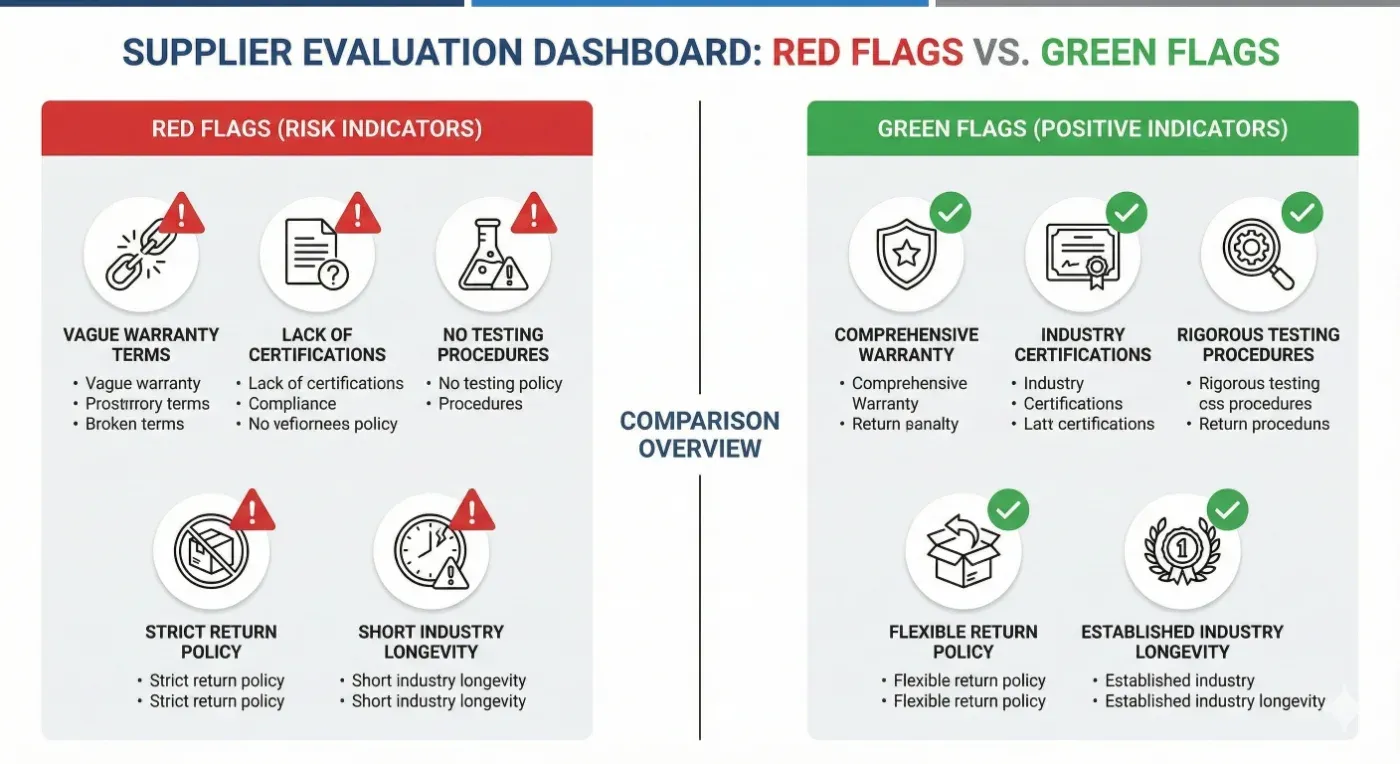
Supplier Evaluation: Red Flags vs. Green Flags
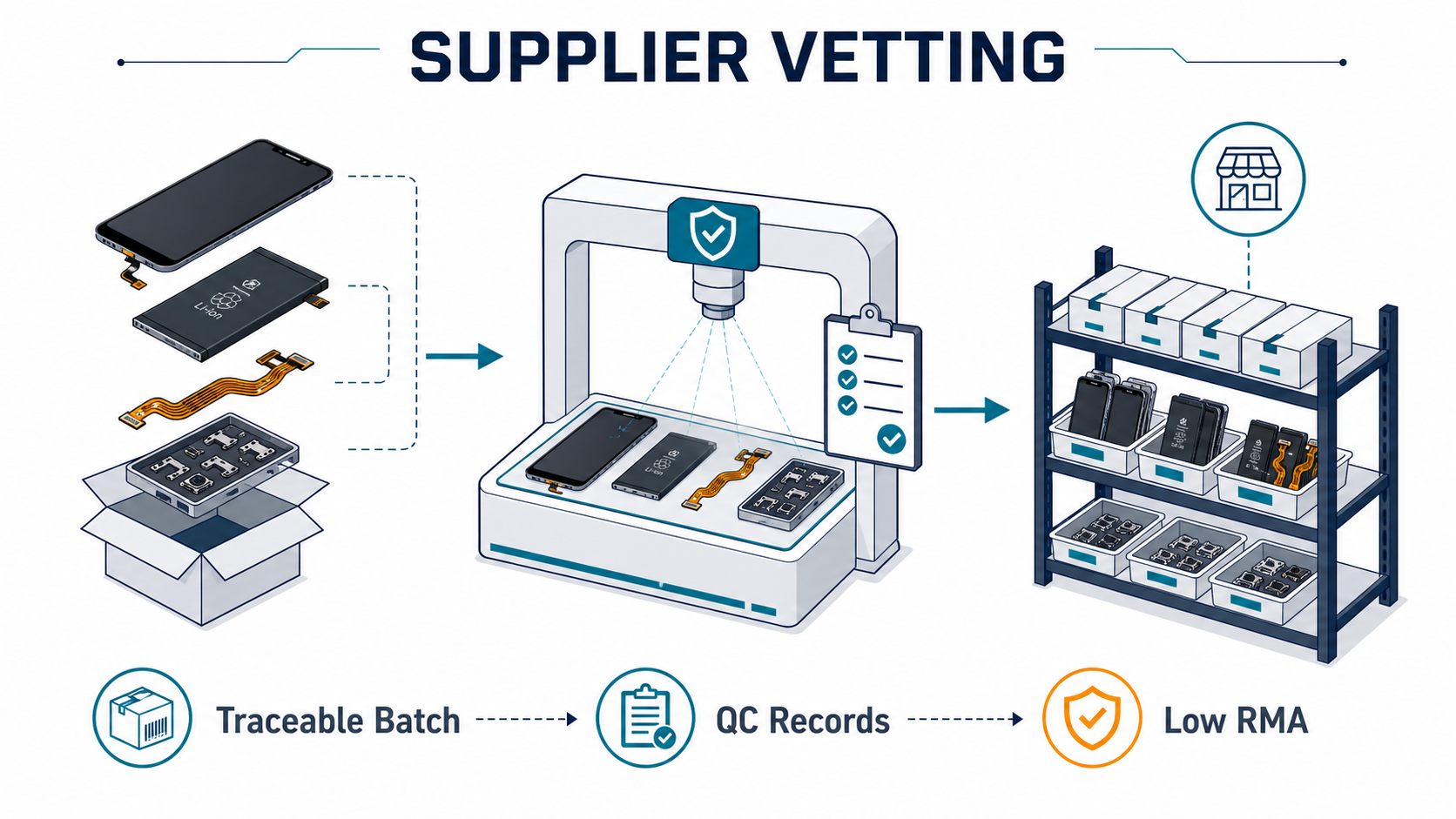
Supplier evaluation is the process of verifying a wholesaler before you place a bulk order. In practice, you check four things. First is a 30-day-minimum warranty. Second is ISO 9001, RoHS, and CE documentation; 68% of faulty displays lack it. Third is at least 5 years in the trade. Fourth is verifiable references. For example, when a vendor cannot name the factory a screen was made in, that single missing answer outweighs any price they quote.
5 Red Flags That Scream "Run Away"
A red flag is a warning signal that a supplier is hiding quality or sourcing problems. Any one of them is reason to walk. According to IDC's Q1 2024 teardown report, 68% of faulty aftermarket displays lacked any certification. For example, these five red flags are the clearest:
-
No clear warranty. 30 days is the minimum standard. Anything less means they know their products won't last.
-
Vague product descriptions. Terms like "high copy," "premium aftermarket," or "A+ quality" without specific grade definitions are meaningless marketing.
-
No certifications. According to IDC's Q1 2024 teardown report, 68% of faulty aftermarket displays lacked any formal certification. ISO 9001, RoHS compliance, and CE marking aren't optional—they're baseline requirements.
-
"All sales final" policies. Legitimate suppliers stand behind their products. If they won't accept returns, they know what they're selling.
-
No serialization or traceability. If a supplier can't tell you where a screen was manufactured, they're either hiding something or don't know themselves. Neither is acceptable.
5 Green Flags of Reliable Suppliers
A green flag is a verifiable signal that a supplier stands behind its products. Reputable wholesalers show at least five of them, with 5+ years in the trade. For example, the five that matter most are below. First is documented testing. Second is clear grading in measurable percentages. Third is a transparent return policy.
-
Documented testing procedures. Request batch testing results. Reputable suppliers test every shipment and can prove it.
-
Clear grading definitions. They should explain exactly what "Grade A" or "Premium" means in measurable terms—color accuracy percentages, brightness levels, failure rate history.
-
Transparent return policies. Who pays return shipping? What's the timeline? What qualifies as defective? These should be in writing before you order.
-
Industry longevity. Five years minimum in the phone parts business. Fly-by-night operations don't survive that long.
-
Verifiable references. Ask for contacts at other repair shops they supply. If they hesitate, that tells you everything.
The Sample Test Strategy
The sample test strategy is a four-step protocol that validates a supplier on 5-10 units before you risk a bulk order. In practice, you never commit to a large order without it. First, order 5-10 units across grades. Second, bench-test each one. For example, the full protocol runs as follows:
- Order 5-10 units across different quality grades
- Test each for: touch responsiveness (all corners), color uniformity, brightness at max/min, front camera alignment
- Install 2-3 in actual customer devices and follow up after 2 weeks
- Only then negotiate bulk pricing
Yes, this costs time and money upfront. It costs far less than a warehouse full of screens you can't sell.
Building a Smart Inventory Strategy
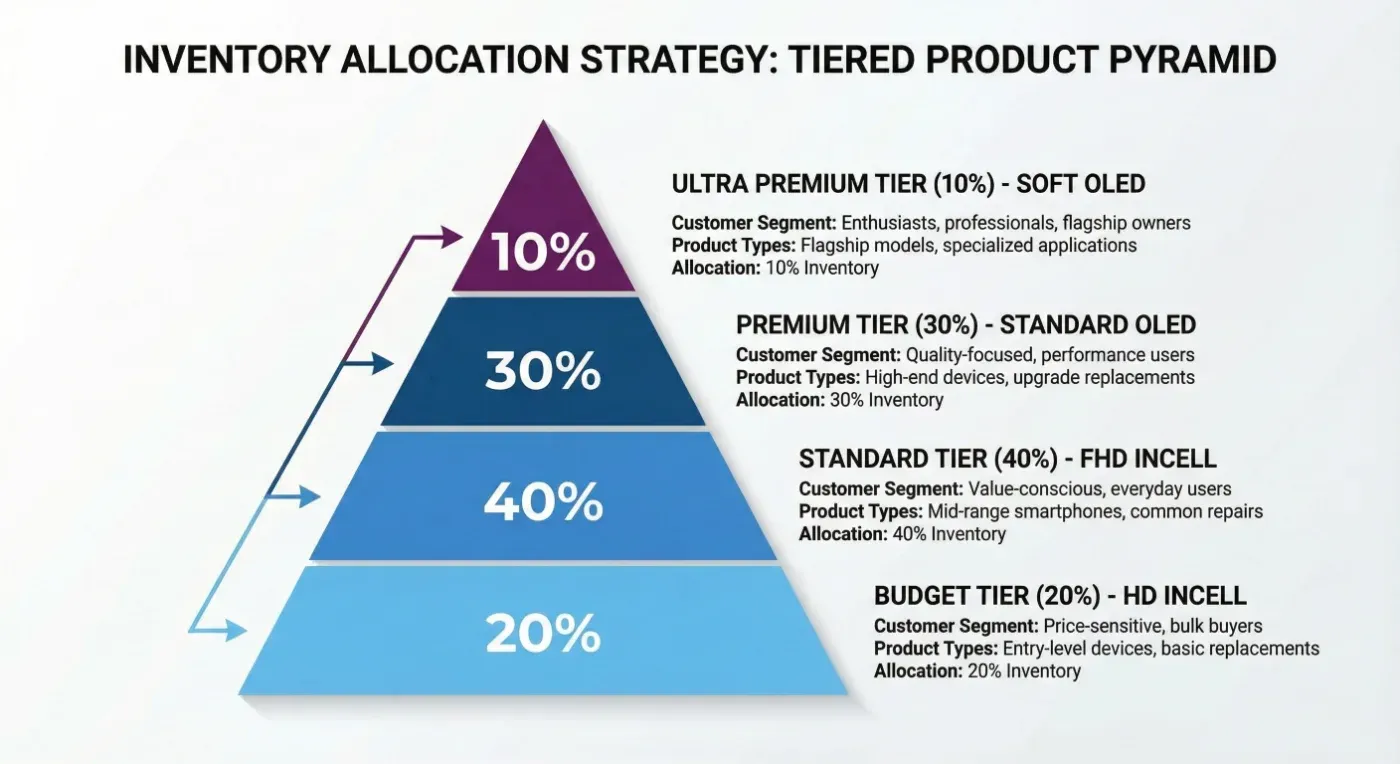
A smart inventory strategy is a tiered stocking system that matches screen grades to customer segments, typically 20% budget, 40% standard, 30% premium, and 10% ultra. In practice, the most successful repair shops I work with don't just buy screens—they build a system around their actual repair mix. For example, a shop in a business district shifts toward premium OLED, while a college-town shop holds more budget INCELL. First track requests by model for three months, then set the percentages, then negotiate MOQs against that real demand.
The Tiered Inventory Approach
A tiered inventory approach is a stocking model that splits screens into budget, standard, premium, and ultra tiers by percentage. Based on wholesale data from thousands of repair shops, the split that works is 20/40/30/10. For example, a balanced shop holds 40% FHD INCELL as its workhorse standard tier:
| Tier | Screen Type | Inventory % | Customer Segment |
|---|---|---|---|
| Budget | HD INCELL | 20% | "Just make it work" customers |
| Standard | FHD INCELL | 40% | Everyday users, price-conscious |
| Premium | Standard OLED | 30% | Quality-conscious, professionals |
| Ultra | Soft OLED / Refurbished Original | 10% | Premium service, photographers |
This distribution serves all customer segments while keeping inventory costs manageable. Adjust based on your local market—if you're in a business district, shift toward premium. College town? More budget options.
Demand Forecasting Basics
Demand forecasting is the practice of predicting screen demand by model before you commit capital to inventory. In practice, three inputs drive it. First, track your repair requests by model for 3 months before making bulk purchases. Second, watch Apple/Samsung release cycles—demand for older models drops 30-40% within 6 months of a new release. Third, account for seasonality, because repairs spike after holiday gift-giving and summer vacation. For example, a model that is 25% of your repairs today may be 15% six months after its successor ships.
MOQ Negotiation Tactics
A minimum order quantity (MOQ) is the smallest batch a supplier will sell, often 50 to 100 units. It can trap you into overstocking a single model. In practice, three counter-strategies keep MOQs from dictating your cash flow. First, combine orders with other local shops. Second, negotiate mixed-model orders instead of single-model bulk. Third, start small and scale up. For example, prove you are reliable with a 50-unit order before committing to a 500-unit MOQ.
- Combine orders with other local shops to meet MOQs while splitting inventory
- Negotiate mixed-model orders instead of single-model bulk
- Start small, scale up: Prove you're a reliable buyer with smaller orders before committing to large MOQs
Making the Right Choice for Your Business
The right screen choice is the grade that matches one customer segment to one price point and warranty. There is no single "best" product. In practice, a budget customer and a professional photographer need different grades from the same supplier. For example, an everyday user is well served by a $50 standard OLED at a 90-day warranty. A creative pro needs an $80 soft OLED or refurbished original at a 6-to-12-month warranty.
Match Quality to Customer Segments
Segment matching is the practice of mapping each customer type to the screen grade that fits their needs and budget. In practice, four segments cover most walk-in repair demand. For example, a budget-conscious customer is best served by a $35 FHD INCELL, while a creative professional needs an $80 soft OLED or refurbished original:
| Customer Type | Recommended Screen | Why |
|---|---|---|
| Budget-conscious | FHD INCELL | Acceptable quality, best value |
| Everyday user | Standard OLED | Good performance, reasonable price |
| Professional/Creative | Soft OLED or Refurbished Original | Near-original quality matters |
| "Just until upgrade" | HD INCELL | Lowest cost, short-term solution |
Warranty Alignment Strategy
A warranty alignment strategy is the practice of matching the warranty you offer the customer to the grade of screen you installed. In practice, the warranty period should rise with quality. First, budget screens get a 30-day warranty. Second, standard screens get 90 days. Third, premium screens get 6 months to 1 year. For example, a 12-month warranty on a soft OLED both justifies the higher price and forces you to stock quality. Longer warranties on premium options build customer confidence. They also force you to stock quality—you can't afford long warranties on screens that fail.
When to Switch Suppliers
The switch signal is a measurable threshold that tells you a supplier relationship has gone bad. In practice, don't wait for a catastrophe. Act on four triggers. First is a defect rate above 5%. Second is evasive communication. For example, switch suppliers when:
- Defect rates exceed 5% for two consecutive orders
- Communication becomes difficult or evasive
- Pricing increases without quality improvements
- They can't provide documentation you request
Loyalty to a bad supplier isn't loyalty—it's self-sabotage.
Frequently Asked Questions
What is the difference between INCELL and OLED in phone LCD wholesale?
INCELL is an LCD technology that builds the touch sensor into the panel, delivering 70-90% color accuracy and 400-650 nits at 20-40% of the original price. OLED is a self-emissive technology used on iPhone X and later and Samsung flagships, delivering 85-95% color accuracy and true blacks at 40-70% of the original price. For example, an FHD INCELL iPhone 13 screen runs about $28-40 wholesale, while a soft OLED for the same model runs $60-85. First match the technology to what the phone originally shipped with; an OLED phone fitted with INCELL is an immediate downgrade your customer will notice.
How much should I pay for wholesale iPhone screens?
The wholesale price of an iPhone screen is a percentage of the Apple service-part price, running from 20% to 100% by grade. For an iPhone 13 in 2026, HD INCELL runs $18-28 and FHD INCELL runs $28-40. Standard OLED runs $45-60 and soft OLED runs $60-85. OEM runs $65-90 and original new runs $120-150. According to IDC's 2024 data, a price more than $15 below the market average almost always signals counterfeit internals. For example, a $30 "OLED" quote is a warning, not a deal.
What warranty should a phone parts wholesaler offer?
A phone parts warranty is a written guarantee that covers defective screens for a set period. The minimum a reliable wholesaler offers is 30 days. In practice, the warranty length should track the screen grade. First, a $20 budget INCELL carries 30 days. Second, a $50 standard OLED carries 90 days. Third, an $80 soft OLED or refurbished original carries 6 to 12 months. For example, in 2026 PRSPARES backs its premium screens with a 12-month warranty, covering the roughly 2% of units that fail. A vendor that will not stand behind a product for even a month already knows it will not last.
How do I verify a China phone parts supplier is legitimate?
You verify a China phone parts supplier by checking its business license, certifications, traceability, and references before placing a bulk order. First, confirm the registered company on China's official gsxt.gov.cn registry. Second, request ISO 9001, RoHS, and CE documentation—68% of faulty aftermarket displays lack any formal certification according to IDC's Q1 2024 teardown report. Third, order 5-10 samples across grades and test touch, color uniformity, and brightness before committing. For example, a Shenzhen supplier that shares batch testing results and factory origin is far safer than one quoting only a low price.
What is 混货 (mixed batches) and how do I avoid it?
混货 (hùn huò), or mixed goods, is a Shenzhen-market practice where a supplier pads a premium order with lower-grade screens, betting you will not test every unit. In practice, the only defense is random sampling. First, test at least 10% of every batch, every time. Second, if you find a single dud, test the entire shipment. For example, on a 200-unit order you should bench-test at least 20 screens for dead pixels, ghost touch, and brightness before any of them reaches a customer device.
Conclusion: The Bottom Line on Phone LCD Wholesale
The bottom line on phone LCD wholesale is that the cheapest option is almost never the most affordable one. Defects, returns, and lost customers all add cost. For example, a 5% failure gap over 1,000 screens is 50 angry customers. Three truths separate profitable repair businesses from struggling ones:
-
Quality grades directly impact your RMA rate and reputation. That 5% difference in failure rate between a cheap supplier and a quality one? Over 1,000 screens, that's 50 angry customers, 50 free repairs, and 50 people telling their friends to go elsewhere.
-
True cost = unit price + hidden costs. Defects, returns, labor, lost customers—they all add up. The "expensive" supplier often costs less when you do the real math.
-
Supplier evaluation is an investment, not an expense. The time you spend testing samples, verifying certifications, and checking references pays dividends every single day you don't deal with a quality disaster.
If you keep using those "cheap" channels without verification, the next horror story might be yours. I've seen shops close because one bad batch destroyed their reputation. Don't be that shop.
Start with samples. Verify everything. Calculate true costs. And remember: in phone LCD parts wholesale, the cheapest option is almost never the most affordable one.